To avoid these ads, REGISTER NOW!

Recommendations on Stud Extractors/Removal Tools?

bulletpruf

Well-known member
Joined
Nov 28, 2013
Messages
10,911
Location
San Antonio
Fairly often I find myself removing studs, whether it's from an automotive engine or something smaller (chainsaw). Some SAE, some metric. I usually just use doubled up nuts to remove the stud, but that can be a sub-optimal method and lead to broken studs.

There seem to be a few different types of extractors out there and I was hoping someone with experience could chime in with a recommendation.

Thanks

Scott
 
To avoid these ads, REGISTER NOW!

Russtred

Well-known member
Joined
Aug 18, 2010
Messages
45
I have only used this type from OTC. It worked perfectly on exhaust manifold studs.
 

Attachments

  • 6987-8_2.jpg
    6987-8_2.jpg
    43.1 KB · Views: 22

four.cycle

Well-known member
Joined
Oct 19, 2015
Messages
28,422
Location
Tacoma, Washington
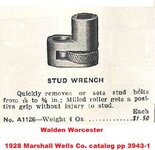
Old school:
Walden Worcester A1126 Stud Wrench 1928 Marshall Wells Co. catalog pp 3943-1.jpg

Walden Worcester A1126 Stud Wrench - 1928 Marshall Wells catalog pp 3943-1

More old school:
Indestro 251 Stud extractor 1971 Indestro catalog No. 55 pp 62.jpg
Indestro 251 stud extractor - 1971 Indestro catalog No. 55 pp 62

Both of these styles were made by a number of different manufacturers over the course of the last century.
Either of them will perform nicely on old flatheads or big diesel trucks where there is room in the engine compartment to swing your arms around.
Otherwise, under the hood of a late-model vehicle, they are effectively useless.

Here's an example of a set made by Assenmacher, similar to Russtred's OTC unit above:

Assenmacher (AST) 201 4-pc stud extractor set (ebay 154700238886 01).jpg
Assenmacher (AST) 201 4-pc stud extractor set (photo ebay)

Assenmacher / Assenmacher Specialty Tools, Inc., 6440 Odell Place, Boulder, CO 80301 / https://asttool.com/ / "AST" / est. 1978 / patent 4040763 Aug 9 1977 Gerhard Assenmacher / automotive specialty tools /

OTC / OTC Tools, Bosch Automotive Service Solutions, 28635 Mound Road, Warren, MI 48092 USA / https://www.otctools.com / originally Owatonna Tool Co., 321 Cedar St., Owatonna, MN / http://alloy-artifacts.org/owatonna-tool-company.html / http://alloy-artifacts.org/owatonna-tool-company.html#history / http://toolarchives.com/node/254 /

I'm sure these are made by other companies as well. Allows you to get AT the thing by means of an extension or other drive tool.
 

seanb02

Well-known member
Joined
Apr 11, 2017
Messages
720
Location
The Farm
I’m in need of a good solution as well. Sometimes doubling up nuts on there doesn’t work, and the cam type are too large. Leaning towards picking up a Snap-on set.
 

Iridium rand

Well-known member
Joined
Sep 23, 2021
Messages
218
The old school ones get about as good a grip as is possible, so do knipex cobras if you have the room but other than that don’t know of any other methods besides what’s already been said, those socket looking ones are probably as good as it gets for tight spaces
 

charbar

Well-known member
Joined
Feb 6, 2021
Messages
1,993
Location
Midwest
I've had awesome luck with one just like this-
It's basically the size of a 1/2" drill chuck, so I can see where the socket style ones mentioned above might work better in a real tight area. Cant say I ever remember a time I could get mine to fit in a tight spot though either.
 

four.cycle

Well-known member
Joined
Oct 19, 2015
Messages
28,422
Location
Tacoma, Washington
charbar said:
"... fit in a tight spot ..."

^ That issue seems to be the problem that I believe Assenmacher, Koken, and a few other companies have attempted to address.

I own copies of both of those "old school" units I posted above - the old 1920s Walden and the 1970's Indestro - and I don't think there's any place in the engine compartment of my '94 Ranger you'd get them to fit into.
Buddy of mine tried to use one of those big ones to pull an exhaust manifold stud out of a Dodge V8 truck and ended up pulling the entire exhaust manifold to get at it.
 

joecon

Well-known member
Joined
Oct 4, 2010
Messages
677
All the above are great except the "old school ones". If you do not have room for them, try this, take a coupling nut in the same thread, screw a set screw into it, screw it on the stud, then tighten up the set screw, and back out the stud, this will work unless the stud is locktighted in or really stuck. Then use the same trick and heat. The old school ones put a sideways torque on the stud and can bend or break the stud.
 
To avoid these ads, REGISTER NOW!
OP
B

bulletpruf

Well-known member
Joined
Nov 28, 2013
Messages
10,911
Location
San Antonio
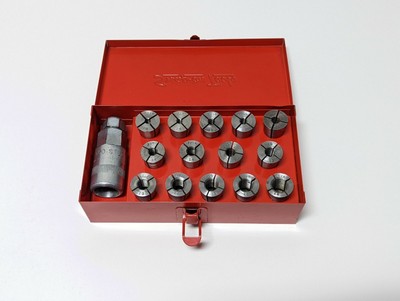
I've used a set offered by Snap On that acts like collets on the stud thread. Luckily, someone else paid for them.

These do look nice, but my budget can't handle the going rate of $375 for a set right now. I'll add it to my wish list.

 
OP
B

bulletpruf

Well-known member
Joined
Nov 28, 2013
Messages
10,911
Location
San Antonio
A mig welder and a nut has proved to be my most successful stud extractor by far.

Yes, I have used that as well, most recently on my '69 Bronco - several of the fender bolts needed this treatment, along with a timing cover stud. But what I'm really looking for is a tool to remove and install studs that are still salvageable.

Thanks
 
OP
B

bulletpruf

Well-known member
Joined
Nov 28, 2013
Messages
10,911
Location
San Antonio
I've had awesome luck with one just like this-
It's basically the size of a 1/2" drill chuck, so I can see where the socket style ones mentioned above might work better in a real tight area. Cant say I ever remember a time I could get mine to fit in a tight spot though either.

I ordered one of those as well. Looks like a good piece of gear.

Thanks
 
OP
B

bulletpruf

Well-known member
Joined
Nov 28, 2013
Messages
10,911
Location
San Antonio
All the above are great except the "old school ones". If you do not have room for them, try this, take a coupling nut in the same thread, screw a set screw into it, screw it on the stud, then tighten up the set screw, and back out the stud, this will work unless the stud is locktighted in or really stuck. Then use the same trick and heat. The old school ones put a sideways torque on the stud and can bend or break the stud.

Yes, as I noted in my initial thread, that's my current method.

Given all the negative comments on the "old school style" I didn't order one of them.

Thanks
 

WWheeler

Well-known member
Joined
Jun 23, 2015
Messages
4,105
Location
Middleofnowhere USA
Welp, GJ got me again. I watched the entire vid and next thing you know... ABN Std Extractor Order.png

FWIW the stud removal tests were toward the end and the ABN set was last up at 13m48s if anyone's else is interested in just checking out how well these did.
 

ATC

Well-known member
Joined
May 12, 2012
Messages
8,254
Location
VA
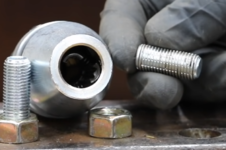
I want the ABN, socket-style set, but after watching the video, it looks like the stud wouldn't be able to be reused with that style of extractor. Too much damage to the threads. The ones that look like a drill chuck looks like you could clean the threads up with a die and reuse the stud. Might be something to think about:


1652471644553.png


1652471761022.png
 

AirMech#406

Well-known member
Joined
Sep 29, 2021
Messages
142
I want the ABN, socket-style set, but after watching the video, it looks like the stud wouldn't be able to be reused with that style of extractor. Too much damage to the threads. The ones that look like a drill chuck looks like you could clean the threads up with a die and reuse the stud. Might be something to think about:


1652471644553.png


1652471761022.png
In my experience, ATC, the drill chuck one will actually chew up the threads more (to the point where they are no longer usable). However, you are correct that the socket type does mash the threads a little.
When I was in A&P school, one of my instructors had a Mac tools version of the ABN socket stud remover. The threads usually were damaged after removal, but he would always chase them with his thread chaser (This set to be exact:https://www.amazon.com/dp/B000P6UNHE/?tag=atomicindus08-20 ) and the threads would work fine again. Obviosuly, there is a limit to how many times you can do this before the stud threads are totally ka-put.
 
Last edited:

WWheeler

Well-known member
Joined
Jun 23, 2015
Messages
4,105
Location
Middleofnowhere USA
Yeah I've never been too worried about reusing a stud that was already broken or seized in place. I've always replaced such with new in any case, hence why I often skip all the nonsense and go straight to welding a nut on the stud. There have been times though where I was worried about frying a module so it's nice to have other methods. Which reminds me, I need to pick up some new left-handed cobalt bits.
 
OP
B

bulletpruf

Well-known member
Joined
Nov 28, 2013
Messages
10,911
Location
San Antonio
Yeah I've never been too worried about reusing a stud that was already broken or seized in place. I've always replaced such with new in any case, hence why I often skip all the nonsense and go straight to welding a nut on the stud. There have been times though where I was worried about frying a module so it's nice to have other methods. Which reminds me, I need to pick up some new left-handed cobalt bits.

I'll replace when I can, but I work on some oddball stuff (60 year-old chainsaws, for example) that it might be difficult to source replacements for.
 

richfinn

Well-known member
Joined
Jan 29, 2011
Messages
4,809
Location
Leeds, Yorkshire, England
I use the roller socket style stud pullers mostly (on good studs that aren't seized), if your dealing with corroded and seized studs your not going to beat oxy/acetylene or a mig welder or maybe even an inductor type tool.

They are more of a technicians time saver than a "get outta jail free" type tool to be honest, if you need to strip a cylinder head for skimming they are useful.
 
OP
B

bulletpruf

Well-known member
Joined
Nov 28, 2013
Messages
10,911
Location
San Antonio
I use the roller socket style stud pullers mostly (on good studs that aren't seized), if your dealing with corroded and seized studs your not going to beat oxy/acetylene or a mig welder or maybe even an inductor type tool.

They are more of a technicians time saver than a "get outta jail free" type tool to be honest, if you need to strip a cylinder head for skimming they are useful.

If I'm dealing with something that's corroded and seized, I'll certainly hit it with the torch first. I just like the fact that these removers support a longer length of stud than you'll get when using two nuts to remove it. Seems to make it less likely that you'll snap it.
 
To avoid these ads, REGISTER NOW!
Top Bottom