yatg
Well-known member
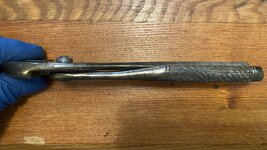
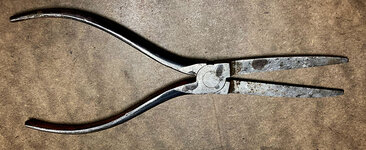
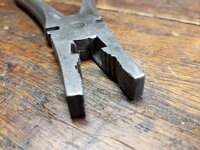
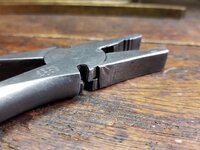
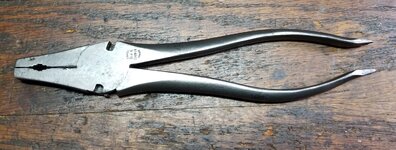
Red Devil 50-7 mini-linesmans, 7" long


Great design for not-in-use and storage safety. Patented in 1937. I have one, too, posted on the utility knives thread, here. Red Devil Tools later made and sold the classic ripped-off Stanley design box cutter, too.I forgot that I had this until I saw this thread…
 ) It was TM'd by S&H in 1914 claiming first use in 1900.


Hello there,Thanks. And yes, I would.
I was less explicit, but that's what I was trying to get at in the discussion of the marking as the brand, not the later company name, and the fact that Smith & Hemenway used Irvington Manufacturing Company (IMCO) in Irvington, NJ as their factory and eventually moved their HQ there, too.
That IMCO eventually ended up being called Red Devil Tools (in 1945) and re-using the same image of the devil that S&H was using makes perfect sense from that perspective, since so many tools bearing that name were originally born there. What I have not been able to explain is how they were able to do that when Crescent bought S&H. I am assuming that sale included the S&H TM's, including "Red Devil." It typically does. And, as I have said before upthread and elsethread, Crescent was also using the "Red Devil" brand name after the acquisition, well into the 1940's. Something neither AA or the Bio on the Trowel and Masonry Tool Collectors Website mentions. I've always been curious if the 1945 name change was some combination of largesse and fait accompli or if they actually cut a deal.
Note that we see a lot of S&H "Red Devil" tools (from before 1926), and conversely, a lot of Red Devil Tools tools (from after 1945). What we don't seem to see are a lot of tools in between 1926 and 1945. Those would be IMCO. Were they also branded "Red Devil"? Or not? See what I'm getting at?
It's almost like Red Devil acquired the TM back from Crescent.
Whether they bought it or they just appropriated it, it was a hugely successful business decision.
My sole pause is that the pliers look so much like the pliers in the 1947 Red Devil catalog and have the same model number.
Yes. Clean shield (no U.S.A.) on each handle. Pat. Pending opposite side near pivot.Do those have a shield logo on the knurling on the handle? Or am I seeing things?


Thank you for sharing that valuable information.Hello there,
I am just a newb on the thread, but have worked at Red Devil for over 40 years, and might help clear up some of the speculation about the S&H company & Landon P. Smith Company & Red Devil tools.
Smith & Hemenway was indeed founded in 1898, and was in importer and manufacturer of hand tools, pliers, auger bits, straight edge razors, and all sorts of things related to the hardware trade. They operated out of office in NYC and Montreal, PQ and sold products using the catalogs referenced in the thread here. A small article on Hemenway found here:
https://books.google.com/books?id=W0YDAAAAYAAJ&dq=John%20Francis%20Hemenway&pg=PA108#v=onepage&q=John%20Francis%20Hemenway&f=false
The story about Smith and the visit to the Swedish forge as a progenitor for the "Red Devil " brand is mostly the truth as Smith had taken a buying trip there to source better steel products and tools of a higher quality to sell. He was a consummate promoter, what we would call today marketing, but back then it was "show & sell". Smith & his brother Dew traveled and sold items to general stores
This is how he originally came into contact with Frank Woodward in NYC, and saw the value to the market of a steel wheel glass cutter, which was as good & cheaper than using diamond chips to score the glass. So he was regularly selling these product alongside the tools they also marketed in the "little green books" . Dew Smith, his brother was also involved a traveling salesman, and Hemenway was in the role of office manger/co-owner with Smith.
The 2 did buy the IMCO plant in Irvington and continue to produce pliers there, many used in WW1 for cutting through the barbed wire on the battlefields. in 1925 Hemenway sued Smith ( https://casetext.com/case/hemenway-v-smith ) & lost. Smith took over and bought out
his partner and registered the Landon P. Smith Company in NJ in 1926. He continued to make and sell tools both under the Red Devil brand and possibly the S&H, as it was costly to change tooling, and why waste a good reputation.
John Hemenway had a different ending: https://en.wikipedia.org/wiki/John_Francis_Hemenway. References to other tool company acquisitions are listed here.
Contrary to what is being said here, Crescent tool company did not buy S&H company, it bought the inventory and factory tooling of the pliers business from Landon P. Smith in 1926, so probably the S&H brand and excess inventory being sold would have carried the brands.
There also might have been a buy/sell agreement to continue to produce product for Smith to sell under the Red Devil brand in it's catalogs as well. I can't find anything firm about this though I do know along with the Red Devil Glaziers tools there were glass pliers of a few types being sold for many years.
Smith ran the business until his son in law, George Lee, bought it from him and continued to grow the business into the painters tools, paint machinery, floor sanders & polishers, and many other sundry items via acquisition through the 30's & 40's. in 1946 the company was renamed Red Devil Tools. All production items were made in the Irvington factory. Smith retired and moved to Florida where he continued to promote himself: "NJ man grows giant tomatoes" & a photo he set up of him "discussing Business of the day" with John Rockefeller (whom he had ambushed with a photographer on Rockefeller's morning constitutional to set up the photo op then release it to the local papers). He passed in 1946.
George Lee ran the business until he named his son president in the 1950's and retired, passing away in 1966. George Lee, Jr. grew the company with the 1963 acquisition of a manufacturer of chemicals for the paint/redecorating/surface repair business which sold alongside the putty knives, paint scrapers & other tools being produced in the new plant location in Union, NJ. The move to Union was in 1955, and the Irvington facility on Coit Street was sold off. In 1966 the business was registered as Red Devil, Inc to reflect the broader range of production and items for sale.
I'll post more later...getting tired an have to actually work for my pay!
Thanks for the attention.


 My neighbor has a putty knife collection so it will be going to him.


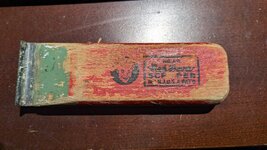


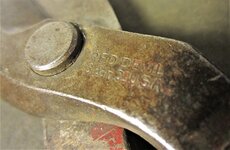
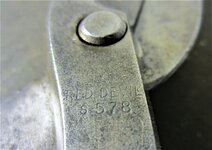


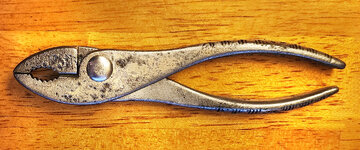
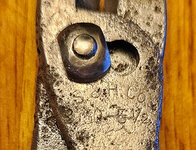

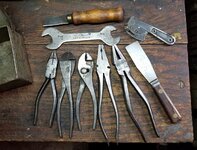
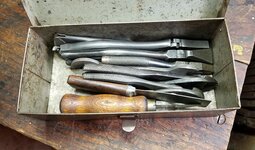
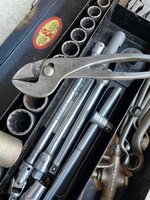
been trying to figure out what the heck this is for awhile and someone in this thread put a old magazine ad up so thanks to whoever that wasI see threads about Red Devil paint and drywall tools but not their hand tools. Outside of pliers and auger bits I haven’t seen anything else even though I know their out there. This is my current crop of Red Devil pliers.
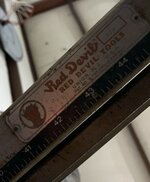


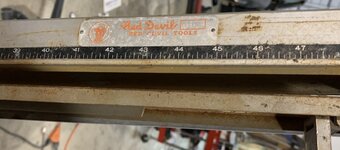

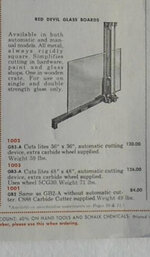
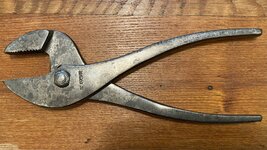
Right? They're very unusual. I was exceedingly excited when I saw them at the flea. I've looked at three catalogs and poured through the general HW store cat images 4.c posted way upthread. The only clue comes from those. There's a model called Heavy Combination Button, 1000-K, that look like a match. The handle ends look regular, but I am surmising whatever I have is a further variant off of those.Wow, Lugz - looks like they were intended for quite a range of tasks.
A few of their Button pattern pliers had that shallow gas & burner type opening in the jaws.Wire, but maybe gas fixtures as well? The stepped design of the throat makes me think of that, for gripping square valves of three sizes?
It's possible. I was thinking gas & burner again. I have gas & burner pliers like that.Then there’s that spike paired with a screwdriver - blasting fuses?
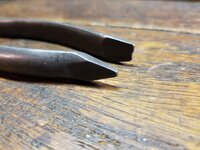
It's beveled. Definitely a cutter.The side-cutting part - is it actually beveled to cut, or is it square to crimp?
You should post it. I've only ever seen them in catalogs. I don't think we've seen one on the thread yet.I have a red devil nail puller in my collection of a dozen or so.

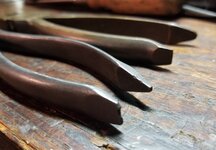

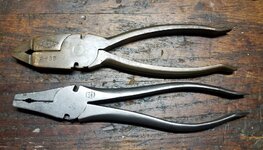
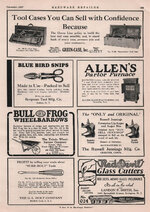
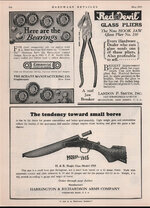
I wasn’t successful finding more “Buttonsy”-looking jaws, but the Utica No700 combination gas pipe side-cutting pliers (described having screwdriver and reamer) date back to 1909 or earlier. Given the early relationship between the companies, I think there may be a common ancestor.Well, I couldn't find the burners I was thinking of, @LesserSon , but check this out!
And you'll never guess what brand they're on...
Even though the AMPCO are clearly not Buttons, the combination of the pipette opening, the linesman-like cutter, the pivot cutters, and the out-turned spike and driver handle ends seems to have been somewhat of a type/pattern that others followed.
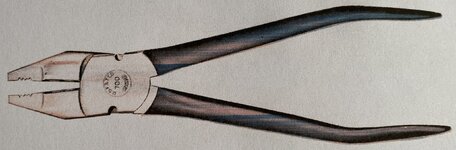

 - the Not So Secret Santa, dropped down the chimney into the Lugzsonian last night!