To avoid these ads, REGISTER NOW!

Removing bottomed out bolt with broken head

promethean-in-fl

Active member
Joined
Sep 23, 2016
Messages
27
Location
North Central Florida
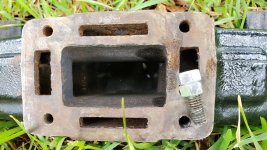
I suspect this Grade 5 3/8"-16 new steel bolt bottomed out in this blind hole in this old cast iron marine exhaust manifold and was torqued until the bolt head sheared off.

I've read quite a bit on here about bolt extraction techniques. Based on that, I'm inclined to go the route of welding on a nut, lubricating with beeswax or Kroil, and trying to back it out with a wrench.

However, I'm unclear what female thread damage is likely and whether it argues for going straight to drilling out the bolt rather than further trying to unscrew it and possibly further damaging the female threads.

So far, I soaked it with PB Blaster overnight, double nutted it, and only got it to move about 10 degrees with a wrench on the bottom nut. It felt springy like it might break if I torqued it further. Then, I heated the surrounding area to about 195 deg F with a heat gun, melted some beeswax at the base of the exposed bolt, sprayed the exposed bolt only with MG Chemicals Super Cold Spray, double nutted it, and the bottom nut slipped without turning the bolt (not sure why it slipped, maybe contaminated exposed threads with beeswax or the cold spray).

My auto mechanic wants to MIG weld a nut on and back it out. Some mechanically inclined guys on a boat forum I'm on think I should talk to a machine shop given how it got stuck.

This is at the gasketed mating surface to a riser.

Thoughts?

CORRECTION: Broken bolt is Grade 2, not Grade 5.

rsz_1994_mastercraft_prostar_190_--_broken_bolt_in_exhaust_manifold_at_mating_surface_to_riser.jpg
 
Last edited:
To avoid these ads, REGISTER NOW!

RPH

Well-known member
Joined
Dec 17, 2006
Messages
4,190
Location
Michigan Thumb
I would go with the welded nut. The heat and cooling sequence will make a difference. Once out then determine thread repair if needed. Good luck.
 

snod83

Well-known member
Joined
May 23, 2010
Messages
81
Man - it seems like there is a significant amount of stud there and I don't see any rust or anything. I would be tempted to go to town with some very tight vice grips prior to going through the trouble of welding on a nut. Maybe I am missing something by being an internet mechanic here though.
 

Millwrong

Well-known member
Joined
Feb 4, 2018
Messages
369
Location
Canada
Ummmm, grab that with a 10" pipe wrench, don't worry about welding or LH drilling until you break it off below flush lol. There must be a lot of engineers on the boat forums if the "mechanically inclined" members are suggesting you take this to a machine shop! Just out of curiosity, what did they suggest you have the machine shop do?
 

bradpac

Well-known member
Joined
Sep 8, 2013
Messages
721
Location
Central TX
Some tight vice grips or a pipe wrench, turn that sucker till it breaks, it probably won't.
 

shawhite

Well-known member
Joined
May 28, 2014
Messages
1,519
I would try jamming 2 nuts together on it and lube and heat and see if I could get it to budge. If that didn’t work tack the top but to the stud and try again. Like others have said looks clean shouldn’t fight too much
 
OP
P

promethean-in-fl

Active member
Joined
Sep 23, 2016
Messages
27
Location
North Central Florida
Ummmm, grab that with a 10" pipe wrench, don't worry about welding or LH drilling until you break it off below flush lol. There must be a lot of engineers on the boat forums if the "mechanically inclined" members are suggesting you take this to a machine shop! Just out of curiosity, what did they suggest you have the machine shop do?

Well, mechanically inclined enough to be in the engine section on a manufacturer-specific forum for direct drive boats which has everyone in it from people deciding which oil to use in an oil change to people who have rebuilt the engines.

I asked the first couple of them who suggested a machine shop exactly what you ask since I had done a lot of research here and elsewhere and had not read about any magic machine shop sauce for broken bolt removal. They didn't know what a machine shop would do. That didn't surprise me when I looked at their profiles -- one is a consultant and another is in sales. I discounted their suggestion.

What got my attention was when another member suggested talking to a machine shop. He's a former factory trained mechanic on these boats. He knows a lot about our engines and is the go-to guy on the forum for engine questions. He thinks the way the threads on the bolt would have deformed by driving the bolt against the bottom of the hole until the bolt head broke could make it harder to get it out than some others think. He seems to be concerned that heating the bolt enough for welding on a nut and trying to back out the bolt is likely to break the bolt again. I haven't asked him what he thinks a machine shop could do, but he knows I'm taking the heads to one so he may figure I might as well talk to them about this issue.
 

foghorn1966

Well-known member
Joined
Aug 18, 2012
Messages
228
Location
N. Alberta
If the part that it is in is expensive ( sounds like it), I would just take it to a machine shop for removal. If you take it after your failed attempt at removal. The second or third thing that they will say is "Wish you would have brought it in before you tried." Talking from experience.
 
OP
P

promethean-in-fl

Active member
Joined
Sep 23, 2016
Messages
27
Location
North Central Florida
If the cast iron manifold around the bolt should be heated, does anyone know to about what temperature?

This exhaust manifold is 26 years old and has the boat manufacturer name cast into it. You can't buy them new anymore. Only without the name. So I want to keep the manifold.
 

The Cobbler

Super Moderator
Staff member
Joined
Oct 24, 2013
Messages
25,902
Location
Niagara Region, Ontario, Canada
not tons of heat, not cherry red or anything close, just hot, to expand it . fast heat so it doesn't transfer to the bolt
don't force the bolt, just try to massage it out of there
 

ez-duzit

Well-known member
Joined
Jun 24, 2013
Messages
5,101
Location
Marina del Rey
I suspect this Grade 5 3/8"-16 new steel bolt bottomed out in this blind hole in this old cast iron marine exhaust manifold and was torqued until the bolt head sheared off...

Right off you are beginning with a very highly unlikely assumption. Much more likely, in a 26-year old boat engine, is corrosion has stuck the bolt in the hole.

If, after soaking for a few days with Kroil, a large pipe wrench won't remove it, bring it to a machine shop.
 

Dumber than lumber

Well-known member
Joined
Dec 19, 2015
Messages
1,898
Something i learned about on this forum is an induction coil.
The guys who use it say it is unbelievably effective. So would that work here?
 
OP
P

promethean-in-fl

Active member
Joined
Sep 23, 2016
Messages
27
Location
North Central Florida
I decided to take one more pass at it myself. I double nutted the exposed threads. Using a propane torch, I heated the surrounding manifold to about 250 deg F measured with my IR temperature gun. I braced the manifold against the ground and broke the bolt loose with a closed end wrench.

Looks like the lubricants I used previously went about half-way down the threads. I haven't inspected/tested the manifold threads yet, but I'm optimistic since, once the bolt broke lose, it easily unthreaded.

I do think the bolt bottomed out in the hole. The length of bolt in the manifold and the hole depth match. I was doing a temporary assembly with a new non-standard length bolt for a pressurized leak test on the manifold. It was late at night, and I got mixed up on my depths, lengths, and washers and was working too fast.

Thanks for all the input.


rsz_1994_mastercraft_prostar_190_--_broken_bolt_in_exhaust_manifold_at_mating_surface_to_riser_p.jpg
 

rsanter

Well-known member
Joined
Dec 22, 2007
Messages
18,514
Location
visalia ca
With a new looking bolt like that and that much thread showing I would double but that thing and carefully try to loosen it.

Welding the nut on will heat the bolt and expand it, while that may be good for breaking rust. I don't see that as an issue in this case.

If you double nut it and it doesn't seem to want to move, I would lightly heat the cast body around the bolt hole and try again
 

dogdog

Well-known member
Joined
Nov 15, 2011
Messages
12,711
LOL good that you were able to take it out... but base on the response..

OP are you some sort of Engin-ma-neer and management type in your boat manufacturing facility ? Just curious LOL.
 
To avoid these ads, REGISTER NOW!

MoonRise

Well-known member
Joined
Nov 5, 2010
Messages
4,029
Location
NJ
Glad it worked out for you.

Based on the one picture of the manifold, I'd suggest cleaning up ALL the threads in the manifold. They look a bit rusty-n-crusty. :lol:

Use a "bottoming tap" to get down as far into the blind threaded holes as you can.

And some never-seize. Just in the threaded holes, but it will still get all over the place. :lol:
 
OP
P

promethean-in-fl

Active member
Joined
Sep 23, 2016
Messages
27
Location
North Central Florida
Glad it worked out for you.

Based on the one picture of the manifold, I'd suggest cleaning up ALL the threads in the manifold. They look a bit rusty-n-crusty. :lol:

Use a "bottoming tap" to get down as far into the blind threaded holes as you can.

And some never-seize. Just in the threaded holes, but it will still get all over the place. :lol:

I did that on the first manifold and forgot to in my haste assembling this second manifold for testing. Probably contributed to the difficulty in removing the broken bolt. Just finished chasing the threads on this second manifold. Bolts run in and out by finger now.
 

BukitCase

Well-known member
Joined
Apr 11, 2017
Messages
1,075
Location
Oregon
You probably already know that if you use ANY lube, you'll cause yourself even MORE problems if you use a DRY torque chart... Steve
 
OP
P

promethean-in-fl

Active member
Joined
Sep 23, 2016
Messages
27
Location
North Central Florida
You probably already know that if you use ANY lube, you'll cause yourself even MORE problems if you use a DRY torque chart... Steve

How much PB Blaster and beeswax is left on the female threads after chasing them and blasting them with carb cleaner and compressed air?

Are you referring to the anti-seize suggestion?
 

BukitCase

Well-known member
Joined
Apr 11, 2017
Messages
1,075
Location
Oregon
1 - Not enough to worry about.
2 - Yeah; I "re-learned" that a couple years ago while replacing a head on a Wisconsin V4 - followed the directions on a downloaded (old) manual that said to apply a (pre-neversieze) mixture of oil and graphite - same manual gave the torque setting. I had nickel neversieze, used that.

I followed the old manual, blamed the first two snapped off bolt heads on Chineseium (5/16 Gr.8) then checked a DIFFERENT torque chart (with lubed AND dry settings)

That chart's DRY setting was what the old manual said to use with their lube version. IIRC, the difference was around 5 ft lbs.

Fortunately for me, the bolts were the ONLY casualty and they broke right at the head; came out easy, replaced bolts, used the LUBED value; done... Steve
 

Shiftless

Well-known member
Joined
Mar 9, 2014
Messages
14,550
Location
East Bay SFO
Glad you were successful.

But I’m still amazed that the head of a 3/8 Grade 5 bolt could just snap off like that.
How many foot pounds do you suppose you were applying when that happened?
 

BukitCase

Well-known member
Joined
Apr 11, 2017
Messages
1,075
Location
Oregon
Actually I said Gr.8 - the old manual said (after talking about the "oil/graphite mix") to torque the 5/16-18 Gr.8 bolts to 25 ft lbs - my OTHER chart says 25 lbs DRY, 18 lbs LUBED. I just looked it up to be sure.

Those were NEW bolts, looked as good as any I've seen (I built my first SBC in 1961 when I was 16 (with some help from a Chevrolet trained mentor), so NOT my first rodeo :=)

And yeah, kinda surprised me too - was using my 3/8" Proto torque wrench, I have 1/4-3/8-1/2" Protos. 3/8" one seemed the logical choice for that range... Steve
 

BukitCase

Well-known member
Joined
Apr 11, 2017
Messages
1,075
Location
Oregon
Oops, sorry; sounds to me like he knows what happened - bolt too long, got in a hurry, bottomed out before it could clamp... Steve
 

Shiftless

Well-known member
Joined
Mar 9, 2014
Messages
14,550
Location
East Bay SFO
The whole adventure makes me want to take a 3/8 grade 5 bolt, double nut it, clamp it horizontally in a big vise, put a 9/16 socket on my half inch drive 24 inch breaker bar and hang all of my weight on it to see if the head snaps off. I doubt it will.

Metallurgical flaws in the OP’s bolt I bet.
 
Last edited:
OP
P

promethean-in-fl

Active member
Joined
Sep 23, 2016
Messages
27
Location
North Central Florida
The whole adventure makes me want to take a 3/8 grade 5 bolt, double nut it, clamp it horizontally in a big vise, put a 9/16 socket on my half inch drive 24 inch breaker bar and hang all of my weight on it to see if the head snaps off. I doubt it will.

Metallurgical flaws in the OP’s bolt I bet.

Or flaws in my information. I went back and checked that broken bolt head. It has no radial markings on the head. It's a Grade 2 bolt from Midwest Fastener that I temporarily substituted for the stock bolt while I was putting together a temporary test assembly and didn't want to clean up the old bolts since I would be getting new ones for actual mating of the exhaust manifold and riser. Too cute by half.

It turns out, while I was in the location in a local store where I normally buy Grade 5 bolts, down the aisle from Grade 8, I dropped down one drawer from Grade 5 and bought a lesser bolt. I'm not even entirely sure of the grade of the stock bolt that engine marinizer Indmar sells for this application; it's an Allen head, so it doesn't have the normal markings found on a hex head.

My Clymer manual for this Indmar engine specifies 35-40 ft-lbs of torque. My torque wrench was set for 35 ft-lbs. Clymer's manual has some mistakes. I'm going to research that spec. I have a MercCruiser service manual for the same basic engine that specifies 23-32 ft-lbs for the riser bolts, but MerCruiser could be using different fasteners than Indmar for attaching the riser to the manifold.

I torqued three others without failure before this one broke.

I noticed the other day a guy who has owned several of these boats over many years that he's maintained was using Grade 8 hex head bolts for this application. I don't know why he was, but I'm going to see if he's had any problems with the stock bolts at the recommended torque.

Meanwhile, I'm just cleaning up the old bolts for my testing.

My apologies for originally posting the misinformation.
 
Last edited:

zkdiesel

Well-known member
Joined
Oct 6, 2013
Messages
8,343
Location
chicagoland cornfields
I’m just laughing you used a heat gun to see how hot you go it heating

Engineers and people of talk and no action do that

People who get things done can tell by smoke, time and colors
 

BukitCase

Well-known member
Joined
Apr 11, 2017
Messages
1,075
Location
Oregon
"about 250 deg F"

Sooo, Mr. "I'm much more man that you", how much "smoke, time and color" we talkin' about at 250F? Pale straw, dark cherry? 10 minutes, half hour? What about weight of the CI, size of heated area, etc?

The guy made a mistake, figured out what he did, and ADMITTED it TO THE ******* WORLD - How many guys do YOU know that can say that??!?

Sheesh... Steve
 

The Cobbler

Super Moderator
Staff member
Joined
Oct 24, 2013
Messages
25,902
Location
Niagara Region, Ontario, Canada
I’m just laughing you used a heat gun to see how hot you go it heating

Engineers and people of talk and no action do that

People who get things done can tell by smoke, time and colors


I find no humour in using an IR temp gun, or as you called it "heat gun" for a job like this. I simply fail to understand your concern, (or criticism) over his approach....
BTW,IMO, a heat gun for most people would not be an IR temp gun
 
OP
P

promethean-in-fl

Active member
Joined
Sep 23, 2016
Messages
27
Location
North Central Florida
To be clear, I first heated the surrounding manifold with a Wagner HT1000 heat gun set to high. I later heated it to a higher temperature with a Bernzomatic propane torch. In both cases, I monitored the temperature of the surrounding manifold with a Raytek MT-6 Infrared Thermometer that I informally referred to as an IR temperature gun more based on its shape than function.

Thanks to the folks who made constructive comments.
 
Last edited:

king nero

Well-known member
Joined
Dec 27, 2010
Messages
1,469
Location
Belgium
Glad you got it out rather easily.
For what it's worth now, I would have threaded a nut on it, with the stud about 3 mm below the top of the nut, and welded the nut to the stud. A bit of heat never hurts to get a bolt loose, let it cool down completely, apply some oil or diesel, wait a bit more, and try to get it loose.
 

Monza Harry

Well-known member
Joined
Dec 29, 2018
Messages
1,433
Location
Windsor ON
Heat Yes! Weld Yes! Drill LH or RH Yes! Oil/Lube Yes! But order of operations can be vary important, if welding do so before the lube, as the lube may be a problem for the weld later. I like to use the lube on the hot [from flame or weld] piece needing extraction, as it cools it off the lube can some times be "sucked' in further from the cooling of the screw causing contraction. As stated above careful assessment is required and you are usually on a one way path once started. Drilling a smaller [say a 3/16" in a 5/16-18 thread, 1/4" tap drill] hole can sometimes relieve the pressure on the threads [more useful on galled threads than rusty ones, but...] and allow easy removal with Vise grips etc. Use an abundance of caution when about to break out the end/bottom of the screw this is the most likely place/time of breakage. Harry
 

sanddan

Well-known member
Joined
Jul 7, 2005
Messages
708
Location
Oregon
Well, mechanically inclined enough to be in the engine section on a manufacturer-specific forum for direct drive boats which has everyone in it from people deciding which oil to use in an oil change to people who have rebuilt the engines.

I asked the first couple of them who suggested a machine shop exactly what you ask since I had done a lot of research here and elsewhere and had not read about any magic machine shop sauce for broken bolt removal. They didn't know what a machine shop would do. That didn't surprise me when I looked at their profiles -- one is a consultant and another is in sales. I discounted their suggestion.

What got my attention was when another member suggested talking to a machine shop. He's a former factory trained mechanic on these boats. He knows a lot about our engines and is the go-to guy on the forum for engine questions. He thinks the way the threads on the bolt would have deformed by driving the bolt against the bottom of the hole until the bolt head broke could make it harder to get it out than some others think. He seems to be concerned that heating the bolt enough for welding on a nut and trying to back out the bolt is likely to break the bolt again. I haven't asked him what he thinks a machine shop could do, but he knows I'm taking the heads to one so he may figure I might as well talk to them about this issue.

If it was broken off flush a machine shop might be a good choice. I recently watched a video (machine shop) where he demonstrated removing a flush bolt. He used a endmill to make the broken bolt flat then drilled the center of the bolt out. The drill bit was the same size as the root of the bolt thread. If done in the center of the broken bolt it will leave only the thread which can be fished out using a pick. He got the complete thread out in one piece, looked like a thread repair insert when out. The PO's situation, I would use vise grips first, then weld a nut if the VG didn't work.
 
To avoid these ads, REGISTER NOW!
Top Bottom