To avoid these ads, REGISTER NOW!

Replacing original air hose ends?

bp460

Well-known member
Joined
Mar 15, 2011
Messages
281
Location
Chicagoland
Look into Flexzilla Pro line with reusable ends.
Or if you don't initially buy the Pro line hose you can always buy the reusable end later.

I have a couple flexzilla hoses and their garden hose. I like them.
But I also have invested in a large variety of various size brass ferrules and a crimper to make and configure my own lengths for what ever I need.
What crimper are you using for flexzilla garden hose?

Thank you,
Brad
 
To avoid these ads, REGISTER NOW!

Wrench97

Well-known member
Joined
Jun 23, 2018
Messages
12,091
Location
Southeastern Pa
Thanks for all the help, guys. Lots of options. I love the idea of just reversing the hose, but I noticed the hose reel end is starting to expand, too, so I'll probably just replace the hose. I have three reels in the shop, but this is the only one that's under pressure all the time, and is the most used, too.

I'd like a decent hose, but don't need a great one. I found a Goodyear (branded, but it's just a made in USA knockoff, as discussed earlier) one for $40, and a Milton for $70. Do any of you have any experience with Milton hoses? The ends look different than the cheap Goodyear one, but I don't know if they are, or if they are better.


Mark
At home I have 50' Flexzilla 3/8 on a hose reel, it's about 8 years old no complaints, at the shop they lasted 5-6 years with a couple repairs
 

metalmagpie

Well-known member
Joined
Nov 1, 2011
Messages
798
Location
Seattle
I made a copy of a Clamptite tool. It works great. Made mine out of an old turnbuckle. Didn't cost me a dime. I make up a fair number of oxygen and fuel gas hoses and fittings secured with my "Clamptite" stay put.

At least go watch their video. Won't cost you a dime either. https://clamptitetools.com

metalmagpie
 

6869704X4

Active member
Joined
Jan 18, 2024
Messages
29
Location
Eastern NM
I made a copy of a Clamptite tool. It works great. Made mine out of an old turnbuckle. Didn't cost me a dime. I make up a fair number of oxygen and fuel gas hoses and fittings secured with my "Clamptite" stay put.

At least go watch their video. Won't cost you a dime either. https://clamptitetools.com

metalmagpie
I was drunk one night and ordered one, thought it cool. It works, air hose, water hose, I temp repaired a split hammer handle. That was two years ago. One beer induced purchase that wound up OK.
 

andyvh1959

Well-known member
Joined
Feb 15, 2020
Messages
2,598
Location
Green Bay WI
If you intend to keep the other hoses, a couple options:
1. Cut off the current hose end, far enough to get past the failed hose section,
2. Go to a local hydraulic hose shop and replace the old hose end with a "reusable" style hose end
3. Add a 90 degree fitting to take the strain off the hose, so the hose hangs straight down from the connection

If you chose a reusable hose end, be sure to use a water based lube on the insert mandrel to turn it into the shell. Once you start turning the insert into the shell don't stop turning until it bottoms out. Then turn it back 1/4 turn to relax stress on the hose wall.

Milton hose is probably fine for whatever application, its just a barrel style crimp versus the original crimp style. But again, if you have the option to connect the hose with no constant 90 degree strain is on the hose, the hose will last a lot longer.
 

kwb

Well-known member
Joined
May 1, 2009
Messages
1,771
Location
PNW
Hose barb and hose clamp - then swap the male and female QD so you don't deal with the hose clamp.
By the time the other end is due it is time to replace the hose.
 

loganb

ALLIANCE MEMBER
Joined
Dec 29, 2011
Messages
5,526
Location
Omaha, NE
I just cut mine back and used a barb to pipe thread adapter held by two stainless oetiker clamps.

Similar solution done here. Instead of actual Oetiker clamps I think I used a pair of PEX clamps from a big box store and topped it off with adhesive lined heat shrink to reduce the risk of the clamps catching on hand or paint

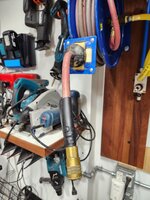
20240912_174035.jpg
 
OP
S

ScaldedDog

Well-known member
Joined
Jan 15, 2008
Messages
1,065
Location
Sedalia, CO/NSB, FL
But again, if you have the option to connect the hose with no constant 90 degree strain is on the hose, the hose will last a lot longer.
To what 90* strain are you referring?

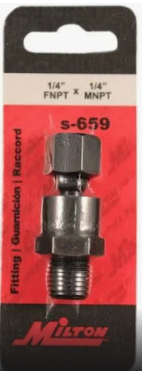
On perhaps a related note, have any of you used the Milton S-659 swivel fittings on the end of a hose that sees a lot of air tool use?


I'm going to try one on this new hose. It seems like it might make using an air tool in tight spaces a little easier.

Mark
 

scooby074

Well-known member
Joined
Oct 26, 2008
Messages
5,237
Location
Nova Scotia
To what 90* strain are you referring?

On perhaps a related note, have any of you used the Milton S-659 swivel fittings on the end of a hose that sees a lot of air tool use?


I'm going to try one on this new hose. It seems like it might make using an air tool in tight spaces a little easier.

Mark

On high vibration tools I make up a shortish (4-6') whip directly hooked into the tool. This gets the tool into tight places and gets the hose coupler out of the way. Plus it protects the coupler from vibration. I havent tried the fitting pictured. But I do use the common swivels on any tool like grinders that might be in a tight area for maximum flexibility..

1730295872903.png
 
To avoid these ads, REGISTER NOW!

PWC Repair

Well-known member
Joined
Dec 27, 2012
Messages
3,179
Location
Arkansas
.........Oh yeah, I also now squirt some Mothers VLR protectant on a micro fiber and wipe the hoses down every few months. An ounce of prevention.......
 

johnre

Well-known member
Joined
Dec 1, 2016
Messages
1,050
Location
Portland, OR
I also now squirt some Mothers VLR protectant on a micro fiber and wipe the hoses down every few months. An ounce of prevention.......
Good tip, thanks. I have been using a cloth to hold the air hose as I rewind it back into the recoil reel, just so I get the dirt off the surface and don't let it carry into the reel where it grinds away at it. This also protected my hands from injury. I'll adopt my technique to do this as well!
 
Last edited:

Wrench97

Well-known member
Joined
Jun 23, 2018
Messages
12,091
Location
Southeastern Pa
To what 90* strain are you referring?

On perhaps a related note, have any of you used the Milton S-659 swivel fittings on the end of a hose that sees a lot of air tool use?


I'm going to try one on this new hose. It seems like it might make using an air tool in tight spaces a little easier.

Mark
Best thing you can do for the air line is use a whip hose on the air tool if you want a swivel use a full flow type.

1730323821498.png
 

Yellerdog

Member
Joined
May 20, 2022
Messages
24
I did remodeling and later ran my own cabinet shop in the 90’s. The air hose we used for 10 years was good year 1/4” with a barbed fitting and a zip tie.

I continuously use that same home in my home shop and it finally gave up the ghost a couple years ago. Cut the fitting off and reinserted the barbed fitting with new zip tie, expect it to outlive me based on past performance.
 

6869704X4

Active member
Joined
Jan 18, 2024
Messages
29
Location
Eastern NM
I bought some Goodyear hose from Northern tool maybe a few years ago, not sure. It's held up very well. I just checked and they don't have it now. I wonder if the red Ironton brand is comparable.
 

andyvh1959

Well-known member
Joined
Feb 15, 2020
Messages
2,598
Location
Green Bay WI
To what 90* strain are you referring?

On perhaps a related note, have any of you used the Milton S-659 swivel fittings on the end of a hose that sees a lot of air tool use?

[/URL]

I'm going to try one on this new hose. It seems like it might make using an air tool in tight spaces a little easier.

Mark
The strain is on the hose carcass, where the constant weight of the hose coming straight out of the connection puts a strain on the hose inner tube and outer jacket, right at the highest stress point fo the hose at the end of shell crimp. A 90 at the hose connection lets the hose hang straight down, reducing the stress on the inner tube and cover. That constant stress, along with heat and ozone aging causes the cover to bcome brittle and crack, and eventually the inner tube will do likewise. When a hose end is crimped onto a hose, the crimp action compresses the hose wall, and even causes a slight bulge of the inner tube at the end of the hose end ******. When a constant stress load is added to the hose, it pulls the outer side of the hose cover and constantly works on that buldge on the inner tube of the hose. Over time one or both will age and fail, just like your picture shown at the start of this thread.

This applies for low pressure hose like an air hose as much as hydraulic hose at 1500, 3000, or 5000 psi and above. Even the hose connecting the clothes washer to the hot and cold house connections. Don't stress the hose by causing the weight of the hose to hang bent at the connection.

This is also why some hoses are made with a strain relief collar that is put on the hose end and onto the hose to spread the strain out into the free length/non-crimped area of the hose.
 
Last edited:

Wrench97

Well-known member
Joined
Jun 23, 2018
Messages
12,091
Location
Southeastern Pa
The strain is on the hose carcass, where the constant weight of the hose coming straight out of the connection puts a strain on the hose inner tube and outer jacket, right at the highest stress point fo the hose at the end of shell crimp. A 90 at the hose connection lets the hose hang straight down, reducing the stress on the inner tube and cover. That constant stress, along with heat and ozone aging causes the cover to bcome brittle and crack, and eventually the inner tube will do likewise. When a hose end is crimped onto a hose, the crimp action compresses the hose wall, and even causes a slight bulge of the inner tube at the end of the hose end ******. When a constant stress load is added to the hose, it pulls the outer side of the hose cover and constantly works on that buldge on the inner tube of the hose. Over time one or both will age and fail, just like your picture shown at the start of this thread.

This applies for low pressure hose like an air hose as much as hydraulic hose at 1500, 3000, or 5000 psi and above. Even the hose connecting the clothes washer to the hot and cold house connections. Don't stress the hose by causing the weight of the hose to hang bent at the connection.

This is also why some hoses are made with a strain relief collar that is put on the hose end and onto the hose to spread the strain out into the free length/non-crimped area of the hose.
I think he said earlier it's on a hose reel.
 

andyvh1959

Well-known member
Joined
Feb 15, 2020
Messages
2,598
Location
Green Bay WI
Correct, my mistake. The first picture showed the hose condition at the crimp with the quick disconnect end resting on a bench, so the hose was hanging off the end. The failed section of the hose out of the crimp though was indicative of the eventual result of aging and flexing stress at the end of the crimp. A strain relief like the shrink tube applied onto the crimp/clamp area is a great idea.
 

welder4956

Well-known member
Joined
Apr 8, 2010
Messages
3,068
Location
Birmingham, AL USA
The strain is on the hose carcass, where the constant weight of the hose coming straight out of the connection puts a strain on the hose inner tube and outer jacket, right at the highest stress point fo the hose at the end of shell crimp. A 90 at the hose connection lets the hose hang straight down, reducing the stress on the inner tube and cover. That constant stress, along with heat and ozone aging causes the cover to bcome brittle and crack, and eventually the inner tube will do likewise. When a hose end is crimped onto a hose, the crimp action compresses the hose wall, and even causes a slight bulge of the inner tube at the end of the hose end ******. When a constant stress load is added to the hose, it pulls the outer side of the hose cover and constantly works on that buldge on the inner tube of the hose. Over time one or both will age and fail, just like your picture shown at the start of this thread.

This applies for low pressure hose like an air hose as much as hydraulic hose at 1500, 3000, or 5000 psi and above. Even the hose connecting the clothes washer to the hot and cold house connections. Don't stress the hose by causing the weight of the hose to hang bent at the connection.

This is also why some hoses are made with a strain relief collar that is put on the hose end and onto the hose to spread the strain out into the free length/non-crimped area of the hose.
After reading this I halfway expected to see a clip from a axisymetric FEA mesh model to illustrate the stress distribution and peak stress locations.
 
OP
S

ScaldedDog

Well-known member
Joined
Jan 15, 2008
Messages
1,065
Location
Sedalia, CO/NSB, FL
Correct, my mistake. The first picture showed the hose condition at the crimp with the quick disconnect end resting on a bench, so the hose was hanging off the end. The failed section of the hose out of the crimp though was indicative of the eventual result of aging and flexing stress at the end of the crimp. A strain relief like the shrink tube applied onto the crimp/clamp area is a great idea.
I set it down that way for the photo, as it exposed the tear in the outer layer. It normally just hangs from the reel. Even so, your point is well taken. When using a tool, the weight of the hose down to the floor is hanging from the end of the tool, so strain relief is a good idea.

Mark
 

andyvh1959

Well-known member
Joined
Feb 15, 2020
Messages
2,598
Location
Green Bay WI
When I worked for Dayco, our most common hose failure claim was laundy washer hose attaching the washing machine to the hot and cold water shut off valves. When the washer/dryer was located on the 2nd floor near the bedrooms, if a hose failed quite often it damaged the room and contents below, adding to the claim. Most often the failure was the hot hose connected to the valve with the hose coming 90 degrees off the valve, constantly stressing the hose. Learned long ago to never buy the cheapest washing mahcine hoses.
 
To avoid these ads, REGISTER NOW!
Top Bottom