To avoid these ads, REGISTER NOW!

Above 1200 Sq/FT Restored 1930's Auto Shop

Wokspaces above 1200 squarefeet.
To avoid these ads, REGISTER NOW!

Jim C.

Well-known member
Joined
Jan 8, 2010
Messages
2,598
Thank you Jim. If you're going to do specific mid-year Corvette seats I can send you a link for a more detailed post I did on that project on another forum.

Haven't forgotten about the wood shop pictures either. ;)

Thomas

Thanks Thomas. No hurry on the wood shop pictures. Everyone is busy, particularly now, as the weather gets better. I know you'll get to it when you get to it. I"m guessing that when you started this thread, you had no idea your projects/machinery/cars/etc. would become a regularly counted upon source of entertainment and inspiration for so many of us, or that you'd be taking "content requests." I've certainly enjoyed the journey thus far and appreciate the efforts you've made to include, and indulge us, when possible. Consequently, you'll receive no pressure from me to post content, wood working or otherwise, until you have the time and desire to do so. I look forward to the next "episode" in your adventures at the Center of the Universe, regardless of what they me be.

Jim C.
 

9C1

Well-known member
Joined
Feb 3, 2006
Messages
153
Location
Illinois, USA
Thomas,
Are you a member of the National Corvette Restorers Society? That seat story would be great in the membership publication – The Corvette Restorer. I know a lot of the members would welcome it. Via PM I can make all the connections you need to get that done, if you wish.

Remember Hans Norberg!

Terry
 

Sunbimmer

Well-known member
Joined
Dec 6, 2011
Messages
2,022
Location
The province of Limburg, The Netherlands
Thomas,

again thanks for all the inspiration you are giving me, almost every day I see another item in your garage and I think hmmm I like that, I want that :)
I have a question, is that a (Original) Milton driveway bell above the man door?

IMG_3368_zps28eab9c8.jpg

I'm thinking of installing one myself.

Hugo.
 

Ted Brown

MEMBER EMERITUS
Joined
Jul 4, 2012
Messages
30
Location
Bakersfield, Calif. U.S.A.
Those were The good old Days of the Smokers Meets in Bako.. back then, I was building AA/Gas super charged cars, like SW/C, JR. Thompson, MGM/C&O Austin pickup, Hamburger & Mustard's 33 Willy, etc. etc. Great times :) Still love your shop ...
 
OP
B

BB767

Well-known member
Joined
Dec 24, 2009
Messages
3,724
Location
Philo, IL
Great progress on all fronts. Landscaping is a joy for me and a green thumb is not necessary, because, if it was, I'd be out of luck!

In looking at the seat restoration, I was shocked to see the level of rust on the seat frames for my 356 project. I'll have more on that aspect posted in my thread a little later on.

Just a note to say that I thoroughly enjoy my time reading about all that happens at your home/shop/garage.

Best,

Ody.

Thanks Ody for checking in. I've been following your impressive exploits when I can. I'm not surprised your 356 seat frame was rusted. It's a fate that befalls most convertible cars, an occupational hazard if you will. I am looking forward to the day I can join your ranks of those retired. :thumbup: When I do, I am planning on going on a "Great Garage Tour". Chris and I want to visit as many folks as we can from this thread who don't mind us visiting. Even those in Australia and New Zealand (is Sick Puppy even still around??) Love all your pictures and great sense of humor! What, me worry. :D

Thomas
 
OP
B

BB767

Well-known member
Joined
Dec 24, 2009
Messages
3,724
Location
Philo, IL
Thomas,
Are you a member of the National Corvette Restorers Society? That seat story would be great in the membership publication – The Corvette Restorer. I know a lot of the members would welcome it. Via PM I can make all the connections you need to get that done, if you wish.

Remember Hans Norberg!

Terry

Interesting you bring the NCRS up Terry. I have been meaning to join for a while so go ahead and send the appropriate material via PM and I'll get going on that.

Hans was one of kind wasn't he? A great loss to the LCOC and his friends alike.

Thomas
 
OP
B

BB767

Well-known member
Joined
Dec 24, 2009
Messages
3,724
Location
Philo, IL
Thomas,

again thanks for all the inspiration you are giving me, almost every day I see another item in your garage and I think hmmm I like that, I want that :)
I have a question, is that a (Original) Milton driveway bell above the man door?

IMG_3368_zps28eab9c8.jpg

I'm thinking of installing one myself.

Hugo.

Hugo, from reading your thread, your workmanship is second to none. Clearly you are enjoining the process as much as I am. That's at least half the fun isn't it? :)

I did briefly mention the driveway bell...


...many, many posts ago but here is some additional information on it. As you know, over the years there have been several manufacturers of driveway bells, with Milton arguably the best known. In fact they are still being made and you can buy a brand new one for around $50 on Amazon no less. But I wanted a vintage driveway bell which I felt was more fitting to the shop and one that was a little unusual. Note the copper "L" fitting through the wall and the clear tube....now hold that thought.


This one is not a Milton and I'm not sure who did make it. There was no information on the unit itself, just the embossed "L" on the lower bell case. I've seen a few others like like it, but not many. I did find a date on the back before it was restored, 1962, so that's my guess when it was made. I have zero pictures of it before or during restoration. That was done long before I realized there was some interest in such things. Who knew? :dunno: It was disassembled, cleaned, painted (again, long before I knew about Rick and his powder coating skills) and I had the bell and attachment acorn nut re-chromed. Milton bells just ring twice with a ding, ding. This one will ring the bell continuously as long as the points under the black dome are in contact with each other. So if someone parks...


..right on top of the air line stretched across the driveway the bell will continue to ring until the air in the line equalizes and the bellows under the dome relaxes and the points are no longer in contact with each other. That takes about 30 seconds, I made sure there were no air leaks in the various lines.


The air goes through the flexible line to this hard line. I used galvanized pipe since it's rugged and not easily damaged, that I additionally painted on top of the existing galvanizing with special galvanize paint to double ensure against it rusting very soon. That's a pet peeve of mine. Rust streaking down unprotected metal, but I digress. I also used clear plastic sleeves under the pipe clamps to prevent the clamps from scratching the paint and galvanizing. Air travels up the pipe into the carport attic space to copper pipe, again non-corrosive material, through to the "L" fitting on the wall inside the shop (remember your mental picture from earlier?) to the clear plastic tube and then to the diaphragm/bellows under the dome. I didn't use plastic pipe anywhere because of concerns it would become brittle with age and, well, frankly...... I find it ugly. The unit needs electrical 110V power so I installed an outlet above the door...


...which you can just barely see from the side. Note how the unit is designed to be raised above the wall surface...


...so I can hide the outlet under there and by using a flat plug, it makes for a very clean installation as viewed...


..from the floor with no cumbersome electrical cord showing. I would highly encourage you to install a driveway bell Hugo. They are PNC to boot. Oh, that's Practical, Nostalgic and relatively Cheap! :D

Thomas
 

Hemihead2

ALLIANCE MEMBER
Joined
Feb 16, 2010
Messages
136
Location
Auburn, CA


The circled LP album cover is titled Bakersfield '64 which a recording of the 1964 Fuel and Gas Championships drag race meet held in..........Bakersfield, California. Yes, it's just a recording of the sounds of the cars and dragsters at the drag strip as they ran down the track. A friend of mine happened to spot that album cover hanging on the wall while he was at the shop a couple of years ago. That in turn leads us to the odd shaped trophy which...


Was a senior in high school and traveled down with 3 buddies from the small town we lived in for the 1964 Fuel and Gas Championships. Great times.
 
OP
B

BB767

Well-known member
Joined
Dec 24, 2009
Messages
3,724
Location
Philo, IL
The circled LP album cover is titled Bakersfield '64 which a recording of the 1964 Fuel and Gas Championships drag race meet held in..........Bakersfield, California.......


Was a senior in high school and traveled down with 3 buddies from the small town we lived in for the 1964 Fuel and Gas Championships. Great times.


Growing up in the mid west in the 1960's we'd read Car Craft, Hot Rod or what have you and see all the neat things happening out in California. All the fabulous street cars, hot rods, dragsters, multiple drag strips, the weather, surfing, bikini girls and all of it. It was like a dream to us here. The standard of living was much more modest here so all we could do was try to visualize what is must be like actually living out there. Every so often a buddy would move out there or do a summer visiting relatives and report back to us what we were missing. To say we were envious would be a gross understatement. :eek:

I can only imagine what is must have been like to see those races and all the legendary cars and drivers back then. Great times indeed!

Thanks Hemihead2! :thumbup:

Thomas
 

Hemihead2

ALLIANCE MEMBER
Joined
Feb 16, 2010
Messages
136
Location
Auburn, CA
The only sad part of the weekend at that Smokers meet was when the Alcohol and Beverage Control folks (no longer in existence) caught us minors with some beers in the parking lot between rounds, made us pour them out and left, telling us to "have a good time". Today, we'd have been hustled off to jail. The races were still great.
Somewhere, I still have my pit pass from that meet with the picture of the previous year's top time winner, Art Malone.
 
OP
B

BB767

Well-known member
Joined
Dec 24, 2009
Messages
3,724
Location
Philo, IL
Here then are a few more details about the fan...


...when you get a close look you can see...


..the finish is original and nice, but it does have patina.


It's a 3 speed, osulating GE fan, manufactured in 1941...


The speed that it osulates can also be varied. That's done by unscrewing the pivot arm on the bottom and changing the pivot points.


Note the replacement period cloth insulated power cord.


Just a wonderful piece that fits right into the shop and is highly functional as well, the best of both worlds.

Thomas
 
Last edited:
OP
B

BB767

Well-known member
Joined
Dec 24, 2009
Messages
3,724
Location
Philo, IL
I have the younger brother (or maybe the son) of your fan - I don't know the exact age but I imagine it's late 1950s, light grey in color, with a 16" blade. Very quiet and moves a lot of air. http://www.garagejournal.com/forum/showthread.php?p=2075472

The fan blades are shaped differently but you can see they used the same oscillating mechanism and base design for quite a while.

It is certainly in the same family Stuart, no question. Mine, like yours, also moves a bunch of air which is a real plus in a fan. :) Ya know, if you have something that works and works well, why change it?

Thanks for sharing that. I hadn't even seen that thread on shop fans before. Chris tells me I need to get out more and she may be right. :dunno:

I'm just about done with a fairly significant restoration/powder coat project. I'm thiiiiiis close to finishing it so I've been spending some major time on it trying to get it done. I thought today would do it, but I had to attend to some small details on it that took several hours to finish. Glad I did though, it's turning out swell. :thumbup: Watch this space.

Thomas
 

Rothammel

Member
Joined
Feb 21, 2013
Messages
5
Here's a Corvette project I've recently finished that has been detailed on another forum but I'll share some highlights here. There is some material that has greater application than just servicing a seat for a Corvette.

The drivers seat didn't move and wouldn't stay latched in position to my satisfaction so I decided this winter to solve the problem. I doubted that it had any service work in the last 45+ years so to begin...


...I removed all the upholstery to leave the bare seat frame. The factory never puts much paint on areas like this which are unseen. In time that paint will break down and the exposed metal will begin to rust. It's worse in a convertible car which at times can get caught in the rain with the top down which will soak the carpet and create a very humid environment for the seat metal. Here is the seat frame is viewed upside down.


The seat latch mechanism (there are 2, one on each side) and seat tracks were all gummed up with decades old dirt and dried out grease.


Additionally there were broken parts like these seat bushing springs and latch return springs that were distorted so they wouldn't put proper tension on the latches.


Some of the problems with the seat not latching properly are due to the return springs not putting proper tension on the latches (circled yellow) and the seat notches themselves (circled blue) which had a build up of old grease and debris keeping the lever from fully engaging the track notch. Cleaning and lubricating would help but there is more to it than just that.


A bit of a surprise was finding how poor quality the factory spot welds were and that most were either cracked or broken.
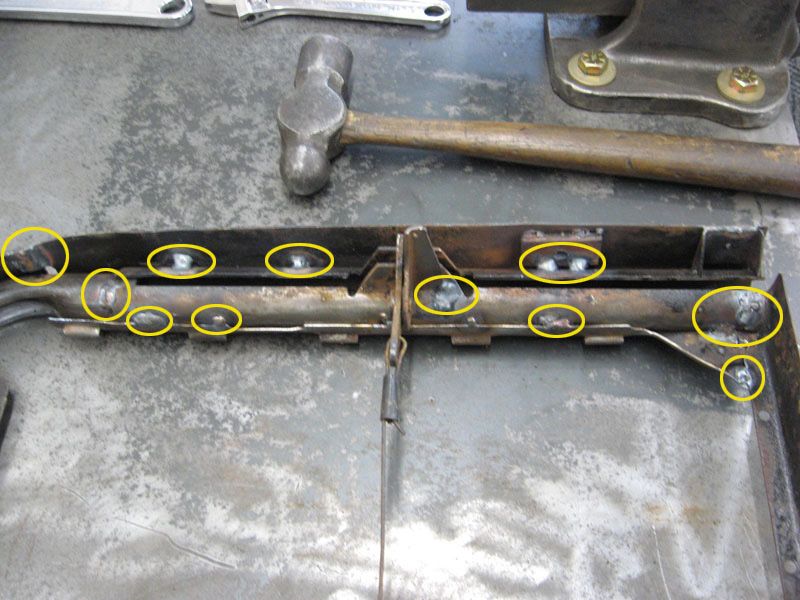


Here is one side of the seat frame with all those spot welds repaired. Once this was all done the seat frame was remarkably more rigid and stronger.


The metal is thin so if you're going to MIG weld use the lowest setting and just use a momentary spot. Better still is TIG welding (results seen here) which gives greater control and localized heat to minimize warping the frame.


There were also a couple of tapped screw holes that were stripped so they were filled, drilled and then...


...re-tapped as seen.


Both latch levers had some wear. That notch was worn into this lever, it shouldn't even be there. So a piece of aluminum was used on the backside of the notch to back up the notch and it was then TIG filled with metal. The new metal won't attach to the aluminum as this was done.


After the new metal filled in the notch, it was reground and filed to shape. Both of the latches were thus repaired.


With all those repairs done, all the various parts were prepared for new paint by removing the old paint and rust...


...and then painted. This was done in the winter so I used the heat from my house boiler (seen in the background) to help dry the paint. Powder coating might have caused some clearance problems with the moving parts plus I didn't really need the durability of powder coating. Priming and painting will be plenty durable enough in this application.

This is the end of Part 1. To be continued.

Thomas

what is the type of boiler? Wood? Gas? Oil? :)
 
OP
B

BB767

Well-known member
Joined
Dec 24, 2009
Messages
3,724
Location
Philo, IL
what is the type of boiler? Wood? Gas? Oil? :)

The boiler was installed in 1952 (61 years ago!) and was originally oil fired. Natural gas came to Philo in 1963 and that's when it was converted to natural gas. My heating guy tells me as well built as that furnace is it should last another 61 years....easy. :)

Thomas
 

BRIANBB

Well-known member
Joined
Aug 27, 2010
Messages
394
Location
Katy Texas
Nice write up on the seats. I wont repost all the photos just to say that though. I always enjoy reading your thread in the morning.
Cheers.
 
OP
B

BB767

Well-known member
Joined
Dec 24, 2009
Messages
3,724
Location
Philo, IL
Hello there Brian and welcome. What a way to start your day, 'let's see what that crazy Thomas has been up to today'! Anyway many thanks for the support and encouragement, more is in store.

Thomas
 
To avoid these ads, REGISTER NOW!
OP
B

BB767

Well-known member
Joined
Dec 24, 2009
Messages
3,724
Location
Philo, IL
For those who may not have much experience with old furniture, here's a brief look at the desk chair...

.

I picked it up not too long ago to go with the desk. Overall it was in pretty nice, original condition...


... in fact all I did was service the casters on it. If you've never gotten up close and personal with the casters on some older furniture you own, take a look at the following, it might be helpful.


To start with, removal is fairly straight forward and I suspect it's the same on most furniture of this vintage, 1900's to the 1940's. They are just pressed in so use a wide blade screw driver...


... to gently pry the caster out. By using a wide blade, it distributes the force over a wider area and you're not as adept to dig into the metal. Gently does it prying both up and down, moving around the caster.


You can see this one is quite dry, who knows when the last time was that it was lubricated. Remove the nut on the caster wheel axle and then to remove the axle...


...I used a small taper punch and a vise...


...to tap the axle out.


Here's what the axle looked like with old fuzz wound up on the axle...


...which is why the caster didn't roll very freely.


Next the wheels...


and other parts needed to cleaned of old hardened grease.


For that I use a 3M Scotch Brite pad and...


3M #8215 adhesive cleaner.


Thoroughly cleaning the wheel and various parts inside...


... and out.


To clean the ball bearings in the swivel I flooded them with adhesive cleaner...


...and used compressed air to blow them out. Do this over a waste can (seen on the right) to keep from blowing that gunk all over the shop.


With everything now clean , I used the same dry graphite spray I used on the Corvette seat tracks to lubricate the ball bearing swivels and axles.


For re-assembly note the notch on the wheel axle which should install into...


...the corresponding notch on the caster housing.


All that's left is installing the nut back on the axle, lubricate the caster shaft as it's being pressed back into the chair and...


... you're good to go. The chair now glides across the shop floor. :thumbup:

Thomas
 
OP
B

BB767

Well-known member
Joined
Dec 24, 2009
Messages
3,724
Location
Philo, IL
Did you consider painting the metal parts of the castors? Or are they left deliberately to maintain authenticity?

That's a fair question Craptain, thanks for asking. I deliberately left everything as original as possible. All I did was clean and service. The wood finish on the chair and desk is still original and so is all the paint under the chair on the seat back tilt mechanism and caster housings. They're far from perfect but still very nice. It's always my preference to leave things original if possible but if it's too far gone, either visually or functionally, then I'll restore to the highest degree that I can. It's only original once. Embrace the patina! ;)

Thomas
 

Spareparts

Well-known member
Joined
Mar 12, 2010
Messages
2,042
Location
Lansing Ks.
Thomas, no powder coat, and I cant believe you didn't have some aluminum angle on that vice jaw. Don't want to chip the jaws. You know I'am just giving you a hard time, don't you. You do some amazing work on every thing you do. Thanks for sharing.
 

Jim C.

Well-known member
Joined
Jan 8, 2010
Messages
2,598
........... It's always my preference to leave things original if possible but if it's too far gone, either visually or functionally, then I'll restore to the highest degree that I can. It's only original once. Embrace the patina! ;)

Thomas

I totally agree!

Jim C.
 
OP
B

BB767

Well-known member
Joined
Dec 24, 2009
Messages
3,724
Location
Philo, IL
For those who are having powder coat withdrawal symptoms my next project should satisfy that craving. I humbly present:

PART l - Big Green Loading Machine - BGLM

To properly set the stage, a little background information.


When I bought my John Deere 855 tractor (it was pre-owned) it came equipped with the snow blower and soft cab but never had a loader. I was very happy with the tractor and thought I'd just get a loader for it. Almost always when these tractors are sold used, if they had a loader with them, they would be sold together. Because of that, trying to find just a loader alone, by itself, is difficult, very difficult I found out. I wanted a John Deere 70A loader which is what that tractor would have been equipped with if a loader had been purchased with it new. 70A loaders are not made any more so I'd have to buy a pre-owned one which is never a problem with me. After many months searching (Craig's List is wonderful :thumbup:) I finally found one I was happy with. That is was for sale in Knoxville, Tennessee, about an 8 hour drive away, wasn't a problem either. For the right equipment I don't mind traveling a little bit to go get it.


The loader didn't appear to be too worn or badly beaten up, and it had no operational issues. Anything wrong with it I could correct in time.


I could see the loader would need some refurbishment at some point but I rather like doing that sort of work. To make sure it would work on my existing 855 tractor, I trailered my John Deere 855 down to Knoxville where we installed the 70A loader and made sure it was compatible with my existing 855 tractor. I used the loader for a couple of years with no problems and this past winter (2012-13) I decided it was time to refurbish/restore it.


All the flexible hydraulic lines were in need of replacement from the day I bought it.


They were in extremely poor condition and I was expecting one or more of them to develop a serious leak...


...but they never did, amazing. Gives me a lot of confidence in just how tough they really are.


Originally I was going to reuse the hard hydraulic lines.


Upon closer inspection they were found to be pitted, bent and kinked so I decided to replace them as well. In retrospect after several frustrating days bending up new lines I might have rethought that decision.


That sets the stage before any work was done.


Next step was to dis-assemble everything.


Anyone who has worked with hydraulics before knows even with your best efforts....


...it's terribly messy work. Using scrap cardboard helped a little in corralling all that stray fluid.


It's hard to see but in the yellow circle to the left of the white jug are two extremely small restrictors found in two of the flex lines which had to be removed and installed in the new lines. It pays to read the manual before just blindly tearing everything apart. Those were placed in clear zip lock bags. I use zip lock bags all the time out in the shop. They are very handy.


The cylinders were boxed up and taken to be rebuilt.


The areas circled on...


...both mounting brackets were worn so new metal was added then filed and reshaped.


A previous welding repair was redone correctly.


The old weld was ground out and a proper "V" ground in it and then re-welded as seen.

This concludes PART l. Up next..........PART II. Don't miss this next fun filled chapter in the continuing excellent adventures of Thomas in The Center Of The Universe! :D

Thomas
 
Last edited:

Jim C.

Well-known member
Joined
Jan 8, 2010
Messages
2,598
Looking good Thomas. I can't wait to see the end result. Also, great tip on using ziplock plastic bags. I use them all the time in the shop, particularly when I'm taking apart a machine and trying to keep track of small parts/hardware. Just drop the parts in a ziplock bag and you're organized. I also label the bags with a "Sharpie" marker so I know exactly what they are upon re-assembly.

Jim C.
 

charlief1

Well-known member
Joined
Dec 1, 2010
Messages
248
Those lines looked pretty good for some I've seen and worked on over the years Thomas. Since they're multi-layered with a woven steel liner they usually hold up really well even if the outer layer of rubber is gone.
 

markviii

Well-known member
Joined
Jan 25, 2010
Messages
1,310
Location
east central IL
But they wouldn't have looked very nice once everything else was refurbished, so he would have had to redo them anyway to satisfy his aesthetic senses!

Chris
 
OP
B

BB767

Well-known member
Joined
Dec 24, 2009
Messages
3,724
Location
Philo, IL
Looking good Thomas. I can't wait to see the end result. Also, great tip on using ziplock plastic bags. I use them all the time in the shop, particularly when I'm taking apart a machine and trying to keep track of small parts/hardware. Just drop the parts in a ziplock bag and you're organized. I also label the bags with a "Sharpie" marker so I know exactly what they are upon re-assembly.

Jim C.

Those lines looked pretty good for some I've seen and worked on over the years Thomas. Since they're multi-layered with a woven steel liner they usually hold up really well even if the outer layer of rubber is gone.

Correct me if I am wrong but you have two tractors now or just a loader to fit on the one you already have ?

I had to look at that.. just one.. I think he took it . To get the loader

Jim, I usually label a piece of note paper with what the part is and stick it in the bag along with the parts. I've had the misfortune of Sharpie's smearing on the bag if it's handled a lot and become illegible. Either way as you mention, they greatly aid in organizing projects and they come in many different sizes. :thumbup:

charlief1 a very few of the lines were OK but most were awful, really scary bad. No point in refurbishing the loader half way, I was all in on the project as you'll see. :)

HOTFR8 I really could have written the paragraph much better, my apologies for the confusion. Vernmotor is correct, I trailered my existing JD 855 to Knoxville just to make sure the 70A loader I was buying would install and work compatibly with my existing tractor. I have and need only 1 tractor, the 855. Should the need arise for a larger tractor, I have friends who will readily loan one to me. As happy as I am with my 855 I can't imagine ever replacing it in my lifetime. The 70A loader is self supporting when off the tractor as you can see in the pictures and is extremely easy to remove or install by myself. Takes about 2 minutes. Really clever, well thought out piece of engineering. In winter I remove the loader and install the snow blower and soft cab. Thanks for keeping me on my toes! :D

Thomas
 
OP
B

BB767

Well-known member
Joined
Dec 24, 2009
Messages
3,724
Location
Philo, IL
OK I went back through post #6749 and added some additional information and also edited it for clarity. I hope that will prevent any misunderstanding. :eek: Thanks everyone.

Thomas
 

HOTFR8

Banned
Joined
Mar 2, 2007
Messages
24,498
Location
Castlemaine, Victoria. The Hot Rod Centre of Austr
I had to look at that.. just one.. I think he took it . To get the loader

HOTFR8 I really could have written the paragraph much better, my apologies for the confusion. Vernmotor is correct, I trailered my existing JD 855 to Knoxville just to make sure the 70A loader I was buying would install and work compatibly with my existing tractor. I have and need only 1 tractor, the 855. Should the need arise for a larger tractor, I have friends who will readily loan one to me. As happy as I am with my 855 I can't imagine ever replacing it in my lifetime. The 70A loader is self supporting when off the tractor as you can see in the pictures and is extremely easy to remove or install by myself. Takes about 2 minutes. Really clever, well thought out piece of engineering. In winter I remove the loader and install the snow blower and soft cab. Thanks for keeping me on my toes! :D

Thomas

:thumbup: :) Gotcha..... thank you.

OK I went back through post #6749 and added some additional information and also edited it for clarity. I hope that will prevent any misunderstanding. :eek: Thanks everyone.

Thomas

:eek: Sorry to keep you on your toes.
 

aggierailroad

Well-known member
Joined
Jan 8, 2012
Messages
581
Location
Houston, TX
Looking good Thomas. I can't wait to see the end result. Also, great tip on using ziplock plastic bags. I use them all the time in the shop, particularly when I'm taking apart a machine and trying to keep track of small parts/hardware. Just drop the parts in a ziplock bag and you're organized. I also label the bags with a "Sharpie" marker so I know exactly what they are upon re-assembly.

Jim C.

To take this a bit further I will sometimes snap a photo and write the auto generated name from the camera on the ziploc bag so that I can reference the photo months later when I put it back together. Works great for things like window lifts, latch assemblies and electronics.
 

oberst

Well-known member
Joined
Jan 8, 2008
Messages
205
Thomas, about the monkey wrench in the picture; I know absolutely nothing about hydraulic fittings, so I'm wondering if this is the correct tool for the job, or just a little bonus fun for all of us hangers-on?
 

gordyy

Well-known member
Joined
Jan 10, 2013
Messages
180
Location
North Dakota
oberst I was going to comment on the monkey wrench also I figure he had to throw that in for a few die hard old tool lovers (we are out here)
My great uncle (an old blacksmith) always said for a square nut or bolt nothing was better than a monkey wrench but use it on anything else you will find out first hand why they call it a monkey wrench. bacause after you split a couple knuckles your dancing around fanning the air and cussing like a monkey
 
To avoid these ads, REGISTER NOW!
Top Bottom