To avoid these ads, REGISTER NOW!

Running Wire from outside (sub-Panel) mounted to stucco to inside garage, how to do it by code?

OP
C

cb248

Active member
Joined
Jul 19, 2022
Messages
42
Copy thanks, I've been people cover the wire with different color electrical tape for easy identification. I assume this is allowed per NEC?

I asked the seller again about this wire and his response was clear, no bare copper. Either he is clueless or this might be a first i've seen this in a 8/3. If it has the 4th conductor I'm shipping it back on his dime and going with 8/2 which is what I wanted anyway or the THHN/THWN like the last install in my picture where I have it mounted outside.

I've looked and have not found anything. I'm also having trouble finding long threaded rigid conduit too.
 
To avoid these ads, REGISTER NOW!

mike93lx

ALLIANCE MEMBER
Joined
Dec 9, 2013
Messages
38,398
Location
Richmond, VA
Copy thanks, I've been people cover the wire with different color electrical tape for easy identification. I assume this is allowed per NEC?

I asked the seller again about this wire and his response was clear, no bare copper. Either he is clueless or this might be a first i've seen this in a 8/3. If it has the 4th conductor I'm shipping it back on his dime and going with 8/2 which is what I wanted anyway or the THHN/THWN like the last install in my picture where I have it mounted outside.

I've looked and have not found anything. I'm also having trouble finding long threaded rigid conduit too.
You can mark the white when it is used as a hot.

The seller is clueless. Send it back and get THWN, please. You will be so much happier. It's way, way, way easier to work with and has a higher ampacity rating (with romex, you use the 60 degree column, but with thhn/THWN, you use the 75 degree).
 
OP
C

cb248

Active member
Joined
Jul 19, 2022
Messages
42
Thanks that is an excellent point, i was looking at the 75 deg when NM-B is actually 10A less.

Yea i'm still not convinced he knows what he is talking about. This is going to be quite irritating when it comes and it does have the 4th conductor but could be a blessing in disguise. If it doesn't have the 4th conductor I will be shocked honestly
 
OP
C

cb248

Active member
Joined
Jul 19, 2022
Messages
42
Well, we were right, he made a mistake and apparently he got the wire from a friend it does have a 4th conductor. Will buy the thhn/thwn now instead, it will cost me more but doing it the right way is more important to me.
 

sparky 1971

Well-known member
Joined
Oct 9, 2018
Messages
8,123
Location
Central Iowa
To be clear I plan to charge at 16a but there could be times it could be higher. I'm using the 8awg to support 40A charger use and the 8awg will support the NEC 80% ampacity requirement. I can't share the circuit even if I wanted to. There is a bug is the EV software where it causes all kinds of issues when it detects a pilot Amperage change. Hence the two independent chargers
You wouldn't be sharing circuits, just the ground if you ditch the romex idea, which you should do.
@sparky 1971, it sounds like you are saying there is no way to avoid making a bigger hole in the stucco to accommodate the fitting. It is less of a problem b/c i can drill larger holes where I mount the EV charger base. But going back to the panel that will not be easy b/c i can't remove the panel,
The only way I see to do it is to drill a hole large enough to accommodate the connector all the way through from the back. If that wall is 2' thick like where the chargers will be, good luck making the pilot hole straight enough.
I see what you are saying about the rigid conduit ******, the length is actually i'm estimating is about 2 feet from the inside of the garage to the outside where the EV charger base is, i would need to find a conduit ****** that long threaded on both ends and would have to chop it off unless i get lucky. I think that is a good idea and would be the most flush way of doing it. Might employ the same tactic on the panel too but i would not be able to get a nut behind it, only in the panel and using the wall as my rear nut technically and i would seal with RTV.

2' is one helluva deep wall. If you were to do that into the panel, the hole would have to be big enough for the lock nut to fit through, which wouldn't be much different than a PVC male adapter.
@Mike
At this point i'm stuck with the wire, i can remove the ground conductor if it is in the bundle, since it is all indoor it should be compliant. My biggest concern is the sealing and with the conduit ****** idea it sounds like i have a path forward.
You're stuck with owning the wire, but not stuck with using it.
I have to be honest i'm surprised there is no flush wall type fitting. I saw some pipetite seal fittings but they are for larger pipes that do just that for plumbing but nothing for electrical. I guess RTV it is.
 

sparky 1971

Well-known member
Joined
Oct 9, 2018
Messages
8,123
Location
Central Iowa
Copy thanks, I've been people cover the wire with different color electrical tape for easy identification. I assume this is allowed per NEC?

I asked the seller again about this wire and his response was clear, no bare copper. Either he is clueless or this might be a first i've seen this in a 8/3. If it has the 4th conductor I'm shipping it back on his dime and going with 8/2 which is what I wanted anyway or the THHN/THWN like the last install in my picture where I have it mounted outside.

I've looked and have not found anything. I'm also having trouble finding long threaded rigid conduit too.
Send it back and forget about using romex.
 
OP
C

cb248

Active member
Joined
Jul 19, 2022
Messages
42
Wire issue is resolved, i got a refund for it already, so going to get the right wire.

As for the sharing of the ground I still would need two separate grounds for each EV charger base but I could use one from the panel to the J-box in the garage and use a wire not for the remainder.

Yea the 2 feet distance scares me, i bought a 17" auger b/c I know there is wood beams there, I don't want to drill large holes in there especially if it is structural. The idea of having a threaded end is appealing b/c i only have to drill the OD of the pipe. If its not perfectly straight i'm not worried b/c in the EV charger base if there is slight deflection i can still work with that.
 
OP
C

cb248

Active member
Joined
Jul 19, 2022
Messages
42
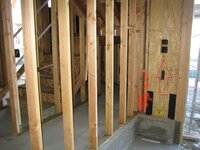
Here is a picture i had taken of the same model of my house before stucco went up. the copper fitting by the arrow is the water heater blow off valve drain. But that is a long distance to go and maybe there isn't more wood in the center. The other side is the drywall you can see the flashing black paper in there. I'm not sure if ill hit a fire block or not that is another concern.

The picture is inside the garage looking out at the front driveway
IMG_6874.jpg
 
OP
C

cb248

Active member
Joined
Jul 19, 2022
Messages
42
THHN THWN-2 8 AWG green, black , red ordered, now the fun part of trying to find an emt pipe with long threads
 
OP
C

cb248

Active member
Joined
Jul 19, 2022
Messages
42
Sorry i meant rigid. My goal is to make the smallest hole possible so the conduit sticks out and easier to seal around it.
 
OP
C

cb248

Active member
Joined
Jul 19, 2022
Messages
42
Back to 3/4" conduit for each charger once in the garage, need to make sure these can fit in the short run from the panel to the garage j-box in 1".
 

sparky 1971

Well-known member
Joined
Oct 9, 2018
Messages
8,123
Location
Central Iowa
Back to 3/4" conduit for each charger once in the garage, need to make sure these can fit in the short run from the panel to the garage j-box in 1".
You can fit six #8 wires in a 1", but not in a 3/4". You can use #10 for the ground, it still has to be 1" conduit, but it's less hassle.
 

sparky 1971

Well-known member
Joined
Oct 9, 2018
Messages
8,123
Location
Central Iowa
i was hoping something like this for electrical existed

I've never seen anything like that. Sealing at the charger boxes won't be an issue since you can do that before the box gets mounted. The panel won't be as easy but if you follow post #11. I personally wouldn't screw around with rigid, but it's an oprion.
 
OP
C

cb248

Active member
Joined
Jul 19, 2022
Messages
42
That's my plan 1" from panel to garage and from there 3/4" to each side.

I've been thinking about this and I think the cleanest way since there is no way to avoid Silicone for both the panel and charger base station is to use something like this where the PVC conduit or EMT goes through the stucco and into this fitting. B/c of the shape it will prevent the conduit from backing out and ill seal the back side of this so its clean and not visible.

I'm just not sure if this is to code thats my concern.

 
OP
C

cb248

Active member
Joined
Jul 19, 2022
Messages
42
I'm going to use silicone like you said but the fitting above to me seems like a much more cleaner options, prevents pull back and its fully sealed and a more polished finish inside the panel and charger box.

Your thoughts?
 

mike93lx

ALLIANCE MEMBER
Joined
Dec 9, 2013
Messages
38,398
Location
Richmond, VA
I'm going to use silicone like you said but the fitting above to me seems like a much more cleaner options, prevents pull back and its fully sealed and a more polished finish inside the panel and charger box.

Your thoughts?
My opinion is that if the wire is protected and the work looks quality, it will pass inspection.
 
OP
C

cb248

Active member
Joined
Jul 19, 2022
Messages
42
Thanks Mike, i'm a stickler to details and clean setups. Sounds like I have a path forward with my idea. I'm not an professional electrician if it is not obvious, just a very ambitious engineer
 
To avoid these ads, REGISTER NOW!

sparky 1971

Well-known member
Joined
Oct 9, 2018
Messages
8,123
Location
Central Iowa
That's my plan 1" from panel to garage and from there 3/4" to each side.

I've been thinking about this and I think the cleanest way since there is no way to avoid Silicone for both the panel and charger base station is to use something like this where the PVC conduit or EMT goes through the stucco and into this fitting. B/c of the shape it will prevent the conduit from backing out and ill seal the back side of this so its clean and not visible.

I'm just not sure if this is to code thats my concern.

That's a reducing bushing and is used to change from one size to another in conduit.
 
OP
C

cb248

Active member
Joined
Jul 19, 2022
Messages
42
understand, but this just simply allows me to have a clean finish where the wires come out into the panel and the charger box, plus the lip acts as a backstop to prevent the conduit from backing out (not that it would happen the other side has a j-box) but it just looks like a more polished finish with the silicon sealed and hidden so you can't tell unless you take it apart. If what Mike is is correct it should hopefully pass inspection. I know from a safety perspective it will be fine but code wise i was not sure about.
 

mike93lx

ALLIANCE MEMBER
Joined
Dec 9, 2013
Messages
38,398
Location
Richmond, VA
understand, but this just simply allows me to have a clean finish where the wires come out into the panel and the charger box, plus the lip acts as a backstop to prevent the conduit from backing out (not that it would happen the other side has a j-box) but it just looks like a more polished finish with the silicon sealed and hidden so you can't tell unless you take it apart. If what Mike is is correct it should hopefully pass inspection. I know from a safety perspective it will be fine but code wise i was not sure about.
I am not saying it is code-perfect. Just that inspectors are human and don't always dig in deep, especially if the work is clearly quality. It doesn't sound like there is a safety issue with what you are doing, which is why I think it will be ok
 

sparky 1971

Well-known member
Joined
Oct 9, 2018
Messages
8,123
Location
Central Iowa
You're going to do what you're going to do. But, I really doubt that reducer is listed for use as a box connector which should cause an inspection to fail if he looks in the panel. Then you start over but you now have to make the hole through the wall larger so the connector has clearance and that's going to be a *****, 10X that if the hole goes through 2' of wall. Are you planning on running the conduit through the box and installing the reducer on the inside? That's the only way I see it working, but you're going to lose valuable space, especially in the charger boxes and it's not going to seal the box very well.. You are making this way too difficult.
 
OP
C

cb248

Active member
Joined
Jul 19, 2022
Messages
42
@Mike, copy all, i just had an electrician come by and he said the same thing, there is nothing in NEC that talks about it and he said as long as it looks professional he didn't believe it would be an issue.

@Sparky, I'm trying to do it the right way as long as it meets the code and passes. I agree I would not want to redo this if I can avoid it. To answer your question yes that is the plan to put the reducer in the panel and in the charger box. I don't believe it is any larger than 1-2" in length so i hope it is not a clearance issue. I know it won't be in the panel but the charger box I don't know b/c I don't have it delivered yet.

I like to keep it as simple as possible, this to me is simple, smallest hole possible in the stucco, drywall and in between. Is there a better option than the reducer that would serve the same purpose in your opinion now that you have an idea what I'm trying to do that would pass as a box connector?

thanks again for all your guys input.
 

sparky 1971

Well-known member
Joined
Oct 9, 2018
Messages
8,123
Location
Central Iowa
@Mike, copy all, i just had an electrician come by and he said the same thing, there is nothing in NEC that talks about it and he said as long as it looks professional he didn't believe it would be an issue.
There may be nothing in the NEC specifically about this, but whatever gets installed has to be listed for such use and I really doubt UL or any other testing agency has listed a reducer as a box connector.
@Sparky, I'm trying to do it the right way as long as it meets the code and passes. I agree I would not want to redo this if I can avoid it. To answer your question yes that is the plan to put the reducer in the panel and in the charger box. I don't believe it is any larger than 1-2" in length so i hope it is not a clearance issue. I know it won't be in the panel but the charger box I don't know b/c I don't have it delivered yet.

I like to keep it as simple as possible, this to me is simple, smallest hole possible in the stucco, drywall and in between. Is there a better option than the reducer that would serve the same purpose in your opinion now that you have an idea what I'm trying to do that would pass as a box connector?

thanks again for all your guys input.
I took some measurements, but I don't have a 1" PVC male adapter on hand to check. If you use the reducer, you will have to run PVC through the wall and that's going to require a 1-3/8" hole to get the pipe through. If you use 1" EMT with a compression connector, the connector that I have would require a 1-3/4" hole to fit through. A PVC male adapter wouldn't need that large of a hole, but since I don't have one on hand, I can't tell you what it would require, but it's probably 1-5/8" or so. As far as the boxes for the chargers, 3/4" PVC will need a 1-1/8" hole. If you use the pipe with a male adapter on the end, you're going to need a 1-1/2" hole. If you were to use 3/4" EMT with a compression connector, a 1-1/2" hole would also be needed..

Remember, the connectors or male adapters are going to be fairly tight in the hole, no different that if you were to have a piece of pipe in there. Sure, the hole will be marginally larger, but it will be behind the box and nobody is going to see it.

That's really all the input I have for your original question about getting through the wall via the back of the panel, but I am going to suggest what I would do if it were my house. Come straight out of the bottom of the panel and use an LB to go through the wall. Sealing will be easy and you have enough going on at the panel that nobody will notice it. The only other thing I could suggest would be conduit around the outside to the chargers, but that may put it on display for everyone that pulls in the driveway to see and I wouldn't want that. If it were on the back of the garage only and I would be the only person to see it when I am mowing the lawn, you bet I'd run it exposed.
 
Last edited:
OP
C

cb248

Active member
Joined
Jul 19, 2022
Messages
42
Thanks for the feedback, HOA would not allow that kind of exposed conduit, hence the trouble to run it inside. I'm going to look at the different connector options and see what I find with the least footprint. appreciate the information.
 

Jim greengo

Well-known member
Joined
Sep 3, 2018
Messages
7,415
Location
Behind my house
Thanks for the feedback, HOA would not allow that kind of exposed conduit, hence the trouble to run it inside. I'm going to look at the different connector options and see what I find with the least footprint. appreciate the information.
I mean a pipe ****** from back of panel through wall.
 
OP
C

cb248

Active member
Joined
Jul 19, 2022
Messages
42
Jim, i wish that was an option, i have a bout 2ft area and i could not fit a ****** that long. That would be the most ideal solution but none of the ****** are that long, longest i found was 8" for 1" and even shorter for 3/4" If you find something let me know b/c that would be a great solution.
 

mike93lx

ALLIANCE MEMBER
Joined
Dec 9, 2013
Messages
38,398
Location
Richmond, VA
Jim, i wish that was an option, i have a bout 2ft area and i could not fit a ****** that long. That would be the most ideal solution but none of the ****** are that long, longest i found was 8" for 1" and even shorter for 3/4" If you find something let me know b/c that would be a great solution.
Get a pipe, mark the length it needs to be and have it threaded. Pipe is threaded all the time for this reason and even HD can do it
 
OP
C

cb248

Active member
Joined
Jul 19, 2022
Messages
42
Thanks, i never considered that and didn't know they could do it? I don't recall ever seeing the pipe threading machine at Lowes or HD near by. I'll ask none the less. How about Galvanized conduit for plumbing, I don't suppose that can be used b/c i assume the threads are NPT? Not sure if its to code anyway
 

mike93lx

ALLIANCE MEMBER
Joined
Dec 9, 2013
Messages
38,398
Location
Richmond, VA
Thanks, i never considered that and didn't know they could do it? I don't recall ever seeing the pipe threading machine at Lowes or HD near by. I'll ask none the less. How about Galvanized conduit for plumbing, I don't suppose that can be used b/c i assume the threads are NPT? Not sure if its to code anyway
I'd try an electrical supply place first. They'll actually have someone that knows how to properly run the machine.
 

JohnC1957

Well-known member
Joined
Mar 19, 2022
Messages
87
I’m not commenting on wire size as I let electricians handle that but I’ve prepped for a bunch. If you want to run wire out the back of the sub panel into the garage just use a knockout and a waterproof fitting out the back of the sub panel. Drill a pilot through the stucco then drill it from the inside big enough to clear the fitting. For the charger either do the same or use a junction box with a rear knockout and use PVC conduit into the charger. Either way no visible holes in stucco. Caulk the penetrations from the inside
 
OP
C

cb248

Active member
Joined
Jul 19, 2022
Messages
42
I'm going to do it the proper way and make a bigger hole and use liquid tight fitting. I don't like shortcuts so as much as it pains me the right way is the only way.
 
OP
C

cb248

Active member
Joined
Jul 19, 2022
Messages
42
Took me a while to find this but this is what I will be using. This will allow me to make the smallest hole possible. Get past the paper, stucco and into the panel and charger box without having to make a huge hole. This extended neck is what i was looking for in a low profile. Finally found something that will go my way. Silicone, add a seal and nut to the front and should meet code.


mike93lx

ALLIANCE MEMBER
Joined
Dec 9, 2013
Messages
38,398
Location
Richmond, VA
Took me a while to find this but this is what I will be using. This will allow me to make the smallest hole possible. Get past the paper, stucco and into the panel and charger box without having to make a huge hole. This extended neck is what i was looking for in a low profile. Finally found something that will go my way. Silicone, add a seal and nut to the front and should meet code.

That looks like the ticket. Good find
 

wyliesdiesels

Well-known member
Joined
Aug 14, 2012
Messages
20,232
Location
Modesto, CA
Thanks, i never considered that and didn't know they could do it? I don't recall ever seeing the pipe threading machine at Lowes or HD near by. I'll ask none the less. How about Galvanized conduit for plumbing, I don't suppose that can be used b/c i assume the threads are NPT? Not sure if its to code anyway
pipe threading machine is in the plumbing section by all the black iron gas pipe in our home depots...
 
Last edited:

AntonLargiader

Well-known member
Joined
Nov 20, 2016
Messages
1,372
Location
Charlottesville, VA
This is a great thread for something I have been wondering about: how best to connect flush boxes properly through a wall. The perfect length raintight conduit approach looks like it meets the needs by allowing both sides to have locknuts.

Where does cable clamping enter the picture? This is sort of a general question but part of what I'm cleaning up involves cables coming through the wall and through the back of the panel. Based on the earlier posts in this thread, it seems that the cable going through the wall isn't the problem, but rather that it's not entering the panel properly. The use of conduit addressed that, but it seems to me that approved wiring methods involve either 1) wires that are in some type of conduit and not subject to clamping, or 2) unenclosed cables secured with staples and clamps. And where you have a transition between them, the cable is clamped where it enters the conduit system. Right?

So in the case of exposed cables entering a panel, they can come through the wall OUTSIDE the panel and go in with NM clamps, or enter as part of a conduit system that does the clamping farther away, right? In my case I want to add some protection on the outside wall, so if I do that by running them in conduit I would need to secure them where they enter the conduit?

Maybe I'm overthinking the clamping but it seems to me that every wiring method has protection against wires being pulled out of connections.
 
To avoid these ads, REGISTER NOW!
Top Bottom