To avoid these ads, REGISTER NOW!

RV and EV Power

endangeredspecies

Well-known member
Joined
Apr 11, 2022
Messages
264
Location
SF Bay Area
Electrical panel at left front of the house has 2 available 50A circuits, ganged together on dual-pole breakers for 240V for a standalone hot tub. 4 wires run from them to above, but not into, the pool equiplment subpanel at the left rear of the house.

Before calling an electrician, I'm trying to ascertain whether pulling that 240V/50A line to a (Hubbel EV) 14-50 receptacle on the right front home exterior to serve our friends and guests is a worthwhile and practical endeavor, without getting too costly and ridiculous. Would that single outlet power both EV's and most modern RV's/trailers (not at the same time)? Could wires be run through the attic to a receptacle, or would it need to go through the sub-panel first?

Any advice or insight from RV owners or experienced electrical installers?

Additional information about our situation:

We went with a built-in hot tub with gas heater, so this line wasn't put to use.

In the past month, I've had friends and family with RVs and EVs come to visit.
Uncle with 35ft 5th-wheel wanted "50A" service. Since there was no receptacle for such, I gave him a dedicated 120V/20A line, and it was (just) sufficient for single A/C. Multiple family members have a wide array of RVs and trailers. Several have posited a visit, or been invited, but no others have come yet. We'd like them to.

2 friends in 1 week with electric cars. From what I can see, 120V/20A "Level 1" charging will yield something like 5 miles range per hour of charge. Hardly worth doing. Whereas 240V/50A Level 2 is closer to 30 miles range per hour of charge, which is actually useful.
I don't own an EV, but expect at some point in the next 2 to 20 years the wife and I will have at least one PHEV or full EV.

There's an RV pad and plently of guest parking at the right front of the house.
Attached garage, slab construction, no basement. I believe the garage sub-panel was wired through the attic.
Garage sub-panel has empty space, and is exterior surface-mounted on the right rear of the house.
We have a 16kW Enphase PV system.

We had the main panel replaced and garage sub-panel installed last year during an extensive remodel. I asked them at the time about "expansion for an EV" and they said it would require a dedicated subpanel, additional service, and possibly a whole new panel. They also left those 2 50A circuits live, (black wires capped off with plastic nuts, white and grean ends exposed.) Not sure if they thought a hot tub was going in really soon, or if they just forgot about that power coming out at forehead-level at the back of the house. They won't be the electrician I call.

Let me know if I've left anything pertinent out.
 
To avoid these ads, REGISTER NOW!

ericm

Well-known member
Joined
Apr 17, 2016
Messages
1,963
Location
Southern Oregon
An EV charger might require an additional service if yours is already fairly well loaded. You'd need to know the previous electrician's load calculation and possibly what the communication between them and PG&E was.

From what I can tell reading the green book, PG&E has 125 and 225a services. Service as in the wiring to the meter and the meter can handle that, not as in the size of the main breaker in the main panel. PG&E may size the transformer for you to use the entire 225a, or may not, even if you get a 225a meter and wiring. It depends on the load calc from the electrician and what they feel like doing. You may for example be within the 225 a service but PG&E would need to put in a larger transformer or even upgrade the wiring in your neighorhood.
 
OP
E

endangeredspecies

Well-known member
Joined
Apr 11, 2022
Messages
264
Location
SF Bay Area
Thank you.
Current panel is 225A Solar Ready with the PV system patched in. PG&E took neighborhood power down for a day to separate 5 homes which had been combined at the transformer to accommodate the new panel during remodel. (Old one was 200A, which they downgraded to 150 when Solar was installed.)
With 2 A/Cs, 3 pool pumps, laundry, and 3 girls getting ready in the morning we’re probably pretty close to capacity during the summer.
 

75gmck25

Well-known member
Joined
Jul 21, 2014
Messages
1,313
Location
Alexandria, VA
If that existing panel is properly wired to support a 50 amp receptacle (for 50 amps (probably using 6/3 copper and 50 amp dual breaker?), then it could be used for an EV charger or for a 50 amp RV receptacle.

My hardwired EV charger only required two hots and a ground (no neutral), so I ran 6/3 and ended up capping the neutral at each end. However, I don't know what is required for a 50 amp RV circuit (does it need the neutral?).

Another consideration is whether you plan to use a GFCI breaker. Some EV chargers have their own internal GFCI, and they often don't play well with a GFCI breaker. My EV charger is exposed on the wall next to the driveway, so the simplest solution was to hardwire and use the built-in GFCI.

You can buy an RV receptacle box that is designed to mount on a post (or wall) for an RV. They usually have a 50 amp 240 volt receptacle, 30 amp 120 receptacle, and a GFCI 20 amp receptacle. EV level 2 chargers usually don't need 120 volts, and may be available with either a 14-50 or 6-50 plug.
 

gtae07

Well-known member
Joined
Mar 6, 2015
Messages
2,962
Location
Fayetteville, GA
I would make sure whatever receptacle you use is rated for continuous use. There are "EV rated" 14-50s out there; the ready-made outdoor boxes typically don't come with them by default.

EVSEs typically don't need a neutral but for whatever reason (probably because it was an RV standard?) they commonly come with 14-50s. Although it may not care if a neutral is missing, I'm pretty sure code would still require you to wire the neutral on the outlet. And I would expect RVs to need the neutral because they'll have 120V outlets inside...

But I too prefer hardwired EVSE vs. plug-in ones if possible.
 
OP
E

endangeredspecies

Well-known member
Joined
Apr 11, 2022
Messages
264
Location
SF Bay Area
I was thinking of the 14-50 so it could be used for either RV or EV, even though it may not be optimized for EV charging. 14-50, TT-30 and 20A GFI all in one would be handy, but unnecessary. (I have 2 dedicated 20A GFI circuits nearby, already.)
I'd prefer not to lock myself in to a specific EV charger yet.
Are you saying that a hard-wired EV charger can offer a 14-50 receptacle as well? I haven't seen that. Just some which can plug into a 14-50 or 6-50 receptacle, but I think that could be covered by adapters for short-term guests just charging overnight.

I do need to confirm that the high-quality EV 14-50 receptacles still accept all 4 wires, so the power will be able to be split properly for RV use.
 
Last edited:

gtae07

Well-known member
Joined
Mar 6, 2015
Messages
2,962
Location
Fayetteville, GA
Are you saying that a hard-wired EV charger can offer a 14-50 receptacle as well?
Never seen that before.

I do need to confirm that the high-quality EV 14-50 receptacles still accept all 4 wires, so the power will be able to be split properly for RV use.
The ones I've installed took all four wires. They're still a 14-50 with all four connections, just built more solidly and made to take continuous high amperage loads and be plugged/unplugged more often than the cheap ones you'll find at Lowe's or HD.
 
OP
E

endangeredspecies

Well-known member
Joined
Apr 11, 2022
Messages
264
Location
SF Bay Area
if its 1x double pole breaker, then it is just 1x 50a circuit NOT 2.
As near as I can tell, it’s 2 legs, each from 1/2 of 2 separate 2-pole breakers. Not sure why they did it that way, unless it was necessary to get 2 120V hots.
I’ll try to measure wire gauge and get a couple photos.
 

dave*99

Well-known member
Joined
May 5, 2009
Messages
4,246
Location
Coastal NJ
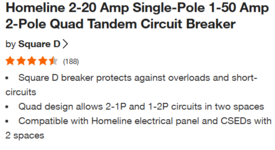
That's a quad tandem breaker.
It's electrically equivalent to a 2 pole 50A breaker and two 1 pole 20A breakers. That combination would occupy 4 spaces. This gets it done in 2 spaces.

Might be worth looking inside this panel. Unless you already know what is on those 20A breakers. They might be unrelated to the hot tub cable.

1754564423031.png
 
OP
E

endangeredspecies

Well-known member
Joined
Apr 11, 2022
Messages
264
Location
SF Bay Area
The 2 20A are unrelated to the hot tub. They send dedicated power to the music room for my audio system.

The Neutral and Ground wires they hooked up on the 50A lines are 10AWG; the hot lines are only 8 gauge. They run about 30ft along the side of the house in exterior, surface-mount, metal conduit before coming out into that loop.

They might technically be long enough to run through the attic to the other side of the house - I think it would be close. But they aren’t large enough to do so, safely, carrying 50A for EV charging. So it looks like I’ll need an electrician regardless.
 

mm08822

Well-known member
Joined
Jan 13, 2012
Messages
5,839
Location
NJ
The 2 20A are unrelated to the hot tub. They send dedicated power to the music room for my audio system.

The Neutral and Ground wires they hooked up on the 50A lines are 10AWG; the hot lines are only 8 gauge. They run about 30ft along the side of the house in exterior, surface-mount, metal conduit before coming out into that loop.

They might technically be long enough to run through the attic to the other side of the house - I think it would be close. But they aren’t large enough to do so, safely, carrying 50A for EV charging. So it looks like I’ll need an electrician regardless.
They are probably #8 THHN/THWN which are good for 50 Amps. That is good for the L14-50 feeding the RV.

However, a 50 amp EV load is consider continuous. At 48 amps, it would require a 60A cb and #6 copper. An EV load of 40A would work with the 50 A cb, #8 copper and L14-50R (get the EV rated one). EVs that use a L14-50R probably are only charging at 40A....read the fine print.

There is still the issue of needing a GFCI to protect the recept vs. incompatible with the EV. That can be managed too.

Edit: corrected from the derating value to the 75C value required for most terminations.
 
Last edited:
OP
E

endangeredspecies

Well-known member
Joined
Apr 11, 2022
Messages
264
Location
SF Bay Area
They are probably #8 THHN/THHW which are good for 55Amps. That is good for the L14-50 feeding the RV.

However, a 50 amp EV load is consider continuous. At 48 amps, it would require a 60A cb and #6 copper. An EV load of 40A would work with the 50 A cb, #8 copper and L14-50R (get the EV rated one). EVs that use a L14-50R probably are only charging at 40A....read the fine print.

There is still the issue of needing a GFCI to protect the recept vs. incompatible with the EV. That can be managed too.
They are THHN/THWN.


As stated, probably adequate for hot tub or RV; likely inadequate for Level2 EV charging.
But running new wires to the right location will be a lot more reasonable than upgrading service and adding a new breaker.

There’s still the matter of GFCI. I would imagine a hot tub circuit needed protection, as well.
 

mm08822

Well-known member
Joined
Jan 13, 2012
Messages
5,839
Location
NJ
They are THHN/THWN.


As stated, probably adequate for hot tub or RV; likely inadequate for Level2 EV charging.
But running new wires to the right location will be a lot more reasonable than upgrading service and adding a new breaker.

There’s still the matter of GFCI. I would imagine a hot tub circuit needed protection, as well.
Level 2 comes in many amperages. You can't go past 40a with existing wiring. If you really think you need greater than 40a, then you need to pull larger wire.

What size is the conduit existing wires are in?
 

dcg9381

Well-known member
Joined
Jun 20, 2018
Messages
11,627
Location
Austin, TX
Before calling an electrician, I'm trying to ascertain whether pulling that 240V/50A line to a (Hubbel EV) 14-50 receptacle on the right front home exterior to serve our friends and guests is a worthwhile and practical endeavor, without getting too costly and ridiculous. Would that single outlet power both EV's and most modern RV's/trailers (not at the same time)? Could wires be run through the attic to a receptacle, or would it need to go through the sub-panel first?
A 14-50R on a 50A circuit is about 9.6kW continuous (40A). That's enough to run 2 x 5th wheels with 2 ACs each.
I have a bunch of RV / EV outlets (14-50R). I've probably installed 10 of them total.

These will work for Level 2 chargers, yes. It's the standard outlet type for plug-in level 2 EV charges (EVSEs).

They will not work for a Level 2 charger and a "50A RV" in most cases unless the EV can control it's charge rate even if you put a Y splitter in cord in there. Many of them you can "set the charge rate" via the car. If the EV can lower it's charge rate to 20-25A, you'll be fine..

You can run 6ga "romex" through the walls just like other power wires...

I would highly recommend an "EV rated" 14-50R. They cost a little more, but worth it. RV cords are notorious for being crappy, having loose ends, and causing heat.

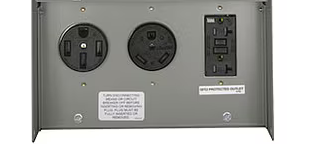
I like installing Siemen's Talon exterior sub-panels. They have a 14-50R (not EV rated), a TT-30R (standard 30a RV), and a GFCI 120V outlet on them for around $240. I would feed it with 60A rated copper minimum.

1754581769321.png
 
OP
E

endangeredspecies

Well-known member
Joined
Apr 11, 2022
Messages
264
Location
SF Bay Area
Level 2 comes in many amperages. You can't go past 40a with existing wiring. If you really think you need greater than 40a, then you need to pull larger wire.

What size is the conduit existing wires are in?
Existing conduit looks like 1". But it wouldn't be used if I re-route power to the other side of the house for vehicle power.
40A continuous would be plenty for my use case. I guess I'd just have users select 40A or less charge current. Which doesn't look like a problem. It seems most contemporary EVs max out at 32A or (occasionally) 40A from a 14-50 connection; need a dedicated charger to pull the 48A option.
Perhaps it's doable after all. I see "Spa Panels" with GFCI at the panel. Talon RV panel is available with it. But EV usage wants it at the breaker.

Using the existing 8ga THHN/THWN wires, what if I were to install a GFCI -protected Siemens Talon sub-panel - running a Hubbell EV-Rated 14-50R receptacle. Would that suffice for when folks come for a visit and need to charge their EV for a few hours to get back home, OR run their RV A/C during the day? Not simultaneously. And only 1 fifth-wheel at a time.
Or is that a terrible idea, and I need to get a proper 50A GFCI breaker, 60ft of 6ga, RV sub-panel, and EV receptacle?

I'm not sure about maintaining both 20A circuits as well as the 4-wire (okay, 3 + ground) 240V if I go to 2 separate breakers in that location.
 
Last edited:

mike93lx

ALLIANCE MEMBER
Joined
Dec 9, 2013
Messages
37,334
Location
Richmond, VA
It looks like a 50A Square-D GFCI breaker and a GFCI Spa Panel have about the same materials cost. Spa panel would be easier for me to wire up. I'm not sure about maintaining both 20A circuits as well as the 4-wire (okay, 3 + ground) 240V if I go to 2 separate breakers in that location
The spa panel doesn't protect the 240v 50a plug, just the 120v 20a receptacle
 
To avoid these ads, REGISTER NOW!
OP
E

endangeredspecies

Well-known member
Joined
Apr 11, 2022
Messages
264
Location
SF Bay Area
The spa panel doesn't protect the 240v 50a plug, just the 120v 20a receptacle
Do you know if that's true on the Talon RV Panel, as well?
I see the 120V 20A receptacle has built-in GFCI. So is the separate breaker for the high-current connections?
Or are those just breakers, with no current-interrupt for the 30A and 50?
 
OP
E

endangeredspecies

Well-known member
Joined
Apr 11, 2022
Messages
264
Location
SF Bay Area
Sorry to be a pain. I'm a mechanical engineer. I know just enough about electrical circuis to get myself into trouble!
(I've wired up mobile audio, replaced tons of outlets, replaced a couple flourescent tube ballasts, done a few ceiling fans, upgraded one pool light to LED, and replaced a couple breakers with like-for-like units. But I leave big changes and high-power wiring to the pros.)

You guys have been great, provided much help, and advanced my knowledge quite a bit.
Thanks all.
 

mm08822

Well-known member
Joined
Jan 13, 2012
Messages
5,839
Location
NJ
Do you know if that's true on the Talon RV Panel, as well?
I see the 120V 20A receptacle has built-in GFCI. So is the separate breaker for the high-current connections?
Or are those just breakers, with no current-interrupt for the 30A and 50?
The Talon panel has 3 recepts and each has a dedicated cb within that panel.
As sold, only the 20A, 120vac recept has gfci protection....it's a gfci recept.
You could change out the 2p 50a cb in the Talon panel to a 2p 50a gfci rated cb for the rv.
The TT-30 recept is not gcfi protected. You could remove it/blank off the hole or add a 1p 30a gfci cb. You could even change it out to add another L14-50R w/correct cb.

There is still room for 4 additional cbs in that panel. Just need to be mindful of it only having a 50a feed when considering simultaneous usage.
 

dcg9381

Well-known member
Joined
Jun 20, 2018
Messages
11,627
Location
Austin, TX
Do you know if that's true on the Talon RV Panel, as well?
I see the 120V 20A receptacle has built-in GFCI. So is the separate breaker for the high-current connections?
Or are those just breakers, with no current-interrupt for the 30A and 50?
Here's a better photo and a link.

1754593608166.png

The panel comes with 3 breakers: 50A (240V), 30A (120V), 20A (120V). The 120V outlet is GFCI.. It's the only thing GFCI protected.

It has 4 additional slots for "future circuits".

All circuits are separate, however you could pop the "feed" circuit if you over draw. This panel itself would handle up to 120A feed. But I wire them all day long at 60A w 6ga copper.

If you want GFI protection on the 50A and 30A outlets, replace the breakers with GFCI versions. One word of caution from an RV owner - many modern RVs with inverter/battery systems don't work great on GFCI... The RV industry hasn't figured out how to get it right and RV pedestals with GFCI aren't common.

It seems most contemporary EVs max out at 32A or (occasionally) 40A from a 14-50 connection; need a dedicated charger to pull the 48A option.
Not entirely true. There are two limits in a typical level 2 charger installation: There is the limit that is built in or set on the charger (typically 40A or 48A continuous, based on how it's wired). Most EVs can handle charge rates above level 2, they "negotiate" with their charge source.. EVs don't care if it's level 2 or level 3, they negotiate it with the charger.

And some, like Telsa, you can set current rate, time of day, etc at the car within the limits of the level 2 charger. IF you go "above" the level 2 chargers limit on the car, it does not override the charger, it'll scale back to what's allowed by the charger (EVSE).

Using the existing 8ga THHN/THWN wires, what if I were to install a GFCI -protected Siemens Talon sub-panel - running a Hubbell EV-Rated 14-50R receptacle. Would that suffice for when folks come for a visit and need to charge their EV for a few hours to get back home, OR run their RV A/C during the day? Not simultaneously. And only 1 fifth-wheel at a time.
8ga THHN seems to be rated for 55A at 90C... So your wires are going to be 90C warm - I'm not a fan. That's why I use 6ga copper. But yes, that's allowed. (note, see the post below, you can't use this at 90C, someone corrected me)

It will suffice for EV Level 2 charging at 40A OR easily do a 5th wheel with 3 ACs, fridge, and a microwave.

It could do both, knock the RV down to 1 AC, limit the charge rate on the EV to 30A. Almost all RV owners carry "50A to 30A" adapters... So you've got all the outlets you need with this panel if the RV owner has that adapter and uses one AC.
 
Last edited:
OP
E

endangeredspecies

Well-known member
Joined
Apr 11, 2022
Messages
264
Location
SF Bay Area
Here's a better photo and a link.

1754593608166.png

The panel comes with 3 breakers: 50A (240V), 30A (120V), 20A (120V). The 120V outlet is GFCI.. It's the only thing GFCI protected.

It has 4 additional slots for "future circuits".

All circuits are separate, however you could pop the "feed" circuit if you over draw. This panel itself would handle up to 120A feed. But I wire them all day long at 60A w 6ga copper.

If you want GFI protection on the 50A and 30A outlets, replace the breakers with GFCI versions. One word of caution from an RV owner - many modern RVs with inverter/battery systems don't work great on GFCI... The RV industry hasn't figured out how to get it right and RV pedestals with GFCI aren't common.


Not entirely true. There are two limits in a typical level 2 charger installation: There is the limit that is built in or set on the charger (typically 40A or 48A continuous, based on how it's wired). Most EVs can handle charge rates above level 2, they "negotiate" with their charge source.. EVs don't care if it's level 2 or level 3, they negotiate it with the charger.

And some, like Telsa, you can set current rate, time of day, etc at the car within the limits of the level 2 charger. IF you go "above" the level 2 chargers limit on the car, it does not override the charger, it'll scale back to what's allowed by the charger (EVSE).


8ga THHN seems to be rated for 55A at 90C... So your wires are going to be 90C warm - I'm not a fan. That's why I use 6ga copper. But yes, that's allowed.

It will suffice for EV Level 2 charging at 40A OR easily do a 5th wheel with 3 ACs, fridge, and a microwave.

It could do both, knock the RV down to 1 AC, limit the charge rate on the EV to 30A. Almost all RV owners carry "50A to 30A" adapters... So you've got all the outlets you need with this panel if the RV owner has that adapter and uses one AC.
That sounds perfect. I mean, I don't like the 90C either, but we're talking a couple times per month, max. And if they're staying overnight, could bump the charge current down to 16A or so (through the vehicle controls.)

Thanks so much for the help!
 

Norcal

Well-known member
Joined
Mar 16, 2008
Messages
13,750
Here's a better photo and a link.

1754593608166.png

The panel comes with 3 breakers: 50A (240V), 30A (120V), 20A (120V). The 120V outlet is GFCI.. It's the only thing GFCI protected.

It has 4 additional slots for "future circuits".

All circuits are separate, however you could pop the "feed" circuit if you over draw. This panel itself would handle up to 120A feed. But I wire them all day long at 60A w 6ga copper.

If you want GFI protection on the 50A and 30A outlets, replace the breakers with GFCI versions. One word of caution from an RV owner - many modern RVs with inverter/battery systems don't work great on GFCI... The RV industry hasn't figured out how to get it right and RV pedestals with GFCI aren't common.


Not entirely true. There are two limits in a typical level 2 charger installation: There is the limit that is built in or set on the charger (typically 40A or 48A continuous, based on how it's wired). Most EVs can handle charge rates above level 2, they "negotiate" with their charge source.. EVs don't care if it's level 2 or level 3, they negotiate it with the charger.

And some, like Telsa, you can set current rate, time of day, etc at the car within the limits of the level 2 charger. IF you go "above" the level 2 chargers limit on the car, it does not override the charger, it'll scale back to what's allowed by the charger (EVSE).


8ga THHN seems to be rated for 55A at 90C... So your wires are going to be 90C warm - I'm not a fan. That's why I use 6ga copper. But yes, that's allowed.

It will suffice for EV Level 2 charging at 40A OR easily do a 5th wheel with 3 ACs, fridge, and a microwave.

It could do both, knock the RV down to 1 AC, limit the charge rate on the EV to 30A. Almost all RV owners carry "50A to 30A" adapters... So you've got all the outlets you need with this panel if the RV owner has that adapter and uses one AC.
You can't size circuits from the 90°C column as there is no equipment rated to handle conductors at the 90°C ampacity.
 

dave*99

Well-known member
Joined
May 5, 2009
Messages
4,246
Location
Coastal NJ
Thank you for the correction. Why do we even have that column then?
One use of the 90C column is in derating bundled conductors. If you fill a raceway or conduit with enough conductors to force derating their ampacity, you start with that column to calculate the derated allowable ampacity. There is a lot more detail for this..... I'm just giving an example where it can be used.
 

mm08822

Well-known member
Joined
Jan 13, 2012
Messages
5,839
Location
NJ
Thank you for the correction. Why do we even have that column then?
Another (rare) example is using the conductors at their stated 90C ampacity where they terminate in hardware rated for 90C, such as terminal blocks in separate junction boxes. From that tb, a larger size conductor is needed with the proper ampacity determined from the 60 or 75C insulation column. The hardware connected to these larger conductors has either a 60C rating or 60/75C rating. This hardware is typically a cb.

For all practical purposes, this would never be found in a residence. It's a situation where typically re-use of a conduit run is needed due to challenges in full upsized replacement. Think of old mills/infrastructures.
(You asked :p)
 

reader2580

Well-known member
Joined
Dec 31, 2014
Messages
14,514
Location
Minneapolis, MN
For my motorhome I installed a 40 amp circuit instead of a 50 amp circuit. I had lots of free 8 AWG wire so I installed a 40 amp breaker. I have never tripped the breaker, even with three A/C units, household fridge, and electric water heater running.
 

Milton Shaw

Well-known member
Joined
Feb 11, 2011
Messages
4,835
General Electric makes a Advantium microwave that requires a 30 amp 240 plug, but nothing in the microwave is actually 240 volt. Everything is hooked to 120, line one or two but, not to both. So it could work on two 30 amp circuits on the same phase. I understood that RV's were wired with nothing actually requiring 240 volts. I have not worked on RV's enough to actually determine how they are wired. Are the nameplate tags listed voltage as 240 or 120 for each load, such as A/C or heaters or water heaters. Some of this could apply to house boats and other RV equipment wired for "shore" power.
 
OP
E

endangeredspecies

Well-known member
Joined
Apr 11, 2022
Messages
264
Location
SF Bay Area
I have that Advantium!

From what I understand, RV’s require the 4-wire circuit at 240V/50A because they do, do, indeed, break it back down into 2 120V circuits. But I don’t have a solid grasp on How.

EVSE can run off 3-wire 240V, because they actually accept the 240V input.
 

dave*99

Well-known member
Joined
May 5, 2009
Messages
4,246
Location
Coastal NJ
I have that Advantium!

From what I understand, RV’s require the 4-wire circuit at 240V/50A because they do, do, indeed, break it back down into 2 120V circuits. But I don’t have a solid grasp on How.

EVSE can run off 3-wire 240V, because they actually accept the 240V input.

Perhaps this will help. Note that this particular RV does not have any 240 appliances.

1757503805984.png
 
Last edited:

ripperd

Well-known member
Joined
Jul 2, 2014
Messages
2,041
Location
Twin Cities, MN
There are some large RV's though that do have true 240 appliances. Some even have washer/dryers in them.

However yes, the vast majority just use the 2 legs of 120 as 120.
 

dcg9381

Well-known member
Joined
Jun 20, 2018
Messages
11,627
Location
Austin, TX
There are some large RV's though that do have true 240 appliances. Some even have washer/dryers in them.
Must be talking Prevost or something like that. Even the DRVs that I've seen with washer/dryer are all 120V appliances and ACs.
It's pretty "expected" with owning an RV that's mobile that you can't get 50A everywhere, so you get to make due "sometimes" with partial 120V @ 30A power.

So, short of having Willie's tour bus parked at your place, you'll probably be fine.
 
OP
E

endangeredspecies

Well-known member
Joined
Apr 11, 2022
Messages
264
Location
SF Bay Area
New breaker (shown above) and 65’ 8AWG THHN/THWN are in place since I got a new SquareD mains panel last year. But existing conduit is run the wrong direction (to back of house, with no RV access.) Hubbell 9450A 14-50R EVSE receptacle is in hand.
Think I could/should get a Handyman to run conduit in attic and along garage wall, pull wires, and install Siemens Talon temporary/RV sub-panel?
Or is that still a job for a licensed electrician?
 

ddurrett896

Well-known member
Joined
Mar 29, 2015
Messages
994
Location
VA
Think I could/should get a Handyman to run conduit in attic and along garage wall, pull wires, and install Siemens Talon temporary/RV sub-panel?
Or is that still a job for a licensed electrician?
I'd use romex thru the house, then transition in a junction box to THHN/THWN or whatever wire you plan on using outside.
 

u3b3rg33k

Well-known member
Joined
Dec 18, 2017
Messages
4,047
I have that Advantium!

From what I understand, RV’s require the 4-wire circuit at 240V/50A because they do, do, indeed, break it back down into 2 120V circuits. But I don’t have a solid grasp on How.

EVSE can run off 3-wire 240V, because they actually accept the 240V input.
I'd suggest looking at it from a different perspective. you're SUPPLYING two hots and a neutral with a 4 wire 14-50. the APPLIANCE is what determines if it's a 120 or 240v load, not the wiring. you wire it up to match its needs. most RVs use the 50A plug because it's a relatively elegant way to do in one plug & panel what would take two separate TT-30s to do.

also I haven't seen it mentioned in here but you can also put in a smaller EVSE. a 30A (24A continuous, 5.7kW) circuit still provides 45kWh in an 8 hour overnight, more than enough for most use cases. I don't know how much fudge factor there is in home RV pedestal load calcs.
 

75gmck25

Well-known member
Joined
Jul 21, 2014
Messages
1,313
Location
Alexandria, VA
For my 240 volt EV circuit I ran 6/3 copper from the panel to a junction box on the outside of the house, then used conduit for the EV wiring box down to the exterior junction box (wiring whip with two hots and a ground was provided with the charger) . Since I only needed two hots and a ground for the EV charger, I just capped the extra wire with wire nuts at the panel and junction box. This gives me the option to convert it later to a 4 wire receptacle if its needed.

I chose a hard-wired EV charger because the GFCI was built-in and I didn't have to worry about whether the EV would work with a GFCI breaker (required because the receptacle would have been outside). I also considered installing an RV panel box (120 and 240) and then plugging in the EV charger. However, EV chargers have very short plug-in cords coming out of the bottom (usually about a foot) and exterior RV boxes require the cords to come up from the bottom so it's shielded from rain. My wife also wanted it to look unobtrusive, and weatherproof RV boxes are kind of chunky.

Whether you need a licensed electrician will depend on your AHJ and permit requirements. If it's my own house I can run a circuit like that myself and pay a reasonable permit fee. You could probably have a handyman helper do most of the work in the attic under your supervision, and then you would be there when it's inspected. You just need to be prepared to answer any questions. If you don't have confidence in your understanding of the safety requirements and code, hire an electrician.
 
To avoid these ads, REGISTER NOW!
Top Bottom