To avoid these ads, REGISTER NOW!

Saylor Beall 705 Compressor - last one I'll ever need!

mattblast

Well-known member
Joined
Jan 30, 2013
Messages
784
Location
Bridgewater, NJ
This is the biggest, heaviest, highest CFM compressor I ever had and this one should have no problems keeping up with my blast cabinet. My blast cabinet has been sitting idle in the garage for the last two years while I finally found a compressor that can handle the load.

I've been looking for a heavy duty compressor at a reasonable price for a while now. Found it on Craigslist in a one man cabinet shop. The listing was actually for his paint booth, but in the photos I spotted the compressor and immediately gave him a call. After a week I didn't hear from him and tried again, but got his voicemail and hung up. He called me right back and said he was asking $500. I didn't hesitate to say I would take it, and told him I could be there later that morning. It was used only for a small brad nailer, and a paint booth. Not a very high demand.
1.jpg

My son came with me and we drove about an hour to see it. It was the quietest compressor I ever heard. We had no problem taking in a normal voice a few feet away while the pump ran. The only problem was that it was powered by a 3 phase 5 HP Baldor motor. The seller helped me walk it the 80ft to the bay door of his shop and we tilted it into my pickup.

2.jpg

I had no idea at the time that this unit weighs 632 lbs! I asked my son to back up (he is 14) and the seller and I slowly tipped it into the bed. It tilted over a small amount, then we couldn't handle it anymore and it fell the last foot (flywheel down) into the bed. If it was a few inches over, it would have slammed into the concrete floor and that would be the end of the story. Fortunately, it didn't and we breathed a sigh of relief and pushed it towards the front of the bed and strapped it in.

Made it home no problem, but with the issue loading I decided there is no way I am going to attempt to unload with anything less than 3 strong men. Called some local movers, but none wanted anything to do with it, so I found a handyman with a friend on craigslist that helped me in the past and asked him to meet me at lunch a few day later. When I got home from work him and his friend were already at my house and had pulled off the tarp. I guess I didn't warn them about the compressor and they had attempted to remove it themselves. Did I mention they were a bit scrawny?

The compressor was out of the truck and on the pavement, on its side! They claimed it was lowered gently, but the aftercooler was bent about 6in up. With some direction, we managed to tilt it back up and get it in position in my garage. I kicked myself for letting them do this, but thankfully the only damage was the aftercooler tube, and some scuffed paint in the back that no one will ever see.

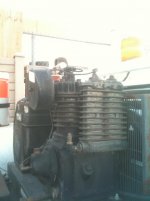
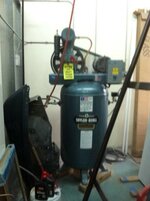
Here it is in my garage. This thing is huge. I have to get up a ladder to service the valves!


3.jpg

4.jpg

I had to get back to work from my lunch break, but I couldn't leave without trying to get the kink out of the aftercooler. It took about 8 iterations of heating to anneal, and forming to get the kink out. You can hardly see it now, but there is still a bend to the tube that didn't exist originally.

6.jpg

5.jpg

I'm OK with it now (after a week of not believing what idiots the guys I hired were).

After the labor left, I found a photo from the night before showing the compressor in my truck and the aftercooler perfectly shaped.

7.jpg

Next - remove and clean the valves

(updated 2/2/2025 with embedded photos - no more broken Photobucket links...)
 
Last edited:
To avoid these ads, REGISTER NOW!

frankush

Well-known member
Joined
Oct 23, 2011
Messages
1,156
Location
IL
You stole it! They are supposed to be the Cadillac of compressors. I'm surprised how clean it is.
 
OP
M

mattblast

Well-known member
Joined
Jan 30, 2013
Messages
784
Location
Bridgewater, NJ
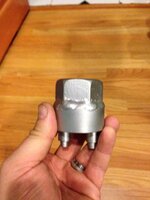
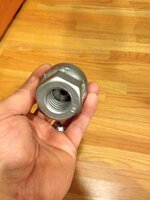
The valves are held in with retainers with two holes in them that require a special ($100) tool to remove. I found a thread on another forum and the poster made his own custom tool to do the job. The tool was a bit crude, but worked perfectly. I contacted him and asked if he would be interested is making me one. He was! And he had some ideas of how to improve the design to make it more compact, and easier to torque.

Here is is under construction

2a.jpg

And with a 1 5/8in nut welded to the top

2b.jpg

This tool is impressive. I saw photos of the OEM tool, and this one is certainly heavier duty (and better made).

2c.jpg

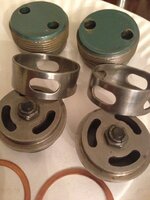
This compressor has 5 valves (2 LP intake, 1 LP exhaust, 1 HP intake and 1 HP exhaust). The first valve I removed was the HP exhaust - it was rusted shut and took some persuasion to loosen every last turn. The other values came out easily. Once out I degreased them, and used a wire wheel to remove any surface rust, then a 3m pad to buff them and make them shine. For good measure I removed any manufacturing burs with a file.

2d.jpg

each of the valves (other than the two LP intake) are different in configuration, so I put them on paper plates with indicators of which one was which. Glad my wife doesn't touch parts I leave on the kitchen counter, though she was happy to have them moved later that night to the dining room table.

After cleaning:
2e.jpg

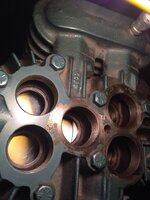
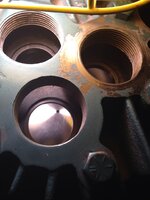
They cleaned up nicely, but the compressor head needed to be cleaned up a bit to remove rust in the threads and clear some debris that got into the intake (sawdust from dirty filter)

2f.jpg

2g.jpg

I cleaned up the internal threads with an old metal brush to clean copper fittings, and used several paper towels pushed into the cylinder openings to clear out the sawdust that accumulated from the previous owner.

The valves are sealed at the bottom with copper crush washers, 1.62in OD x 1.368in ID x 0.017in thick. They are one time use and the manufacturer recommend inspecting valves quarterly, so I'll have to find a source to order a bunch. OEM washer is about $4 each.

Until now, it appeared that the compressor was never serviced, but once inside the valves I could see signs of prior service. The valves had been rebuilt in the past, and whoever did the job forgot to put the copper crush washers on the valve cover (used on the back 3 valves). So I'll have to order those too (0.52in x 0.32in x 0.017in)

Next - Gaskets
 
Last edited:
OP
M

mattblast

Well-known member
Joined
Jan 30, 2013
Messages
784
Location
Bridgewater, NJ
This is my third compressor I needed to rebuild. The first was was a 1920s Quincy that no longer had parts available, so I found a company based in Thailand that could custom make me gaskets and valve plates for it. They turned out great, and for my next rebuild - a dual head IR I used him as well. The IR did have parts available, but the OEM parts were 15x more expensive than the custom made ones, and that is after shipping!

Here are some photos of the old compressor and the gaskets I got - http://gasketstogoblog.com/2009/12/20/air-compressor-gaskets/

So for the Saylor Beall, I figured I would go the same route. The first step was to figure out the layout of the gaskets. The cover gasket got ripped to pieces upon removal of the cover, so I had the use the actual cover as a template.

Once I got the cover off, I cleaned out the inside of the pump with about a dozen paper towels to clean out the gunk that didn't drain with the oil, then I degreased the part to prepare it for the next step.

With the other compressors, I found the best technique was to place the part on a scanner and then trace over the image with a CAD software to get an accurate placement. My scanner isn't working, so I tried the copier at work. After 15 minutes of cleanup I discovered the scanner wasn't calibrated and that the image was slightly distorted. I needed to use a higher quality scanner so I brought the part to Staples and had them scan it. They have to scan it with the cover up, so I highlighted the edges in white-out to improve the contrast.

3a.jpg

It came out well. To make sure the results were good, I had them mirror it and print it, then laid the cover over it and the holes lined up perfectly! Total damage - $0.52 (including two copies!). The woman at Staples didn't give me a second look when I asked her to scan the part. I was half expecting them to refuse to put a heavy part on their expensive copier.

After tracing and cleanup, here is what I got. I made the gasket work even if it is installed upside down by tweaking the position of the holes and enlarging them slightly.

3b.jpg

(the circle gasket is the valve cover for the top of the three back valves).

The valves get hot, so I specified material that can withstand 375deg. The cover doesn't need to have that level of material. The quote came in at $4.95 for the cover gasket and $0.95 for the valve cover gasket. I'm still waiting on a quote for the crush washers.

The valve gaskets are going to be cut from Interface Solutions NI-2085 which is rated for high temp, and comes in 0.8mm thickness. (specs at http://i855.photobucket.com/albums/ab112/mattscher/NI-2085_zpsc6f59cd9.jpg)

For comparison, the OEM parts are available from the local distributor for $13 for the side gasket and $4 for the valve cover gasket. That is a nice savings, considering I need to order a few sets. I won't be doing quarterly inspections, but figure I'll open the cover and valves up at least yearly.

Next - Electrical
 
Last edited:
OP
M

mattblast

Well-known member
Joined
Jan 30, 2013
Messages
784
Location
Bridgewater, NJ
The last remaining obstacle for the compressor is getting a single phase 5HP motor and wiring up the starter.

I put a call into Saylor Beall and spoke to Jerry who was very knowledgeable on technical aspects of the compressor. He recommended a Baldor L1430L motor but cross-referencing found that I could also use a Leeson 131537 or a Marathon I114.

Motor Specs:
184T Frame
5HP
1750RPM
OPSB enclosure

The local shops wanted $450 for the Marathon and even more for the Baldor. I have had good success with Baldor motors and wanted to keep to that brand. I found a company in MA that sells "surplus" units on ebay for about $325, or new ones for about $375. The surplus ones are new units taken off of air compressors and repackaged for shipment. I happen to be traveling to MA in the next few weeks so I'll give them a call and see if I can save on shipping. I would like to keep the cost to $300 total for the motor.

I did get an offer to buy the old motor for "scrap and a half" (which comes to about $0.30/lb), but for $20, I'd rather just hold on to it. Once I get the unit running I may throw it up on craigslist and see if anyone can use it.

Here is the original motor - 3 phase Baldor. Looks to be in great shape. It ran quietly and is from 2004, same as the compressor.

4a.jpg

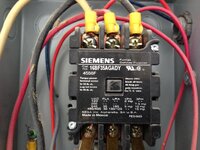
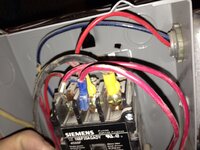
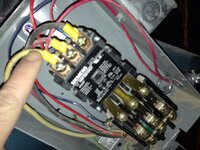
And the starter - Definite Purpose Siemens Furnas.

4b.jpg

4c.jpg

4e.jpg

4f.jpg

4g.jpg

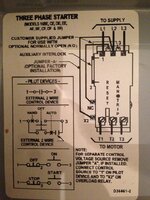
From what I can gather, this is a class 16 30 amp 3 pole 240v coil magnetic starter. I never had to use a starter on any of my equipment so I've been reading up on forums and even got a library book on industrial wiring and control systems. The book wasn't so helpful, but I did learn a lot on the forums.

The Baldor has a FLA of 20.6 amps, which translates to an E62 heater for this starter.

I would like to use the existing starter for the new motor and just buy a new heater. Only a single heater is needed for a single phase motor. That will cost about $20 vs about $120 for a new starter. My goal is to keep the total cost of the compressor and rebuild below $1000, so every bit of savings will help.

I'm left with a few questions:
1. Any good sources for E62 heaters? I never had to buy one before and don't know if it is OK to buy these off ebay, or should I find a local shop that has factory new ones? Do heaters wear out?

2. To wire this starter for the new motor (single phase), do I need to buy any new parts, or do I simply put the second hot on T2 before the heater?

3. Would it be easier to buy a single phase starter on ebay and just wire it up? I did some searches and there are so many types and brands that I gave up.
 
Last edited:
OP
M

mattblast

Well-known member
Joined
Jan 30, 2013
Messages
784
Location
Bridgewater, NJ
The starter was connected as follows:
Power in (3 phase) - L1 L2 L3
Power out to motor (3 phase) T1 T2 T3
Pressure Switch L1 and 3 (which is directly behind L3)
On/Off switch on side: NC and unmarked connection behind L1
Jumper L2 and X2

I did find a nicely drawn diagram to hook up a single phase motor to a 3 phase starter here, but it doesn't exactly match my starter:

2009-03-02_032540_Compressor_pressure_switch_wiring.JPG
 
Last edited:
Trey T

Well-known member
Joined
Aug 3, 2011
Messages
3,749
Location
Houston, TX
Looks like a brand new compressor. I'm working on my SB-705, too. Mine has a lot of mileage on it. Made my own tool and took off the head and put the head on a vise to take off those disc valves.

Anybody know where I can purchase the unloader tower that look like the last picture? Is the tower features similar to quincy qr-25 series for loadless start up?
 

Attachments

  • IMG_0113.jpg
    IMG_0113.jpg
    139.8 KB · Views: 197
  • IMG_0111.jpg
    IMG_0111.jpg
    143 KB · Views: 199
  • IMG_0121.jpg
    IMG_0121.jpg
    144 KB · Views: 187
  • IMG_0110.jpg
    IMG_0110.jpg
    137.1 KB · Views: 225
OP
M

mattblast

Well-known member
Joined
Jan 30, 2013
Messages
784
Location
Bridgewater, NJ
The compressor holds 4 pts of oil. The PO did change the oil occasionally, but told me it was due for a change. I wasted no time getting the oil out. First I had to find a way to do this without waiting for each drip to drain. Pulled two 1 liter bottles from recycling and duct taped one to the tank with a funnel in the top.

5a.jpg

By the time the first liter was full, it was draining slow enough to make it easy to switch to the next bottle. It didn't appear that he oil was too dirty, but close inspection with a light showed that the oil was due for a change.

5b.jpg

I picked up 4 16-oz bottles of compressor oil at Home Depot to replace it.

Also ordered L6-30 output and plug from Amazon to wire up the garage with a 10/2 30amp 220 line. The ceiling in that part of the garage is down (due to a washing machine overflow which wet all the insulation and drywall a few months ago). I've been too distracted to completely install the new insulation, which makes it easier to wire the new circuit. Then it dawned on me that there is a 220 line for a electric dryer hookup we don't use. Took a look and found it is a 10/3 line already on a 30a breaker. Perfect! I pulled the wire down to the garage ceiling and routed it to the side wall. The length was perfect - just enough so it is the right height off the ceiling. Later this week I'll head back to Home Depot to pick up a square box to attach to the wall and complete the circuit.

5c.jpg

Running total of costs
$500 compressor
$100 labor to unload it
$47 valve tool and adapter to attach to ratchet
$10 compressor oil
$25 L6-30P and L6-30R outlet and plug
$0.52 Side cover scan for gasket template

Upcoming expenses
$300? Baldor L1430T motor
$20? E62 heater
$10? air filter
$10? square box and cover plate for electrical
$50? gaskets and copper crush washers
 
Last edited:

frankush

Well-known member
Joined
Oct 23, 2011
Messages
1,156
Location
IL
As far as the heaters go, find a local electrical supply house that stocks Siemens controls. If you can find NOS on Ebay, I wouldn't be afraid to go that route either. Common practice is to go one size up from what you need. If you don't install a second heater, you'll need to jumper across the two wiring terminals where it sits. Siemens may also make a premanufactured jumper for this, but that will be harder to find.
 
Last edited:

Smiliesafari

Well-known member
Joined
Dec 27, 2012
Messages
288
Location
Orlando, Florida
I also own a Saylor-Beall. It was used in a motorcycle shop for several years before I bought it. I've had it for almost 40 years. "Last one I'll ever own"....that's a true statement. Ironically, I paid $500 for mine. And it was a great deal back then.
 
OP
M

mattblast

Well-known member
Joined
Jan 30, 2013
Messages
784
Location
Bridgewater, NJ
Look at what I found at my door when I got home from work today

<a href="http://s855.beta.photobucket.com/us...33-5653-0000020979804857_zpsc3e387a0.jpg.html" target="_blank"><img src="http://i855.photobucket.com/albums/...246C433-5653-0000020979804857_zpsc3e387a0.jpg" border="0" alt=" photo 4AAB2228-FBD8-493A-BA89-9098A246C433-5653-0000020979804857_zpsc3e387a0.jpg"/></a>

I bought a new Baldor L1430T 5HP single phase 1750 RPM motor from a supplier on ebay. Lost it the first time by $5 at the last 8 seconds of the auction, but they had another one listed that was ending Sunday night. I put in a bid with 3 seconds to spare and got the motor for $344.95, shipping included. To simplify the wiring, I also picked up a new single phase starter from the same source.

When I took off the old motor I made sure to measure the belt tension so I could properly tension it with the new motor. I should have also made a measurement of the distance between the two sheaves - that would have simplified the process somewhat. What I didn't expect was how hard it is to tension a belt. I would have to apply 100s of pounds of force to the motor to get enough tension. There had to be an easier way. Shouldn't there be a tool for this? I called the local Auto Zone to see if they had one for sale or loan. Nope - belts on new cars are auto-tensioning. I did find a tool that looks perfect for this "Belt Tension Jack" at MSC

3543820-24.jpg

It was going to be too hard to wait, so I decided to build one myself. My inspiration was a post on Garage Journal a few years ago http://www.garagejournal.com/forum/showthread.php?t=51872

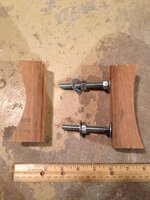
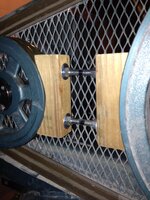
The construction looked to be simple, and it was after a few tries. First step was to use a cereal box behind the pulley to trace the curvature. Then I taped that to a 2x4 and cut out the pattern. The first trick is to trim the tracing so that the curve is 5in from end to end. I then placed the trace on the 2x4 1.25in from the bottom, so that the thinnest part of the tool would be 1.25in. I rotated the pattern so that the ends of the trace were the same distance from the edge of the 2x4. This was the step I didn't do the first time and ended up with a set of asymmetrical pieces.
6a.jpg

Once cut, I mounted each piece in a vice and used a rasp to even out the edge for a better fit. Then drilled 3/8 hole 1in from each edge. It is important to widen the hole so that the 3/8 rod isn't snug.

I "dry fit" the pieces to see what the maximum rod length would be. For my compressor it was 4.5in before the rod hit the pulley. Cut two equal pieces from a 12in rod and ground down the ends, the fit it with some washer and nuts.

6b.jpg

I set the nuts so that they were as close together as possible without bottoming out on the pulley and then held the tool in place while I snugged up the nuts. Then with a few turns on each side I measured the tension until it was right. I marked the center of the rod with a sharpie so I would apply tighten both ends evenly.

I don't have a tension gauge, so I bought one from Amazon that looked good enough for my needs (Gates Rubber Company 91107 Krikit belt Tension Tester). The directions made no sense, but there was a video on youtube that made it look easy. Gave it a few tries, but always got a different reading. And the design of the tool makes it very inaccurate for tensions below 100lbs.

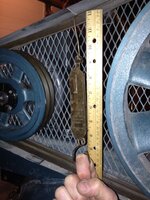
So I built my own tension gauge using a 25lb fish scale. Before removing the old motor, I picked a spot on the belt that was exactly 12in from top to bottom. Then I measured how far the belt moved when I maxed out the scale (25lbs). The belt moved 1/2in. I applied more pressure on the spreader until I got the same measurement. (it is much easier to do this with two hands)

6c.jpg

The I tightened the motor bolts and removed the tensioner. When I re-measured the tension to confirm, it was down down 25%, so I loosened the bolts securing the motor and tensioned it 25% higher than I wanted. Re-measure and it is exactly where it needs to be.

6d.jpg


Running total of costs
$500 compressor
$344.95 motor
$113.89 starter
$100 labor to unload it
$47 valve tool and adapter to attach to ratchet
$25 L6-30P and L6-30R outlet and plug
$10 compressor oil
$2.50 threaded rods, nuts and washer to make tensioning tool
$0.52 Side cover scan for gasket template

Upcoming expenses
$10? air filter
$10? square box and cover plate for electrical
$50? gaskets and copper crush washers
 
Last edited:
firebox40dash5

Well-known member
Joined
Mar 19, 2012
Messages
4,185
Shoulda kept the old starter box. Too easy, you just hook each hot leg into a heater, and each motor leg out of the contactor... same as 3PH, but only 2 wires. That's all we did on our 5hp shop compressor, works like a champ. At least your starter box has some headroom, mine is maxed out with the 25A motor we're using, and I think those highest-rated heaters were only rated for 24.8A or something.
 
OP
M

mattblast

Well-known member
Joined
Jan 30, 2013
Messages
784
Location
Bridgewater, NJ
Have you considered annealing the old washers?

That's a good idea. I was waiting on a quote to custom make a new set and never considered annealing the old ones. There are a few smaller copper washers missing which I'll still need to order, and I'll probably order a few of the larger ones for the future.

Shoulda kept the old starter box. Too easy, you just hook each hot leg into a heater, and each motor leg out of the contactor... same as 3PH, but only 2 wires. That's all we did on our 5hp shop compressor, works like a champ. At least your starter box has some headroom, mine is maxed out with the 25A motor we're using, and I think those highest-rated heaters were only rated for 24.8A or something.

I was debating this for about a week. The wiring to use the old starter was complex, plus I would need to buy 2 heaters. The new starter with heater properly sized wasn't much more than the purchase price of two new heaters. And once I get everything hooked up I should be able to recover some of the added expense by selling the old motor and starter on ebay.

Can you send me a photo of the wiring you used to do this? I'm curious to see how it ended up.
 

Trey T

Well-known member
Joined
Aug 3, 2011
Messages
3,749
Location
Houston, TX
Kams1973: are the disc valves from SB-705 compatible with the clone ones?

MattBlast: If the answer is yes above, you should order a set from online air compressor part. I forgot the site but it's about 40bucks shipped which includes the springs, disc, and copper washers for all five disc valves.
 

Pumpman1968

Well-known member
Joined
Oct 21, 2012
Messages
1,520
Location
Upstate, NY
Ya know....this is EXACTLY why I read these threads. This guy is sharp. Did I say sharp? I meant SHARP! After being in the industry in one shape or another for 26 years, I've had my hands in a LOT of stuff. Still, probably the best thing experience has brought me is to watch/listen to the guys around you.......there are some very smart guys out there and there is ALWAYS something to learn!
 

cwlo

Well-known member
Joined
Jun 29, 2010
Messages
167
A nice find, and I'm sure you'll keep it in fine running shape for many years.

I did the exact same thing with a barely used 3ph 5 hp Champion that I picked up for $450, and carried in the back of my truck. Slightly bent the intercooler line, but not too bad. Used a chain hoist to lift out of my truck, but it took a while, as its so top heavy, and hard to safely maneuver. Next time, I would take the motor off ahead of time, as that would have reduced the weight a bit right where you need to. Anyway, bought the baldor from the same place as you, and re-used the starter as it has adjustable heaters. I also re-wired it, because the 3ph wiring is undersized for single phase.

Now my compressor was used for a couple months at most, and then left in a corner for a while. A non-profit that helps disabled people purchased it to inflate plastic bags for the happy meal toys, so that it is easier to insert the toy. Hmmm, gotta wonder how honest the compressor salesman was to recommend a big 5hp compressor. Anyway, just wanted to chime in that these deals are available if your willing to do a little work.

Chris
 
To avoid these ads, REGISTER NOW!

jonathan75

Well-known member
Joined
Mar 27, 2013
Messages
1,451
Location
NC
The valves are held in with retainers with two holes in them that require a special ($100) tool to remove. I found a thread on another forum and the poster made his own custom tool to do the job. The tool was a bit crude, but worked perfectly. I contacted him and asked if he would be interested is making me one. He was! And he had some ideas of how to improve the design to make it more compact, and easier to torque.

Here is is under construction

<a href="http://s855.beta.photobucket.com/user/mattscher/media/5FCF897A-866E-46F1-A387-B872B3ECB756-974-000000579BDCC189.jpg.html" target="_blank"><img src="http://i855.photobucket.com/albums/ab112/mattscher/5FCF897A-866E-46F1-A387-B872B3ECB756-974-000000579BDCC189.jpg" border="0" alt=" photo 5FCF897A-866E-46F1-A387-B872B3ECB756-974-000000579BDCC189.jpg"/></a>

And with a 1 5/8in nut welded to the top

<a href="http://s855.beta.photobucket.com/user/mattscher/media/B51B22B7-0A8A-41E5-9C5F-530988BBF92B-974-0000005795E6E433.jpg.html" target="_blank"><img src="http://i855.photobucket.com/albums/ab112/mattscher/B51B22B7-0A8A-41E5-9C5F-530988BBF92B-974-0000005795E6E433.jpg" border="0" alt=" photo B51B22B7-0A8A-41E5-9C5F-530988BBF92B-974-0000005795E6E433.jpg"/></a>

This tool is impressive. I saw photos of the OEM tool, and this one is certainly heavier duty (and better made).

<a href="http://s855.beta.photobucket.com/user/mattscher/media/1A83A723-BC68-487B-A226-1AF7B4D16CDC-974-000000579ECC1678.jpg.html" target="_blank"><img src="http://i855.photobucket.com/albums/ab112/mattscher/1A83A723-BC68-487B-A226-1AF7B4D16CDC-974-000000579ECC1678.jpg" border="0" alt=" photo 1A83A723-BC68-487B-A226-1AF7B4D16CDC-974-000000579ECC1678.jpg"/></a>

This compressor has 5 valves (2 LP intake, 1 LP exhaust, 1 HP intake and 1 HP exhaust). The first valve I removed was the HP exhaust - it was rusted shut and took some persuasion to loosen every last turn. The other values came out easily. Once out I degreased them, and used a wire wheel to remove any surface rust, then a 3m pad to buff them and make them shine. For good measure I removed any manufacturing burs with a file.

<a href="http://s855.beta.photobucket.com/user/mattscher/media/EBBF1183-11B3-43A7-AB55-8E21063D3E0A-974-00000052819AEBDE.jpg.html" target="_blank"><img src="http://i855.photobucket.com/albums/ab112/mattscher/EBBF1183-11B3-43A7-AB55-8E21063D3E0A-974-00000052819AEBDE.jpg" border="0" alt=" photo EBBF1183-11B3-43A7-AB55-8E21063D3E0A-974-00000052819AEBDE.jpg"/></a>

each of the valves (other than the two LP intake) are different in configuration, so I put them on paper plates with indicators of which one was which. Glad my wife doesn't touch parts I leave on the kitchen counter, though she was happy to have them moved later that night to the dining room table.

After cleaning:
<a href="http://s855.beta.photobucket.com/user/mattscher/media/C82F17AE-EAB9-4C92-A321-D270E6A4FE3C-974-00000052E8538B6E.jpg.html" target="_blank"><img src="http://i855.photobucket.com/albums/ab112/mattscher/C82F17AE-EAB9-4C92-A321-D270E6A4FE3C-974-00000052E8538B6E.jpg" border="0" alt=" photo C82F17AE-EAB9-4C92-A321-D270E6A4FE3C-974-00000052E8538B6E.jpg"/></a>

They cleaned up nicely, but the compressor head needed to be cleaned up a bit to remove rust in the threads and clear some debris that got into the intake (sawdust from dirty filter)

<a href="http://s855.beta.photobucket.com/user/mattscher/media/7C6CB048-C227-4F0C-80DD-2D8BDB068DD1-974-0000005455244DB7.jpg.html" target="_blank"><img src="http://i855.photobucket.com/albums/ab112/mattscher/7C6CB048-C227-4F0C-80DD-2D8BDB068DD1-974-0000005455244DB7.jpg" border="0" alt=" photo 7C6CB048-C227-4F0C-80DD-2D8BDB068DD1-974-0000005455244DB7.jpg"/></a>

<a href="http://s855.beta.photobucket.com/user/mattscher/media/88AF96CA-CDE3-410F-88B3-E54289A9BC88-974-0000005427D78CE9.jpg.html" target="_blank"><img src="http://i855.photobucket.com/albums/ab112/mattscher/88AF96CA-CDE3-410F-88B3-E54289A9BC88-974-0000005427D78CE9.jpg" border="0" alt=" photo 88AF96CA-CDE3-410F-88B3-E54289A9BC88-974-0000005427D78CE9.jpg"/></a>

I cleaned up the internal threads with an old metal brush to clean copper fittings, and used several paper towels pushed into the cylinder openings to clear out the sawdust that accumulated from the previous owner.

The valves are sealed at the bottom with copper crush washers, 1.62in OD x 1.368in ID x 0.017in thick. They are one time use and the manufacturer recommend inspecting valves quarterly, so I'll have to find a source to order a bunch. OEM washer is about $4 each.

Until now, it appeared that the compressor was never serviced, but once inside the valves I could see signs of prior service. The valves had been rebuilt in the past, and whoever did the job forgot to put the copper crush washers on the valve cover (used on the back 3 valves). So I'll have to order those too (0.52in x 0.32in x 0.017in)

Next - Gaskets

Could you help me get in contact with they guy that made you the valve tool? I need to rebuild my 707.

Thanks,
Jonathan
 

AntonyJ1214

Active member
Joined
Sep 8, 2014
Messages
33
Location
Hampton, VA
So I have a question for ya... I also have a 705 compressor and mine is not piped up the same as yours.... where does the copper line off the front of the compressor run to? Mine is piped to the after cooler and that doesnt seem right to me. It was plummed to a switch that had 2 ports on it before and the other port was connected to the line coming from the aftercooler.


this just doesnt seem right to me especially after seeing pictures of yours.
 

Trey T

Well-known member
Joined
Aug 3, 2011
Messages
3,749
Location
Houston, TX
To the right of the head. I believe 705 have 3/4" pipe thread. That copper pipe looks kinda small.
 

AntonyJ1214

Active member
Joined
Sep 8, 2014
Messages
33
Location
Hampton, VA
It's been running on it for however long the previous owner had it. If you are talking about the small line going from the front of the motor to the after cooler that's plastic, but if your talking about the fill line from the compressor to the tank that's a steel braided line.
 

woodzie

Member
Joined
Oct 14, 2014
Messages
9
This looks exactly the same as a webster 65 or whatever. alot more info online than the webster.

great write up, I was tying to see how to service the valves, thanks.
 
OP
M

mattblast

Well-known member
Joined
Jan 30, 2013
Messages
784
Location
Bridgewater, NJ
Wow. I just read through this thread. This was my first post on this site. It didn't seem so long ago.

Compressor is complete and has been running for 3 years now with no issues. I wrapped up the project soon after my last post and got busy with other projects. Had to look through the some paperwork to remember the details of the repair.

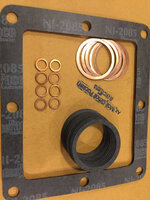
I had several gaskets and copper crush washers custom made. They were made in Thailand by gasketstogo.com for $32 which included international shipping and several spares for the next time I need to rebuild. Here are the spares which I kept in my Saylor-Beall folder.

ab2a76f7160fd576a811b2119091d69a.jpg

The inspection cover gasket was $4.95 each (vs $13 from local dealer), the valve cover gaskets were $0.95 each (vs $4) and the copper washers were $0.25 for 16 small ones and $0.50 for 8 large ones (vs $6.50 for set of 26 for small ones and $4 each for large ones).

The quote I got from a local dealer was another $18 for shipping and they were in the same state. The ones from gasketstogo.com were $32 total! They were very easy to work with and made my gaskets exactly to spec.

I was able to sell the old motor and starter on eBay to cover some of the expenses. Motor sold for $192 and starter for $48.

That comes to about $935 total spent for the compressor. I'm very happy with this as the new units I was looking at were twice that amount and this compressor has been flawless. I keep the tank pressurized and it holds pressure for months at a time without starting up again (garage is cold in the winter and I end up not using it for a few months at a time)

It fills up from empty in about 6 minutes to 175psi and while it does I can be standing 5 feet away having a conversation at normal volume. It's about the same volume as the garage door opener. It supplies enough air to keep my blast cabinet blasting without long pauses to wait for more air, though I'm in the process from converting from siphon blast to pressure blast to reduce air consumption and increase effectiveness.

I have three compressors in my garage right now - my Saylor-Beall plus a Quincy 325 which I just completed repairing and another 325 which is in progress to be done soon. I didn't need any new compressors but it was fun to rebuild mine so I've been on the lookout for bargain units to rebuild and sell. Amazing the Quincy 325 ended up costing me a lot less than the S-B even after cost of repair parts, and it is a higher end unit with pressure lubrication (vs splash) and an oil filter and a continuous run setting so that motor runs constantly and unloader opens and closes as more air is needed (to reduce motor startup current and wear and tear). I need to get rid of the Quincy soon since it is taking up a lot of floor space.

Though the Quincy is a higher end unit, I'm sticking to my Saylor-Beall. This is the compressor I intend to keep forever.

Matt
 

golferguy

Active member
Joined
Dec 4, 2015
Messages
35
Location
Mid state Ga.
Picked up this SB705 for 375 with it's 390 honda electric start but couldn't ever get the honda to start good so put 230v electric motor on it and a bigger tank. Here's a pic of it when I got it and a champion that needs a rebuild.
 

Attachments

  • new compressor 002.jpg
    new compressor 002.jpg
    147.7 KB · Views: 88
  • champion 001.jpg
    champion 001.jpg
    147.8 KB · Views: 91

pixel_revolt9

Member
Joined
May 20, 2016
Messages
14
Location
Powder Springs, GA
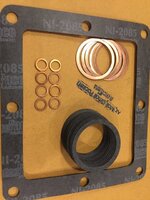
I had several gaskets and copper crush washers custom made. They were made in Thailand by gasketstogo.com for $32 which included international shipping and several spares for the next time I need to rebuild. Here are the spares which I kept in my Saylor-Beall folder.

ab2a76f7160fd576a811b2119091d69a.jpg

The inspection cover gasket was $4.95 each (vs $13 from local dealer), the valve cover gaskets were $0.95 each (vs $4) and the copper washers were $0.25 for 16 small ones and $0.50 for 8 large ones (vs $6.50 for set of 26 for small ones and $4 each for large ones).

The quote I got from a local dealer was another $18 for shipping and they were in the same state. The ones from gasketstogo.com were $32 total! They were very easy to work with and made my gaskets exactly to spec.


Matt

Hey Matt,

I am about to begin a rebuild on a Saylor-Beall 707 pump.
I was wondering if you could put me in contact with the guy who built your valve cover tool.
Also, if you would be willing to share the PO/details of the crush washers/gasket diagrams you designed so I could order from the same company out of Thailand.

Thanks for your time.
 

TheGreyGoose

Member
Joined
Jan 27, 2017
Messages
10
MattBlast, thank you sooo much for your 705 thread! Out of sheer luck I recently purchased an old 100gal tank and a Saylor-Beall 705 (1973 to 80 model). I got them both for just $100 but nothing is running nor hooked up so I have a lot of work to do on both the pump and old tank (and on first looks inside the tank looks great). I'm looking at buying the 705 tune up kit or major overhaul kit depending on how it all looks once taken apart. Since I don't know the abuse I figure I'm much better off doing a full rebuild but do not want to replace the valves unless absolutely necessary as that adds on at least another $200 on top of the $400 tune up kit. If you know where I can get the kits cheaper please let me know.

Perhaps most importantly I'd greatly appreciate any info on getting that same guy you used to make me a valve tool. Hopefully he'd be willing to make another one. I'll obviously pay for it but hope its better and cheaper than the factory tool. Please let me know ASAP, I'm very eager to get started as this, like yours, is for a home shop blast cabinet among other general uses. I'm a pilot and build flight simulators and also have a buddy who rebuilds a few old motorcycles every year so we are tackling this together. Thanks for any / all help you can provide.
 
Last edited:

bsaint

Well-known member
Joined
Apr 26, 2010
Messages
5,109
Location
Manchester, CT
Make sure you use a dryer if you're going to use that with a sand blast cabinet. Wet air will clog up your cabinet.
 

TheGreyGoose

Member
Joined
Jan 27, 2017
Messages
10
bsaint, I will surely do that. I've already watched several youtube vids on DIY air dryers with tall wall-mounted pipes to trap condensation. Seems to be a cheap but very effective way to go when made properly. I've been doing a ton of research over the last month on all aspects..pump, tank reconditioning, electrical and the blast cabinet which I plan to make 6.5ft wide with dual glove sets or three front panels which can be swapped out left, right, or center. I also weld (170amp wire feed / mig) and have a horizontal bandsaw (both Harbor Freight cheapo's) so I'm going to make something nice given my primitive tools and limited budget.

I think I've probably bookmarked over 30 threads on the SB-705 and various DIY blast cabinets. I really want to do everything right the first time so I've been cutting and pasting parts of many threads into a "DIY manual" that I'll provide a link to when done. Rebuilding an air compressor is totally new territory for me and it looks like there's a ton of work to do and so I'd rather have a A-Z punch list rather than having to constantly dig back through threads. This one is easily the best though for the 705. I'm really loving this whole internet thing lol.
 
OP
M

mattblast

Well-known member
Joined
Jan 30, 2013
Messages
784
Location
Bridgewater, NJ
MattBlast, thank you sooo much for your 705 thread!

This was actually my very first thread. I joined Garage Journal specifically to post about my new compressor and to document the rebuild. Glad to hear you found it useful. Before I did my rebuild I relied on posts here and elsewhere to learn about this model. One useful thread is Saylor Beall 745-80 rebuild The SB stands in the corner of my garage and has provided me practically unlimited air. I now run my blasts cabinet with a pressure pot and that consumes a lot less air (while blasting a lot more effectively). I never run out of air. You can see my pressure pot and cabinet in post #1 on my Baldor Rebuild Thread

I'm looking at buying the 705 tune up kit or major overhaul kit depending on how it all looks once taken apart.

I would recommend that you don't buy any parts until you have it apart and see what you need. So far I've been lucky to only need minor parts plus I needed to rebuild the valves (a couple hours of work). Take the valves out and clean them and see what condition they are in. They will likely need to be cleaned and polished and this will make a big difference in the efficiency of the pump.

Perhaps most importantly I'd greatly appreciate any info on getting that same guy you used to make me a valve tool

I sent him an email to see if he would be interested in making more valve tools. I'll let you know.


My next compressor rebuild was a Quincy 325 and I go into a lot of detail on hooking up the magnetic starter (see post #41), plus there are a lot of shared techniques you can see Quincy 325 craigslist find and repair

I'm in the process of rebuilding two more pumps right now - a SB 705 clone (just finished the valves, but need to buy a new valve seat for the HP exhaust) and a LeRoi Dressor 550 (a monster that can do up to something like 40CFM at 175PSI with a 10HP motor, but can also run off a 7.5HP or 5HP motor at a slower RPM). I did start a thread on the LeRoi Dresser and will update it as I progress.
 

TheGreyGoose

Member
Joined
Jan 27, 2017
Messages
10
My 705 pump is completely apart save for just two valves on the big piston / high pressure side. What an amazing PITA to get the first three out. I first built my own tool with some 3/16" x 1.25" steel bar at 24" long which I had as scrap on hand in my shop along with some 5/16" rod I pulled from some aircraft scrap I had as well. And Im really glad I had some as my local metal supply only stocks .5" and larger.

I was able (barely) to get the first three valves out using a Mapp gas torch and penetrating oil. I pretty much had to lean all of my body weight into the bar to get them to budge. I wound up bending both the bar and rods on the last valve but was able to at least get it halfway out, maybe up 1/4" off the heads top surface. The second or last valve is unfortunately the rectangle style! I have to assume this one was either a replacement at some point due to similar circumstances or maybe all 4 of the dual prong valves were replacements but I doubt it. Regardless, I will want to replace that one and likely the one I'm still working on as I boogered up the holes a little while wrecking tool number one.

So..on to tool number two! - I went to my local IMS (Industrial Metal Supply) which lucky for me is only 5 miles away and purchased a 1.25" x .5" x 36" piece of hefty flat bar as well a 1.25" x 3/8" x 12" piece for fashioning the rectangle valve key. I then cut two more 5/16" rods at 2.25" to insert and weld in the 1/2" thick bar so that 7/8" sticks out each side. I lucked out because the rod is just a few thousandths shy of 5/16 so I was able to use a 5/16" drill bit on my drill press and make pretty accurate holes which by my eye and using a good metal ruler are exactly 1-1/16" apart on center.

Using the 2.25" rods I carefully measured out the 1-1/16" with a metal scribe, 3" machinist square and spring punch to mark the drill points. After drilling I inserted the 5/16" rods with 7/8" of protrusion out each side so that I will have two potential tools, one rod set on each side of the bar. I then welded the **** out of them on both sides. I lathered on several layers of weld in a cone-like fashion so that only maybe 7/16" of each rod is left untouched to insert in the valve. After wrecking the first tool I figured this will probably help a lot to make sure the rods don't bend. And I specifically used the 7/8" clearance per side so that the tool can clear over the bolt heads as I have the pump head bolted onto a very heavy work table for torque resistance. With ~3/8" inserted in the valves that leaves 1/2" clearance Clarence!

On the other end of this hand made monster I welded on the 3/8" flat bar which I first cut down to 1-1/8" wide on my horizontal bandsaw and then test fit the piece in the rectangular value prior to welding. So that is now welded on one end of the 36" bar with the rods on the other end thus making 2 tools in total with one set on each end.

I finished it up tonight and will give it a heave-ho tomorrow. If this doesn't work I don't know what will as the tool probably weighs at least 20lbs and at 36" long it is going to be a foot more of leverage than the last tool plus its almost double in thickness. I'm really hoping this does the trick.

Lastly,..how do I add images on here? Do I need to upload elsewhere first and then point to the URL? I have taken maybe 50 pictures so far of the dismantling and tool building. I also talked to a sand-blast place this past week and they will blast the pump and tank as well powder coat both for $200 which seems very reasonable. I am however debating the powder coat because I was thinking of just spraying on green-gray Hammerite from Masterchem/Kilz via spray can. It's a hammered epoxy-paint with glass in it. I've used it alot, including on my old truck and various tools and I'm very happy with how it holds up. Would there be any bigger advantages to powder-coating aside from being able to do it all in hot pink or safety orange lol?

And as a P.S. - totally out of left field; the guy who is doing the sand-blasting just turned me on to another SB compressor for sale which is all complete and working for $350. It's at least 20 years old but looks just as good as the one Matt bought for $500. For $350 I think I'll grab it. Why not. If I've rebuilt one.. might as well do another lol. I don't know yet though if its a 703 or 705. I'm hoping for another 705 of course. For the one picture I was sent it could be either. I won't know till I check it out in person next week and I didn't want to say much to them about it and have them want more money if it is a 705. Even if it is a 703 and working I figure $350 is reasonable.
 
Last edited:

TheGreyGoose

Member
Joined
Jan 27, 2017
Messages
10
Ok ...well... I'm now on to examining how to craft up tool number 3. With the second tool iteration I quickly snapped off BOTH sections of my 5/16" rod on both sides of the tool. I literally sheared off one rod on each side. The 1/2" thick bar is definitely the right thing to use though as it was not flexing at all like the original 3/16" bar was. I was fortunately able to turn the valve another 3/4 turn before it just froze up again but it was unable to keep up the torque momentum because my table is in the way so its difficult to keep the turn / torque going in a full circle without stopping. And to even get it going I first reversed the bolt maybe 3/4" turn, then started un-threading again and boy is that sucker really in there! It's definitely half way out though so I've only got maybe 5/16" of thread left to unwind but man is this thing stuck. I used several squirts of penetrating oil first as well a good 10 minutes of heating evenly around the bolt with mapp gas. No dice.

I think what I will have to do now is cut off 3" from the end of my bar to get rid of the broken rod section and then re-do the end again but this time I'm going to use 3/8" rod and will also tap out the bolt holes to 3/8" as well also drill them deeper, maybe to 9/16" or even 3/4" if possible. I just don't see any other way at this point save for getting a 1.25" milling bit and just eat a giant hole through the entire thing. That will certainly be tool #4 as I won't keep attempting the initial methods after another go at this with my bar tool.

As for the rectangular keyed valve bolt, same story but worse. It hasn't even budged a millimeter yet and the tool steel just slips out of the key when trying to torque on it and both the slot and tool are getting rounded edges. My thoughts are if I can get two bolt replacements I will sacrifice the first one, drill all the way through it (hopefully after it comes out) and then use it as a drill template for the rectangular bolt and just drill two matching 3/8" holes in it as well and then use the same tool to remove it too. I just don't see any other way aside from having to fully drill them out in which case I will likely lose the two actual valves as well. Id like to avoid that of course.

So may last questions are A: should I try and have tool #3 made by someone else with a harder steel? Stainless? Titanium? I just have a 170amp Harbor Freight wire feed welder. It is mig capable but I don't have it set up as mig yet. Do I need mig or tig to weld stainless?

Secondly, once I get these out, and by god I will if I have to drill to china lol, is there any special high-heat grease like a graphite or teflon or something that can be used with these for future ease of maintenance? I would never want to have to do this twice...ever..ever..ever.

And lastly, am I going to be able to purchase new valve head bolts if I completely destroy these two because I'm thinking it's going to come to that, especially with drilling larger and deeper holes in both of them.

All advice is most appreciated!
 
Last edited:
OP
M

mattblast

Well-known member
Joined
Jan 30, 2013
Messages
784
Location
Bridgewater, NJ
Lastly,..how do I add images on here? Do I need to upload elsewhere first and then point to the URL? I have taken maybe 50 pictures so far of the dismantling and tool building.

You can post photos by clicking the "Go Advanced" button under the post then pressing the "Attachment" (paperclip) icon in the toolbar above where you type a reply. If you want to embed the photo you can to right click and copy the link, then press the "Insert Image" (yellow icon) and paste in the URL.

Or use a app such as tapatalk which automates this process.

Post up some photos - it will be much easier to see what is going on by seeing a photo.

I also talked to a sand-blast place this past week and they will blast the pump and tank as well powder coat both for $200 which seems very reasonable. I am however debating the powder coat because I was thinking of just spraying on green-gray Hammerite from Masterchem/Kilz via spray can. It's a hammered epoxy-paint with glass in it. I've used it alot, including on my old truck and various tools and I'm very happy with how it holds up. Would there be any bigger advantages to powder-coating aside from being able to do it all in hot pink or safety orange lol?

Mine wasn't in bad shape and I just left it alone. But if dirty or rusted a sandblast and paint job will make it look new again.

And as a P.S. - totally out of left field; the guy who is doing the sand-blasting just turned me on to another SB compressor for sale which is all complete and working for $350. It's at least 20 years old but looks just as good as the one Matt bought for $500. For $350 I think I'll grab it. Why not. If I've rebuilt one.. might as well do another lol. I don't know yet though if its a 703 or 705. I'm hoping for another 705 of course. For the one picture I was sent it could be either. I won't know till I check it out in person next week and I didn't want to say much to them about it and have them want more money if it is a 705. Even if it is a 703 and working I figure $350 is reasonable.

I would jump at that and buy it. That sounds like a good deal. Make sure it is made by Saylor Beall and not a Chinese clone. (real ones have Saylor Beall in the main casting)

Ok ...well... I'm now on to examining how to craft up tool number 3. With the second tool iteration I quickly snapped off BOTH sections of my 5/16" rod on both sides of the tool. I literally sheared off one rod on each side. The 1/2" thick bar is definitely the right thing to use though as it was not flexing at all like the original 3/16" bar was. I was fortunately able to turn the valve another 3/4 turn before it just froze up again but it was unable to keep up the torque momentum because my table is in the way so its difficult to keep the turn / torque going in a full circle without stopping. And to even get it going I first reversed the bolt maybe 3/4" turn, then started un-threading again and boy is that sucker really in there! It's definitely half way out though so I've only got maybe 5/16" of thread left to unwind but man is this thing stuck. I used several squirts of penetrating oil first as well a good 10 minutes of heating evenly around the bolt with mapp gas. No dice.

The valve covers can be on tight. After struggling with mine with a long breaker bar and a dead blow hammer, they finally came off. I'm in the process of rebuilding a Saylor Beall clone and found it very easy to remove using an air impact attached to the removal tool (of course this requires you have a second compressor to drive the impact)

So may last questions are A: should I try and have tool #3 made by someone else with a harder steel? Stainless? Titanium? I just have a 170amp Harbor Freight wire feed welder. It is mig capable but I don't have it set up as mig yet. Do I need mig or tig to weld stainless?

Secondly, once I get these out, and by god I will if I have to drill to china lol, is there any special high-heat grease like a graphite or teflon or something that can be used with these for future ease of maintenance? I would never want to have to do this twice...ever..ever..ever.

And lastly, am I going to be able to purchase new valve head bolts if I completely destroy these two because I'm thinking it's going to come to that, especially with drilling larger and deeper holes in both of them.

I cannot comment on welding - never had a welder but maybe one day I'll learn how. I didn't use any grease or anything when I reassembled my compressor. You can order any part off this pump. So don't worry too much about breaking something - it is just a matter of time and money to get the replacement part and many of the parts are standard. If you are on tight budget there are a few dealers out there that sell used parts.
 
To avoid these ads, REGISTER NOW!
Top Bottom