
To avoid these ads, REGISTER NOW!

School me on Taps?

fr0mastaj

Well-known member
Joined
Jan 18, 2010
Messages
1,265
Location
MA
Weekend project was the change the struts on the car...and one of the bolts that mates the strut bracket to the lower control arm decided to snap! Don't know why they felt an little 12mm hex head bolt (M6-1.0) was a good idea for such a vital component. :dunno:

Anyways, I was able to grind down and drill out the snapped bolt. Now my problem is I dont know what type of tap to use. I had a cheapie HF tap set on hand which did absolutely nothing. All the cutting threads just got mushed.

IMAG0455.jpg


IMAG0456.jpg


What would be a good set?

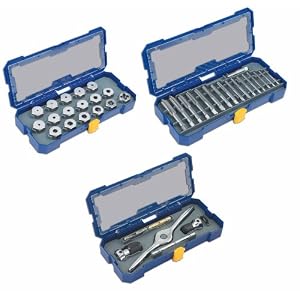
I currently have my eye on the Irwin/Hanson 'alignment' set:
http://www.amazon.com/dp/B002M78R68/?tag=atomicindus08-20
51M-Qfb1nhL._SL500_AA300_.jpg


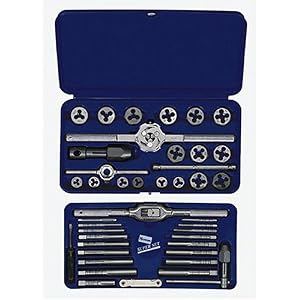
But it seems like most of you guys use the set that SO rebadges:
http://www.amazon.com/dp/B0000DD4KV/?tag=atomicindus08-20
51HDVNEM2AL._SL500_AA300_PIbundle-41,TopRight,0,0_AA300_SH20_.jpg


Does the second one have any advantage over the first set? I like that the first set 'aligns' and has ratcheting adapters in the kit. And will either of them have a problem cutting into the control arm metal? I assume it is super hard metal...
 
Last edited:
To avoid these ads, REGISTER NOW!

djkeev

Well-known member
Joined
Feb 8, 2012
Messages
1,223
Location
North Western New Jersey
As a rule of thumb, but NOT always true..... The less you pay....the less the quality.

Most of my taps and dies I got from my father, a post WWII machinest. They are top quality and I treat them with care and respect.

HF has made a brand based on cheap. I wouldn't use their taps, you break off a tap in a hole your little problem just multiplied to a HUGE problem!

You also need to know what you are running a tap into, a hardened steel will be a lot harder to tap than mild steel.
Take a sharp file and file a spot on the metal, does it file easily or does it laugh at your file as it glides over the steel doing little if anything? Hard steel with be difficult to file.

Go and get the best quality taps that you can afford and proceed cautiously. Taps are easy to break, when running in a tap, get it started, turn it in a turn or Two, back it off a turn to break off the metal curl that you are creating, turn it in another turn or two, back off, turn in, back off until you are done.

Use a cutting oil, or at least an oil to cool and lubricate as you cut.

Dave
 
Last edited:

dankicksass

Well-known member
Joined
Jul 28, 2010
Messages
1,820
Location
New Jersey
Looks like aluminum, just go slow and evacuate chips as you go. One turn in, half a turn back, repeat. Cutting oil is your friend.
 
OP
F

fr0mastaj

Well-known member
Joined
Jan 18, 2010
Messages
1,265
Location
MA
So are there any major differences between the two sets I posted? If the first set is of high quality, I will likely get that...
 

Sureshot

ALLIANCE MEMBER
Joined
Jan 3, 2011
Messages
3,134
Location
Bridge Creek, OK
You also need to be sure you are using the right type of tap. Tapered, ????, and bottoming. New holes generally you want a tapered, The next one someone will chime in the name but it is far less tapered and more fitting to repair threads in general, and the bottom tap is for finishing blind holes.
 

jetmech09

Well-known member
Joined
Mar 26, 2012
Messages
254
You also need to be sure you are using the right type of tap. Tapered, ????, and bottoming. New holes generally you want a tapered, The next one someone will chime in the name but it is far less tapered and more fitting to repair threads in general, and the bottom tap is for finishing blind holes.

Intermediate tap.
I always run all 3 taps through, if the hole needs to be threaded all the way. Again, go SLOW, make sure you turn a half turn back every turn or so to clear the chips, and you should be alright. Also, make sure you are square.
 
OP
F

fr0mastaj

Well-known member
Joined
Jan 18, 2010
Messages
1,265
Location
MA
What would be a good set to have as an only set? I certainly do not have enough money to get multiple style sets... Are the Irwins tapered? And if so, would that be good enough for DIY use?

The hole I am retapping does not go all the way through. Is that a 'blind hole'?
 

Linh

Well-known member
Joined
Apr 14, 2012
Messages
58
Yes, that is what you call a blind hole. You need to use a bottoming tap.
 

ihredo4

Well-known member
Joined
Sep 3, 2009
Messages
1,575
Location
100 miles W of Daileyville in Idiotnois
Yes that is a blind hole. Ultimately you will need a bottoming tap to finish cutting the threads. You can grind a taper tap into an intermediate and bottoming tap but obviously you can't go backwards from there. Good Luck.
 

larry_g

Well-known member
Joined
Apr 28, 2007
Messages
16,872
Location
oregon
Weekend project was the change the struts on the car...and one of the bolts that mates the strut bracket to the lower control arm decided to snap! Don't know why they felt an little 12mm hex head bolt (M6-1.0) was a good idea for such a vital component. :dunno:

Anyways, I was able to grind down and drill out the snapped bolt. Now my problem is I dont know what type of tap to use. I had a cheapie HF tap set on hand which did absolutely nothing. All the cutting threads just got mushed.

IMAG0455.jpg


IMAG0456.jpg


What would be a good set?

I currently have my eye on the Irwin/Hanson 'alignment' set:
http://www.amazon.com/dp/B002M78R68/?tag=atomicindus08-20
51M-Qfb1nhL._SL500_AA300_.jpg


...

Bells and whistles going off here... Concerning the hole that you have left in the suspension arm, are there any threads left in the hole? You should be just cleaning up a few damaged threads not retapping a new bigger hole. If all threads are gone from the hole then you have different problems. If your HF tap did not clean the hole and just 'mushed' then you are trying to remove to much metal or your using and oversized tap without a proper clearance hole.

As far as the Irwin taps I see that they are carbon steel, the lowest strength material for this work. I'm not sure what self aligning is but I'd bet its a marketing term as I've never heard it in the machine shop. At least get a HSS tap or if the file method mentioned above shows it to be hard then go for Cobalt. http://www.mcmaster.com/#standard-taps/=hbiwsf

So bottom line here is, are you cleaning up old threads or cutting new ones? If your cleaning up old and removing more that a few sand sized pieces of metal then your doing it wrong and your hosed.

lg
no neat sig line
 

RECox286

Well-known member
Joined
Apr 11, 2012
Messages
1,399
Location
South Joisey (yeah, that is part of the USA)
The "normal" type of tap found at the local hardware, auto, and discount

store will be of the tapered variety. Intermediate and bottoming taps are

usually found in industrial supply outfits. Yes, a hole that doesn't go all

the way thru is a "blind" hole and requires a bottoming tap to properly

thread the hole. My trick: take a spare tapered tap of the correct size and

grind the taper off of it leaving the rest of the tap intact. Start the threading

process with a tapered tap, and finish it off with the homemade bottoming

tap. (I can hear the groans now from some of the gang out there, but

if you are careful, it works, and I don't have the $$ to spend on fancy stuff

that I only need very ocassionally. )

Uncle Bob
 

jjjrmx5

Well-known member
Joined
Dec 30, 2010
Messages
3,431
Location
Cincinnati, OH
(I can hear the groans now from some of the gang out there, but

if you are careful, it works, and I don't have the $$ to spend on fancy stuff

that I only need very ocassionally. )

Uncle Bob

LOL Uncle Bob.

You are on a tool forum posting a short cut against "fancy stuff" tools (especially taps).
LOLOLOLOLOLOLOLOLOLOLOLOLOLOL

Buy the right **** or send it out. Done.

Irwin's via NAPA, Grainger or McMaster. I don;t care.
Cheap taps or the wrong taps lead to a ****** story book ending.

Taper taps.
Bottom taps.
Intermediate taps.


Google those f&^%$rs and learn what they mean and what you need.

C'mon .

:(
 

Jim Johnstone

Well-known member
Joined
Apr 11, 2011
Messages
1,841
Location
Brantford, Ontario
The "normal" type of tap found at the local hardware, auto, and discount

store will be of the tapered variety. Intermediate and bottoming taps are

usually found in industrial supply outfits. Yes, a hole that doesn't go all

the way thru is a "blind" hole and requires a bottoming tap to properly

thread the hole. My trick: take a spare tapered tap of the correct size and

grind the taper off of it leaving the rest of the tap intact. Start the threading

process with a tapered tap, and finish it off with the homemade bottoming

tap. (I can hear the groans now from some of the gang out there, but

if you are careful, it works, and I don't have the $$ to spend on fancy stuff

that I only need very ocassionally
. )

Uncle Bob

I don't see how this saves any money. You still need two taps, one you grind down to make a bottoming tap. If you're going to be buying two taps anyway, why not buy a tapered and a bottoming?
 

RECox286

Well-known member
Joined
Apr 11, 2012
Messages
1,399
Location
South Joisey (yeah, that is part of the USA)
OK, I buy a lot of my stuff from an industrial surplus outlet.

That means that I don't pay top dollar. Most of the time, they only have

common taps (tapered) available, so I'm not buying sets, only open stock.

I have plenty of the sizes I know I'll need. It only takes a few minutes to

"ruin" a tapered tap to make the bottoming tap I will have use for maybe

3 or 4 times in a year, if I'm lucky. The bottom line is, I don't usually have

time to fool around on a project by shopping for one lousy tap to finish out

a job. Getting done is more important than running for or ruining one tap.

What would you do ?

Uncle Bob
 

woody 73

Well-known member
Joined
Apr 14, 2009
Messages
11,540
Location
The Great State Up North
Wow all good advice.

Maybe I can give you a few tips:

The next time you go to the food store pick up a can of crisco or lard they work great on your taps & Dies.

Sears makes a set that all the truck companies use like (Mac snap on,etc.) it is item # 009-42275 a 48pc. rethreading kit that does come in handy; if you rethread with a tap it does enlarge the hole so you want to use this kit to avoid that.

Some products that HF make are very nice but I tend to avoid their drill bits and taps, other people might love them.

You are never screwed so too speak because today they make products like heli-coil inserts if you want to get the original threads; so never sweat the small stuff.

Going slow is your friend, going fast tends to break the tap.

Carbon steel is ok HSS is very nice but very expensive.

Clean up all your tap & dies when you are done (trust me been there done that).

Hope these tips will help you out.
 

jjjrmx5

Well-known member
Joined
Dec 30, 2010
Messages
3,431
Location
Cincinnati, OH
What would you do ?

Uncle Bob

First----I;d quit posting in forums with double spacing 'cause it's anoying.

If via a phone or tablet fix it. If a PC or laptop then it's a no brainer.

ON the other side , buying from industrial outlets gives you great tools, but still not necessarily the right tool for the job.

:)

:hug:
 

Ign

Well-known member
Joined
Jul 7, 2006
Messages
12,769
Location
Butte Peak ND
Taper, plug and bottoming are how I know them.

I've often taken a taper tap to the belt sander to make it a "bottoming" tap. Not technically correct, but it works.

Both Enco and MSC are currently selling Cleveland hand taps in sets of 3 - same size of taper, plug and bottoming. I'm gonna order a 1/2-13 and cost is around $38 in that size. They're not showing the metrics on sale tho of course.

You've also got hand taps (generally good for just that), spiral point (pushes the chip ahead for thru holes), and spiral flute (kinda like a drill bit and really a lot of fun to use as it strings the chips back out of the hole). Spiral flutes are great for spanning keyways too. Plus many others.

Irwins are fine. I usually order Kennametal, OSG, Cleveland or Hertel (most Hertel stuff made in US).
 
To avoid these ads, REGISTER NOW!
Joined
Feb 13, 2012
Messages
470
I'd go to an industrial supply store where I can get high quality taps and just buy the size I needed for that one job and its matching drill bit; that way I can concentrate the money into a quality tap instead of a whole set of mediocre quality taps. And while I was there, I'd get me a nice Starrett T-handle tap holder to go with it.
 

jetmech09

Well-known member
Joined
Mar 26, 2012
Messages
254
I'd go to an industrial supply store where I can get high quality taps and just buy the size I needed for that one job and its matching drill bit; that way I can concentrate the money into a quality tap instead of a whole set of mediocre quality taps. And while I was there, I'd get me a nice Starrett T-handle tap holder to go with it.

I agree. I would just buy the tap/drill size I need as I go along. You really don't want to go cheap here.
 

Dillithium

Well-known member
Joined
Dec 14, 2011
Messages
151
What are some quality brands for taps and dies though?
Or is anything with HSS on it good enough?

not thread-jacking, I'm genuinely just curious because I'm also in the market for a good set
 

Whitworth

Well-known member
Joined
Dec 26, 2011
Messages
2,084
I call them tapered, plug and bottoming. Most sets will be plug style, (intermediate) and almost all tap and die sets are high carbon steel, otherwise a set would cost hundreds of dollars.

I find a complete or semi-complete SAE set (national course and national fine) is good as an occasion comes up for a tapping job, or just use the taps and dies as thread gauges.

The high carbon steel is good for a few go-arounds, then garbage. At that point throw them out.

The HSS (high speed steel) is preferred, and is often on sale at ENCO or MSC, Travers, etc. You can get a 'set' ( taper, plug and bottoming) or buy the specific tap you want.

Even HSS will wear eventually. When the cutting tool stops working as it should, throw it out and replace. Disposable tooling, you know.


Gary
 

Linh

Well-known member
Joined
Apr 14, 2012
Messages
58
My favorite ones to use at work are balax And Guhring taps.
 

OccupantRJ

Well-known member
Joined
May 15, 2009
Messages
10,966
Location
Eastern North Carolina
Taps are ground all the time for use in our machining processes. I have yet to figure out how a proper size tap being used enlarges a pre- existing tapped hole, so someone please explain, other than using an H3 tap in a H1 hole. All I have ever found one to do is clean the **** out of the threads in the hole. Taps are available in various tolerances, denoted as H1, H2, H3, etc. There is a difference of one half thousandth of an inch per, getting larger as the H number does, so clearances can be custom tapped, relative to the threaded fastener.
 

OccupantRJ

Well-known member
Joined
May 15, 2009
Messages
10,966
Location
Eastern North Carolina
The picture the OP posted looks like the hole has been drilled fairly well on center, and is ready to have the remaining fastener collapsed and picked out of the hole, instead of tapping, anyway.
 

larry_g

Well-known member
Joined
Apr 28, 2007
Messages
16,872
Location
oregon
The picture the OP posted looks like the hole has been drilled fairly well on center, and is ready to have the remaining fastener collapsed and picked out of the hole, instead of tapping, anyway.

Now that you say that I went back and blew up the photo and I believe you may be correct.

To the OP, if this is so then trying to pick the remaining threads of the fastener out may be what you need to do. The odds of trying to tap it out and picking up the existing threads are against you. If you do it wrong then you have just cut out the threads you need to reuse.

lg
no neat sig line
 

darkzero

Well-known member
Joined
Oct 20, 2011
Messages
3,317
Location
SoCal
Looks like aluminum.

Not to me. Cast aluminum suspension are usually just bare, no need to paint/coat to prevent rust.


Are you mental? don't see many aluminium steering arms:dunno:

That's a lower control arm but many new vehicles in the past 10 years have aluminum suspension parts.


Taper, plug and bottoming are how I know them.

Same here. Everywhere I have bought taps, this is what they are called. I've never heard them called an intermediate tap. What would that be, equivelent to a plug tap?


Sears makes a set that all the truck companies use like (Mac snap on,etc.) it is item # 009-42275 a 48pc. rethreading kit that does come in handy; if you rethread with a tap it does enlarge the hole so you want to use this kit to avoid that.

Yup I have that same kit from Sears but do they even sell it anymore? Mine's made in USA & is the same exact kit Matco sold. But this was over 10 years ago when I got it. This kit has saved my *** countless times. Before I had this set, I would cut a groove at the tip of a bolt or nut, works the same most of the time. Some OEM bolts are even made this way.


You're thinking of a thread chaser. Not the tool for this app, but a good set to have. Cleans out old locking compound, etc.

Concerning the hole that you have left in the suspension arm, are there any threads left in the hole? You should be just cleaning up a few damaged threads not retapping a new bigger hole. If all threads are gone from the hole then you have different problems. If your HF tap did not clean the hole and just 'mushed' then you are trying to remove to much metal or your using and oversized tap without a proper clearance hole.

If the OP was able to remove the old bolt with no or little damage to the threads then a thread chaser like from the kit mentioned above is what I would use. Many people use a tap to "repair" threads that have only minor damage. But a tap will cut out the damaged areas leaving less threads in the hole where as a threader chaser will somewhat "form" the damaged areas back into place.

But if the OP completely drilled out the original threads then I agree with larry_g. OP would have to tap the next size up base on the size of the hole it is now assuming whatever needs to bolt there can even use a bigger bolt. I would never just carelessly drill out a broken bolt along with the threads unless I absolutely had no choice. If that's what happened, I'd opt to fix it with Heli-Coil if possible before even thinking about tapping for the next size up.


First----I;d quit posting in forums with double spacing 'cause it's anoying.

What about grammar? :)
 
OP
F

fr0mastaj

Well-known member
Joined
Jan 18, 2010
Messages
1,265
Location
MA
Now that you say that I went back and blew up the photo and I believe you may be correct.

To the OP, if this is so then trying to pick the remaining threads of the fastener out may be what you need to do. The odds of trying to tap it out and picking up the existing threads are against you. If you do it wrong then you have just cut out the threads you need to reuse.

lg
no neat sig line

It's a little late in the day now to go back at it...but what is the best method for getting rid of the old thread? Literally with a mini pick set? Figured it'd be seized on there pretty good and just bend the tips...
 

andywander

Well-known member
Joined
Mar 24, 2012
Messages
359
The usual taps, as posted by others, are called taper, plug, and bottoming.

A Plug tap(the only kind you will find in most tap & die sets) usually have about five threads tapered at the end. For general use, as long as you don't need to tap close to the bottom of a blind hole, they are a good compromise, if you are only going to have one tap.

A Bottoming tap, as implied by it;s name, is used after you have tapped as close to the bottom of a blind hole as you can get with a Plug tap. The bottoming tap usually has only 1 or 2 threads tapered. With little to no taper, it is very difficult to start a bottoming tap in a previously-untapped hole, and even if it starts, it is more likely to go in crooked.

A taper tap has around 8 or so threads tapered, and is used when you are tapping difficult materials, as it will start easier, and tend to go in straighter, because of the long taper.


As far as the sets, the first one you posted looks ;like a set designed for repair of threads, rather than making threads, i say that because usually the hexagon dies are rethreading dies, and will NOT do a good job at making new threads. Therefore, i would not recommend that set as a general use set, if you ever hope to make male threads on something that is unthreaded.
 
OP
F

fr0mastaj

Well-known member
Joined
Jan 18, 2010
Messages
1,265
Location
MA
If the OP was able to remove the old bolt with no or little damage to the threads then a thread chaser like from the kit mentioned above is what I would use. Many people use a tap to "repair" threads that have only minor damage. But a tap will cut out the damaged areas leaving less threads in the hole where as a threader chaser will somewhat "form" the damaged areas back into place.

But if the OP completely drilled out the original threads then I agree with larry_g. OP would have to tap the next size up base on the size of the hole it is now assuming whatever needs to bolt there can even use a bigger bolt. I would never just carelessly drill out a broken bolt along with the threads unless I absolutely had no choice. If that's what happened, I'd opt to fix it with Heli-Coil if possible before even thinking about tapping for the next size up.

It was pretty much my last resort. I tried soaking it in Kroil for about an hour, cutting a slot into it with a dremel and turning it with a flat head. Snapped the flat head and the slot just got mangled and did not move. So I ground it down flat, used a center punch, and drilled down.

Currently, the proper bolt will NOT fit into the hole i drilled, it is still a tad too small (the hole), thats why I figured it was better to start tapping than drill any wider. Perhaps I am going about it the wrong way then? Again, i dont think i have drilled past the OE threads YET.

And I miss worded in my original post, it is actually an M8-1.25 bolt, if that matters at all. I have a replacement class 10.9 flanged bolt waiting to go in...
 
Last edited:

dwilliams35

Well-known member
Joined
Sep 27, 2008
Messages
271
Location
Pattison, TX
Lose the "set" mentality: the GOOD taps don't come in sets, at least I've never seen them that way, and my tap bill every year is probably into the six figures... Go to a machine shop supply, tell them what you're doing, and they'll set you up...
 

darkzero

Well-known member
Joined
Oct 20, 2011
Messages
3,317
Location
SoCal
It was pretty much my last resort. I tried soaking it in Kroil for about an hour, cutting a slot into it with a dremel and turning it with a flat head. Snapped the flat head and the slot just got mangled and did not move. So I ground it down flat, used a center punch, and drilled down.

Currently, the proper bolt will NOT fit into the hole i drilled, it is still a tad too small (the hole), thats why I figured it was better to start tapping than drill any wider. Perhaps I am going about it the wrong way then? Again, i dont think i have drilled past the OE threads YET.

And I miss worded in my original post, it is actually an M8-1.25 bolt, if that matters at all. I have a replacement class 10.9 flanged bolt waiting to go in...

Well that's good that you have not drilled out the original threads. Like the others said, try picking out some of the old bolt at the start of the threads so you can at least get enough threads to line up to tap the rest out.

But if that old bolt was completely rusted/fused in there then I don't know. I've never experienced that & I'm not sure if it's safe/strong enough to just retap the same size thread assuming you have the correct starting hole diameter. Hopefully someone else can answer that.

But if you are able to tap, like Ign mentioned, a spiral flute tap would be best to use. A bottoming tap is the correct tap to use since you want to thread as close to the bottom of the hole as possible but since it's a blind hole, the sprial flute tap will work best so the chips extract out the hole. You can get away with using a straight flute tap but you will have to remove the tap often & clear out the chips. You won't be able to find a spiral flute tap at any local hardware or auto parts store though. I don't think they even carry bottoming taps.
 

andywander

Well-known member
Joined
Mar 24, 2012
Messages
359
TI have yet to figure out how a proper size tap being used enlarges a pre- existing tapped hole, so someone please explain,

I agree that it probably won;t make a huge difference, and I use regular cutting taps all the time to repair or clean out a threaded hole.

However, i do find that the repaired hole is usually a little bit looser than I would expect, compared to a freshly tapped hole.

The way I understand it is thus:

-When you first use a tap, it will cut evenly all around it's circumference.

-when you are cleaning out a tapped hole, there is, by definition, something in there that needs to come out. Usually, whether it is rust, dirt, or pieces of the previous fastener, the "stuff" will not be distributed evenly around the inside of the hole.

-Rust will typically be much harder and more difficult to cut than the steel that it is formed from. The remains of a fastener may also be made of different material than what they are threaded into(ie: a steel bolt in a block of aluminum)

-for this reason, the tap will have some of it;ls edges cutting the (harder or softer) stuff you are trying to clean out, and some edges cutting the parent material.

-there is no way that the tap has of "knowing" not to cut on the parent material, it will cut on all edges as long as they are bearing on something.

Therefore, it will most likely make the threaded hole larger, to whatever degree, than it was before.


Heck, if I WANT to enlarge a threaded hole, I just jam a few toothpicks into one flute of the tap, and that forces the cutting edges on the other side to cut into the previously-threaded areas, and makes the female threads larger.
 

larry_g

Well-known member
Joined
Apr 28, 2007
Messages
16,872
Location
oregon
Currently, the proper bolt will NOT fit into the hole i drilled, it is still a tad too small (the hole), thats why I figured it was better to start tapping than drill any wider. Perhaps I am going about it the wrong way then? Again, i dont think i have drilled past the OE threads YET.

Ok then, if all the origional threads are still in there then you have a chance to get this thing out. Your 'pick' is what ever will work. I usually try to get under the outside of what is left of the bolt with a slim center punch and tap it toward the middle. Start in the thin side if your a bit off center. Fold the side in to make the hollow bolt look heart shaped. As the top starts to fold in then work down the side and get it all folded. Sometimes you may have to grind a chisel to a fine small edge to keep the fold going. If you have a dremel type tool you can even grind a bit of a notch on one side to get the fold going. Just try not to get into the original threads. You may nick them but a small bit won't ruin them. Just go slow and take small bites.

lg
no neat sig line
 
To avoid these ads, REGISTER NOW!
Top Bottom