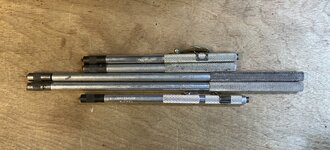
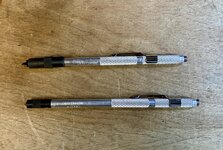
Mintgrun
Well-known member
I used some of mine the other day. I was trying to pick a favorite.

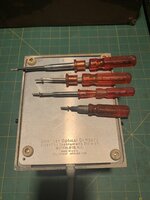

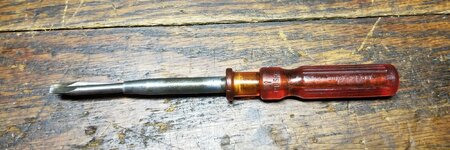
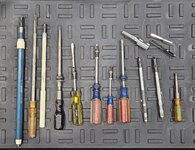
Nice that you have three (3) different original Kedman Quick-Wedges. Looks like Nos. 1253, 1732N, and 1734.I used some of mine the other day.
 )
)I am intrigued by the numbering scheme and wondering if it scales with the various tip sizes somehow. 1957 catalog page hosted on IA/ITCL linked here. (We've got a long way to go to have a full set!
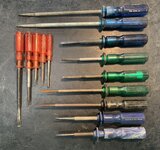

I saw that. I was thinking the first three digits may have been decimal inches, and it tracks with the 125xx = 1/8", but quickly falls apart after that.Thank you for posting that catalog link. It says the last digit in the number represents the blade length.
Nice collection! I hardly ever see them.You inspired me to lay mine out for a photo and record the number/letter codes.
I really don't have time for this, but my cryptographer's bone is tingling! We have one code ("mc") in common across all of our drivers and it appears on two different units: your No. 2354 and my No. 1734. Can't be handle mold/die. Date code? Those both have tapered push tubes and the same marking scheme. You didn't discuss that yet, but IF (and it remains a big question of IF, in my mind, at least) we're really going to accept a project to try to figure out their production timeline, akin to what has been done for Xcelite nut drivers, etc, the markings would have to be a category. We probably need a table just to start organizing data.I don't know what those little lower-case two-letter codes represent either.
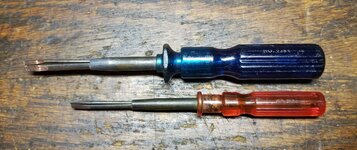
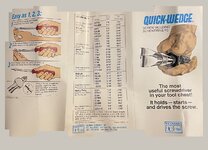
There are seven (7) Quick-Wedge references on IA/ITCL, dated 1954, 1957, 1959, 1962, 1965, 1967, and 1969. It's difficult to tell on some of them, but most of them show a pentagonal pusher....but the three on the right in this photo are pentagonal. I am guessing those might be earlier.
That's interesting, because I discovered that Kedman owned two (2) TM's, and that one - sans hyphen - was the first version....the marbled one is only marked "Quick Wedge."

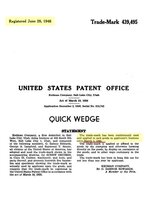
There are seven (7) Quick-Wedge references on IA/ITCL, dated 1954, 1957, 1959, 1962, 1965, 1967, and 1969. It's difficult to tell on some of them, but most of them show a pentagonal pusher.

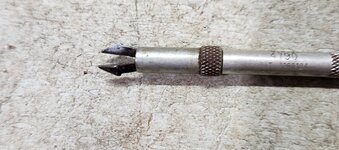
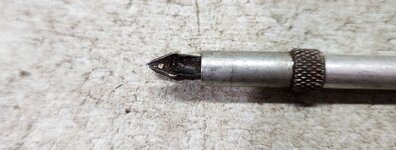
Please post a photo of one when you can. No rush.Most of them have US and Canadian patent numbers on the end of the pusher,
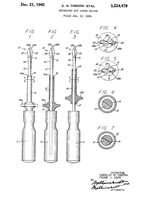
Do you mean this marking? "PAT. U.S. 3224479 & OTHER COUNTRIES"but the un-numbered middle green one has "US patent # & Other Countries."
Please post a photo when you can.The US and CA patent info is printed on the handles of the Pentagonal style
This, in combination with it bearing the first TM ("QUICK WEDGE"), is a sure sign of it being very early, dating surely prior to 1960 (second TM with hyphen). All of the other examples we have between us are later than 1965.and there's no patent info on the marbled one.
That's a neat design.I found an interesting Indestro 4790 screw starter for Phillips screws
Thanks! I added the patent number (3288184) to my original post.That's a neat design.
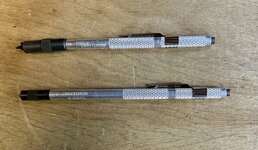
I've got a couple of Phillips starters. I'm surprised in the era of Phillips screws being predominant, we don't see more of those running around. I must have 20+, and I think all but 2 or 3 are slottedI found an interesting Indestro 4790 screw starter for Phillips screws at the local auto swap meet Saturday. You pull a collar back and forth to expand the V-shaped teeth to grip the screw.
Patent number is 3288184.Indestro 4790 screw starter


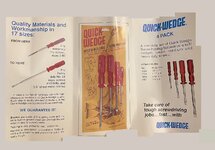

I've found at least a half-dozen starters in the wild, but none have been Phillips.I've got a couple of Phillips starters. I'm surprised in the era of Phillips screws being predominant, we don't see more of those running around. I must have 20+, and I think all but 2 or 3 are slotted
Snerk.So much for my color-based-on-size observation.
That's the spirit!I'm tempted to buy one new, but that would be giving in.
^ that's the white-nylon-handled, Ullmann Devices manufactured unit I referred to above (post #171) -Indestro Super IN-4782
I'm sure I have a smaller one around somewhere, but it wasn't in the screwdriver drawer this morning. It's about the size of the metal Ullmann example if I remember right.^ that's the white-nylon-handled, Ullmann Devices manufactured unit I referred to above (post #171) -
But I think I figured out what you mean by...Most of them have US and Canadian patent numbers on the end of the pusher,
...by scanning ebay.The US and CA patent info is printed on the handles of the Pentagonal style

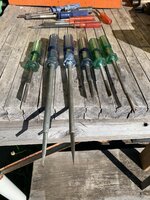

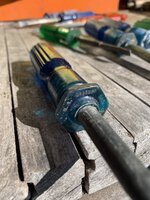

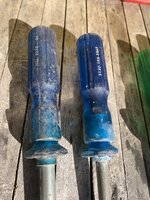

If you mean 5120-292-3343, that's a Federal Stock Number.That long number on the blue handle is unique.
Yes, I have those. I just posted the patents.I do see two different US patent numbers.
Check to see if there is a "PAT APLD FOR" marking on the tube. It may be barely legible....the marbled one is only marked "Quick Wedge."


Check to see if there is a "PAT APLD FOR" marking on the tube. It may be barely legible.

I don't know which type came first though, with the "PAT. U.S. 2445383 CAN. 456642" marking circling the pusher, as you have shown on one of your blue ones above, or with the "PAT U.S. 2445383 - CANADA 456642" marking on the handle
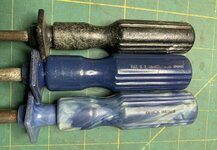


I was thinking the same thing. Once they started putting the patent info on the pusher, they stayed with that approach. That's where the second patent information went.I'm guessing the style with the patents on the handle came before the ones with the patent on the pusher.
What is the second Canadian patent number? What is the exact syntax of the marking? Please transcribe it. I don't have any of this type, there aren't any other than yours on this thread, and none on ebay.The red ones also have the CA patent
What is the second Canadian patent number? What is the exact syntax of the marking?
Another type has "QUICK-WEDGE" on one line, a much smaller "SALT LAKE CITY" underneath on one flat of the handle. And the Model number with a letter-letter code is on the opposite flat of the handle, like this... "No. 2354 mc"


 -Don
-Don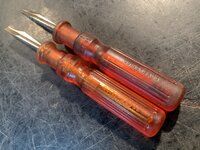

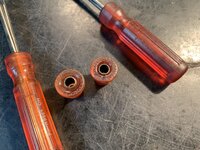



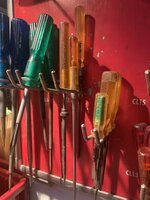
^ Millen "Jiffy-Tite": patent 1699306 Jan 15 1929 E.L. Millen
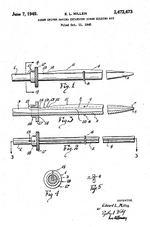
Wait. What?!We found a Stanley Spee-D-Grip...
...and the first patent number marked on the ferrule. Very cool!I also found this nifty JIFFY-TITE #6. It's the third J-T in the thread, but the others have wooden handles and larger blades.
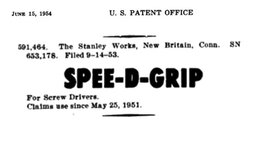
here is the name branding on this thread
 www.garagejournal.com
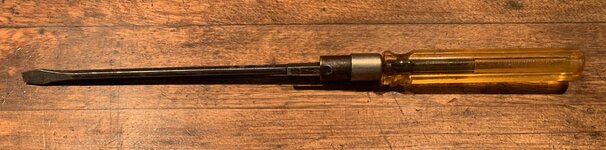

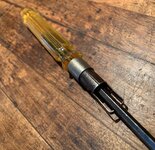
Hmm. I thought the LOK-BLOK was to prevent the shank from turning or being buried further inside the handle. I don't think the HOLD-E-ZEE is dependent on it, and I don't think the LOK-BLOK is exclusive to HOLD-E-ZEE screwdrivers. I could be wrong. We could asterisk it.I suppose you could add Upson Bros Lok-Blok to the-list. It's stamped on the inner green plastic of the Hold-E-Zee screwdriver that WisJim shared here.
I thought I looked it up, you are correct .Hmm. I thought the LOK-BLOK was to prevent the shank from turning or being buried further inside the handle.