To avoid these ads, REGISTER NOW!

Sewing machine for heavier weight fabric

Ohmthis

Well-known member
Joined
Jan 20, 2013
Messages
3,014
Location
Outside of Louisville KY
I did want to highjack a thread going on right now on a sewing machine recommendation. I’m in the beginning stages of research, acquiring a machine, and eventually sewing up seat covers for our boat and eventually my project F100. So what I don’t know will make this a headache. I will be sewing marine vinyl for both of these projects. Down the road I will be using it for sunbrella heavy canvas for covers. My budget was $400 before researching, now I’m up to $600. I’d love to find something closer to my original budget, but you can wish in one hand and **** in the other and see which one fills faster! Is a walking foot a must? Reverse? Are the cheaper Consew CP206RL or Rex RX-607 capable? I looked into the “Heavy Duty”Singer’s thinking I’d be ok (Hence my original budget), are those even an option? I know a nicer Consew, Pfaff, or Juli would be best, but I have not seen anything near me that will fit the bill. Any help that you could provide would be greatly appreciated!
 
To avoid these ads, REGISTER NOW!

cgrutt

Well-known member
Joined
Mar 4, 2016
Messages
8,300
Looking at used for a walking foot, which is ideal, but you can probably get away with a less expensive industrial if it's only a couple of projects. I'm in same boat. I've been seeing "some" Juki 563 (note the "-3" models lack reverse), PFAFf 145 (A4 i believe is high foot (more capacity)). and Consew 206RB (1-5, with the higher number being newer design) in the $500 - $1000 range. A few much cheaper but usually long drive. May find a used Sailrite straight stitch within your budget but usually higher. I think the Rex is pretty much same machine without the marketing (and possibly missing a few upgrades). I've kinda avoided old Singers because I really don't know much about them and the ones I've seen didn't have reverse. Certainly a long history of upholstery done on Singers so not knocking them i just don't know alot about them.
 

DGersic

Well-known member
Joined
Mar 12, 2017
Messages
6,326
Location
DeKalb, IL
I did want to highjack a thread going on right now on a sewing machine recommendation. I’m in the beginning stages of research, acquiring a machine, and eventually sewing up seat covers for our boat and eventually my project F100. So what I don’t know will make this a headache. I will be sewing marine vinyl for both of these projects. Down the road I will be using it for sunbrella heavy canvas for covers. My budget was $400 before researching, now I’m up to $600. I’d love to find something closer to my original budget, but you can wish in one hand and **** in the other and see which one fills faster! Is a walking foot a must? Reverse? Are the cheaper Consew CP206RL or Rex RX-607 capable? I looked into the “Heavy Duty”Singer’s thinking I’d be ok (Hence my original budget), are those even an option? I know a nicer Consew, Pfaff, or Juli would be best, but I have not seen anything near me that will fit the bill. Any help that you could provide would be greatly appreciated!

Same as I posted in the other thread…

I have the Consew CP206RL. Meets your described needs, for a bunch less than the Juki. $425 on Amazon right now.

Having it, I’d probably get something else. It works fine just as described, but doesn’t have zig zag. Now I think it’s worth the extra couple bucks to get the zig zag, even if you don’t think you’ll use it.

It also doesn’t have any support for optional other feet. It has a walking foot, straight stitch. But if you want, for example, piping, there are other machines where you can install a piping foot. You may not want piping, yet, but if you’re doing upholstery, you might.


Go watch the Sailrite videos on youtube. They’re very good, and very applicable to what you want to do.
 

MikeC55

Well-known member
Joined
Nov 1, 2020
Messages
425
Location
CT
I have a 1955 vintage Singer 111W155, which, although it does not have reverse, is a very capable walking foot machine. From what I've read, it was widely copied for many years. Parts are easily available and are interchangeable with some of the copys. The walking feet can be changed out for specific applications such as piping feet. Older machines were originally equipped with a continuous run motor and clutch type operation. I would suggest looking for a machine where the original motor was swapped for a servo motor. The old clutch type motors are very difficult for a beginner to control (i.e. sew slow). I installed a servo motor and can make my machine crawl when I need to. With the help of Youtube, I taught myself to sew decently enough to do a nice job reupholstering my antique car pleated leather seats. I paid $500 for the machine 6 years ago and have been pleased with the machine (after the servo motor swap).
 

IndyGarage

Well-known member
Joined
Apr 29, 2010
Messages
9,705
Location
Indy
You should be able to find a walking foot machine for under $600. You might not get a servo motor, but they are easy to replace and cost about $150 for a new one.

I would look for a Singer 111 or a copy if you need one cheap - The two you mention are 111 clones, with reverse. I bought my first 111 at a swap meet for $250 and then a couple weeks later found another one that was in pretty poor condition without a table for $50. I bought my first Pfaff for $450, so you can find one in your budget range.

Don't worry about buying used. Industrial sewing machines are built like a tank, so if they run and sew, they are probably OK. My singer 111's were WWII era and worked fine.
 

cgrutt

Well-known member
Joined
Mar 4, 2016
Messages
8,300
I see (older) Brother and Mitsubishi come up alot and they appear to be solid industrial machines. Anybody know what model numbers have walking foot and are good choices for marine upholstery?

Also just a note about walking foot. Apparently there are different ways to accomplish this and some are more suitable than others. I understand best type for marine upholstery are so called triple transport (aka unison feed, aka compound feed) where walking feet, feed dogs and needle all work together to hold down, stitch and advance fabric. This system is ideal for heavy fabrics and leathers but mechanism is more complex and timing is critical for system to operate properly. This makes triple feed machines more costly, heavier and higher maintenance requirements. The machines I mentioned earlier are all triple transport. I understand some Singers may have walking foot but use different designs (I believe mainly where needle is not used in conjunction with feet and feed dogs to advance material. Another reason why I steer away from Singer, I just dont know enough about them.
 

rdoty

ALLIANCE MEMBER
Joined
Feb 7, 2018
Messages
644
Location
Massachusetts
I recently went through the same process. Check around for a local place that sells and services industrial sewing machines.

I found one and they recommended a refurbished Juki 563 - high wear parts replaced, checked out and tuned up. Came with a new servo motor (which you REALLY want) and a new table. Their recommendation was "simple machine, sews great, handles anything you can throw at it, and bring it back to us if you have any problems". When I picked it up they showed me how to use it and ran several seams to show that everything worked.

My reasoning was that this let me start with a known good machine. Their price wasn't that much higher than a similar used machine. Since I was a complete beginner it would be hard to know if problems were me or the machine. This way I knew it wasn't the machine...

I've been very happy with the Juki 563. I'm using it to do a car interior (guess which one!) and it has no problems sewing through 6 layers of automotive vinyl.
 

Sumboodie

Well-known member
Joined
Mar 20, 2021
Messages
10,698
Location
AK
A jewky (sp?) Is what we used for canvas.
Sold it for maybe $300 several years ago.
Worked fine, just was taking up space and hadn't used it much since the 90s.
 

Bert_

Well-known member
Joined
Dec 24, 2016
Messages
9,745
Location
NW Iowa
I sort of browsed craigslist and marketplace but I couldn't see spending the kind of money these machines bring.

I've used my mom's phaff 130 a few times. I think that was $5 at an estate sale 25 years ago. I have use it on heavy cotton canvas before and it does fine.

I am working with some 14oz polyester canvas now and that machine really struggles with it. But I've also bent several heavy pins just trying to push them through the canvas.
 
Last edited:

LopezBart

Well-known member
Joined
Oct 13, 2023
Messages
2,540
Location
Lopez Island, WA
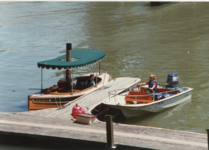
My (now) wife bought a sturdy Kenmore sewing machine in the 80s to sew her wedding dress. That machine has done a lot of heavy sewing since then, including the canopy for our 19' steamboat made of Sunbrella, but the machine has its limitations; heavy Sunbrella seams are too much for the machine. My brother's partner bought her machine from SailRite, and has sewn their sail covers, repaired sails, made weather cloths, etc. for their 42' live-aboard ketch, as well as paying sewing jobs for others. Note the floating glacial ice on the lefthand photo; we were sailing near Petersburg, Alaska towards a calving glacier.

1740243565262.png1740243238962.png


I should note that the canopy on the steamboat has survived many tens of thousands of miles of trailering on short 6" poles, with the edges flapping merrily. Sunbrella (UV resistant acrylic fabric ) is tough stuff.

A heavier machine will allow you to sew thicker materials, somewhat obviously, and be less frustrating to use.
 

IndyGarage

Well-known member
Joined
Apr 29, 2010
Messages
9,705
Location
Indy
My (now) wife bought a sturdy Kenmore sewing machine in the 80s to sew her wedding dress. That machine has done a lot of heavy sewing since then, including the canopy for our 19' steamboat made of Sunbrella, but the machine has its limitations; heavy Sunbrella seams are too much for the machine. My brother's partner bought her machine from SailRite, and has sewn their sail covers, repaired sails, made weather cloths, etc. for their 42' live-aboard ketch, as well as paying sewing jobs for others. Note the floating glacial ice on the lefthand photo; we were sailing near Petersburg, Alaska towards a calving glacier.

1740243565262.png1740243238962.png


I should note that the canopy on the steamboat has survived many tens of thousands of miles of trailering on short 6" poles, with the edges flapping merrily. Sunbrella (UV resistant acrylic fabric ) is tough stuff.

A heavier machine will allow you to sew thicker materials, somewhat obviously, and be less frustrating to use.
Nice boats. Sunbrella is not particularly thick or difficult to sew, but it is sort of a slick material, so that's where you need the walking foot or triple feed to keep it moving through the machine. Marine vinyl also is pretty thin and not difficult to sew. The challenge is when you are crossing seams and going over 4 or six layers.

Actually one of the best non-industrial machines for thick materials is my old Singer model 66. From 1910 to 1950 nearly every home had one, so they are common to find everywhere and cheap. you can get one for $100 easily. They were made to sew almost anything a homeowner would need to sew and built to last a lifetime.
 

WILD-BILL

Well-known member
Joined
Dec 10, 2011
Messages
873
Location
Brook Park Oh
There are some things I consider a must. Presser foot availability, Triple feed and reverse being the 3 most important. Bobbin size is also up there. Many machines take the M size bobbin. While not small per say when compared to a domestic machine it is dwarfed by the U size bobbin. Nothing ***** more then doing a decorative top stitch and having your bobbin thread run out in the middle. DAMHIK :oops:

A servo motor is a game changer as the learning curve to sew slow and slip the clutch can be very steep but those can be added after the fact. My Consew 255 RB 2 has a sailrite motor and my 255 RB 3 has a Consew Premier. Both are very capable and will sew through as much vinyl as I can fit under the foot. (I think 12 or 14 layers IIRC) The only down side to the sailrite is that you can't add a needle positioner to them. At first I didn't see this as a big deal but my RB 3 came with one and now I prefer it especially for fine decorative work and I'm considering swapping out the sailrite motor for A Servo with a positioner.

Also, look into how large a thread the machine can handle. Most of your stitching will probably be with Tex 90/V 92 size thread but for top/decorative stitches you may want something larger as it makes the stitch stand out more. Most of my Top stitching has been with either a 138 or 207 thread. I prefer the 207. It just looks better.

I'd like to try a 270 thread to see how that looks/ preforms. I just wish I could find them with the same color availability that I can find in the 207
 
OP
O

Ohmthis

Well-known member
Joined
Jan 20, 2013
Messages
3,014
Location
Outside of Louisville KY
Looking at used for a walking foot, which is ideal, but you can probably get away with a less expensive industrial if it's only a couple of projects. I'm in same boat. I've been seeing "some" Juki 563 (note the "-3" models lack reverse), PFAFf 145 (A4 i believe is high foot (more capacity)). and Consew 206RB (1-5, with the higher number being newer design) in the $500 - $1000 range. A few much cheaper but usually long drive. May find a used Sailrite straight stitch within your budget but usually higher. I think the Rex is pretty much same machine without the marketing (and possibly missing a few upgrades). I've kinda avoided old Singers because I really don't know much about them and the ones I've seen didn't have reverse. Certainly a long history of upholstery done on Singers so not knocking them i just don't know alot about them.
Here in the Louisville area, a walking foot machine starts at $600-$700. That doesn’t include any of the other needed items. I’m not really ready just yet, so I will broaden my search when I am.
 
OP
O

Ohmthis

Well-known member
Joined
Jan 20, 2013
Messages
3,014
Location
Outside of Louisville KY
Same as I posted in the other thread…

I have the Consew CP206RL. Meets your described needs, for a bunch less than the Juki. $425 on Amazon right now.

Having it, I’d probably get something else. It works fine just as described, but doesn’t have zig zag. Now I think it’s worth the extra couple bucks to get the zig zag, even if you don’t think you’ll use it.

It also doesn’t have any support for optional other feet. It has a walking foot, straight stitch. But if you want, for example, piping, there are other machines where you can install a piping foot. You may not want piping, yet, but if you’re doing upholstery, you might.


Go watch the Sailrite videos on youtube. They’re very good, and very applicable to what you want to do.
Is the zig zag the only thing you’d want different? If his is an attractive option for me right now.
 

WILD-BILL

Well-known member
Joined
Dec 10, 2011
Messages
873
Location
Brook Park Oh
IMHO, I think Zig Zag capability is a bit over rated for 99.99 % of upholstery work. Add to that I'm not even sure (at least I have never come across) a true triple feed ZZ machine was ever made. Most of the one's I've seen were either bottom feed or a walking foot like the Sailrite machines.

I mean sure, If you were sewing nylon or a bunch of sail work I could see where it would be a good idea.

Here's a thread on this topic over on The Upholstery Forum....

 
To avoid these ads, REGISTER NOW!
OP
O

Ohmthis

Well-known member
Joined
Jan 20, 2013
Messages
3,014
Location
Outside of Louisville KY
There are some things I consider a must. Presser foot availability, Triple feed and reverse being the 3 most important. Bobbin size is also up there. Many machines take the M size bobbin. While not small per say when compared to a domestic machine it is dwarfed by the U size bobbin. Nothing ***** more then doing a decorative top stitch and having your bobbin thread run out in the middle. DAMHIK :oops:

A servo motor is a game changer as the learning curve to sew slow and slip the clutch can be very steep but those can be added after the fact. My Consew 255 RB 2 has a sailrite motor and my 255 RB 3 has a Consew Premier. Both are very capable and will sew through as much vinyl as I can fit under the foot. (I think 12 or 14 layers IIRC) The only down side to the sailrite is that you can't add a needle positioner to them. At first I didn't see this as a big deal but my RB 3 came with one and now I prefer it especially for fine decorative work and I'm considering swapping out the sailrite motor for A Servo with a positioner.

Also, look into how large a thread the machine can handle. Most of your stitching will probably be with Tex 90/V 92 size thread but for top/decorative stitches you may want something larger as it makes the stitch stand out more. Most of my Top stitching has been with either a 138 or 207 thread. I prefer the 207. It just looks better.

I'd like to try a 270 thread to see how that looks/ preforms. I just wish I could find them with the same color availability that I can find in the 207
This is great info! The thread size is definitely something I need to learn about. Same with needles. I’ve done quite a bit of sewing, but with a domestic machine on very lightweight fabric. This will be a new ballgame.
 
OP
O

Ohmthis

Well-known member
Joined
Jan 20, 2013
Messages
3,014
Location
Outside of Louisville KY
I recently went through the same process. Check around for a local place that sells and services industrial sewing machines.

I found one and they recommended a refurbished Juki 563 - high wear parts replaced, checked out and tuned up. Came with a new servo motor (which you REALLY want) and a new table. Their recommendation was "simple machine, sews great, handles anything you can throw at it, and bring it back to us if you have any problems". When I picked it up they showed me how to use it and ran several seams to show that everything worked.

My reasoning was that this let me start with a known good machine. Their price wasn't that much higher than a similar used machine. Since I was a complete beginner it would be hard to know if problems were me or the machine. This way I knew it wasn't the machine...

I've been very happy with the Juki 563. I'm using it to do a car interior (guess which one!) and it has no problems sewing through 6 layers of automotive vinyl.
I have talked with a guy on MP local to me. He services and sells machines from his home. He doesn’t have anything right now that will fit me right now. He’s watching for me though and I’d love to buy from him.
 

MikeC55

Well-known member
Joined
Nov 1, 2020
Messages
425
Location
CT
Excellent point Wild Bill, bobbin size. The Singer 111W uses the tiny domestic bobbin and is a major drawback to the old machines if you are doing long seams in visible areas. I found this to be more of a pain in the neck than not having reverse...
 

DGersic

Well-known member
Joined
Mar 12, 2017
Messages
6,326
Location
DeKalb, IL
IMHO, I think Zig Zag capability is a bit over rated for 99.99 % of upholstery work. Add to that I'm not even sure (at least I have never come across) a true triple feed ZZ machine was ever made. Most of the one's I've seen were either bottom feed or a walking foot like the Sailrite machines.

I mean sure, If you were sewing nylon or a bunch of sail work I could see where it would be a good idea.

Here's a thread on this topic over on The Upholstery Forum....


I can’t think of a need for zig zag in upholstery. It’s that once you have a sewing machine, you’ll find other things that need sewing. In my case, one of the first things that turned up was a blanket that SWMBO bought. It is the type with the (satin?) fabric over the top and bottom ends, about 3” strip. The maker sewed it, but missed the edge of the fabric for several inches. So I got tasked to fix it. That needed a zig zag to match. but a straight stitch is holding it together just fine.

IIRC, the Consew option with zig zag is only another few bucks. If I were buying now, I’d buy the one with it.

It looks like I’ll soon have a second machine. Parents are down sizing, and I’m getting whatever it is that mom had.
 

DGersic

Well-known member
Joined
Mar 12, 2017
Messages
6,326
Location
DeKalb, IL
Excellent point Wild Bill, bobbin size. The Singer 111W uses the tiny domestic bobbin and is a major drawback to the old machines if you are doing long seams in visible areas. I found this to be more of a pain in the neck than not having reverse...

Agreed. I’d like to have something that would take a spool instead of a bobbin. Or even a much larger bobbin. Running dry on the bobbin mid seam *****.
 

Modern Garage

Well-known member
Joined
Mar 26, 2015
Messages
583
Location
Southern Minnesota
I'm going to throw my opinions in here as I think I'm in the same situation as the OP. I upholstered two cars and sewed a new convertible roof for one of them all with a 50's era Japan made household White brand sewing machine that I was given for free. Quite a few of the 50's, 60's era machines are capable of sewing multiple layers of marine vinyl. Sewing thru six and eight layers of vinyl at cushion corners didn't even slow the machine down a bit. The only shortcoming was room under the foot. I actually adjusted the foot bar higher so it gained a little room but no longer touched the feed dogs with no fabric under it, then adjusted it back down when done. Easily done with a screwdriver on my machine because I'm not on the clock. Would a walking foot be easier? Of course, but I proved it's not necessary, especially when I'm not trying to make a living and can take my time. As for bobbin size, yes, running out in the middle of a seam *****, but I'm not sewing giant sails. The seam length on upholstery isn't so long that bobbin size is a problem, just something to keep in mind before I start a visible topseam. I recently bought the Consew 206 RL (with the longer arm for a little more table length) so I finally have a walking foot. I asked about zig-zag and they advised me to skip it as the straight stitch machine uses a narrower foot which is easier to work around. The standard foot has a channel underneath for piping and I've sewn quite a few yards of vinyl and Sunbrella piping with it already. I still have my White for doing zig-zag and used it a few time this Summer when the wind tore a fabric sunshade I should have lowered. The beauty of the 206RL is that it's a portable machine and doesn't need a dedicated table like the larger industrial machines, so I can stash it out of the way when I'm not using it or when I want to use the White instead. I did add the heavy flywheel which gears it down slower so it's easier to use (as a non-professional) and I can tell you that any of the Sailrite/Consew/Rex/Reliable clones will take at least a half hour of running before it will be free enough to run well.
TL/DR: an industrial machine would be nice, but you can do what you want with an inexpensive home machine - just not a cheap plastic one from the last thirty years.
Joe
 

WILD-BILL

Well-known member
Joined
Dec 10, 2011
Messages
873
Location
Brook Park Oh
I can’t think of a need for zig zag in upholstery. It’s that once you have a sewing machine, you’ll find other things that need sewing. In my case, one of the first things that turned up was a blanket that SWMBO bought. It is the type with the (satin?) fabric over the top and bottom ends, about 3” strip. The maker sewed it, but missed the edge of the fabric for several inches. So I got tasked to fix it. That needed a zig zag to match. but a straight stitch is holding it together just fine.

IIRC, the Consew option with zig zag is only another few bucks. If I were buying now, I’d buy the one with it.

It looks like I’ll soon have a second machine. Parents are down sizing, and I’m getting whatever it is that mom had.
I guess that's why I have 4 machines LOL

The 255 RB 2 and 255 RB 3 are my go to industrial machines. I also have a Janome HD9BE for "Heavy" domestic stuff that "lighter" then my 2 Consews are set up for. And lastly, An old singer stylist that is a very light machine I don't use often but it has a Zig Zag stitch so I keep it around just in case.


Agreed. I’d like to have something that would take a spool instead of a bobbin. Or even a much larger bobbin. Running dry on the bobbin mid seam *****.

Funny story, One of the ladies (a friend of my moms) who works in the store where we bought the Janome was "going on and on" about how large the bobbin was. (had no knowledge of industrial machines BTW). I just had to bring one of my U size bobbins in. :cool:

On the left, The Singer Stylist. Middle Janome HD 9. Right, U size for my Consew (1 in grids on my cutting mat for ref)
bobbin comparison.jpg
 
OP
O

Ohmthis

Well-known member
Joined
Jan 20, 2013
Messages
3,014
Location
Outside of Louisville KY
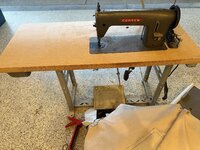
After some time of looking and looking…..and looking. I pulled the trigger on a used Consew 118. It is an industrial rated machine with a walking foot. It is middleweight rated, but will sew vinyl and lighter leather. It came with several #17 needles and some 92 thread so I can at least set it up. I still need to get some oil (I plan on using liberty synthetic oil) and clean/oil it. A servo upgrade is definitely in the plans. What else should I put on my list of needed items. I have shears, and the measuring tools.
 

Attachments

  • IMG_2886.jpeg
    IMG_2886.jpeg
    1,007 KB · Views: 2

cgrutt

Well-known member
Joined
Mar 4, 2016
Messages
8,300
Congrats and good luck with it! Good staple puller if you are redoing old seat cushions. I'm going through this right now. I bought the C S Osborne with the 2 narrow points from Sailrite but it is available on Amazon and others. Works great along with a pair of diagonal cutters (I'm using an old pair that are pretty flat and wide comparatively to other styles they might be kleins). A seam ripper is handy Im using one from sailrite but single edge razor blades work good too. Buy a 100 pack they get dull quick. Pneumatic upholstery fine wire stapler and stainless staples (Im using 316 which are somewhat harder to find than 304). Not strictly needed but glad I bought... large self healing cutting mat with rotary cutter and a 6x24 (min) guide. I bought Fiskars mat and titanium rotary cutter and the Sailrite guide. Extra bobbins and a bobbin case. Oh, assortment of pressure feet for your machine including piping and zipper feet if you dont have them.

ETA a hand plier stapler with short staples. I bought bostitch but staples are too long need to get shorter ones. Really helps keeping panels aligned.
 
Last edited:

IndyGarage

Well-known member
Joined
Apr 29, 2010
Messages
9,705
Location
Indy
After some time of looking and looking…..and looking. I pulled the trigger on a used Consew 118. It is an industrial rated machine with a walking foot. It is middleweight rated, but will sew vinyl and lighter leather. It came with several #17 needles and some 92 thread so I can at least set it up. I still need to get some oil (I plan on using liberty synthetic oil) and clean/oil it. A servo upgrade is definitely in the plans. What else should I put on my list of needed items. I have shears, and the measuring tools.
Looks like a good machine. Looks like it's older but doesn't have a ton of use. If they are used a lot, the paint gets scrubbed off under the arm from material being pulled past. I would clean it up good before you use it - looks like there is some corrosion on the bobbin cover.

That one looks like a vertical hook machine because the bobbin seems to be on the left side of the needle vs. the right. Mine have all been on the other side. I don't know if there's an advantage or disadvantage to that. I think it's a bit harder to change the bobbin, but you get used to it pretty quickly.

You can learn to use a clutch motor, they've been in use for 75 years and have worked fine. The only problem is they are a little touchy at slow speeds. I prefer the Servo motor and would buy one if I was buying new, but it's not a necessity. If you've learned on a homemaker machine you'll be shocked at the speed of a commercial machine. You get used to that too, and over time you can't stand to use the slow machine anymore. Enjoy.
 

dscheidt

Well-known member
Joined
Apr 26, 2017
Messages
2,895
After some time of looking and looking…..and looking. I pulled the trigger on a used Consew 118. It is an industrial rated machine with a walking foot. It is middleweight rated, but will sew vinyl and lighter leather. It came with several #17 needles and some 92 thread so I can at least set it up. I still need to get some oil (I plan on using liberty synthetic oil) and clean/oil it. A servo upgrade is definitely in the plans. What else should I put on my list of needed items. I have shears, and the measuring tools.

Get the service manual and read it before you do anything to the machine. Get some bobbins, too. In a production setting, you only need two -- you wind one while you're sewing, using a second cone of thread. You're unlikely to be doing enough that having two cones of the same thread makes sense, so winding several before you start work saves you having to stop in the middle to wind one. a bobbin box is also a good idea.

consult the manual and get the correct needles, peferably in an assortment of sizes. (Be prepared to get very confused about this, because needles are nuts. Lots of different systems, all with six names.) Note the manual will probably say it can use a range of sizes, but it probably requires timing adjustments to go from the biggest to the smallest.

You'll also want a machine light, having light right at the needle makes seeing what you're doing a lot easier. get a bendy one, not a spring articulated one, trust me on that.

Then, practice.
 

dscheidt

Well-known member
Joined
Apr 26, 2017
Messages
2,895
You can learn to use a clutch motor, they've been in use for 75 years and have worked fine. The only problem is they are a little touchy at slow speeds. I prefer the Servo motor and would buy one if I was buying new, but it's not a necessity. If you've learned on a homemaker machine you'll be shocked at the speed of a commercial machine. You get used to that too, and over time you can't stand to use the slow machine anymore. Enjoy.

Clutches on sewing machine predate the electric motor, they were originally lineshaft driven.
The problem with most clutch motors is the clutch is shot. No one adjusts them, no one lubricates them, and they're grabby as all get out. Properly set up, they're actually pretty easy to use, and work well. But worn out, they ****, and for what a servo costs, a worthwhile upgrade. they're also a lot quieter, which is a nice bonus.
 
OP
O

Ohmthis

Well-known member
Joined
Jan 20, 2013
Messages
3,014
Location
Outside of Louisville KY
Looks like a good machine. Looks like it's older but doesn't have a ton of use. If they are used a lot, the paint gets scrubbed off under the arm from material being pulled past. I would clean it up good before you use it - looks like there is some corrosion on the bobbin cover.

That one looks like a vertical hook machine because the bobbin seems to be on the left side of the needle vs. the right. Mine have all been on the other side. I don't know if there's an advantage or disadvantage to that. I think it's a bit harder to change the bobbin, but you get used to it pretty quickly.

You can learn to use a clutch motor, they've been in use for 75 years and have worked fine. The only problem is they are a little touchy at slow speeds. I prefer the Servo motor and would buy one if I was buying new, but it's not a necessity. If you've learned on a homemaker machine you'll be shocked at the speed of a commercial machine. You get used to that too, and over time you can't stand to use the slow machine anymore. Enjoy.
I have only run it to make sure everything worked as designed (forward, reverse, walking foot, bobbin filler, motor and clutch) and even with my knowledge of feathering the clutch, OMG it’s fast. There is some rust on the bobbin cover that I am going to remove. I plan to clean/oil it up and practice on some scrap fabric. If I can’t learn to control the clutch, I’m going straight to a servo set up. Thanks for helping out.
 
OP
O

Ohmthis

Well-known member
Joined
Jan 20, 2013
Messages
3,014
Location
Outside of Louisville KY
Get the service manual and read it before you do anything to the machine. Get some bobbins, too. In a production setting, you only need two -- you wind one while you're sewing, using a second cone of thread. You're unlikely to be doing enough that having two cones of the same thread makes sense, so winding several before you start work saves you having to stop in the middle to wind one. a bobbin box is also a good idea.

consult the manual and get the correct needles, peferably in an assortment of sizes. (Be prepared to get very confused about this, because needles are nuts. Lots of different systems, all with six names.) Note the manual will probably say it can use a range of sizes, but it probably requires timing adjustments to go from the biggest to the smallest.

You'll also want a machine light, having light right at the needle makes seeing what you're doing a lot easier. get a bendy one, not a spring articulated one, trust me on that.

Then, practice.
I have downloaded the manual and have read through it a couple of times. I won’t even play around and run it without cleaning and oiling it. My grandmother was a stickler for cleaning and oiling her machines every time she used them. She said there was no better way to destroy them than not oiling them.
I have 4 or 5 bobbins and several needles (the needles are loose and I have no idea the size. They are probably good enough to practice on scrap material). What size do you suggest (I do know the machine will dictate somewhat)?
Yes, I agree on a light. The one on it ***** and also ***** at putting it where you’d probably want it. I have seen the LED magnetic type. Thanks for helping out.
 
OP
O

Ohmthis

Well-known member
Joined
Jan 20, 2013
Messages
3,014
Location
Outside of Louisville KY
Clutches on sewing machine predate the electric motor, they were originally lineshaft driven.
The problem with most clutch motors is the clutch is shot. No one adjusts them, no one lubricates them, and they're grabby as all get out. Properly set up, they're actually pretty easy to use, and work well. But worn out, they ****, and for what a servo costs, a worthwhile upgrade. they're also a lot quieter, which is a nice bonus.
I will say that the manual doesn’t explain how to adjust or lubricant the clutch, I’ll try to find more info on this. I need to also look up how to tension the threads correctly. I’m hoping to get it in my shop and start getting it ready. I need to put a new (and grounded) cord on it, but may wait until I go with a servo or not.
 

IndyGarage

Well-known member
Joined
Apr 29, 2010
Messages
9,705
Location
Indy
Clutches on sewing machine predate the electric motor, they were originally lineshaft driven.
The problem with most clutch motors is the clutch is shot. No one adjusts them, no one lubricates them, and they're grabby as all get out. Properly set up, they're actually pretty easy to use, and work well. But worn out, they ****, and for what a servo costs, a worthwhile upgrade. they're also a lot quieter, which is a nice bonus.
I never adjusted the clutch motors I had. They seemed to work just fine, but they did make it tricky to learn to sew on an industrial machine. I suspect if you never learned a car or motorcycle clutch the concept would be totally new.

I'd never sewn on any machine (other than playing with my mom's when i was a kid) before my first industrial, so I didn't really know what to expect. I had to learn everything from scratch. My first machine was a Singer Industrial, but it was a non-walking foot machine - so it wasn't what i needed but I used it anyway. I had to use the clutch because I couldn't afford to replace the motor. When I finally did, it was nice, but I already had the clutch technique down, so I can't say it was a game changer.
I have only run it to make sure everything worked as designed (forward, reverse, walking foot, bobbin filler, motor and clutch) and even with my knowledge of feathering the clutch, OMG it’s fast. There is some rust on the bobbin cover that I am going to remove. I plan to clean/oil it up and practice on some scrap fabric. If I can’t learn to control the clutch, I’m going straight to a servo set up. Thanks for helping out.
The difference with the clutch motor is it runs all the time and you use the pedal to engage the drive, while the servo turns on when you push the pedal. I would say the clutch has more power than a servo at low RPM, but it's also much harder to control - you've got to feather the clutch. Once you learn to sew at higher speed, the advantage of the servo is negated somewhat. Obviously since the clutch motor runs all the time it makes more noise and probably uses more electricity, but the ones I've had were pretty quiet.

There are a bunch of oiling points on the machine - the owners manual will point them all out. I just put a drop of oil in every oil point before I sit down to work - it takes about 30 seconds. Probably the only tricky things are: 1. balancing the tension between top and bottom threads and 2. Timing the machine.

You shouldn't really ever have to time the machine, but industrial machines tend to sew really heavy materials and sometimes they get jammed and the timing gets thrown off. I've bought two used machines that needed re-timing. If the machine skips or misses stitches or won't stitch, then the timing is probably off. It sounds really onerous, but it's not. The way a sewing machine works is the needle pierces the material stretching the top thread through. Just as the needle starts to come back up and the top thread bulges away from the needle a metal hook passes by, grabs the top thread and loops it over the bottom thread, forming a stitch. So setting timing is setting up the relationship between the position of the needle and the position of the hook. It needs to be pretty precise, because a machine can do a up to 80 stitches a second. Usually you set the position of the needle at a certain distance above the bottom of the stroke and then loosen a screw and set the tip of the hook to line up with the needle at that point. Every machine is slightly different so you need the manual to do this.
 
OP
O

Ohmthis

Well-known member
Joined
Jan 20, 2013
Messages
3,014
Location
Outside of Louisville KY
I never adjusted the clutch motors I had. They seemed to work just fine, but they did make it tricky to learn to sew on an industrial machine. I suspect if you never learned a car or motorcycle clutch the concept would be totally new.

I'd never sewn on any machine (other than playing with my mom's when i was a kid) before my first industrial, so I didn't really know what to expect. I had to learn everything from scratch. My first machine was a Singer Industrial, but it was a non-walking foot machine - so it wasn't what i needed but I used it anyway. I had to use the clutch because I couldn't afford to replace the motor. When I finally did, it was nice, but I already had the clutch technique down, so I can't say it was a game changer.

The difference with the clutch motor is it runs all the time and you use the pedal to engage the drive, while the servo turns on when you push the pedal. I would say the clutch has more power than a servo at low RPM, but it's also much harder to control - you've got to feather the clutch. Once you learn to sew at higher speed, the advantage of the servo is negated somewhat. Obviously since the clutch motor runs all the time it makes more noise and probably uses more electricity, but the ones I've had were pretty quiet.

There are a bunch of oiling points on the machine - the owners manual will point them all out. I just put a drop of oil in every oil point before I sit down to work - it takes about 30 seconds. Probably the only tricky things are: 1. balancing the tension between top and bottom threads and 2. Timing the machine.

You shouldn't really ever have to time the machine, but industrial machines tend to sew really heavy materials and sometimes they get jammed and the timing gets thrown off. I've bought two used machines that needed re-timing. If the machine skips or misses stitches or won't stitch, then the timing is probably off. It sounds really onerous, but it's not. The way a sewing machine works is the needle pierces the material stretching the top thread through. Just as the needle starts to come back up and the top thread bulges away from the needle a metal hook passes by, grabs the top thread and loops it over the bottom thread, forming a stitch. So setting timing is setting up the relationship between the position of the needle and the position of the hook. It needs to be pretty precise, because a machine can do a up to 80 stitches a second. Usually you set the position of the needle at a certain distance above the bottom of the stroke and then loosen a screw and set the tip of the hook to line up with the needle at that point. Every machine is slightly different so you need the manual to do this.

Thank you! I’ve sewn with a domestic machine in light fabrics. My grandmother taught me how as a youngen. I’ll post a link to the machine from Consew’s website. Maybe you guys can educate me more.
 
To avoid these ads, REGISTER NOW!
Top Bottom