
You are using an out of date browser. It may not display this or other websites correctly.
You should upgrade or use an alternative browser.
You should upgrade or use an alternative browser.
Show me your tiny pipe wrenches
- Thread starter Mallen
- Start date
Mintgrun
Well-known member
I posted this in the "Smallest pipe wrench ever?" thread. I think I won the contest.

 www.garagejournal.com
Smallest Pipe Wrench ever ?
Unfortunately, only the main part. :sad: STEELCRAFT Made in West Germany So made between 1973 and 1989. :dunno: Need GJs help to make this whole again !!
www.garagejournal.com
d42jeep
Well-known member
This seems like fun. 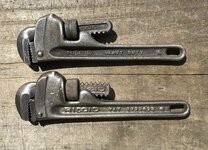
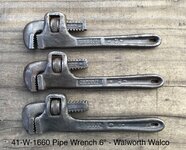
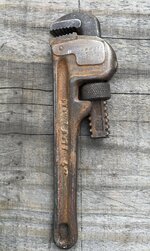

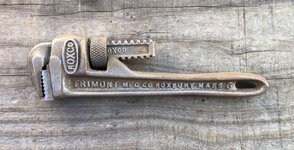


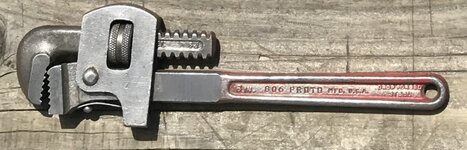

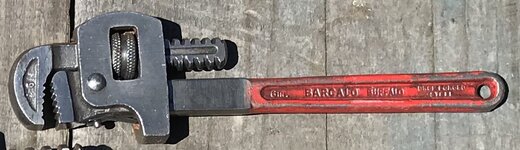 Here are some 6” pipe wrenches.
-Don
Here are some 6” pipe wrenches.-Don
Mintgrun
Well-known member
Wis it made out of decent metal so it will hold up to use?
Chrome-plated pot-metal would be my guess. I think it's intended use was hanging on a keychain.
Tom

steaks&anvils
Well-known member
For adjusting your crack "pipe"?Chrome-plated pot-metal would be my guess. I think it's intended use was hanging on a keychain.
Tom


Actually, the amount of broken vape parts I see on the curb, it's probably for those.
Indexmill
Well-known member
What are some examples of what one used (still use?) these babies for. Maybe small gas pipe ages ago for lamps?
I keep them around for rounded fasteners. They are vastly better than vise grips IF you can get them in there. A vise grips force depends on how tight you clamp it on. A pipe wrenches gripping force depends on how hard you turn it. They work especially well to get rounded flare nuts off. Often if you can get the nut out, you can take just the flare off, put a new nut on and reflare it without having to splice or replace the line. That's why I'm always looking for smaller ones.
The little Stilson pattern is the smallest I have found so far. 6" Stillsons are about one size smaller than a 6" modern style pipe wrench. Wikipedia claims that pipe wrenches come as small as 3" but I think someone's speaking with their ******. I've never been able to find one less than 6". I've actually been considering making one.
The little Stilson pattern is the smallest I have found so far. 6" Stillsons are about one size smaller than a 6" modern style pipe wrench. Wikipedia claims that pipe wrenches come as small as 3" but I think someone's speaking with their ******. I've never been able to find one less than 6". I've actually been considering making one.
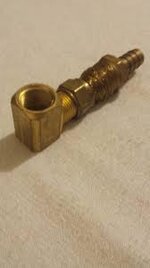
For adjusting your crack "pipe"?
Actually, the amount of broken vape parts I see on the curb, it's probably for those.
You may be on to something there.
steaks&anvils
Well-known member
That is a flash back.You may be on to something there.
Back to the thread, I have used a small 6in pipe wrench under the sink in cramped areas. Also on sprinkler stuff, down in the soupy water filled hole.
Private Lugnutz
Well-known member
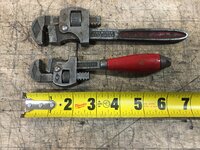
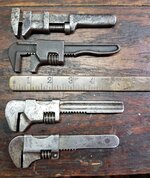
I looked into this a few years ago, checking early Walworth, Ridge, Erie, Nye, and USHCO-Lawson catalogs, and the smallest size they all advertised was 6". What made me curious was the fact that bicycle, auto, and even some early monkey or screw type adjustable wrenches coming in truly tiny sizes. Less than 6" (pic attached). They are all wrenches of similar design with very similar construction in terms of a handle and static jaw and moving jaw. I even have a 3" bicycle wrench (Gormully & Jefferey) that is a working wrench, not an ornament. It made me start thinking about the reasons a pipe wrench would be effective at 6" but apparently ineffective at 4" or 5" and I really couldn't come up with anything convincing. The only thing I can think of is the dynamic jaws in bicycle, auto, and monkey wrenches are much more stable, not as free-floating, and perhaps that created fragility under stress.I've never been able to find one less than 6".
Attachments

Debcrow
Well-known member
I think its more related to what size pipe was available. There were always small nuts and bolts but pipe sizes have been pretty well fixed for ages.
I *think* a small pipe wrench should work, but I have noticed that many 6" Stillsons are bent. So maybe. One thing to keep in mind of you want a really one is that the typical modern pattern pipe wrenches in the 6" size have much larger heads than the Stillsons. A 6" Stillsons has a head that would be about the same size as a hypothetical 4" modern style pipe wrench.
Private Lugnutz
Well-known member
The smallest pipe sizes included in the vintage period (1930s, 40s) pipe wrench charts I reviewed was 1/8" to 1/2". Typically mated with 6" Stillson pattern pipe wrenches. Interestingly, non-Stillson pattern (Ridge, Erie) 6" pattern wrenches were mated only with 3/4" pipe. They were never charted for 1/8" to 1/2". I'm guessing because they were bulkier. The jaws would obviously close on a 1/8" pipe as well as a Stillson. So the question might come down to leverage. The jaws of a conceptual pipe wrench with 4" OAL would certainly close on a 1/8" pipe as well as the jaws of a 6" OAL wrench. Would the 4" handle provide enough leverage to turn it? Was the industry's answer no?I think its more related to what size pipe was available. There were always small nuts and bolts but pipe sizes have been pretty well fixed for ages.
Provincial
Well-known member
There is a certain amount of distortion involved in making a tight pipe joint. This requires a proportional amount of torque to be applied. The torque arm of a 4" pipe wrench would be somewhat less than 3", and perhaps approaching 2" if the force was applied near the center of the handle. That isn't much leverage.
Provincial
Well-known member
I finally found a table for torque on pipe fittings. It was in a Chilton's manual for 1997-2003 Ford pickups.
1/8" Pipe: 5-8 ft./lbs. or 60-96 in./lbs.
1/4" Pipe: 12-18 ft./lbs. or 144-216 in./lbs.
Assuming a 3" effective distance applying the force to the handle (which is optimistic, since your fingers will use most of the handle) you would need to apply 20 to 32 pounds of force to the handle to get recommended torque on a 1/8" pipe thread.
1/8" Pipe: 5-8 ft./lbs. or 60-96 in./lbs.
1/4" Pipe: 12-18 ft./lbs. or 144-216 in./lbs.
Assuming a 3" effective distance applying the force to the handle (which is optimistic, since your fingers will use most of the handle) you would need to apply 20 to 32 pounds of force to the handle to get recommended torque on a 1/8" pipe thread.
Private Lugnutz
Well-known member
That seems to bear out our mutual conjecture that the industry reached optimal minimum form factor at 6".
bbbarracuda
Well-known member
- Joined
- Jun 1, 2008
- Messages
- 709
"optimal minimum form factor at 6"."
That's what she said.
That's what she said.
Private Lugnutz
Well-known member
HAHA!
The following may also be true.That seems to bear out our mutual conjecture that the industry reached optimal minimum form factor at 6".
1: You just done need anything smaller for pipes, because the 6" Stillsons pattern can tighten the smallest of pipes (it's true that my use of them for rounded fasteners is not their intended purpose)
2: A hypothetical 3" pipe wrench may well be small enough that you can bend it with the force you can produce with your hand. While it might even be able to tighten the pipes that it fits, it might be that it's too easy to go to far. You wouldn't want to make something that weak, even if it could do the job. Everyone would blame the company that made it.
Oldtuleguy
Well-known member
- Joined
- Nov 4, 2017
- Messages
- 10,486
Yes pipes just are not that small, at least the garden varieties I have seen.
rlitman
Well-known member
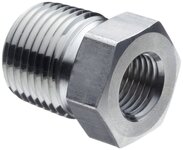
1/8" NPT is still around 3/8" OD, and fittings are move like 5/8", so a much smaller wrench wouldn't serve well. While I've seen plenty of 1/16" pipe with soldered and flared fittings, and I know 1/16" NPT is on the charts, I've never seen 1/16" NPT. Probably because it's only slightly smaller than 1/8" NPT. At these sizes, the wall thickness starts to dominate.Yes pipes just are not that small, at least the garden varieties I have seen.
Here's a 1/8" NPT to 1/16" NPT bushing:
genog
Well-known member
Wow
Those little 6"ers are tiny
I thought these two 8"ers were small....

Those little 6"ers are tiny
I thought these two 8"ers were small....
aheroicdose
Active member
Most tanks have a little open end wrench, kinda like the ones you get with rotary tools to torque the chuck down. I've never understood why they don't give you a baby pick, for the o rings.For adjusting your crack "pipe"?
Actually, the amount of broken vape parts I see on the curb, it's probably for those.
slik560
Well-known member
The smallest I have are a 10' Ridge and a 10" Bridgeport. I put the little 4" Snap-On crescent in for scale.

slowtwitch73
Well-known member
The tiny antique wrenches shown are for nuts/flats, not pipe. Typical pipes are larger so no need for anything < 6"
rlitman
Well-known member
1/16" NPT is the smallest threaded pipe size I've heard of, but its OD isn't all that much smaller than the far more common 1/8" NPT which isn't that much smaller than 1/4" NPT. Which is why I don't see any call for pipe wrenches under 6".The tiny antique wrenches shown are for nuts/flats, not pipe. Typical pipes are larger so no need for anything < 6"
Bobioz1
Well-known member

genog
Well-known member
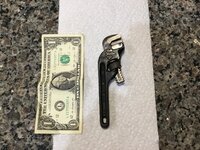
Found one
A little Rigid 6"er
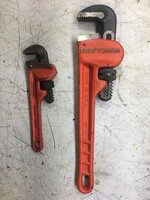
A little Rigid 6"er

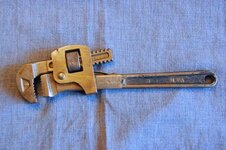
This Stillson-pattern (made by J.H. Williams for Woolworth and branded as Blue Banner) is nominally an 8-inch, but it measures 7-1/2 when closed. From the discussion up-thread, it appears these li'l guys were mainly used on nuts-with-problems. I also have two 8-inch Ridgids in Ridge Tool's own style, one straight and the other angled.
Attachments


d42jeep
Well-known member
More doll house tools currently in our Granddaughter’s doll house. Grandma found them at an estate sale around a week ago. They went through the evaporust just like regular sized tools.Doll house pipe wrench.


I did find an 8” Trimo recently.


-Don
A trip to the local ReStore netted this 8-inch Tiger Tools pipe wrench (actually 7 inches long). The (G/S) in the stamping indicates this was made for Gamble-Skogmo, a chain of auto tool stores. AA lists the brand under Vlchek, who apparently made these in the late 1930s to early 1940s.
The wood handle was originally painted black but the paint was in patchy shape when I got the wrench (for $1). So I sanded it down to bare wood, then finished it with stain and shellac.
The wood handle was originally painted black but the paint was in patchy shape when I got the wrench (for $1). So I sanded it down to bare wood, then finished it with stain and shellac.
Attachments

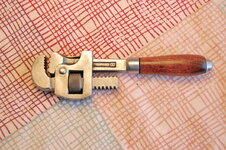
Nice job on the handle. Good looking wrench.A trip to the local ReStore netted this 8-inch Tiger Tools pipe wrench (actually 7 inches long). The (G/S) in the stamping indicates this was made for Gamble-Skogmo, a chain of auto tool stores. AA lists the brand under Vlchek, who apparently made these in the late 1930s to early 1940s.
The wood handle was originally painted black but the paint was in patchy shape when I got the wrench (for $1). So I sanded it down to bare wood, then finished it with stain and shellac.
Nice job on the handle. Good looking wrench.
Thank you. I waffled a bit on redoing the handle because — patina or something. But it came out all right. It has given me the idea of doing the same to a 10-inch GTD pipe wrench, also with a wood handle needing a redo. Normally I would avoid even buying one of these as I like to be able to use the tools I have, and an all-steel construction just seems more robust overall.
Last edited:
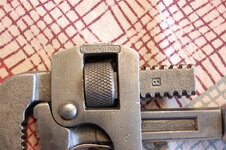
And a recent find (antique shop, Minocqua, Wisc.) — a 6-inch Walworth Stillson. I've sanded, stained, and shellacked the wood handle and cleaned up the metal.
It's a cutie and a keeper.
Edited to ask — What does the stamping on the non-Stillson side of the moveable jaw mean? (Looks like an old fashioned dip-pen nib, but that can't be the case.)
It's a cutie and a keeper.
Edited to ask — What does the stamping on the non-Stillson side of the moveable jaw mean? (Looks like an old fashioned dip-pen nib, but that can't be the case.)
Attachments


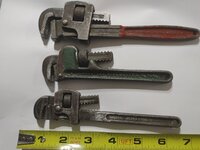
Not sure if anyones still paying attention to this thread, but it’s all new to me because I just found it. So here’s my contribution, my smallest pipe wrenches 6-10”. 

I’ve made it somewhat of a hobby to restore old tools, mostly pipe wrenches. Some back close to their original state, some not so much…….
I’ve made it somewhat of a hobby to restore old tools, mostly pipe wrenches. Some back close to their original state, some not so much…….