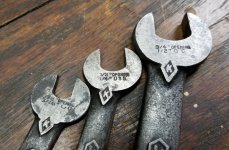
Back in April 2018 (page 29, post #580) I found a Lectrolite tappet wrench (11/16" x 5/8") with apparent and still mystifying alloy compositional content quantity markings (.05 CHROME, .05 VANADIUM). Unaiu has a Tru-Fit combo wrench with the same markings, but abbreviated with less shank space on either side of the Tru-Fit panel.
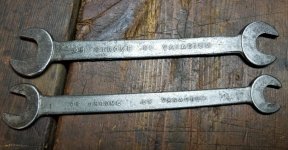
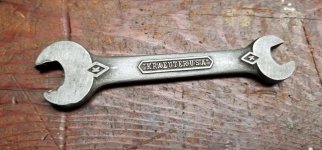
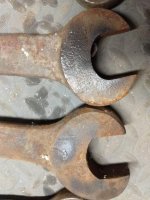
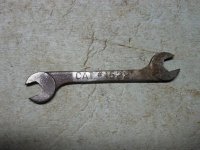
Today I found another example to go with the first, and lucky for me, it's a 9/16" x 1/2".
See Pic 1 before clean-up.
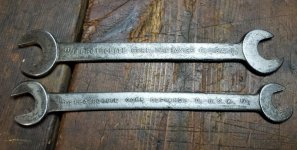
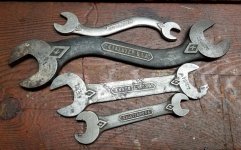
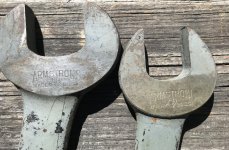
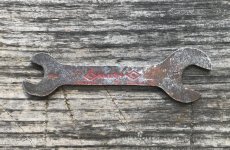
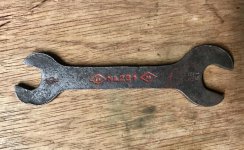
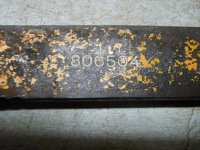
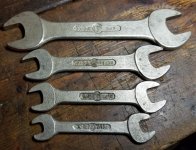
See Pic 2 and 3 for photos of both wrenches together on the bench.
They both have the remains of cadmium-plating. As I have often said, cadmium plating is not enough to date a tool to WWII by itself, since it was used as an economy line alternative finish before and after the war. The apparent alloy percentage markings would seem to help date these wrenches to wartime, but the numerical values just don't make sense.
AISI 86XX and 87XX "New Emergency" steel formulas were triple alloys, with .5% Nickel, .5% Chromium, and .25% Molybdenum. On top of that, Vanadium was banned in any amount.
The other NE formula was a Manganese (1.45%) steel that used .6% Nickel, Chromium, or Molybdenum.
One possible explanation is late war production when the Vanadium restriction was lifted, but ".05" is extremely, nonsensically low for a double alloy, implying a third and primary content, or these values refer to something else other than percentage.
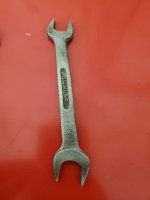
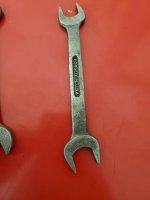
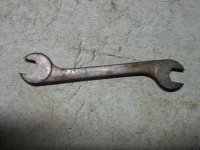
Don has a bunch of these that seem to be from just after this era production, with the same 'LECTROLITE, DEFIANCE, O.' markings on the top side, but instead of the strange composition markings on the flip side, they just have Tru-Fit 8001 and 8002 markings.
Whether the alloy quantity markings or the Tru-Fit 8001/8002 markings, these are the only two sizes of these Lectrolite tappet wrenches I have ever seen.









 )
)