
You are using an out of date browser. It may not display this or other websites correctly.
You should upgrade or use an alternative browser.
You should upgrade or use an alternative browser.
Show us your handplanes
- Thread starter trainman1385
- Start date

MattGarage
Well-known member
Here are my planes. The 220 and the jack plane are absolute gems. I could plane down a sequoia in a couple days with the big 'un. The 220 is insanely sharp and just does what it's supposed to every time. I bought that other box plane originally but it takes more finesse. The number 4 probably gets equal use to the 220. All Stanleys of various vintage. The bunny rabbet gets no love as I use the table saw for rabbets now.
Attachments

esben57
Well-known member
Memsahibs uncle passed away last year, helped clear the undercroft of his house. Found this amongst other items.
His father in law was a carpenter so this must be of some age.


His father in law was a carpenter so this must be of some age.
RTM
Well-known member
Yup, a Stanley Bedrock 604. Great user. Flat tops on the cheeks means it's a little later.
esben57
Well-known member
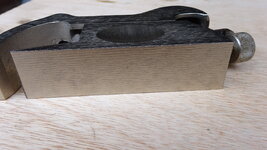
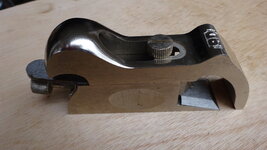
My mother worked at Stanley tools in Sheffield. She bought this as a souvenir because she liked it, not sure if it wasn't a special edition run.
Sat in my toolbox unused for decades, just sold it to someone who will appreciate it.
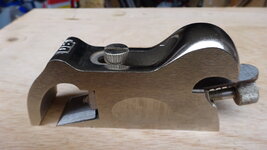
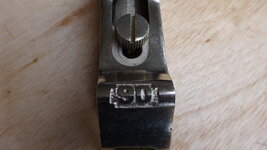
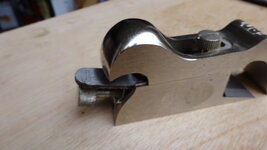

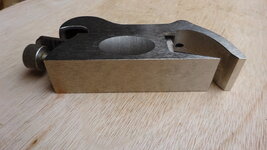

Sat in my toolbox unused for decades, just sold it to someone who will appreciate it.
Attachments


CRSINMICH
Well-known member
esben: It would be a sad thing to sell your mother's tools. I hope whoever bought it will make use of it.
Old tool guy
Well-known member
- Joined
- Apr 13, 2023
- Messages
- 3,646
I recognize memsahib, but not undercroft …Memsahibs uncle passed away last year, helped clear the undercroft of his house. Found this amongst other items.
CRSINMICH
Well-known member
esben: The plane that you posted appears to be a Stanley Bed Rock (Type 5). It probably was made around 1911. Stanley only introduced Bed Rocks in 1898 so yours is an early model. Here is a section of a Bed Rock type study from Virginia Tool Works that shows what to look for. Your plane is very old and it looks like it's in very good condition under the rust and dust. Congratulations.
RTM: I didn't see your post until later or I wouldn't have bothered. I've BOLOed a 604 in the wild for a long time but haven't found one yet.
RTM: I didn't see your post until later or I wouldn't have bothered. I've BOLOed a 604 in the wild for a long time but haven't found one yet.
Attachments

Last edited:
esben57
Well-known member
Uncle G's offspring were throwing everything in the skip (think they are dumpsters across the pond) until I asked to look first.esben: The plane that you posted appears to be a Stanley Bed Rock (Type 5). It probably was made around 1911. Stanley only introduced Bed Rocks in 1898 so yours is an early model. Here is a section of a Bed Rock type study from Virginia Tool Works that shows what to look for. Your plane is very old and it looks like it's in very good condition under the rust and dust. Congratulations.
RTM: I didn't see your post until later or I wouldn't have bothered. I've BOLOed a 604 in the wild for a long time but haven't found one yet.
Seen lots of Stanley's from the Sheffield factory, not one of those though. Had a trawl and read articles similar. £127 GBP bought it.
Ex steelworks mate (buddy?) of mine had his Father die last year and he was a joiner/carpenter.
His collection of planes is vast, from spokeshaves box planes to large jack planes. Some are boxed and well looked after, mostly British makes.
They have sentimental value though, where as I am more mercenary.
LWB
Well-known member
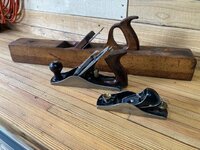
I cleaned these up last year. I have an old scrub plane to look after soon. I'm very pleased with all of them. They're a joy to use.
CRSINMICH
Well-known member
LWB: That's a nice looking set. Is there a name stamped into the wooden jointer or on it's cutting iron?
LWB
Well-known member
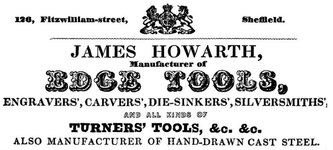
Thank you. James HowarthLWB: That's a nice looking set. Is there a name stamped into the wooden jointer or on it's cutting iron?

CRSINMICH
Well-known member


LWB
Well-known member
LWB: You are lucky. James Howarth (& Son) of Sheffield made fine edge tools for a long time - as far back as 1835.
I am. IIRC my research lead me to believe it was from the early 1900's. The previous owner bought it in PA, brought it back to Canada and had it on display for over 20 years. I love it and it works perfectly.
RTM
Well-known member
And the mass makes it unstoppable, right? I have a few really dense 15"-22" woodies that are just beasts on tough grain.I am. IIRC my research lead me to believe it was from the early 1900's. The previous owner bought it in PA, brought it back to Canada and had it on display for over 20 years. I love it and it works perfectly.
LWB
Well-known member
Yep. I’m amazed at how it works effortlessly.And the mass makes it unstoppable, right? I have a few really dense 15"-22" woodies that are just beasts on tough grain.
Farmer J.
Well-known member
Found an interesting article about an early smoothing plane dug up in London:

 taths.org.uk
An early Cabinet Maker's smoothing plane from the City of London
Although eighteenth century woodworking tools survive in surprising numbers, they are mainly found to be specialised types whose slumber in their owners' tool chests was rarely disturbed, like panel-fielding planes, moulders, or gouges. Everyday tools such as hand saws, hones and mallets are...
WisJim
Well-known member
As I mentioned in the garage sale thread, I got a bunch of tools at a local online auction this week. One lot had a few planes, including this Stanley 45 with 14 blades and a Stanley 140 block plane missing the side plate and in generally rough shape. Not sure what I will do with them as they are both duplicates in my shop collection of planes.
There were a couple of wooden planes and a large 7 or 8 size jointer plane that I need to take pics of after I do some cleaning up.

There were a couple of wooden planes and a large 7 or 8 size jointer plane that I need to take pics of after I do some cleaning up.
WisJim
Well-known member
I took a picture of my plane shelves above my bench when I was in the garage this morning. These are the ones that I use (or might use) and keep out where I can find them. I decided that I'm not a plane collector and have sold a lot of the rare or valuable ones so I can buy drilling tools, which is what I do collect.
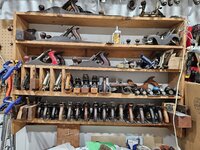
Old Radar
Well-known member
Despite all evidence to the contrary...I decided that I'm not a plane collector

RTM
Well-known member
That could be a fun jigsaw puzzle.
Looking at the picture on my phone blown up as big as possible and saying okay 48, 49 couple 78 style, a woodie dado plane, couple of big bedrocks can't remember the numbering on my circular planes. A different type of puzzle, deciphering them by what you can see, without checking blood & gore.
CRSINMICH
Well-known member
WisJim: It looks exactly like a collection to me too. I call the planes I have an accumulection. Like yours they are also the planes I use and the ones I think I might use sometime, or I intend to use them someday.
CRSINMICH
Well-known member
VAUGHAN & BUSHNELL Drop Forged planes
If you look at the bottom of the catalog page you'll see Lincoln Cast Planes. Vaughan only made drop forged planes for a short time so be careful which one you may buy.
FYI: Vaughan is still in business. They sell quality Made in USA hammers.
Attachments


RTM
Well-known member
they are supposedly great planes. Tried to pick up one at an auction a few years back, and it went way above my comfort level.I hadn't heard about this plane maker before today. They made the beds of their planes by drop forging steel instead of casting iron. The frog and receiver is similar to Stanley Bedrock.
VAUGHAN & BUSHNELL Drop Forged planes
CRSINMICH
Well-known member
RTM: I read that the V&B drop forged planes sold for a lot of money but not their cast iron models. That's why I cautioned people to be careful.
d42jeep
Well-known member
I found this at a sale on Friday. Looks like it needs some restoration to me. I didn’t see any markings.
-Don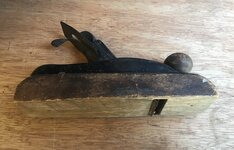

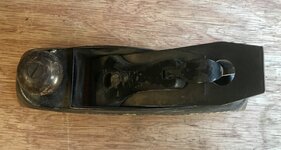
-Don
crguy
Well-known member
The base is either modified or replaced. Not much value there.I found this at a sale on Friday. Looks like it needs some restoration to me. I didn’t see any markings.
-Don
Modern Garage
Well-known member
That's pretty well worn judging by how big the mouth has become. I have one very similar and just as worn that came from a garage sale. The women there said it had belonged to their father, a carpenter who had built most of the houses in the small town where they lived. I refinished the wood and sharpened and tuned it as well as I could. I have no intention of using it but if the story was true it deserved a little care in its retirement. Worth? That can be a variable concept...
Joe
Joe
RTM
Well-known member
Yup, it is well worn, and unevenly at the toe. With more pix we might be able to tell who made it.
I’ve repaired one by resoling the existing wood, but it’s a labor of love, it will never be sold. And I still have two more queued up.

I’ve repaired one by resoling the existing wood, but it’s a labor of love, it will never be sold. And I still have two more queued up.
d42jeep
Well-known member
I didn’t pick it up because I thought that it might be valuable. I hoped that it might be of interest to a collector. I would be happy to send it along to anyone that would like to own it, maybe someone right across the bay. It could be added to the two currently in line.
-Don
-Don
CRSINMICH
Well-known member
Three planes and a plane iron
I've just returned from a vacation (holiday) in Northern Ontario. I was pleasantly surprised to find several good wooden planes at prices that were bargains even without the favorable (favourable) exchange rate.The first is a J Kellogg dado plane complete with nickers and depth stop.
The next one is a JP Milliner & Co beading plane with some boxing. Milliner & Co. was located in Kingston, Ontario.
The last plane is a Greenfield Tool molding plane. The photo is a close-up of the spring lines on the toe.
The plane iron was made by I&H Sorby. Information about early Sorby tools is screwy and contradictory so at best guess this iron is perhaps nearly close to being circa 200 years old - maybe. It's fairly certain that Sorby didn't make planes and that their irons were meant for infill planes. The weird blob above the writing is supposed to be a sheep being carried. Don't ask why.
Attachments


Last edited:
I have zero interest in anything hand planes or woodworking, however, I constantly see hand planes at yard sales and I always leave them behind. Are there any particular brands or models that are actually worth picking up?
RTM
Well-known member
If it says Marples, Speier, Ayrs, looks anything like this, grab them


If it says Corsair, PEXTO, Shelton, Great Neck, Stanley in a shade of blue, Buck Bros in metal, run run run run away. Plus others, if they feel cheap.
Many others in between those extremes that are a case by case basis.
If it says Corsair, PEXTO, Shelton, Great Neck, Stanley in a shade of blue, Buck Bros in metal, run run run run away. Plus others, if they feel cheap.
Many others in between those extremes that are a case by case basis.
Thank you for the info. How about the old large wooden block ones (not sure how else to describe them or exactly what they are referred as).If it says Marples, Speier, Ayrs, looks anything like this, grab them
If it says Corsair, PEXTO, Shelton, Great Neck, Stanley in a shade of blue, Buck Bros in metal, run run run run away. Plus others, if they feel cheap.
Many others in between those extremes that are a case by case basis.
RTM
Well-known member
Wooden bench planes or moulding planesThank you for the info. How about the old large wooden block ones (not sure how else to describe them or exactly what they are referred as).
(Block planes are generally 6-8” metal planes, made to use with one hand. Lots of discussion on where the name comes from.)
Again, generally a **** shoot. Most you will find are well worn, the mouth is often gaping wide. Bodies often cracked, wedges and irons mismatched or missing, handles busted.
I have found a few nice ones over the years, I have at least 2 dozen bench, and 100 moulding planes. And handled 3-4x that many, and put them back down.
Unless you find a beauty cheap, you won’t make much flipping them. Most moulding go for $15 or so, unless unique or pristine, or both. Rare ones can go for crazy $$, but without a scorecard I could not tell you. I often see lots, with lots of mismatched pieces, and have bought a few, cuz of one good one.
Bench planes, in good shape, can go $15-75, depending on usability. They are harder to learn to use than their metal bodied peers, and wear out much faster. There are some boutique makers selling new ones that easily hit $300, and most are works of art.
Unless you plan on using them, buying to flip can be a challenge. I have trouble giving away my extras.
Old Radar
Well-known member
Picked up this 18" Tower and Lyon corrugated sole plane at an estate sale this week. Spent a few hours cleaning it up. Most of the chrome is gone but most of the japanning is still there. 

O.R. Chaplin's patent date on the iron is May 7, 1872 with a couple of improvements from John J. Tower on July 4, 1876.

Normally the tote was Vulcanized (Goodyear!) India rubber but the plane was also available with wood or metal totes. I can't swear this is an original wood tote option--it may be, but there's a hole too close to the edge that someone drilled. Can't imagine that was any manufacturer's work and it is extraneous for this plane.

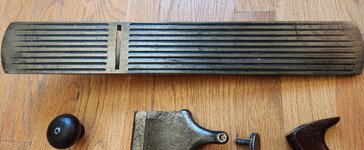
This is a Type 3 from between 1887 and 1899. The "PAT. APLD. FOR" stamped on the dovetail tote collar places this example close to the date the patent was granted--March 13, 1888. See 2nd photo above.
Australian jeweler, Peter McBride did a type study 17 years ago that helped me type this example, but also has left me a little confused about the model number. His narrative and the table entitled Original Patent Chaplin’s Iron Plane Sizes indicate the 18" corrugated plane should be #1208. On this corrugated, 18" plane, under the tote and a thick layer of japanning is what appears to me to be the number 208 with no "1" preceding it. According to McBride, this number is indicative of a smooth bottom. Above the number is an unreadable series of characters that I can will myself to see as "x & x CO. But no matter how hard I squint, I cannot see T & L CO.
If anyone has any familiarity with this type of plane, I'd love to hear it.

O.R. Chaplin's patent date on the iron is May 7, 1872 with a couple of improvements from John J. Tower on July 4, 1876.
Normally the tote was Vulcanized (Goodyear!) India rubber but the plane was also available with wood or metal totes. I can't swear this is an original wood tote option--it may be, but there's a hole too close to the edge that someone drilled. Can't imagine that was any manufacturer's work and it is extraneous for this plane.
This is a Type 3 from between 1887 and 1899. The "PAT. APLD. FOR" stamped on the dovetail tote collar places this example close to the date the patent was granted--March 13, 1888. See 2nd photo above.
Australian jeweler, Peter McBride did a type study 17 years ago that helped me type this example, but also has left me a little confused about the model number. His narrative and the table entitled Original Patent Chaplin’s Iron Plane Sizes indicate the 18" corrugated plane should be #1208. On this corrugated, 18" plane, under the tote and a thick layer of japanning is what appears to me to be the number 208 with no "1" preceding it. According to McBride, this number is indicative of a smooth bottom. Above the number is an unreadable series of characters that I can will myself to see as "x & x CO. But no matter how hard I squint, I cannot see T & L CO.
If anyone has any familiarity with this type of plane, I'd love to hear it.
Last edited:
crguy
Well-known member
I have owned several Chaplin planes. The optional wood handles were painted black like the wood front knob. Your handle isn't an original. The early Chaplin planes had nickel plated cast iron handles & knobs.Picked up this 18" Tower and Lyon corrugated sole plane at an estate sale this week. Spent a few hours cleaning it up. Most of the chrome is gone but most of the japanning is still there.
O.R. Chaplin's patent date on the iron is May 7, 1872 with a couple of improvements from John J. Tower on July 4, 1876.
Normally the tote was Vulcanized (Goodyear!) India rubber but the plane was also available with wood or metal totes. I can't swear this is an original wood tote option--it may be, but there's a hole too close to the edge that someone drilled. Can't imagine that was any manufacturer's work and it is extraneous for this plane.
This is a Type 3 from between 1887 and 1899. The "PAT. APLD. FOR" stamped on the dovetail tote collar places this example close to the date the patent was granted--March 13, 1888. See 2nd photo above.
Australian jeweler, Peter McBride did a type study 17 years ago that helped me type this example, but also has left me a little confused about the model number. His narrative and the table entitled Original Patent Chaplin’s Iron Plane Sizes indicate the 18" corrugated plane should be #1208. On this corrugated, 18" plane, under the tote and a thick layer of japanning is what appears to me to be the number 208 with no "1" preceding it. According to McBride, this number is indicative of a smooth bottom. Above the number is an unreadable series of characters that I can will myself to see as "x & x CO. But no matter how hard I squint, I cannot see T & L CO.
If anyone has any familiarity with this type of plane, I'd love to hear it.

Old Radar
Well-known member
Thanks for confirming my suspicions about the tote. Are you able to comment on the model number or the stamp on the base plate?