RTM
Well-known member
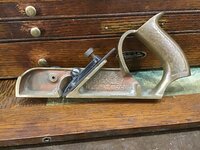
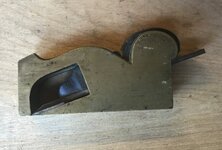
Side rabbet plane, dual, might be Stanley, but looks more like a Preston.What is this tool?

Side rabbet plane, dual, might be Stanley, but looks more like a Preston.What is this tool?

 www.woodcraft.com
Preston side rabbet plane. Here's some info about it. https://www.findmytool.co.uk/preston-side-rebate-plane-small-review.php#gsc.tab=0What is this tool?
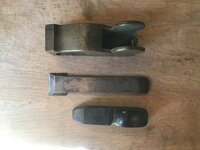
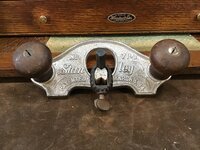
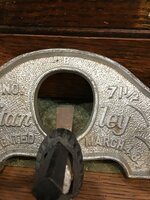
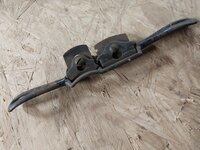
Here is an unusual plane I found on Saturday at a Tahoe garage sale. According to the seller, it belonged to his grandfather and had been stored on a shelf in his garage for 30 years. It came with quite a few very old woodworking tools.
-Don
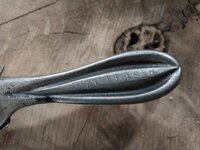
It has some markings but I don’t know who made it. I didn’t want to post it on the Stanley thread.
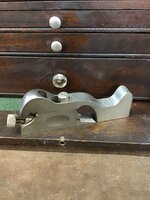
Another picture of the plane.
-Don
These were part of the garage sale lot as well.
-Don



So, Ararat asked about two planes sitting off to the side in a previous picture I shared. Those two are a pair of side rabbet planes, the wooden brother, and simpler version of the dual rabbet Preston that he just posted inadvertently. I got these in an auction lot out of the UK, they sat un bid on, so my starting bid grabbed them. Then shipping to a UK central location that consolidated them into a 30kg box, wherein they got shipped to Virginia, unpacked, and reshipped to me in the SF bay area. By that time, tho I'd saved a bunch of money, I kinda forgot the sellers description, so making this up as I go.These got my attention




Thanks for the pics, those are cool. I think the Marples blade looks like it was a regular rabbet plane blade that was used to replace a worn out blade for the side rabbet. The other one seems like a replacement as well since it is a little crude for a planemaker original blade I would think. It's cool that these were used so much they were using up blades. That's the first time I've seen this design in wooden planes. I'll send some pics of the metal side rabbet when I get back from vacation.So, Ararat asked about two planes sitting off to the side in a previous picture I shared. Those two are a pair of side rabbet planes, the wooden brother, and simpler version of the dual rabbet Preston that he just posted inadvertently. I got these in an auction lot out of the UK, they sat un bid on, so my starting bid grabbed them. Then shipping to a UK central location that consolidated them into a 30kg box, wherein they got shipped to Virginia, unpacked, and reshipped to me in the SF bay area. By that time, tho I'd saved a bunch of money, I kinda forgot the sellers description, so making this up as I go.
This pair of wooden planes was (probably shop made in my mind, until I looked harder into the last two pictures about 5 minutes before I posted) made by a J. Wood in either London or Manchester, has been through 3 owners before me, and I can't wait to sit down and try to get them to work.
So here they are together, and this pic should give you a pretty good clue that they may have been home made. I took this one tonight, when I finally had a few minutes to sit and think.
Here is an end view of one of them
And a perspective view, giving a general idea of the geometry involved.
And a back view giving another clue into the shop made theory.
It wasn't until I took this pic that I realized that they weren't twins. All of the solo pics were the right hand unit from the 1st pic.
This sort of adds to the wondery, was this blade built this way from the start of the plane's life, or was it created to fill in when the original got lost, or worn out. Not lots of sharpening room on the right iron above
And the 3 previous owners appear to have been, in no particular order
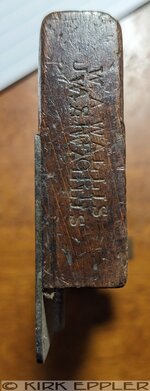
P. Tadd, stamped 2x each plane, pic one
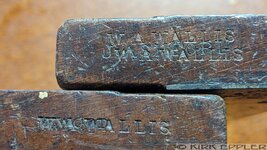
W A Wallis,, stamped 2x on each toe (2nd pic) and once on each heel (no pic)
But he very rudely stamped over a prior owner, looking like J ASHFORD and a J. WOOD
You can see the J. Ashford here, in the top pic, and J. Wood a bit in the lower pic
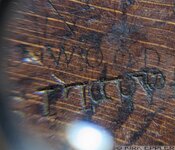
And J. Wood here with a little magnification assistance. After taking this pic, I looked in my Goodman's British Planemakers 4th edition, and realized this name was actually here. The other names stamped were already checked before tonight. (Being stamped 2-6 times is usually not a makers' mark.)
The page from Goodman's. Holy cow, these things may be coming up on 200 years old Whether James or Jason made them I will never know.
And for those who don't know, a rabbet plane is usually for cutting a rebate (notch) on the side of a board, like cutting a notch to hold a piece of glass in a picture frame. This side rebate (rabbet) plane is used for cutting the vertical face to make the notch a bit wider, or to make a groove wider for a tongue and groove joint. Because of this 2nd usage, these planes are very skinny near their cutting edge, so they can drop into a groove, and make it a touch wider. I like having wooden planes around, I much prefer my wooden rabbets over my Stanley 78 for being users. Generally less fiddly
I have a couple of modern side rabbet versions, but one just is too big for many groove applications, and the other is kinda tiny. I used this one once to fix a wonky groove for 1/8" thick plywood on a toolbox, which they had undersized the sheet, and under cut the groove, so it was a real bear to get square to itself. Somewhere I have a Stanley 79, but the one edge is busted up.
Oh well, gotta go to bed, enjoy
Me too, that's why I grabbed them. Wondered if the three owners meant not easy to use, but 3 owners over 200 years is pretty good lifetime. Wearing out a blade as well.That's the first time I've seen this design in wooden planes. I'll send some pics of the metal side rabbet when I get back from vacation.
While we are on the topic, here is a heartbreaking video on the Preston side rabbet. (Not mine, but I know the guy)Here's pictures of the Preston side rabbet. There's also a larger model but I haven't seen one for sale in my price range.
When they have the guides the price goes way up. I had a priority package get lost for almost 2 months. It was an ebay item coming from the Midwest somewhere and the tracking got stuck in "moving through the network". One day I happened to check the tracking and it got scanned in Mississippi. Couple days later it made it. Did the guy make another one?While we are on the topic, here is a heartbreaking video on the Preston side rabbet. (Not mine, but I know the guy)
I didn't ask him yet, waiting for it to come up in conversation. I weighed in on the screw development to avoid any mods to the factory build.When they have the guides the price goes way up. I had a priority package get lost for almost 2 months. It was an ebay item coming from the Midwest somewhere and the tracking got stuck in "moving through the network". One day I happened to check the tracking and it got scanned in Mississippi. Couple days later it made it. Did the guy make another one?
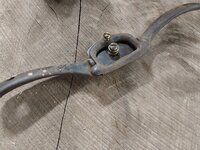
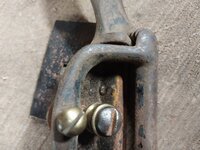
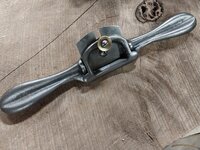
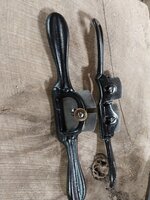
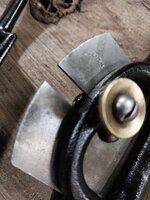
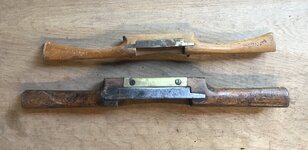
Looks a lot like my Stanleys, the top has a custom screw. Forget if there are casting numbers.Here's a spokeshave I have that I can't ID. No marks on the blade. Brass screw for the mouth adjustment, steel screw with a knurled brass collar that makes it easier to tighten and loosen.
There's an "S" mark on the casting on the inside that is like early Stanley planes that have the "S" and "B" casting marks. So maybe an early No 53 with some cool customizations?

I think the S casting mark looks like the ones on the Stanley planes from the late 1800's. It's weird that it doesn't have 53 on the back though. I didn't find anything like the screws in the Spokeshave book. I got it because it was different and hoped there was a mark on it, but nothing on it except for the S.Looks a lot like my Stanleys, the top has a custom screw. Forget if there are casting numbers.
The screws are an oddball thread, so some special work required.
There were several different years with different knobs.
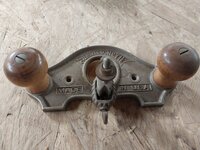
Models manufactured c. 1899-1901 may have "B" casting marks. From: https://www.hyperkitten.com/tools/routers/stanley/stanley_71.5.htmlWell it’s kinda a hand plane or is it early router plane note it has no plate holes and date. So would this be type one?
Yes it has the B casting mark on topModels manufactured c. 1899-1901 may have "B" casting marks. From: https://www.hyperkitten.com/tools/routers/stanley/stanley_71.5.html
Nice, it's in great condition.
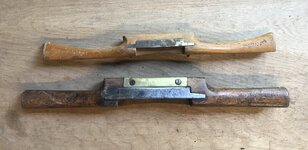
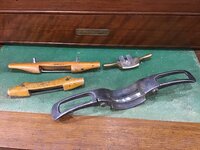
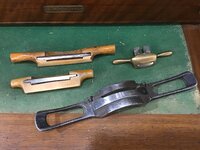
The larger metal one is a cobbler's heel shave. The small one is a patternmaker spokeshave.A few unmarked ones I cant identify
The wooden ones look like beech wood body spokeshaves. They may be user made or their marks worn off over time.A few unmarked ones I cant identify
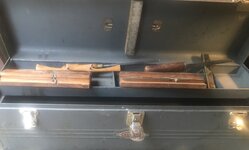
That makes sense as I got them in a rare 31 inch gerstner pattern makers toolbox loaded with tools. Got them from a friend and were his buddies toolbox. Jim and his buddy were both pattern makers in the 1950s to the 80s. A number of unusual tools in the box making my head scratch. A few of the cool tools they used.The larger metal one is a cobbler's heel shave. The small one is a patternmaker spokeshave.
That's great you were able to get that box from your friend. I don't know what those tools are for. Is the one with the wooden handle a marking knife?That makes sense as I got them in a rare 31 inch gerstner pattern makers toolbox loaded with tools. Got them from a friend and were his buddies toolbox. Jim and his buddy were both pattern makers in the 1950s to the 80s. A number of unusual tools in the box making my head scratch. A few of the cool tools they used.
It was nice to get Hops toolbox and both him and Jim are 82 years young. Yes that is correct and carvers on the other end. The brass semicircle is for finding the edge to draw a radius with your compass dividers. The brass round disk is an old school shaper for the drill press and it works like a power planer and not OSHA approved . The steel balls are used for doing radius with hot wax or other materials.
My 71 1/2 is type 5. About 25-35 years younger than yours.Yes it’s got the B casting mark and thanks for the link
Ohh, like that ideaThe brass semicircle is for finding the edge to draw a radius with your compass dividers.
Nice. Did your patternmaker friends make it?Interesting Stanley 192 in bronze
The Smith is not marked except for the blade. The Bailey has Bailey's Patent on the back of one handle and the 1858 Patent date on the other. According to the Spokeshave book the earlier models had the Bailey mark on the brass adjustment screw.@ararat Beautiful spokeshaves and interesting as they have No markings and just on the iron.