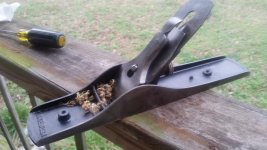
Here's what I was working on today. A Defiance branded plane. Still need screws for the handles. Anybody know what size I should be looking for? I know it was made before 1953 so I'm hoping it's not an obsolete thread form. Still have to flatten the sole but I'll need a bigger piece of tile.

You are using an out of date browser. It may not display this or other websites correctly.
You should upgrade or use an alternative browser.
You should upgrade or use an alternative browser.
Show us your handplanes
- Thread starter trainman1385
- Start date
jimreed2160
Well-known member
Defiance planes were made by Stanley and those tote rods probably fit. It is an unusual pitch--like most of their plane hardware.
EOC_Jason
Well-known member
It's probably a fine thread but an oddball size that normally isn't stocked. Never hurts to go to the store and try though.
CRSINMICH
Well-known member
jumbo: Stanley is known for their oddball proprietary thread pitches. You could probably find the correct Stanley threaded rods online, but you'd probably end up spending a bit of dough. You should be able to find a beater/donor plane for about the same amount and you'd have some extra parts left over. Uhh, has anyone warned you about the hand plane rabbit hole yet?
Last edited:
crguy
Well-known member
It's probably a fine thread but an oddball size that normally isn't stocked. Never hurts to go to the store and try though.
Going to any store will be a waste of time. It's a Stanley proprietary thread 12-20.
jumbo: Stanley is known for their oddball proprietary thread pitches. You could probably find the correct Stanley threaded rods online, but you'd probably end up spending a bit of dough. You should be able to find a beater/donor plane for about the same amount and you'd have some extra parts left over. Uhh, has anyone warned you about the hand plane rabbit hole yet?
I'm afraid I've already slipped in... that was just yesterday's project. I have another Bailey I'm still tweaking and a Dunlap that needs going through. There's also a small japanese block plane that's been giving me fits. And, I'm on the lookout for more.
I'll try to get a shot of all of them tonight. My cleanup isn't as thorough as what a lot of folks do. I just get them into usable condition.
M_George
Well-known member
Defiance planes were made by Stanley and those tote rods probably fit. It is an unusual pitch--like most of their plane hardware.
Stanly planes use a 12-20 thread size. I was able to find a tap and die that size on the Web. Don't remember the company's name except they were an industrial tool supplier from New York. They didn't carry a bottom tap so I bought two straight taps and ground the point off one of them.
EOC_Jason
Well-known member
Good to know... Learn something new every day... 
CRSINMICH
Well-known member
SCIOTO TOOL #33 (OR #33)
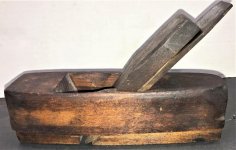
I got this plane yesterday at a barbershop of all places. At first I thought it was a coffin smoother. It turns out it's a rabbet plane. As near as I can figure it's a curved rabbet plane. Scioto Tool was yet another name that Ohio Tool/Auburn Tool/Ogontz Tool used to market their stuff. If you look closely at the Scioto Tool stamp on the toe you'll see that someone stuttered when they did it. That's why I'm not sure if it a #3 or a #33. Scioto did make a #3 coffin smoother. They also made a #33 which they called a Pump Plane. Anyone know what that is? Also the heel has a metal strike button. That's the first time I've seen that.Attachments


jimreed2160
Well-known member
CRS--That is an interesting little plane you have there. Generic woodies were often modified by users for special tasks but yours looks like it came that way.
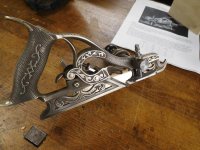
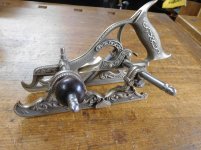
Here is a plane that I just spiffed up. It is a Hamler bronze replica of a Stanley Miller 1870 plow plane.
Here is a plane that I just spiffed up. It is a Hamler bronze replica of a Stanley Miller 1870 plow plane.
Attachments
hsvtoolfool
Well-known member
Just a guess, but I don't think that's a curved rabbet plane. I think it's a
regular a coffin smoother and the bottom came off. Or perhaps someone
intended to add a nice ironwood bottom and then never got around to it.
We need a photo of the bottom with the blade installed. From what I can
see, the plane would not function very well as a smoother or a rabbet. The
mouth appears to be too wide to take a decent shaving. From a rabbet
perspective, the blade side must be exactly aligned with the side profile.
Yours looks like it would stick out from the side too much. For this type of
a rabbet to work well, it would also need a nicker in front of the blade to
slice cross-grain.
regular a coffin smoother and the bottom came off. Or perhaps someone
intended to add a nice ironwood bottom and then never got around to it.
We need a photo of the bottom with the blade installed. From what I can
see, the plane would not function very well as a smoother or a rabbet. The
mouth appears to be too wide to take a decent shaving. From a rabbet
perspective, the blade side must be exactly aligned with the side profile.
Yours looks like it would stick out from the side too much. For this type of
a rabbet to work well, it would also need a nicker in front of the blade to
slice cross-grain.
CRSINMICH
Well-known member
SCIOTO PLANE pt. 2
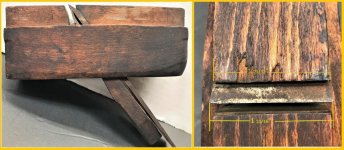
Here are a couple more pictures and some measurements. In case it's hard to read, the mouth is 1 21/32" wide at the front and at the rear. The blade measures 1 11/16" at the cutting edge. That's only a difference of 1/32". I believe that on most rabbet planes the blade is a shade wider than the opening.NOTE: I just found out that Scioto was a budget line for Ohio Tool. That might explain some things?
jim: Love that Art Nouveau Hamler's!
Attachments
Last edited:
crguy
Well-known member
IMO that's an owner modified plane, and not very useful at this point. .
Joe Huld
Well-known member
I am 99% sure that the 1950's defiance planes used the same 12-20 threads as other Stanley bench planes. It is a non standard thread so you'll have to salvage the parts from another Stanley plane. Stanley was among the first users of rolled rather than cut threads and likely standardized on 20 tpi to keep tooling costs down..
jimreed2160
Well-known member
I am 99% sure that the 1950's defiance planes used the same 12-20 threads as other Stanley bench planes. It is a non standard thread so you'll have to salvage the parts from another Stanley plane. Stanley was among the first users of rolled rather than cut threads and likely standardized on 20 tpi to keep tooling costs down..
I have refurbed hundreds of Stanley planes from 1880s thru 1950s. Almost all of them use non standard or oddball threads. But they were very consistent. A tote toe screw from 1877 will fit a plane body made in 1950. Because of this, the simplest way to find repair screws and rods is to collect several planes and create your own boneyard.
hsvtoolfool
Well-known member
I believe that on most rabbet planes the blade is a shade wider than the opening.
True. But most rabbet/fillister planes cut along a straight line. Only the
bottom of the blade does the real work.
I suspect you'd need a nicker ahead of the blade to cut a curve with
this type of plane. But having both sides curved allows you to always
cut "downhill" on the grain. You'd always work from each end toward the
bottom of the radius at the middle.
With the blade installed, the mouth looks better but still rather open.
After giving this more thought, I'm convinced this was a user-modified
plane. I doubt someone intended to add some ironwood as a new bottom.
I just found out that Scioto was a budget line for Ohio Tool. That might explain some things?
I agree this is another clue against a rabbet/fillister plane. A cost-conscious
tool line won't offer exotics like a curved rabbet/fillister. They just sell the
basic meat and potatoes in large volume.
But if a craftsman needed to modify a smoother for a special one-off job,
then it makes sense to grab a less expensive tool and go to hacking. It
may been used as a curved rabbet. Another good guess is that someone
had a trough or channel which needed a smooth bottom. The width of the
trough was close to the same width of the blade. By curving the sides of
his plane profile, the craftsman could slightly skew the plane while in the
trough and cut with less effort. I'd also guess that the trough depth was
exactly the same as the plane's inset.
quadrcr87
Well-known member
Here is mine. The kit had good instructions and it was easy to put together. Looks way different then the ones you have though?

CRSINMICH
Well-known member
quad: That's funny! But I can't find any Jetfire information in any of my tool catalogs. Are they foreign? 
crguy
Well-known member
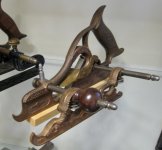
Here is a plane that I just spiffed up. It is a Hamler bronze replica of a Stanley Miller 1870 plow plane.
The originals are so much better:
Attachments
jimreed2160
Well-known member
Crguy--Nice plane. Let me know if you need any cutters for it.
CRSINMICH
Well-known member
STANLEY #71 Type 11 1939-1941
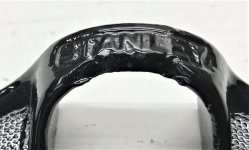
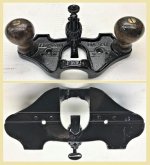
I was going to wait until I had restored this so that I could post Befores and Afters of it. If you'll look closely you might notice that the metal parts are painted black - ALL the metal parts - on all sides. It was part of an Old Tool decorating motif at a local barbershop. All of the metal on all the tools hanging on the walls were painted black - on all sides. The barber told me that he had a hard time stripping the knobs. Ironically, the knobs are the only part of this router that should be painted black.People who are familiar with 71's will probably have noticed that this one is missing the throat closing device. It was apparently broken off. However, from 1892 to 1908 Stanley 71's, Types 4, 5, 6, and 7 were manufactured without a throat closing device. So instead of thinking that the missing device is a defect, I prefer to think that this router is a Type 11 with features of a Type 4. Yeah, that's what it is. I'm sure of it.
Attachments
Last edited:
jimreed2160
Well-known member
Even so, it is still a handy plane. I have always thought the throat closing gimmicks were cheesy, so good riddance to it.
CRSINMICH
Well-known member
jim: I know you have a Type 1 so, when I saw this article in an 1895 issue of Building Age announcing the introduction of Stanley's router plane, I clipped it. It looks just like a #711/2. You probably already know that #71 types 1-3 (1884-1892) were all like that. I've read that there were lots of guys like us who didn't like the new features of the type 4 and the #711/2 was born.
Attachments

Last edited:
jimreed2160
Well-known member
That is a great promo piece. Those guys in 1895 sure lived in an age of technological advancement!
That is a great promo piece. Those guys in 1895 sure lived in an age of technological advancement!
Still simple but effective 123 years later. It’s a great design and a wonderful tool that delivers as advertised. One of my favorite planes to use. The Stanley #271 is another winner in my book.
Jim C.
Thrumcap
Well-known member
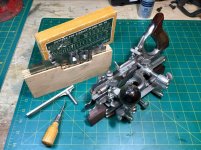
Here’s a Stanley 45 Type 20 plane I cleaned up recently.
All there except for the box and long rails.


Thrumcap

All there except for the box and long rails.
Thrumcap
CRSINMICH
Well-known member
Thrumcap: Nice #45! They do have a lot of parts to clean and sharpen, don't they? I was able to find a complete one in the box but I'm going to make a slightly larger box out of wood so that I don't have to completely disassemble the plane to get it back into the box. You should have fun playing with it. They do so many things.
jimreed2160
Well-known member
Thrum--Good score on your #45. They are getting harder to find.
CRS--You are on the right track with the box. The Stanley boxes are good only for keeping things together to sell. Once you start using, you tire quickly of having to totally disassemble the plane after each use. I keep mine in a plastic tool box but lots of my ww buddies like to make a handsome home for theirs out of wood.
Whatever you do for storage, be sure to add an extra body. I keep an extra body in my box loaded with the 1/8" cutter because that is the most frequently used cutter. Sure is nice to have it ready to go.
CRS--You are on the right track with the box. The Stanley boxes are good only for keeping things together to sell. Once you start using, you tire quickly of having to totally disassemble the plane after each use. I keep mine in a plastic tool box but lots of my ww buddies like to make a handsome home for theirs out of wood.
Whatever you do for storage, be sure to add an extra body. I keep an extra body in my box loaded with the 1/8" cutter because that is the most frequently used cutter. Sure is nice to have it ready to go.
CRSINMICH
Well-known member
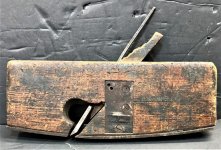
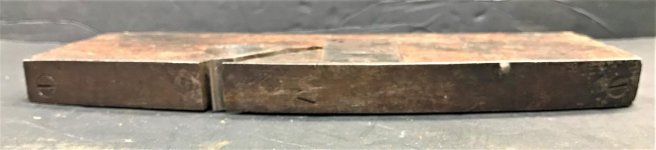
SANDUSKY TOOL #50
LATE EDIT: This might be a #151. The first 1 is barely visible. 151's were described as rebate planes.
Yet another Ohio Tool Company nom-de-plane. It's in as-found condition and so unusual with so many issues that I'm just going to post pictures and ask for comments and observations.
Attachments

Last edited:
crguy
Well-known member
SANDUSKY TOOL #50Yet another Ohio Tool Company nom-de-plane. It's in as-found condition and so unusual with so many issues that I'm just going to post pictures and ask for comments and observations.
That's hardly even good firewood.
CRSINMICH
Well-known member
Jim C: I thought it was a compass plane too. I haven't located a picture or a drawing yet but I did run across a description of a Mathieson (London plane maker) compass plane that said it had a steel sole. It said that the steel allowed for a closer mouth opening. I thought it was probably added to the Sandusky by the guy who inlayed the steel scraps to prevent further splitting but then I noticed the carefully offset screw holes. They don't show well in the photos but there are four holes for screws to hold the steel to the sole. They are staggered to one side and then to the other. With a wood sole that narrow having the screws in a line might lead to splitting.
Btw, Sandusky did make croze (crozes?). Those were the coopers' tools for cutting the groove around the inside of a barrel for the flat round tops and bottoms to fit into. I've been looking for one of them for awhile.
Btw, Sandusky did make croze (crozes?). Those were the coopers' tools for cutting the groove around the inside of a barrel for the flat round tops and bottoms to fit into. I've been looking for one of them for awhile.
Last edited:
jimreed2160
Well-known member
CRS--That plane looks like it has seen lots of use. Since almost everything in the 19th century was made of wood this plane would have found use in many industries. Shipbuilding, carriagemaking, barrelmaking, etc. I think the steel sole puts it in some sort of factory workshop.
CRSINMICH
Well-known member
jimreed: There was something about the plane that I didn't spot at first which is why I emphasized that it was in "as found" condition. Either no one else noticed or they didn't care to mention it. The iron and the wedge are reversed. That may account for the split in the main body and the condition of the wedge. I have wanted to tinker with making a wedge and here is my chance.
I checked the iron carefully and it has a very good laminated edge and still fairly sharp. I plan to do a thorough cleaning and spiff up to see if I can get it into something like working condition. Who knows, I might have a use for it someday.
EVERYONE: Have any of you ever used a fixed radius compass plane?
I checked the iron carefully and it has a very good laminated edge and still fairly sharp. I plan to do a thorough cleaning and spiff up to see if I can get it into something like working condition. Who knows, I might have a use for it someday.
EVERYONE: Have any of you ever used a fixed radius compass plane?
Last edited:
jimreed2160
Well-known member
I have seen it all in "as found" condition. Someone probably just stuck the wedge and blade back into the plane when they both fell out. I doubt anyone used it in that condition. The blade is not supported and would have chattered itself to sleep.
If you have a bandsaw, making a wedge is easy. At least you have a pattern. Once you get it cut out, make a shallow vee stop so you can plane the wedge to its final size.
If you have a bandsaw, making a wedge is easy. At least you have a pattern. Once you get it cut out, make a shallow vee stop so you can plane the wedge to its final size.
Farmer J.
Well-known member
jimreed: There was something about the plane that I didn't spot at first which is why I emphasized that it was in "as found" condition. Either no one else noticed or they didn't care to mention it. The iron and the wedge are reversed. That may account for the split in the main body and the condition of the wedge. I have wanted to tinker with making a wedge and here is my chance.
I checked the iron carefully and it has a very good laminated edge and still fairly sharp. I plan to do a thorough cleaning and spiff up to see if I can get it into something like working condition. Who knows, I might have a use for it someday.
EVERYONE: Have any of you ever used a fixed radius compass plane?
I did see that the Iron and wedge were reversed, but being English was too polite to mention it, ha ha!!
I have never used a plane like that, but I think I remember as a kid seeing a wheelwright smoothing the inside of wheel rim, the 'felloes' with one like that.
jimreed2160
Well-known member
I did see that the Iron and wedge were reversed, but being English was too polite to mention it, ha ha!!
I have never used a plane like that, but I think I remember as a kid seeing a wheelwright smoothing the inside of wheel rim, the 'felloes' with one like that.
Good guess. This would be a good plane to chamfer the edges of the felloes. Since they were made of tough woods like hickory, oak and ash, the metal bottom of the plane would be nice to have.
CRSINMICH
Well-known member
Farmer J: Of course! This plane would be perfect for that. When you think about the millions of wooden wheels that were made over the years, it would make sense that there would have been some specialized tools. Thank you for adding your childhood memory to the discussion and for increasing my vocabulary. Felloe - jolly good word. (I couldn't resist )
)Farmer J.
Well-known member
Farmer J: Felloe - jolly good word. (I couldn't resist
Remember to correctly pronounce it 'fellie', when mentioned in the context of wheels..!
Glad to be of help with this, I used to walk down and watch the village wheelwright after school sometimes whilst waiting for a lift home. Learned a lot watching him, more interesting than school! He used ash for making felloes, it is springy, oak for spokes, and elm for hubs as with it's cross grain was resistant to splitting.
Last edited: