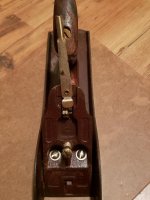
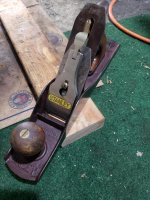
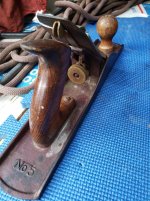
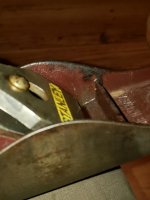
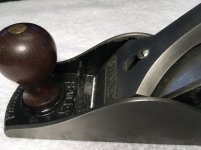
Seems I need to tighten up my Stanley plane history. I saw No5., Bailey, Made in USA, Brass, Wood handles and figured that was old. I didn't know about Cordovan.
My Stanley No4 type 16 has the Orange background to "Stanley"
This Stanley No5 type 21? has Yellow Background to "Stanley"
Know these dates below?
I plugged around on google and ebay to get these. Please let me know if you have more accurate dates.
Stanley stopped using Brass: 60s or 70s?
Stanley stopped using redwood handles?
Plastic handles were introduced in the late 60s. So seemingly late T20-T21.
Stanley logo background colors/years:
No Logo at all: T12 and earlier
Orange T13-T16 (1925-1941)
Orange, NoColor, Black WWII years T16-t17
Yellow T19-T20 (1948-1967)
Stanley bed color:
Black: T1-T19 (1867-1961)
Dark Blue: T20 (1962-1967)
Cordovan: T21 late 1960s
It is possible and likely that a color change happened somewhere in the middle of a type range, as well as having some overflow. These are general observations.
B,
It’s easy to get caught up in old hand planes. There’s a good amount of information out there regarding bench plane types and various nuances between the types. Stanley didn’t waste inventory, so it’s possible to have parts on a factory original plane that came from two consecutive types. Unless you’re collecting, it doesn’t matter too much. If you’re planning to use the plane, get a good one, particularly if it’s a common size like a #4 or #5 in this instance. There’s tons of them out there, so be a little picky. Avoid those with a lot of rust/pitting, missing parts, and badly damaged/cracked wood totes and/or knobs. Basically, make sure the parts are all present and not significantly damaged to the point of needing to be replaced. As you get more experience looking at old planes, you’ll become more familiar with the parts, logos, casting marks, etc., and be able to determine whether or not the plane is “likely” in original factory condition. Again, if you’re just going to use the plane, don’t get too hung up on its type. Just because it’s old doesn’t mean it’s rare or even very valuable. Garage sale sellers and most eBay sellers typically don’t have a clue. I’ve come across garage sale planes that were underpriced (occasionally, but not too often) and some that were absolute junk and way overpriced (more often than not).
If you’re buying planes to collect, then you really need to know what you’re looking at, and unless you’re buying something very rare, condition is everything. That holds true even if the plane is a common size. It’s very easy to overpay for a plane that’s in great USER CONDITION and misidentify it as a true COLLECTOR example. Trust me, I’ve done it myself. If you’re going after old Stanleys, in the future avoid planes that are finished in blue or maroon/cordovan. There’s a learning curve for sure. You just need to keep educating yourself and keep looking at old planes. Good luck but more importantly, do your homework. Basically, make your own luck!! Don’t rely on the seller.
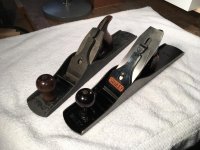
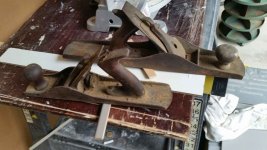
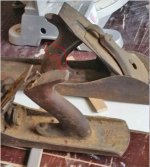
Early on, after I made a few costly mistakes, I came up with this card (see below) that I kept with me when I’d go to tool auctions, swap meets, etc. I wrote it to myself as a reminder not to get carried away. I used it to objectively evaluate a plane before I bid on it or bought it. I remained true to the criteria on the card and occasionally walked away from overpriced planes. It kind of helped me stay disciplined. Maybe it will serve as a guide for you too. Take a look at the two #6 planes below. The example in the foreground represents the Top Collector Quality category on the card. The plane in the background represents the User category. That sort puts things in perspective.
One more thing in regards to obtaining old hand planes. Over the years, people I know, like family, friends, neighbors, co-workers, etc. have learned that I like woodworking and also using/collecting old planes. I can’t tell you how many planes I’ve gotten for free in the past 25 years from people who don’t want them after a spouse/relative dies, when people decide to down size their living conditions, etc., etc. The reasons go on and on. (I’ve actually received a few old woodworking machines in this manner.) So far, all the planes have been between good user quality and junk. Most however, with just a little elbow grease on a Saturday morning, can become solid workers again. Something to consider.
Jim C.