Modern Garage
Well-known member
A folder is exactly what I was originally asking about, but if I can do without it I'm ahead of the game.
Joe
Joe

Yes that is why you push to allow a compound stretch.Thanks Kerry, that's how I did half the seams on my seats, a top sewn felled seam I think it's called? I don't think I'll have any trouble with that thickness, especially with polyester fabric instead of vinyl for binding tape.
When you suggest I "push" the binding on corners I'm guessing you mean to compress it so as to have a little extra material to stretch around the extended radius when I fold it over the outside of the corner, right?
Joe
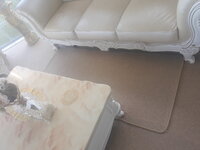
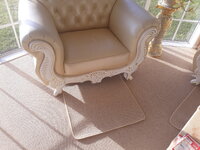
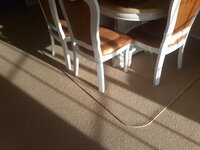

Beautiful mats. I have a few things to do before I start practicing, but I'll let you know how I do.
At first glance I thought that you had an interesting tile pattern on your patio, but then realized it was non-skid tape applied on the step areas. I still like the pattern though...
Joe
good job!It's like anything else, practice makes perfect. When I first looked into sewing ripstop / silnylon, I found a ton of light/fast hikers messing with it and spreading a lot of FUD about how difficult it was to work with. Coincidentally most of that was from folks selling products they'd sewn with that material, to other hikers.
Id does have a tendency not to feed correctly. The foot pulls the lower layer but the top layer doesn't stay aligned well. I learned to hold the fabric before and after the needle under some light tension, then feed it thru at the machine's pace. After that it was easy.
And I also spent a lot of time at the beginning just sewing seam after seam in some fabric scraps. Most of a spool of thread just running practice. One piece looked like a gaudy pinstriped suitcloth.
The bit above about holding purses reminds me of one of the more amusing aspects of sewing. It's walking into a fabric or craft store for something and surprising the sales staff again and again by knowing what I'm after and where it is located in the store. They look at you like you are an alien. Or an invader. I take extra delight in dragging my knuckles as much as possible on such visits. Really confuses people. 'No, I'm not looking for my wife, I'm looking for some canvas duck cloth in a green shade.' was a favorite. Then there was the time I went in around halloween with some very specific fabrics in mind, had the bolts under my arm and was standing at the wall of zippers and buttons, looking for something particular. The staff were actually whispering about me.
[can't seem to find my hammock pix]
found'em


8" dobsonian telescope cover, with integral stuff-sack. The money I saved on this alone paid for the sewing machine.



Question to everyone who has jumped into the sewing pool. I have been accruing a list of various sewing projects and I am getting ready to purchase a machine. I am seeing plenty of used machines come up for sale with a handful of industrial machines as well. Also happy to consider new if that is a better option. The projects are mostly covers for tools and I would also like to repair a couple articles of clothes in the future. I am not seeing sewing as being a phase, but something I will try to incorporate more into projects. Should I just go ahead and jump to an industrial machine or is there a smaller non-industrial machines I should start on. I have always tried to buy tools and machines that allow me to grow into them and I am seeing if that is something as well. Lastly, I am happy to pay a premium for turn key or minimized setup and trouble shooting.
Thoughts? Any resources I should be looking at?
@Bad Mojo, my advice is worth something less than 2¢ so listen to others before you decide what to buy and how much to spend. If you want do fancy stitches or buttonholes, one of the modern machines is the way to go. They have smartphone-like interfaces and you push buttons to make the machine do the job for you. If you want to do straight stitches through leather or heavy denim, I would recommend an old fashioned Singer 15-91 machine. I have one and have used it to make boat covers and some simple upholstery work. Unlike the majority of older machines, the 15-91 has a gear drive rather than a belt and pulley system. The gear drive lets you to sew through some pretty heavy stuff. There's a YouTube video showing one stitching 12 layers of denim. It shows up if you search for: "Layers of denim through 15-91 singer" (I can't post a link directly to the video).I have always tried to buy tools and machines that allow me to grow into them and I am seeing if that is something as well. Lastly, I am happy to pay a premium for turn key or minimized setup and trouble shooting.
Thoughts? Any resources I should be looking at?
I just had to look up what free arm means, but that is good to know about.I bought a table top Brother sewing machine about fifty years ago and it has served me adequately in repairing/hemming jeans etc. Did make a couple of jean jackets way back. Those kind of machines often show up at garage sales, make sure it is a free arm model, so much more versatile.
You mentioned walking foot, which have seen mentioned several times in descriptions. All that is a foot that holds down the material and then helps feed it forward? Is there any reason not to get a walk foot machine. It seems like a good thing.It depends on what work you intend to do.
My first machine I ever sewed on was an old Adler walking foot [in 1977] , I personally can't stand "Home sewing machines" but bought 2 for my wife [who never uses them] and these are easy to store out of sight.
If you get an industrial machine, don't get a "flat sew"machine that clothing factories used [these are too brutal in the speed for a novice] But you can swap the motors on them.
If you're only doing household sewing, [clothing , curtains, pillows etc] a home sewing machine is sufficient.
But if you want to do leather, upholstery , marine, awnings, tarpaulins, tents etc etc get and industrial walking foot.
A walking foot can also do lightweight sewing [with skills acquired] and is best for repair jobs.
Machine of choice is German "Durkopp Adler", then any Japanese machine made by Juki Heavy Industries [Juki, Brother, Consew etc]
I have very little experience with USA Singer [except the heavy leather dinosaur} so I cannot comment.
The whole sewing/textile industry is changing......... Glues, Tapes, and Welding is slowly creeping in
If you are going to play around with PVC's etc , I would recommend a hot-air welder and a silicone roller.
I just hemmed up the bottom of nice coat for my wife using iron on double sided tape [a new skill for me]
I couldn't agree more, and I am glad this forum exist and that there is a place to ask some questions.@Bad Mojo, my advice is worth something less than 2¢ so listen to others before you decide what to buy and how much to spend. If you want do fancy stitches or buttonholes, one of the modern machines is the way to go. They have smartphone-like interfaces and you push buttons to make the machine do the job for you. If you want to do straight stitches through leather or heavy denim, I would recommend an old fashioned Singer 15-91 machine. I have one and have used it to make boat covers and some simple upholstery work. Unlike the majority of older machines, the 15-91 has a gear drive rather than a belt and pulley system. The gear drive lets you to sew through some pretty heavy stuff. There's a YouTube video showing one stitching 12 layers of denim. It shows up if you search for: "Layers of denim through 15-91 singer" (I can't post a link directly to the video).
@Bad Mojo, I like mechanical stuff and for me sewing machines fall into the Holy Cow end of the spectrum. Singer made attachments that do amazing things, including zig-zag stitches. As a kid, watching some of the sewing machine attachments entertained me for hours (pretty sure I was on some kind of spectrum). Here's a zig-zag attachment that works on a 15-91:You mentioned straight stitch, but I have also seen zig-zag and other ones mentioned. I assume there are more types as well, and they each have their place. Do machines allow different types of stitches or do you get specific machines for specific stitch types?
In regards to your comment about how much technology I want in my machine at this point I lean towards less buttons and screens and a more manual experience as I am learning. At some point I could see adding machines with those features, but right now I know I need to get some skill and terminology under my belt before I jump into the deep end.


You mentioned walking foot, which have seen mentioned several times in descriptions. All that is a foot that holds down the material and then helps feed it forward? Is there any reason not to get a walk foot machine. It seems like a good thing.
I have seen the mention of speed before. I assume that it is in regards to how fast material can be feed through the machine and how fast the machine is stitching. So the the whole point for servo drives on some machines is to be able to really control how fast the machine moves through the material.
That is a super interesting point and good to know about the changing ways stuff is being held together.
There were some great nuggets of information there. And thank you for taking the time to explain the servo situation.I ended up buying a Consew 99 in 2010 since it had a walking foot/bed, forward/reverse, straight stitch and zig-zag and a knee lift. The guy I bought it from replaced the clutch motor with a servo motor which was more preferred for me. It seems like it is a medium duty machine I guess as it will handle a mid-weight thread which holds bulky items better.
The clutch motor engages the motor when you press on the "go" pedal and the motor can be quite noisy. The servo motor only runs when the "go" pedal is activated so it is silent until spoken to. The knee lift of a commercial machine over the rear lever of a home owner machine (or at least the ones I'm used to) is very nice so you can use both hands to position your material while you raise/lower the foot and the lever doesn't inadvertently lifted if the material bunches up under it. There are two variations on the walking foot as well, as far as I know. One will have the foot walk forward on each forward stitch to help feed the material and the other has a mirror "foot" in the table with matches the foot motion so each portion reaches forward and grabs the material and feeds it into the target zone for the needle. Reverse is kind of obvious, but I have seen old Singers that didn't have it. I also wanted zig-zag so I could tack off things. The downside to this option is the wide foot which allows for the lateral travel of the needle. This keeps me from sewing welting or doing a narrow stitch along a zipper. Trade offs.
I have a binder attachment for adding 3/4" or 1" wide ribbon to the edge of a piece of material which is a nice way to finish an edge or add protection/strength. I also made a hemmer attachment to roll a consistent edge over to stitch. These are mounted on a swing arm so I can kick them out of the immediate way for making corners and stuff, then realign it and continue with the binding/hemming.
I love the mechanical stuff as well and this only makes me think about carbs or injection pumps on diesels. The level of control over how everything works together is baffling to me.@Bad Mojo, I like mechanical stuff and for me sewing machines fall into the Holy Cow end of the spectrum. Singer made attachments that do amazing things, including zig-zag stitches. As a kid, watching some of the sewing machine attachments entertained me for hours (pretty sure I was on some kind of spectrum). Here's a zig-zag attachment that works on a 15-91:
Because Singer made so many sewing machines back in the day, you can still buy all kinds of repair parts and attachments. This box of attachments is for sale for $40 and is described as "Vintage Singer Low Shank Attachment Box 160977, for 306 and other Low Shank Models- 9 Pieces including Shelled Seams Foot Hemmer."
Don't be surprised if you run across a rabbit while exploring this gigantic hole.
That makes complete sense. And while I want to think I will do this often I know there will be some pauses while doing other projects and knowing I can walk up to a machine and be successful is huge.Bad Mojo
I have an older Pfaff industrial machine that works great for what I do, the thing I would change on it would be to put a servo motor on it. The amount of control you have is phenomenal. When you dont do this every day I can get in trouble very quick with the speed thing! Just my less than two cents.
That video was very helpful and I subscribed to that channel and I think I finally got my suggested videos to understand what I am after now.Go back to my post on Aug 2 [#313] there is a video about walking foot machines.
On a flat sewing machine the presser foot is like a "Ski" so you need to have reasonably good skills [feel] feeding the fabric , especially when sewing on a bias.
Most industrial machines [the cheap ones GJ'ers buy] only have a pedal operated clutch motor, that has a brake on the heel.
It is all or nothing, so a skilled machinist will tap the foot pedal to "flywheel" the position of the needle or limit the speed.
Usually there is only 2 different speed motors available [1300 and 2600 rpm] and the pulleys are fixed.
Most old 2nd hand clothing factory machines are the fast variety.
The heel brakes on them are amazing ! they can stop the machine within about 22° rotation from full speed.
I have been sewing on and off for 46 years and I've never ever came close to putting a needle in my finger [that is the domain of women gossiping in clothing factories]
If you can get your hands on a walking foot machine start with that. All you need is a straight stitch machine and a flat table,
Later if you want to venture into lightweight fabrics try and get a Home sewing overlocker [until then you can use a hot knife to cut]
There were some great nuggets of information there. And thank you for taking the time to explain the servo situation.
I love the mechanical stuff as well and this only makes me think about carbs or injection pumps on diesels. The level of control over how everything works together is baffling to me.
Thats great to know that there are attachments and support for the older machines.
I have chased some already and I am glad I started asking questions because I wasn't sure which path I wanted to take. Everyone in this thread has been a huge help. I also see myself using that line if you don't mind in the future.
That makes complete sense. And while I want to think I will do this often I know there will be some pauses while doing other projects and knowing I can walk up to a machine and be successful is huge.
That video was very helpful and I subscribed to that channel and I think I finally got my suggested videos to understand what I am after now.
The more sewing machines and sewing in general has been explained my brain is just making all these connections between machining and automotive concepts and it has only made this only more interesting.
I look at the needle moving the same way I look at a table saw blade running. Know where it is and sometimes you need to get your fingers close, but no need to get careless.
Thank you everyone, I think I am more focused on the features of the machine that I want to go after trying to find used.

I beg to differ on never needing a Zig Zag. I made a tent out of wool blankets, Wool will tear out in use with a straight stitch. It needs to be able to spread the load, and a Zig Zag can accomplish that. I'm sure other more delicate or less robust fabrics may have similar issues.
If I could have gotten the Baby lock to work right (timing issues) I would have used that, but the Zig Zag worked fine.

Wow, that is a bit of an over the top response for an observation - I never said anything about what you should recommend, read my post again.
As to your insulting comments of my choice of tent materials - Why? Millions have lived and died in wool tents, both in the African and Arabian deserts, and in and around Mongolia. At least a million still do in Mongolia... I think they know more about tent making for extreme weather than Coleman, or even the US army.
You didn't ask, but I spent most of a year researching for this particular car top tent replacement. None of the canvas material was usable, even the wood platform had to be made new. I used the hardware - that was it.
Why wool? Canvas is heavy and durable it's not warm at all unless you line it double layer like the old US army arctic tents. Rip stop? its light -and even colder, even double lined.
Taking a page from the above "primitive" peoples, I decided to give wool a try. The easiest source of wool was army blankets, I bought new ones.
The top is doubled, wool inside and coated rip stop nylon on top. The sides have plastic tarps cut to size that can be clipped to the outside edges of the top. good for most any rain.
I've used this tent for the past 5 years, and never slept more comfortably - I'm sensitive to cold air, it kills my sinuses. in all of my old tents, I had to wear a bandanna mask and a knit cap or by the end of a week I'd likely have bleeding sinuses. Since I started using this tent, no issues, and I don't need the bandanna to keep from ******, sore, and aching sinuses.
The wool breathe as neither canvas nor rip stop will, and does not get musty like canvas can in storage. It does not collect condensation from my breathing, so no more "frozen icicles" (literally) inside when its really cold.t
For me it works great. Will it take a beating like canvas? No, but I don't beat my gear.
So a suggestion; You have a great deal of knowledge, I respect that. But maybe you should consider asking a few questions whan something new to you come up, instead of making pronouncements from that great knowledge base. People can learn from asking questions when they hear of something outside their experience.

Walking foot machines can be found on Craigslist or FB marketplace in your area. You have to know the difference between a standard industrial sewing machine and a walking foot machine. There are a lot of people selling industrial machines and don't understand what a triple feed walking foot sewing machine is. Your best bet is to just look for certain model machines. Consew 206 RB-1 through 5 is a very common walking foot machine and the most common to find parts for. The are a lot of "clone" machines out there and most of them are pretty good machines too. Once you find one you will really enjoy it.A little project update. I had asked for advice a while back about carpet binding for a car project and here's the result. Far from perfect but good enough to be stepped on.
I'm going to look at a walking foot machine next week. Up to now I've been using a 50's era White that will sew thru plywood but thick or tacky material is a bit frustrating. I'm going to sew a new roof for this car and a walking foot and wider stitch length would make that easier.
Joe
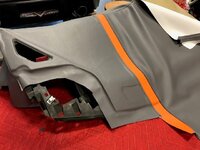
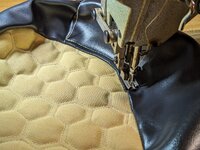
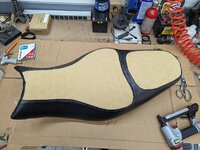
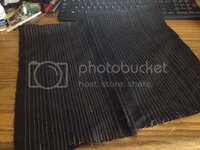
A little project update. I had asked for advice a while back about carpet binding for a car project and here's the result. Far from perfect but good enough to be stepped on.
I'm going to look at a walking foot machine next week. Up to now I've been using a 50's era White that will sew thru plywood but thick or tacky material is a bit frustrating. I'm going to sew a new roof for this car and a walking foot and wider stitch length would make that easier.
Joe

I find it funny you mention that you like horizontal hook machines. I started with a Singer 111W155 that is a horizontal hook machine. I upgraded to A Nakajima 280L (Same machine has a Juki DNU-241H) which is a vertical hook machine and love it. I find it much easier to change bobbins with the vertical hook machine. Also the vertical hook machines I've run and own don't seem to be has finicky about holding on to the threads when you start sewing. Just curious, what do you prefer about horizontal hook machines?I much prefer the horizontal hook machines like the Consew 255. If you’d like your mats to lay flat, you can buy a product called snap back. Glue carpet to the snap back, then hand bind the edge the same way - sewing the top in the ditch. The bottom of the snap back is a rubbery sorta thing. Keeps them from sliding around. It’s available at upholstery supply houses.
Nice job! Once you find a deal on a walking foot machine you will see how much better they sew heavier materials. I too learned about the adhesive on Velcro. I now buy non adhesive backed Velcro. Stay persistent on your search for a walking foot machine. When deals pop up then don't last long!Sometimes you can surprise yourself by not knowing what you can and can't do.
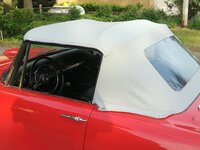
I didn't buy a better sewing machine (long rant that won't appear here) but I still had a convertible top that needed to be made, so I ignored the fact that I shouldn't be able to and I just did.
Maybe would have been easier or quicker with a better machine but it's done and I'm happy with it. Learning that self-adhesive Velcro will gum up a needle in about three inches and soaking all my Velcro in a basin of acetone to remove the sticky back was probably more hassle than accommodating my little old sewing machine but that's something else I learned.
I'm still on the watch for a walking foot machine but I can wait until a ridiculous deal presents itself - this is only a hobby.
Joe