To avoid these ads, REGISTER NOW!

Show us your VFD conversions/installations

whateg01

Well-known member
Joined
Mar 13, 2006
Messages
11,211
Location
doo dah, kansas, usa
I ended up recycling the factory 3 - phase barrel switch to control the low voltage inputs to the VFD. In addition to having it on hand, it's a much more satisfying "clunk" when switching it on than a plasticky little switch.
I used all of the factory switches on my 10ee to control the vfd. I even contrived a way to use the original speed knob to spin a pot for it. Very satisfying for it all to look original on the outside but have modern guts inside.
 
To avoid these ads, REGISTER NOW!

gregs

Well-known member
Joined
Mar 16, 2007
Messages
1,589
Looking like the best way to go is with a 20hp VFD . That should give me at least 10hp usable power which should be more than enough. Now I have to do a some measuring and mocking up where the beast would go to see if I can really fit it in the shop.
 

Beerhippie

Well-known member
Joined
Oct 13, 2023
Messages
9,674
Location
Far NE Oregon
Looking like the best way to go is with a 20hp VFD . That should give me at least 10hp usable power which should be more than enough. Now I have to do a some measuring and mocking up where the beast would go to see if I can really fit it in the shop.
Shop addition time!
 

AEAdam

Well-known member
Joined
May 27, 2023
Messages
2,729
Location
SE PA
The switch will loosen up a little over time, but will probably be fine as is. If I was worried about it, I would probably just other a switch that has the tab for clocking rather than trying to make something work.

No offense, but I doubt you are going to do anything that hasn't been done by somebody already. I do like the idea of making 120v available at the machine. It's easy to find a bunch of stuff that'll use it.
None taken. Ya know, I’ve really been inspired by a couple folks from Practical Machinist and some other sites. PM has an entire VFD forum. And I asked over there and no one had seen or had reference to exactly what I’m doing. I’m sure other people have painted Bridgeports, scraped them, restored them, but until some posts this stuff.…I made the mount for my VFD out of PVC. It’s a pretty cool design.

Maybe you are right and I won’t bother make a thread. I’ll see how I feel.

Thanks for your help
 

ching0n

Well-known member
Joined
Jul 21, 2016
Messages
1,496
what's the typical sweet spot upsizing a DP motor from 1 phase to get some reasonable torque w/o needing to touch the belt? 2xhp 3 phase? My DP was offered from 1/2 - 1 hp so thinking 2-3 hp
 

paulsomlo

Well-known member
Joined
Jul 16, 2013
Messages
3,866
Location
Northern Colorado
This is the generic 8x30" Taiwan mill - I got rid of the three pulley v-belt system and replaced it with two pulleys turned from aluminum for a 1:1 ratio and a J section poly v-belt. The control box is hanging off a piece of steel channel with the control wires running in metal flex - I commandeered part of the coolant delivery system to route them. I hard wired the VFD into a surface mount metal box, with the VFD and braking resistor residing in the base of the mill, out of harms way. Originally, there was a pushbutton on/off switch on the side of the column, which no longer functioned - I replaced it with a motor rated toggle switch and utilized a crush cover from a metal box to hold the switch and cover the big, ugly, gaping hole that had been hacked into the mill's column. The motor is a 2hp Lincoln.
attachment (41).jpegattachment (39).jpegattachment (38).jpeg
 

PowerWagonBuilder

Well-known member
Joined
Jan 21, 2025
Messages
82
Location
NW of Richmond, Va
I'm running a GT Series Huangyang VFD on my 9X4 Cinci Bickford Radial Arm Drill. I don't have 3 phase but wanted to keep the original 3 hp motor. The machine had a series of switches on it to either run the drive Forward / Reverse, and then a power tapping hand, and the arm climbs and descends the column under its own power.
Using the various control settings, I setup the drill Fwd/Rev and the power tapping handles on one common and then dialed in the DC braking settings too for reversing. I even put a pause in the direction reversing in the event that something needs to be considered for a full stop before things start running in the opposite direction.
I also set a parameter for the climb / descend control to dial back the motor speed when that gearbox is engaged. It was just too fast for my liking while climbing and lowering. Felt concerned that a few friends that work in my shop some might be likely to crash it if I let it run that fast.

20240129_175751.jpg

20240129_175802 (1).jpg

I left all of the original controls, just bypassed them and stole the motor power and switch logic from the contactors. This way, if I ever sell the thing, someone can hook a few main leads back up and run it on 3 Phase if they wanted and can ditch the VFD. The guy I bought it from was running a whole shop RPC for his machines.

20240203_113608.jpg

For scale, thats a 1-5/16" drill bit installed. Tall boy brake parts cleaner can too.
20240204_122442 (1).jpg
 

jetlag

Well-known member
Joined
Feb 26, 2008
Messages
114
Location
Centralia,Wa
This is the generic 8x30" Taiwan mill - I got rid of the three pulley v-belt system and replaced it with two pulleys turned from aluminum for a 1:1 ratio and a J section poly v-belt. The control box is hanging off a piece of steel channel with the control wires running in metal flex - I commandeered part of the coolant delivery system to route them. I hard wired the VFD into a surface mount metal box, with the VFD and braking resistor residing in the base of the mill, out of harms way. Originally, there was a pushbutton on/off switch on the side of the column, which no longer functioned - I replaced it with a motor rated toggle switch and utilized a crush cover from a metal box to hold the switch and cover the big, ugly, gaping hole that had been hacked into the mill's column. The motor is a 2hp Lincoln.
That's a great looking, and well thought out installation. I have a fondness for those 8x30 mills, and if I ever have to downsize, to where I couldn't keep my Bridgeport, that's the way I'd go.
 

elmer

Well-known member
Joined
Apr 7, 2016
Messages
246
Location
Detroit
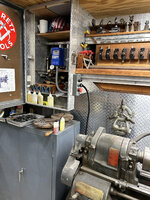
Old 1 hp south bend lathe, old 1 hp Bridgeport both 3ph.
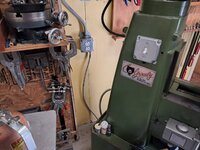
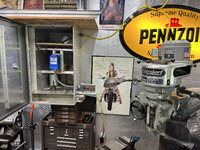
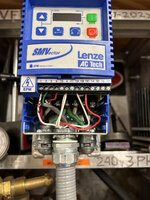
220 single phase power to lenze VFD. Pretty easy to wire the switches. Had my wife program the VFDs because she's smarter and more patient than me.
 

Attachments

  • unnamed-5.jpg
    unnamed-5.jpg
    1.1 MB · Views: 48
  • unnamed-8.jpg
    unnamed-8.jpg
    1.1 MB · Views: 49
  • unnamed-1 copy.jpg
    unnamed-1 copy.jpg
    799.4 KB · Views: 44
  • unnamed-6.jpg
    unnamed-6.jpg
    640.2 KB · Views: 46
  • unnamed-2 copy.jpg
    unnamed-2 copy.jpg
    1.1 MB · Views: 48

bggrnchvy

Well-known member
Joined
Nov 14, 2011
Messages
579
Location
Pleasant Hill, CA
I posted this back when I did it in my garage thread, but it's specific to this as well. I may as well contribute after reading through almost 30 pages of other installs.

5a62d726-9809-4626-bea3-c180bb346b23.jpg

It started with a 220v 3ph Rockwell press I picked up.

47cfd30c-06bd-44fb-9eea-6140230202ea.jpg
5f0af688-fe93-49cf-b016-d52416dc8d2a.jpg

A hobby box, a Teco drive, DRO, rheostat, power supply, a fan and some covers along with an 22mm switch for forward/stop/reverse.

1dd9c668-0b3c-4b99-92f3-707f1e7ce1d8.jpg

A simple column clamp style mount.

6c15b4d6-d5a0-4f19-80c1-c9fa65843b06.jpg

Now it drills holes in metal and the DRO helps me manage speeds.
 

Beerhippie

Well-known member
Joined
Oct 13, 2023
Messages
9,674
Location
Far NE Oregon
I posted this back when I did it in my garage thread, but it's specific to this as well. I may as well contribute after reading through almost 30 pages of other installs.

5a62d726-9809-4626-bea3-c180bb346b23.jpg

It started with a 220v 3ph Rockwell press I picked up.

47cfd30c-06bd-44fb-9eea-6140230202ea.jpg
5f0af688-fe93-49cf-b016-d52416dc8d2a.jpg

A hobby box, a Teco drive, DRO, rheostat, power supply, a fan and some covers along with an 22mm switch for forward/stop/reverse.

1dd9c668-0b3c-4b99-92f3-707f1e7ce1d8.jpg

A simple column clamp style mount.

6c15b4d6-d5a0-4f19-80c1-c9fa65843b06.jpg

Now it drills holes in metal and the DRO helps me manage speeds.
Very clean install!
 

gregs

Well-known member
Joined
Mar 16, 2007
Messages
1,589
I posted this back when I did it in my garage thread, but it's specific to this as well. I may as well contribute after reading through almost 30 pages of other installs.

5a62d726-9809-4626-bea3-c180bb346b23.jpg

It started with a 220v 3ph Rockwell press I picked up.

47cfd30c-06bd-44fb-9eea-6140230202ea.jpg
5f0af688-fe93-49cf-b016-d52416dc8d2a.jpg

A hobby box, a Teco drive, DRO, rheostat, power supply, a fan and some covers along with an 22mm switch for forward/stop/reverse.

1dd9c668-0b3c-4b99-92f3-707f1e7ce1d8.jpg

A simple column clamp style mount.

6c15b4d6-d5a0-4f19-80c1-c9fa65843b06.jpg

Now it drills holes in metal and the DRO helps me manage speeds.
Why didn't you just replace the motor with a single phase motor? I have nearly the same drill press with the variable speed control, single phase motor and it works well.
 

whateg01

Well-known member
Joined
Mar 13, 2006
Messages
11,211
Location
doo dah, kansas, usa
Why didn't you just replace the motor with a single phase motor? I have nearly the same drill press with the variable speed control, single phase motor and it works well.
Can't speak for bgg, but I do like having a vfd. Very easy to change speeds. Easier than starting the machine then adjusting the crank on the Reeves. (I'm not sure if this vs qualifies as a Reeves,tbh) My vfd can also stop on a dime for tapping. And it's reversible. Dump that I would convert a working one, but I stuck an ac motor and vfd in my 10ee since it was a basket case when I bought it. Never looked back.
 

TurnipTruck

Well-known member
Joined
Aug 28, 2005
Messages
1,552
Location
Southcentral Alaska
I guess I haven’t participated in this VFD page yet.
It all began when I was finally inspired to build my woodshop when a member here gifted me this 1980 three phase Powermatic 66 tablesaw project.

The saw carcass needed only cleaning and a riser to match the other bench heights.
IMG_5361.jpeg

Assembled and greased, with new arbor bearings and all the bent or missing motor mounting bolts replaced and torqued.
IMG_5374.jpeg

Then some salvaged 2” rigid conduit got some more bends added to become both a wire way and a dust collection support.
IMG_5430.jpeg
IMG_5447.jpeg

Then an imported vfd got bolted into an imported too-small filtered enclosure

IMG_5461.jpeg

I had to enlarge too-shallow enclosure with an old stainless headlight trim ring and plexiglas to clear the speed knob.
IMG_5525.jpeg


With some 240v power:
IMG_5485.jpeg

And a couple wires up overhead to the start/stop button and down across the floor to the motor
IMG_5475.jpeg

And what a relief it was when the saw actually spun up without any death noises, since I was unable to test the motor beforehand.
IMG_5480.jpeg
 

Attachments

  • IMG_5478.jpeg
    IMG_5478.jpeg
    872.3 KB · Views: 19
Last edited:

gregs

Well-known member
Joined
Mar 16, 2007
Messages
1,589
Can't speak for bgg, but I do like having a vfd. Very easy to change speeds. Easier than starting the machine then adjusting the crank on the Reeves. (I'm not sure if this vs qualifies as a Reeves,tbh) My vfd can also stop on a dime for tapping. And it's reversible. Dump that I would convert a working one, but I stuck an ac motor and vfd in my 10ee since it was a basket case when I bought it. Never looked back.
I can understand that. I am fortunate to have a vertical mill for those operations and only use the DP for mundane work. But it is a very nice sized DP and well built.
 
To avoid these ads, REGISTER NOW!

whateg01

Well-known member
Joined
Mar 13, 2006
Messages
11,211
Location
doo dah, kansas, usa
I can understand that. I am fortunate to have a vertical mill for those operations and only use the DP for mundane work. But it is a very nice sized DP and well built.
I use the mill and the drill press for whatever I need them for. I drill and tap on the DP. I also drill and tap on the mill. It's nice to have options.
 

twagler

Well-known member
Joined
Jun 29, 2016
Messages
101
Location
Ottawa, Canada
Here's my contribution to this thread - a pretty basic VFD installation on a new-to-me wood planer. It is a vintage made-in-Japan 16” planer (Heian AP-400), likely from the late 1960s or 1970s. It was sold off as obsolete/surplus from a commercial cabinet making shop, and has a Toshiba 3 hp, 3-phase, 550v motor. Here in Canada, this kind of used industrial equipment can often be bought inexpensively, basically because it is not good enough for industrial use anymore but is too heavy and too inconvenient for home workshop use because of the need for 3-phase power. The typical Canadian industrial workplace electrical power level is 575v (but used to be 550v years ago). I think in the US the equivalent is 460v? Anyway, my workshop only has single-phase 240v power available, so I have made use of a step-up VFD in a quick “proof of concept” installation to see if I could get my planer powered up and working. (Ignore the lifting straps in the picture - I still have it sitting on the frame of the engine hoist I used to unload, and I'll be lifting it again shortly to place the planer onto some sort of mobile base.)
VFD install.jpg

The VFD that I purchased is exactly this one shown in the picture below. Its is one of these cheap Chinese VFDs of dubious quality. I bought it probably about 2 years ago, but it only cost $109 at that time - it was some sort of end of model run special pricing, because as can be seen they are now quite a bit more expensive, at least for these larger 7.5 kW (10 hp) models. But the important selling point for me is that these VFDs, while advertised as “Single Phase 220V Input to 3 Phase 380V Output" are actually voltage doublers. So that means that at my rural home, where grid voltage runs a little bit hot at about 245v, the VFD doubles that and delivers 490 volt 3-phase to the motor. This is a bit short of nameplate 550v, so probably causes a bit of power loss in the motor, but is good enough for my home shop use requirement. I have tested my planer with this and it seems to work fine. I was just curious if others have been buying these step-up VFDs? Especially in the USA, where you only need 460v, it would seem like an ideal way to power higher voltage machinery without needing to bother with a transformer.


Susme SU-900 VFD.jpg

Also wondering if there is an elegant solution to providing strain relief or proper tethering of the power in and power out wires from the terminal connection at the bottom of the VFD? Nothing is provided on the body of the VFD to clamp to, so I installed a small box below for connecting the power cord, and then routed a short bit of flexible conduit bent to end up in a relatively close position to the terminals. Not pretty, so hoping there are better ways.

Thanks, Tom

20250514_165833.jpg
 

paulsomlo

Well-known member
Joined
Jul 16, 2013
Messages
3,866
Location
Northern Colorado
Step up from 120V to 220V is fairly common with VFD's designed for lower hp. The strain relief issue is the reason that many opt to put the VFD in an enclosure - I've installed a VFD on my mill and lathe, and chose to put the VFD inside the base of each machine, which eliminates the strain relief issue. I do have to add buttons, pots, etc. for control functions.
 

whateg01

Well-known member
Joined
Mar 13, 2006
Messages
11,211
Location
doo dah, kansas, usa
Here's my contribution to this thread - a pretty basic VFD installation on a new-to-me wood planer. It is a vintage made-in-Japan 16” planer (Heian AP-400), likely from the late 1960s or 1970s. It was sold off as obsolete/surplus from a commercial cabinet making shop, and has a Toshiba 3 hp, 3-phase, 550v motor. Here in Canada, this kind of used industrial equipment can often be bought inexpensively, basically because it is not good enough for industrial use anymore but is too heavy and too inconvenient for home workshop use because of the need for 3-phase power. The typical Canadian industrial workplace electrical power level is 575v (but used to be 550v years ago). I think in the US the equivalent is 460v? Anyway, my workshop only has single-phase 240v power available, so I have made use of a step-up VFD in a quick “proof of concept” installation to see if I could get my planer powered up and working. (Ignore the lifting straps in the picture - I still have it sitting on the frame of the engine hoist I used to unload, and I'll be lifting it again shortly to place the planer onto some sort of mobile base.)
VFD install.jpg

The VFD that I purchased is exactly this one shown in the picture below. Its is one of these cheap Chinese VFDs of dubious quality. I bought it probably about 2 years ago, but it only cost $109 at that time - it was some sort of end of model run special pricing, because as can be seen they are now quite a bit more expensive, at least for these larger 7.5 kW (10 hp) models. But the important selling point for me is that these VFDs, while advertised as “Single Phase 220V Input to 3 Phase 380V Output" are actually voltage doublers. So that means that at my rural home, where grid voltage runs a little bit hot at about 245v, the VFD doubles that and delivers 490 volt 3-phase to the motor. This is a bit short of nameplate 550v, so probably causes a bit of power loss in the motor, but is good enough for my home shop use requirement. I have tested my planer with this and it seems to work fine. I was just curious if others have been buying these step-up VFDs? Especially in the USA, where you only need 460v, it would seem like an ideal way to power higher voltage machinery without needing to bother with a transformer.


Susme SU-900 VFD.jpg

Also wondering if there is an elegant solution to providing strain relief or proper tethering of the power in and power out wires from the terminal connection at the bottom of the VFD? Nothing is provided on the body of the VFD to clamp to, so I installed a small box below for connecting the power cord, and then routed a short bit of flexible conduit bent to end up in a relatively close position to the terminals. Not pretty, so hoping there are better ways.

Thanks, Tom

20250514_165833.jpg
3D printed cover for the bottom of the drive
 

u3b3rg33k

Well-known member
Joined
Dec 18, 2017
Messages
4,047
Name brand 1140rpm 3/4hp 1ph 56 frame footed TEFC motors are expensive.
one of my favorites are the Marathon Black Max 6 pole Y537. footed TENV 143/5 frame, but the back side of the motor has the 56 frame shaft (meant for brakes IIRC). sometimes they can be found online for cheap. it is long so if that's a constraint it won't fit, but 1HP from 1200-5400RPM is quite flexible.
 

Firebrick43

Well-known member
Joined
May 12, 2015
Messages
13,994
Location
West central Indiana
Step up from 120V to 220V is fairly common with VFD's designed for lower hp. The strain relief issue is the reason that many opt to put the VFD in an enclosure - I've installed a VFD on my mill and lathe, and chose to put the VFD inside the base of each machine, which eliminates the strain relief issue. I do have to add buttons, pots, etc. for control functions.
Nema 1 vfd are not designed to be mounted in any shape or fashion outside of an enclosure. Every manual will tell you this.

To be mounted exposed the vfd should be Nema 4

One may get away with it with a clean piece of equipment like a drill press at 240v but a dirty piece such as a planer where dust will get into the unit, and especially at480v is just a dumb way to die.


twagler

Well-known member
Joined
Jun 29, 2016
Messages
101
Location
Ottawa, Canada
Nema 1 vfd are not designed to be mounted in any shape or fashion outside of an enclosure. Every manual will tell you this.

To be mounted exposed the vfd should be Nema 4

One may get away with it with a clean piece of equipment like a drill press at 240v but a dirty piece such as a planer where dust will get into the unit, and especially at480v is just a dumb way to die.
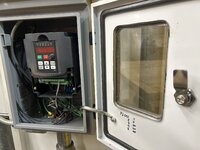
Thanks for the good advice regarding enclosures for VFDs, especially in my case where it may be dusty from the wood planer chips. I've read through a few pages of this thread and noticed that most (but not all) are installed in enclosures. As I mentioned, this was really just a "proof of concept" installation to see if the VFD would work to operate a 550v motor. And it worked brilliantly - I did some testing yesterday with some very heavy cuts drawing max amps from the 3 hp motor. No signs of bogging down or of overheating; the motor casing temperature only increased by about 15degC from ambient. My planer motor has Class B insulation, rated for 80degC temp rise, so no issues with overheating, despite the lower than spec voltage supply.

I'm just really impressed with the technology of VFDs. As a comparison, my neighbor across the road also runs some 3-phase, 575v equipment for his part-time business. His installation includes a 10 hp Rotary Phase Converter ($1500), a 15 kVa step-up transformer ($2000), and a 3-phase breaker panel with a few wiring drops throughout his shop ($1000) and it takes up a small corner closet worth of space. I've managed adequate equivalent capability with a $109 VFD that weighs 5 lbs and is the size of a loaf of bread!

Thanks, Tom
 

W-Cummins

Well-known member
Joined
Jan 9, 2006
Messages
1,639
Location
Iowa
I guess it's time to upload one of my many VFD installs

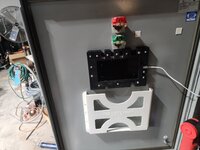
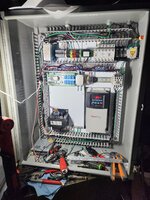
This one is the replacement for the controller for my dust collector. It's a A&B 10hp powerflex 40 drive with an external heat sink. I normally run drives with the internal cooling fans but got this one cheap so... It was a pain the *** to lineup all the holes for the screws to attach the heat sink to the drive through the enclosure. But not having the fan noise will be nice...

20250517_225025.jpg
9dc99c02-f5ca-4a88-9224-cb2944dbdc74~1.jpg


Here is a start on the rest of the control panel

d8697262-6aff-48d1-9f20-845a29fa0b19~1.jpg


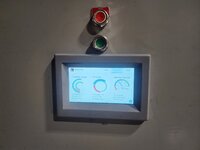
it will run the collector and talk to the Plasma controller via esp-now, and have a custom HMI panel.
 
Joined
Nov 14, 2021
Messages
11
Here's my recent Craftsman drill press conversion. Motor is a 1 HP 3 phase Baldor Super-E. This machine has great torque down to 30 RPM.
1000004769.jpg
 

Attachments

  • 20241108_165603.jpg
    20241108_165603.jpg
    605.3 KB · Views: 34
  • IMG_20241116_170258_723.jpg
    IMG_20241116_170258_723.jpg
    367.6 KB · Views: 31
  • 20250527_161322.jpg
    20250527_161322.jpg
    779.8 KB · Views: 27
  • 20250527_161311.jpg
    20250527_161311.jpg
    474.9 KB · Views: 28

AEAdam

Well-known member
Joined
May 27, 2023
Messages
2,729
Location
SE PA
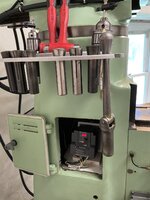
I wanted my Bridgeport’s VFD solution to be super clean. As this is a 1hp machine, I can get away with a 120V VFD, which means I plug this into any 120V 20A outlet. For this reason, I wanted a single power cord and no external gadgets.

IMG_8568.jpeg
Since my machine has a column door, I made use of this area to house my VFD. Rather than building an enclosure. I made the shelf and mount out of cPVC (Azek), then grounded the VFD to the machine.

Not visible in the picture, I added a 3 gang electrical box to the back of the column (you can kinda see the top of it behind the door). That has 2 duplex 15A outlets (with USB A & C outlets) for machine lights, DRO, etc. In the third space, I installed a master power switch that kills power to the entire machine.
IMG_8566.jpeg
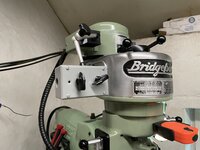
For controls, I wanted to maintain the location and tradition of the original machine. I wanted old fashioned feeling switches. But I wasn’t sure how to use the original drum switch.

Turns out, I used the drum switch enclosure for a junction box. The shielded wires I used were bigger than necessary but they were what I could find inexpensively.

I used the cheapest mag base I could find on Amazon and adapted the clamp end to mount to the control box.

I need to add labels, but you get the idea. Left hand switch is REV OFF FWD and right hand is the speed pot. Right now I think it’s 20-80hz, which I thought was a good range (but easily changed).

I’ve had no problems with over heating of the VFD, but I had plans to put a computer fan in the aluminum door.

Someone above said no one would be interested in this, but as I said, I’ve never seen anything like this. I hope this helps somebody. I worked really hard on this.

Recall I bought this mill for $500. I probably spent that rebuilding the head. This installation was nearly that again. I think the VFD was $200. I think the wire was $100! I’ll probably spend at least that on a DRO.
 

whateg01

Well-known member
Joined
Mar 13, 2006
Messages
11,211
Location
doo dah, kansas, usa
I wanted my Bridgeport’s VFD solution to be super clean. As this is a 1hp machine, I can get away with a 120V VFD, which means I plug this into any 120V 20A outlet. For this reason, I wanted a single power cord and no external gadgets.

IMG_8568.jpeg
Since my machine has a column door, I made use of this area to house my VFD. Rather than building an enclosure. I made the shelf and mount out of cPVC (Azek), then grounded the VFD to the machine.

Not visible in the picture, I added a 3 gang electrical box to the back of the column (you can kinda see the top of it behind the door). That has 2 duplex 15A outlets (with USB A & C outlets) for machine lights, DRO, etc. In the third space, I installed a master power switch that kills power to the entire machine.
IMG_8566.jpeg
For controls, I wanted to maintain the location and tradition of the original machine. I wanted old fashioned feeling switches. But I wasn’t sure how to use the original drum switch.
I used the cheapest mag base I could find on Amazon and adapted the clamp end to mount to the control box.
I like that. I had been looking at how to Billy a box to the side of the belt cover but it's not a flat surface near the front where there's room and I wanted it to look like it belonged there. I only want to move the two speed switch closer so it's easier to reach since I can reverse easy enough on the vfd.
 

W-Cummins

Well-known member
Joined
Jan 9, 2006
Messages
1,639
Location
Iowa
Well I have made some progress on the project.... It's been slow going though! I spent weeks tearing my hair out messing with the powerflex drive and Modbus. No mater what I tried to do I couldn't get it to work reliably and I finally had to give up and just control the drive using the digital inputs. After I gave up on the Modbus/ rs485 stuff, I found out that the drive I am using is not "Stock". It was a new unused surplus drive, but it appears to have custom software loaded on it ( found this out when I tried to do a factory reset to start over with/out the modbus setting). It seems that A&B will make custom firmware for you and the stuff on that drive appears to have a custom implementation of the modbus protocol.... Anyway I now have the 3 nodes of the ep32's running. There is one master node that runs on the board with the display and 2 slave nodes ( esp-now) one that runs in the plasma table controller and the other that is shown below goes in the dust collector cab. I'm about 95% done with the programing and just need some tweeks to the UI and tighten up the code a bit and I will be running!1000008650.jpg1000008651.jpg
 
Last edited:

W-Cummins

Well-known member
Joined
Jan 9, 2006
Messages
1,639
Location
Iowa
Oh boy was I wrong!!

I'm about 95% done with the programing and just need some tweaks to the UI and tighten up the code a bit and I will be running!
That was wish full thinking!

So I have also started another message thread in metalworking section about the retrofit of the dust collector as it contains information that is not pertinent to this thread if your interested check it out!

I cleaned up the ui and the code to run it took a long time to get it squared away

1000008775-jpg.2409615


I also added some more nodes to the system to run it from the wide belt sander and I also added hand held remote control too...


1000008776-jpg.2409616
 
To avoid these ads, REGISTER NOW!
Top Bottom