chrislehr
Well-known member
Is the FM 50 a 110 volt input?
It can be. 3 models do 110 input
Best way to learn is to find a decent storefront to filter with
http://www.factorymation.com/ac_drives_qs/FM50_Series/Input_Power/115V-~-1-PH


Is the FM 50 a 110 volt input?
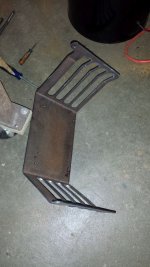
Slightly newer, but yep. I need to find that guard, but I don't have the bolt holes, so I am thinking earlier models maybe didn't have it. Mine is a 1955 iirc.
Capacitors are probably dying. Happens with VFD's after a few years. Companies will refresh them, but for small drives it's likely cheaper to replace than repair. Might be able to do it yourself if you are inclined to give it a try.How are you guys doing for reliability?
Mine seem to die every 5 to 7 years. This seems to be related to age, not usage.
I started with a couple of Hitachi's. Replaced them with Teco's when they died.
Replaced one of the Teco's with a generic chinese unit about a year ago.
Capacitors are probably dying. Happens with VFD's after a few years. Companies will refresh them, but for small drives it's likely cheaper to replace than repair. Might be able to do it yourself if you are inclined to give it a try.
Sent from my Pixel using Tapatalk
Actually you create all 3 phases from nothing (DC). Most of the point of a Variable Frequency Drive is a Variable frequency... AC power is a fixed 60hz (50 in Europe, or apparently 49hz for the past month). A VFD converts AC (1 or 3 phasel to DC then DC to AC (typically 3 phase). Inverters that convert DC to AC are common & cheap these days.yup
x2
and with single phase in and three phase out, it has to compensate via its internal circuits. You can't just "create " the third phase from nowhere.
Actually you create all 3 phases from nothing (DC).


so.. where did the DC come from?
Pi = Po

https://en.wikipedia.org/wiki/Rectifier which actually quickly links to https://en.wikipedia.org/wiki/Power_inverter
.....
Actually you create all 3 phases from nothing (DC).
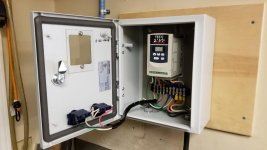
Always configure your VFD to switch off via the VFD control. If you cut power to or from the VFD you are likely to blow up the VFD.Please check my thinking and offer advice on converting an old power hacksaw with 1hp 3-phase motor via a Teco VFD.
The saw has a starter; is there anything about the starter function which would be beneficial and/functional with the VFD? If the starter remained in place, supplying the AC to the VFD, would it function?
When saw completes the cut, a huge mechanical lever trips a two-pole switch with two wires going into the starter and the starter opens. It is desirable to keep a stop switch and use the VFD. Would the existing stop switch open the starter while it was supplying AC to the VFD?
If necessary to remove the starter and the stop switch, we can rig up a DPST switch to be tripped mechanically by the existing mechanism. I know the switch needs to be between the 240v AC supply and the VFD and not between the VFD and the motor. It also needs to open both 120v legs going to the VFD.but is there a better science better way? How would you do it and what switch would you recommend?
jack vines
My bandsaw has a switch like that. On mine, you lift the blade and flip the switch "on" (by hand). Then when it completes the cut, a tang on the blade frame pushes the switch off.Please check my thinking and offer advice on converting an old power hacksaw with 1hp 3-phase motor via a Teco VFD.
The saw has a starter; is there anything about the starter function which would be beneficial and/functional with the VFD? If the starter remained in place, supplying the AC to the VFD, would it function?
When saw completes the cut, a huge mechanical lever trips a two-pole switch with two wires going into the starter and the starter opens. It is desirable to keep a stop switch and use the VFD. Would the existing stop switch open the starter while it was supplying AC to the VFD?
If necessary to remove the starter and the stop switch, we can rig up a DPST switch to be tripped mechanically by the existing mechanism. I know the switch needs to be between the 240v AC supply and the VFD and not between the VFD and the motor. It also needs to open both 120v legs going to the VFD.but is there a better science better way? How would you do it and what switch would you recommend?
jack vines
Jack, much as I love VFD's, this sure sounds like a motor swap would be a better solution in this case. No need for variable speed or reverse, I'd just swap out the motor. It's probably geared way down, and a 3/4 HP might even work just fine.Please check my thinking and offer advice on converting an old power hacksaw with 1hp 3-phase motor via a Teco VFD.
The saw has a starter; is there anything about the starter function which would be beneficial and/functional with the VFD? If the starter remained in place, supplying the AC to the VFD, would it function?
When saw completes the cut, a huge mechanical lever trips a two-pole switch with two wires going into the starter and the starter opens. It is desirable to keep a stop switch and use the VFD. Would the existing stop switch open the starter while it was supplying AC to the VFD?
If necessary to remove the starter and the stop switch, we can rig up a DPST switch to be tripped mechanically by the existing mechanism. I know the switch needs to be between the 240v AC supply and the VFD and not between the VFD and the motor. It also needs to open both 120v legs going to the VFD.but is there a better science better way? How would you do it and what switch would you recommend?
jack vines
Jack, much as I love VFD's, this sure sounds like a motor swap would be a better solution in this case. No need for variable speed or reverse, I'd just swap out the motor. It's probably geared way down, and a 3/4 HP might even work just fine.
Agree, and we tried that. The 3-phase is a two speed - 1hp@1150 and .5hp@560 RPM. Losing 1/3 of that .5hp doesn't leave enough.Easier than that, if horsepower isn't a problem, would be a static phase converter. Cheap, easy to wire in, and no modifications to the tool or original wiring. The only downside is loss of horsepower from the original motor. The motor will drop to 2/3 of the original power output.
For true, but this saw is designed to be driven slowly, 1150/560 RPM. Converting the drive is more difficult than converting the motor.Jack, much as I love VFD's, this sure sounds like a motor swap would be a better solution in this case. No need for variable speed or reverse, I'd just swap out the motor. It's probably geared way down, and a 3/4 HP might even work just fine.
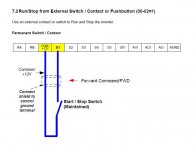
This may be the answer. As previously mentioned, the existing stop mechanism triggers a double pole switch. All we need is to understand which terminal is looking for what signal to tell the VFD to cut the motor power.You should use the terminal functions (low voltage) to operate the on off function, What you could do is similar to what I described. Hook up a toggle switch in a position where the blade frame will push it "off". You would hook the toggle to the terminal function that will apply the terminal voltage to a terminal that will give the vfd a "run forward" command.
post picture of manual page or post link to manual or provide vfd make model.All we need is to understand which terminal is looking for what signal to tell the VFD to cut the motor power.

The L510 shows a positioning switch between COM and S1 which can control Stop. Has anyone done this?
jack vines
I bought a Soyanpower 220v 1p -> 3p 3hp unit to power a bandsaw.
I later realized that the shop wiring is old enough that there's no ground on my 220 outlets. Just 2 hots and a neutral.
How important is having a separate ground on the VFD and motor?
Actually, more than likely you have 2 hot legs and a ground, no neutral. This was the std 230 volt wiring till they decided to make it a 4 wire with a neutral, that way you can pull a 115 volt circuit off it with 1 hot leg and the neutral. You should be fine wiring up your VFD. I still only run 3 wire 230 volt circuits in my shop, just can't pull 115 volt off those circuits.
Actually, more than likely you have 2 hot legs and a ground, no neutral. This was the std 230 volt wiring till they decided to make it a 4 wire with a neutral, that way you can pull a 115 volt circuit off it with 1 hot leg and the neutral. You should be fine wiring up your VFD. I still only run 3 wire 230 volt circuits in my shop, just can't pull 115 volt off those circuits.
The L510 shows a positioning switch between COM and S1 which can control Stop. Has anyone done this?
jack vines
In general, VFDs (beyond small 2hp units) fed from single phase power need to be derated by roughly half... i.e, a 15hp might be more suitable for your 7.5hp motor. I would confirm with the vendor if derating is necessary.
Also, you mentioned 440v - if your motor is 440-480v, you will need an additional transformer.
YMMV
This is probably a stupid question - but I want to make sure I look before I leap.
I'm looking into getting a bandsaw for my shop - and one of the top-of-the-list candidates is a Jet J-9225 - which is a 1.5hp 220V 3 phase motor. I know powering a 1.5hp motor with a VFD isn't an issue - but what I don't know is how "picky" the voltage is. I was looking at the selection at www.vfds.com - and they have specific models listed out for 220V, 230V, and 240V - which got me wondering......
I've got 240V single phase coming into my shop. I know most single phase motors would be rated for 200-240V. Will 3 phase motors run on a similar range of voltage?
This is probably a stupid question - but I want to make sure I look before I leap.
I'm looking into getting a bandsaw for my shop - and one of the top-of-the-list candidates is a Jet J-9225 - which is a 1.5hp 220V 3 phase motor. I know powering a 1.5hp motor with a VFD isn't an issue - but what I don't know is how "picky" the voltage is. I was looking at the selection at www.vfds.com - and they have specific models listed out for 220V, 230V, and 240V - which got me wondering......
I've got 240V single phase coming into my shop. I know most single phase motors would be rated for 200-240V. Will 3 phase motors run on a similar range of voltage?
So long as your mains voltage is equal to, or higher than, motor nameplate it'll be fine. You set the VFD parameters to nameplate voltage and frequency which'll supply the motor the correct voltage.
Any idea why there are different rated VFDs for 220V, 230V and 240V ?
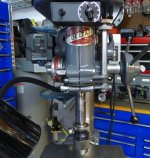
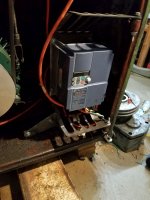
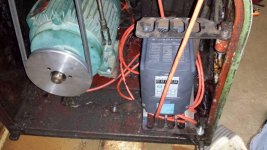
I finally hooked up a Teco L510 to my Bridgeport. So far, I'm underwhelmed. It didn't work at all at first. I did some digging, and found a service bulletin. Apparently, some of them left the factory with the wrong parameters. I changed two of them, and got it to work, after a fashion. When you power it up, it's supposed to flash '5.00' for the frequency. Mine just flashes whatever frequency I was running it at. It's very slow to start and stop. If you brake it while still spinning, when you release the brake, the spindle starts turning again until the unit ramps down. Still, I can make chips now, although power tapping is out of the question. Should have gone with a rotary phase convertor. There are zillions of parameters to change things, but the manual doesn't explain them at all. For instance, I can't figure out how to display RPM instead of frequency.
...Using the stock drum switch and interrupting the output to the motor is a big no-no with vfd. Doing that will destroy the vfd....
... Should have gone with a rotary phase convertor...