To avoid these ads, REGISTER NOW!

Show us your VFD conversions/installations

To avoid these ads, REGISTER NOW!

u3b3rg33k

Well-known member
Joined
Dec 18, 2017
Messages
4,047
how do you guys plan out & source your control boxes? i've got a control system project (not a VFD) and all the boxes with wiring harnesses/looms I can find are awful spendy.
 

sreeb

Well-known member
Joined
Jul 29, 2009
Messages
460
Location
SoCal
How are you guys doing for reliability?

Mine seem to die every 5 to 7 years. This seems to be related to age, not usage.

I started with a couple of Hitachi's. Replaced them with Teco's when they died.

Replaced one of the Teco's with a generic chinese unit about a year ago.
 

manwithtools

ALLIANCE MEMBER
Joined
Aug 24, 2015
Messages
13,639
Location
Lebanon, TN
How are you guys doing for reliability?

Mine seem to die every 5 to 7 years. This seems to be related to age, not usage.

I started with a couple of Hitachi's. Replaced them with Teco's when they died.

Replaced one of the Teco's with a generic chinese unit about a year ago.
Capacitors are probably dying. Happens with VFD's after a few years. Companies will refresh them, but for small drives it's likely cheaper to replace than repair. Might be able to do it yourself if you are inclined to give it a try.

Sent from my Pixel using Tapatalk
 

laser3kw

Well-known member
Joined
Nov 17, 2012
Messages
7,276
Location
northen IL
Capacitors are probably dying. Happens with VFD's after a few years. Companies will refresh them, but for small drives it's likely cheaper to replace than repair. Might be able to do it yourself if you are inclined to give it a try.

Sent from my Pixel using Tapatalk

yup
x2
and with single phase in and three phase out, it has to compensate via its internal circuits. You can't just "create " the third phase from nowhere.
 

Fallon

Well-known member
Joined
Jul 18, 2013
Messages
113
Location
Parker, CO
yup
x2
and with single phase in and three phase out, it has to compensate via its internal circuits. You can't just "create " the third phase from nowhere.
Actually you create all 3 phases from nothing (DC). Most of the point of a Variable Frequency Drive is a Variable frequency... AC power is a fixed 60hz (50 in Europe, or apparently 49hz for the past month). A VFD converts AC (1 or 3 phasel to DC then DC to AC (typically 3 phase). Inverters that convert DC to AC are common & cheap these days.

Capacitors help smooth out the DC bus as it's converted from AC to DC.

Sent from my SM-N950U using Tapatalk
 

Packard V8

Well-known member
Joined
Mar 16, 2009
Messages
7,380
Location
Spokane, WA
Please check my thinking and offer advice on converting an old power hacksaw with 1hp 3-phase motor via a Teco VFD.

The saw has a starter; is there anything about the starter function which would be beneficial and/functional with the VFD? If the starter remained in place, supplying the AC to the VFD, would it function?

When saw completes the cut, a huge mechanical lever trips a two-pole switch with two wires going into the starter and the starter opens. It is desirable to keep a stop switch and use the VFD. Would the existing stop switch open the starter while it was supplying AC to the VFD?

If necessary to remove the starter and the stop switch, we can rig up a DPST switch to be tripped mechanically by the existing mechanism. I know the switch needs to be between the 240v AC supply and the VFD and not between the VFD and the motor. It also needs to open both 120v legs going to the VFD.but is there a better science better way? How would you do it and what switch would you recommend?

jack vines
 
Last edited:

Fallon

Well-known member
Joined
Jul 18, 2013
Messages
113
Location
Parker, CO
Please check my thinking and offer advice on converting an old power hacksaw with 1hp 3-phase motor via a Teco VFD.

The saw has a starter; is there anything about the starter function which would be beneficial and/functional with the VFD? If the starter remained in place, supplying the AC to the VFD, would it function?

When saw completes the cut, a huge mechanical lever trips a two-pole switch with two wires going into the starter and the starter opens. It is desirable to keep a stop switch and use the VFD. Would the existing stop switch open the starter while it was supplying AC to the VFD?

If necessary to remove the starter and the stop switch, we can rig up a DPST switch to be tripped mechanically by the existing mechanism. I know the switch needs to be between the 240v AC supply and the VFD and not between the VFD and the motor. It also needs to open both 120v legs going to the VFD.but is there a better science better way? How would you do it and what switch would you recommend?

jack vines
Always configure your VFD to switch off via the VFD control. If you cut power to or from the VFD you are likely to blow up the VFD.

Wire up that switch to tell the VFD control inputs to turn on or off, not cut the power anywhere.

Sent from my SM-N950U using Tapatalk
 

laser3kw

Well-known member
Joined
Nov 17, 2012
Messages
7,276
Location
northen IL
Please check my thinking and offer advice on converting an old power hacksaw with 1hp 3-phase motor via a Teco VFD.

The saw has a starter; is there anything about the starter function which would be beneficial and/functional with the VFD? If the starter remained in place, supplying the AC to the VFD, would it function?

When saw completes the cut, a huge mechanical lever trips a two-pole switch with two wires going into the starter and the starter opens. It is desirable to keep a stop switch and use the VFD. Would the existing stop switch open the starter while it was supplying AC to the VFD?

If necessary to remove the starter and the stop switch, we can rig up a DPST switch to be tripped mechanically by the existing mechanism. I know the switch needs to be between the 240v AC supply and the VFD and not between the VFD and the motor. It also needs to open both 120v legs going to the VFD.but is there a better science better way? How would you do it and what switch would you recommend?

jack vines
My bandsaw has a switch like that. On mine, you lift the blade and flip the switch "on" (by hand). Then when it completes the cut, a tang on the blade frame pushes the switch off.
As Fallon pointed out, you do not want to interrupt the output of the vfd - ever. You should use the terminal functions (low voltage) to operate the on off function,
What you could do is similar to what I described. Hook up a toggle switch in a position where the blade frame will push it "off". You would hook the toggle to the terminal function that will apply the terminal voltage to a terminal that will give the vfd a "run forward" command.
You may want to also witch the incoming 220v single phase with a switch when not in use
 

Fallon

Well-known member
Joined
Jul 18, 2013
Messages
113
Location
Parker, CO
Oh, and what do you mean by starter? A magnetic starter, as in a relay & overload protection box typically used for motors over 5hp (real HP, not big box store HP). Or a start capacitor, which means it's a single phase motor. Most VFDs if not nearly every consumer accessible one are for 3 phase only.

If it's a magnetic starter, the VFD takes the role of the relay & overload protection. At least if you properly configure the parameters for the motor in the VFD when you set it up.

Sent from my SM-N950U using Tapatalk
 

454ragtop

Well-known member
Joined
Mar 24, 2008
Messages
5,010
Location
Carver, MA
Please check my thinking and offer advice on converting an old power hacksaw with 1hp 3-phase motor via a Teco VFD.

The saw has a starter; is there anything about the starter function which would be beneficial and/functional with the VFD? If the starter remained in place, supplying the AC to the VFD, would it function?

When saw completes the cut, a huge mechanical lever trips a two-pole switch with two wires going into the starter and the starter opens. It is desirable to keep a stop switch and use the VFD. Would the existing stop switch open the starter while it was supplying AC to the VFD?

If necessary to remove the starter and the stop switch, we can rig up a DPST switch to be tripped mechanically by the existing mechanism. I know the switch needs to be between the 240v AC supply and the VFD and not between the VFD and the motor. It also needs to open both 120v legs going to the VFD.but is there a better science better way? How would you do it and what switch would you recommend?

jack vines
Jack, much as I love VFD's, this sure sounds like a motor swap would be a better solution in this case. No need for variable speed or reverse, I'd just swap out the motor. It's probably geared way down, and a 3/4 HP might even work just fine.
 

Provincial

Well-known member
Joined
Sep 21, 2011
Messages
6,855
Location
Near Salem, OR
Jack, much as I love VFD's, this sure sounds like a motor swap would be a better solution in this case. No need for variable speed or reverse, I'd just swap out the motor. It's probably geared way down, and a 3/4 HP might even work just fine.

Easier than that, if horsepower isn't a problem, would be a static phase converter. Cheap, easy to wire in, and no modifications to the tool or original wiring. The only downside is loss of horsepower from the original motor. The motor will drop to 2/3 of the original power output. I know several people who use static phase converters to run Bridgeport milling machines with no ill effects.
 

Packard V8

Well-known member
Joined
Mar 16, 2009
Messages
7,380
Location
Spokane, WA
Easier than that, if horsepower isn't a problem, would be a static phase converter. Cheap, easy to wire in, and no modifications to the tool or original wiring. The only downside is loss of horsepower from the original motor. The motor will drop to 2/3 of the original power output.
Agree, and we tried that. The 3-phase is a two speed - 1hp@1150 and .5hp@560 RPM. Losing 1/3 of that .5hp doesn't leave enough.

Jack, much as I love VFD's, this sure sounds like a motor swap would be a better solution in this case. No need for variable speed or reverse, I'd just swap out the motor. It's probably geared way down, and a 3/4 HP might even work just fine.
For true, but this saw is designed to be driven slowly, 1150/560 RPM. Converting the drive is more difficult than converting the motor.

You should use the terminal functions (low voltage) to operate the on off function, What you could do is similar to what I described. Hook up a toggle switch in a position where the blade frame will push it "off". You would hook the toggle to the terminal function that will apply the terminal voltage to a terminal that will give the vfd a "run forward" command.
This may be the answer. As previously mentioned, the existing stop mechanism triggers a double pole switch. All we need is to understand which terminal is looking for what signal to tell the VFD to cut the motor power.

jack vines
 

laser3kw

Well-known member
Joined
Nov 17, 2012
Messages
7,276
Location
northen IL
All we need is to understand which terminal is looking for what signal to tell the VFD to cut the motor power.
post picture of manual page or post link to manual or provide vfd make model.
On a lot of vfds, they use a pretty common terminal strip numbering and function sequence.
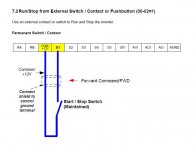
I would be willing to guess "S1" (may be known as "FOR") when grounding to terminal ground (may be know as "SC")will issue a "run forward" command. Opening that circuit (remove ground - "off") stops the output / motor.
After that there may be some tuning or parameter changes to finish off the setup
here is a sample from another vfd:
(note this is a sample and may not be like yours)
(looks simple don't it)
bf9d9daaf480b1800042616a1cde4b25.jpg
 

Attachments

  • bf9d9daaf480b1800042616a1cde4b25.jpg
    bf9d9daaf480b1800042616a1cde4b25.jpg
    115 KB · Views: 7
Last edited:
To avoid these ads, REGISTER NOW!

laser3kw

Well-known member
Joined
Nov 17, 2012
Messages
7,276
Location
northen IL
The L510 shows a positioning switch between COM and S1 which can control Stop. Has anyone done this?

jack vines

looks like it will if parameter code 00-03 is set to "1" & 00-04 = "0" & 03-00= "0"
maybe a few other things to check, but I am thinking default vales in the parameters will allow this.

Can't help right now. just got to work. Maybe someone else can chime in?
I will look at it tonoght
 
Last edited:

PNWguy

Well-known member
Joined
Jan 3, 2018
Messages
494
Location
Near Grants Pass, OR
I bought a Soyanpower 220v 1p -> 3p 3hp unit to power a bandsaw.

I later realized that the shop wiring is old enough that there's no ground on my 220 outlets. Just 2 hots and a neutral.

How important is having a separate ground on the VFD and motor?
 

454ragtop

Well-known member
Joined
Mar 24, 2008
Messages
5,010
Location
Carver, MA
I bought a Soyanpower 220v 1p -> 3p 3hp unit to power a bandsaw.

I later realized that the shop wiring is old enough that there's no ground on my 220 outlets. Just 2 hots and a neutral.

How important is having a separate ground on the VFD and motor?

Actually, more than likely you have 2 hot legs and a ground, no neutral. This was the std 230 volt wiring till they decided to make it a 4 wire with a neutral, that way you can pull a 115 volt circuit off it with 1 hot leg and the neutral. You should be fine wiring up your VFD. I still only run 3 wire 230 volt circuits in my shop, just can't pull 115 volt off those circuits.
 

PNWguy

Well-known member
Joined
Jan 3, 2018
Messages
494
Location
Near Grants Pass, OR
Actually, more than likely you have 2 hot legs and a ground, no neutral. This was the std 230 volt wiring till they decided to make it a 4 wire with a neutral, that way you can pull a 115 volt circuit off it with 1 hot leg and the neutral. You should be fine wiring up your VFD. I still only run 3 wire 230 volt circuits in my shop, just can't pull 115 volt off those circuits.

Thanks for the info. I'll double check and hook up the VFD.
 

laser3kw

Well-known member
Joined
Nov 17, 2012
Messages
7,276
Location
northen IL
Actually, more than likely you have 2 hot legs and a ground, no neutral. This was the std 230 volt wiring till they decided to make it a 4 wire with a neutral, that way you can pull a 115 volt circuit off it with 1 hot leg and the neutral. You should be fine wiring up your VFD. I still only run 3 wire 230 volt circuits in my shop, just can't pull 115 volt off those circuits.

edit:
must check manual
 
Last edited:

Davefr

Well-known member
Joined
Jan 7, 2010
Messages
11,815
Location
OR
The L510 shows a positioning switch between COM and S1 which can control Stop. Has anyone done this?

jack vines


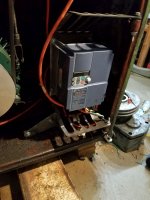
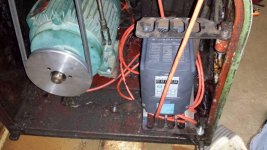
Is this what you're referring to? If so then yes. It makes it so conveniant to toggle between run and stop.
 

Attachments

  • Capturesw.JPG
    Capturesw.JPG
    50.6 KB · Views: 121
  • P1060862.jpg
    P1060862.jpg
    122.6 KB · Views: 180

ultgar

Well-known member
Joined
Jan 11, 2005
Messages
1,117
Location
New Jersey
In general, VFDs (beyond small 2hp units) fed from single phase power need to be derated by roughly half... i.e, a 15hp might be more suitable for your 7.5hp motor. I would confirm with the vendor if derating is necessary.

Also, you mentioned 440v - if your motor is 440-480v, you will need an additional transformer.

YMMV

Phase Technologies just introduced a digital phase converter for 7.5hp + applications with 480v. See http://info.phasetechnologies.com/phase-perfect-480v .
 

jdwilson44

Well-known member
Joined
May 7, 2005
Messages
128
Location
Chelmsford, Massachusetts
This is probably a stupid question - but I want to make sure I look before I leap.

I'm looking into getting a bandsaw for my shop - and one of the top-of-the-list candidates is a Jet J-9225 - which is a 1.5hp 220V 3 phase motor. I know powering a 1.5hp motor with a VFD isn't an issue - but what I don't know is how "picky" the voltage is. I was looking at the selection at www.vfds.com - and they have specific models listed out for 220V, 230V, and 240V - which got me wondering......


I've got 240V single phase coming into my shop. I know most single phase motors would be rated for 200-240V. Will 3 phase motors run on a similar range of voltage?
 

454ragtop

Well-known member
Joined
Mar 24, 2008
Messages
5,010
Location
Carver, MA
This is probably a stupid question - but I want to make sure I look before I leap.

I'm looking into getting a bandsaw for my shop - and one of the top-of-the-list candidates is a Jet J-9225 - which is a 1.5hp 220V 3 phase motor. I know powering a 1.5hp motor with a VFD isn't an issue - but what I don't know is how "picky" the voltage is. I was looking at the selection at www.vfds.com - and they have specific models listed out for 220V, 230V, and 240V - which got me wondering......


I've got 240V single phase coming into my shop. I know most single phase motors would be rated for 200-240V. Will 3 phase motors run on a similar range of voltage?

220-240V is no problem, 200 volt stuff isn't likely to be happy running on more than 220V.
 

jdwilson44

Well-known member
Joined
May 7, 2005
Messages
128
Location
Chelmsford, Massachusetts
I don't recall the last time I've even seen a 200V motor in single or three phase.

Most of the single phase stuff is either 220V or 240V coming off the street in my experience.

Any idea why there are different rated VFDs for 220V, 230V and 240V ?
 

MattT

Well-known member
Joined
Feb 20, 2010
Messages
3,201
This is probably a stupid question - but I want to make sure I look before I leap.

I'm looking into getting a bandsaw for my shop - and one of the top-of-the-list candidates is a Jet J-9225 - which is a 1.5hp 220V 3 phase motor. I know powering a 1.5hp motor with a VFD isn't an issue - but what I don't know is how "picky" the voltage is. I was looking at the selection at www.vfds.com - and they have specific models listed out for 220V, 230V, and 240V - which got me wondering......


I've got 240V single phase coming into my shop. I know most single phase motors would be rated for 200-240V. Will 3 phase motors run on a similar range of voltage?

So long as your mains voltage is equal to, or higher than, motor nameplate it'll be fine. You set the VFD parameters to nameplate voltage and frequency which'll supply the motor the correct voltage.
 

jdwilson44

Well-known member
Joined
May 7, 2005
Messages
128
Location
Chelmsford, Massachusetts
So long as your mains voltage is equal to, or higher than, motor nameplate it'll be fine. You set the VFD parameters to nameplate voltage and frequency which'll supply the motor the correct voltage.

Thanks, you got me thinking. I recently picked up a Precision Matthews PM1340-GT lathe - and that came with a Hitachi WJ-200 VFD. I haven't setup the lathe yet - but I figured I'd check the documentation - and sure enough, there is a setting in there to limit the output voltage to the motor:

http://www.clrwtr.com/Hitachi-VFD-FAQ.htm

How could I limit the inverter output voltage to the motor?

Please adjust parameter A045 to the proper value for your application and motor.


If/When I get the bandsaw - if I get one with a 3-phase motor, at least I know I can go with a Hitachi VFD to be able to set the output voltage to the correct number.
 

MKSJ

Active member
Joined
Apr 1, 2018
Messages
34
Location
Tucson, AZ
Any idea why there are different rated VFDs for 220V, 230V and 240V ?

Most VFDs are rated for a range of voltages so for the Hitachi WJ200 series they come in a low voltage L series which is typically 200-240V and high voltage H series which are rated at 380-480V. As previously mentioned, the output voltage cannot be greater than the input voltage You set the VFD output voltage and motor poles according to your motor specifications, so for the stock PM 1340GT it would be 220V and 4P. The amperage is set based on the kW setting, which for 2Hp would be 1.5kW, on some VFDs you can set the specific amps. There are a multitude of VFD parameters that need to be set, do not assume that the default parameters are correct or generic for most motors.
 

whateg01

Well-known member
Joined
Mar 13, 2006
Messages
11,183
Location
doo dah, kansas, usa
I pulled the motor/generator and DC motor out of my 10ee when I first bought it, despite the cries from the purists to make it work. Eventually, I want to put a 3HP, 6 pole motor in, but for now, it's a 2HP, 6 pole motor. I had a cheap import VFD to begin with, but recently updated it to a Fuji Electric. Much happier with it. The location is where one of the relay and resistor boxes lived originally. I cut and bent a new bracket that swings out to get to things behind it. I also kept the original knob for speed control, adapting a modern carbon trace pot to the existing chain and sprocket with another new bracket cut and bent to fit.

Here's the new swinging bracket cut and bent.
attachment.php


This is the first VFD. The wires were kind of stuffed behind at the time, but kept well away from the pulley and belt. Also visible is the motor I'm using for the time being. It does well, but really could use the backgear. I need to work on getting that adapted, but just don't have time right now. The arm that sticks out to the lower left of the VFD has a 1/4" bolt that screws into a boss to keep it from swinging. Eventually, I plan to make a captive fastener, but for not this'll do.
attachment.php


This is the new VFD in its home. Not visible in this photo is the braking resistor attached to the backside of the swinging bracket. What is visible to the right on the floor is the backgear. It has a 5:1 reduction, so I should be able to turn most anything I want to turn with that installed.
attachment.php


This is the new speed control, or part of it, next to the original, huge wire-wound pots.
attachment.php


The slot on the left allows the chain (visible in the next photo) to be tightened. The bolt sticking out to the right keeps the body of the pot from rotating. I didn't get any photos of that side with the pot installed. Maybe someday.
attachment.php


Here's the chain that runs up to the speed control knob. You can kind of see the arm that engages that aforementioned bolt sticking out near the bottom of the photo.
attachment.php
 

Attachments

  • speedcontrol.jpg
    speedcontrol.jpg
    122.2 KB · Views: 975
  • speedcontrol2.jpg
    speedcontrol2.jpg
    111.6 KB · Views: 964
  • speedcontrol1.jpg
    speedcontrol1.jpg
    127.2 KB · Views: 960
  • new VFD.jpg
    new VFD.jpg
    95.5 KB · Views: 971
  • VFD_installed.jpg
    VFD_installed.jpg
    92.1 KB · Views: 967
  • new bracket.jpg
    new bracket.jpg
    88.8 KB · Views: 972
Last edited:

Johnny_V

Well-known member
Joined
Jun 14, 2015
Messages
54
Location
Mentor, Ohio USA
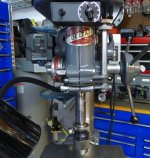
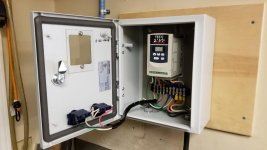
Bought a VFD for my Bridgeport. For years, yes that's right, YEARS, I've been having to use my lathe as a rotary converter to start my mill because it would constantly "single phase" when I would attempt to start it. First I thought it was the drum switch, so I replaced it with a reversing mag starter and still had the same problem. So after reading through the posts on this and other forums I decided it was time, and am I glad I did. The unit is a TECO FM50 (maybe not the best, but it works for my situation) that is in an Eldon enclosure, and uses a remote push button station with momentary contact switches (Stop, Start, Forward/Reverse, and a 10K Potentiometer). I added Vents to the top of the enclosure and a Plexiglass window to view the Frequency reading. When funds allow, I'll be changing my grinder over to a VFD, til then, run the lathe. Attached are some pictures.
 

Attachments

  • 100.jpg
    100.jpg
    58.7 KB · Views: 113
  • 300.jpg
    300.jpg
    70.1 KB · Views: 143
  • 200.jpg
    200.jpg
    55.3 KB · Views: 144

MushCreek

Well-known member
Joined
Jan 14, 2015
Messages
9,736
Location
Upstate South Carolina
I finally hooked up a Teco L510 to my Bridgeport. So far, I'm underwhelmed. It didn't work at all at first. I did some digging, and found a service bulletin. Apparently, some of them left the factory with the wrong parameters. I changed two of them, and got it to work, after a fashion. When you power it up, it's supposed to flash '5.00' for the frequency. Mine just flashes whatever frequency I was running it at. It's very slow to start and stop. If you brake it while still spinning, when you release the brake, the spindle starts turning again until the unit ramps down. Still, I can make chips now, although power tapping is out of the question. Should have gone with a rotary phase convertor. There are zillions of parameters to change things, but the manual doesn't explain them at all. For instance, I can't figure out how to display RPM instead of frequency.
 

Johnny_V

Well-known member
Joined
Jun 14, 2015
Messages
54
Location
Mentor, Ohio USA
Well time and money worked in my favor. Got everything I needed to install a VFD on my pedestal grinder. Works like a charm.
 

Attachments

  • 20180528_171932.jpg
    20180528_171932.jpg
    111.4 KB · Views: 86
  • 20180528_171952.jpg
    20180528_171952.jpg
    68.1 KB · Views: 76

laser3kw

Well-known member
Joined
Nov 17, 2012
Messages
7,276
Location
northen IL
I finally hooked up a Teco L510 to my Bridgeport. So far, I'm underwhelmed. It didn't work at all at first. I did some digging, and found a service bulletin. Apparently, some of them left the factory with the wrong parameters. I changed two of them, and got it to work, after a fashion. When you power it up, it's supposed to flash '5.00' for the frequency. Mine just flashes whatever frequency I was running it at. It's very slow to start and stop. If you brake it while still spinning, when you release the brake, the spindle starts turning again until the unit ramps down. Still, I can make chips now, although power tapping is out of the question. Should have gone with a rotary phase convertor. There are zillions of parameters to change things, but the manual doesn't explain them at all. For instance, I can't figure out how to display RPM instead of frequency.

Yes VFD's are confusing. I deal with them in our equipment and still scratch my head when something acts up.
The manufactures normally put in some pretty lazy parameters to help safe guard the user from accidental surprises.
Have you done a motor tune? I recommend that as it helps the vfd program do it's job correctly on the equipment it is attached to.
The slow start up and stop is a function of the "accel" and "decel" parameters. The smaller the number, the faster it spins up or tries to slow dow - there is a limit.
To achieve "power tapping" you will need two things:
the forward / reverse functions should be push button / two position switch functions tied to the terminal strip. Using the stock drum switch and interrupting the output to the motor is a big no-no with vfd. Doing that will destroy the vfd.
The other thing is choosing the type of stop action you want the vfd to provide. You can have braking action by the vfd or coast to stop action. I haven't had the opportunity to test it but I would start with coast to stop. That will prevent the vfd from trying to decel to quickly and dump the back emf into the dc bus and throw fault codes. The other benefit will be that it allows the tapping action to slow the motor. Although be aware that you may break a tap if the stop / start is to abrupt. That is where the acel / decel will help.
Take my recommendations with a grain of salt. I have not worked with your specific brand and don't know the intricacies. Maybe another GJ member can share some experience and teach us all something.
If I get a chance, I'll look at the manual and see if there is a easy route to take.
 
Last edited:

whateg01

Well-known member
Joined
Mar 13, 2006
Messages
11,183
Location
doo dah, kansas, usa
...Using the stock drum switch and interrupting the output to the motor is a big no-no with vfd. Doing that will destroy the vfd....

That's the reason I wired my lathe to use the fwd and rev pins on the VFD. It can slow the motor to a stop then reverse in its own time.

... Should have gone with a rotary phase convertor...

I'm not sure what your goal was here. Was it just to allow the use of a 3ph motor and then use the machines built in mechanisms to control spindle speed? Or do you intend to use the VFD to get better control of the spindle speed? A RPC won't do anything but spin the motor at whatever its nameplate says. That means variable speed and power tapping are both out with a RPC.

Dave
 
To avoid these ads, REGISTER NOW!
Top Bottom