Jehannum
Well-known member
I'm with you. The sweatshirt came off shortly after. I didn't want to interrupt concentration.Loose clothing is not the best when using a lathe. Just sayin.

I'm with you. The sweatshirt came off shortly after. I didn't want to interrupt concentration.Loose clothing is not the best when using a lathe. Just sayin.
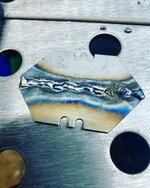
Used both 1/16 and 3/32 on this project. But you can see that the HAZ was pretty consistent throughout regardless.
They'll never forget that prize!Finished up pinewood derby trophies. Still need to brush some of the welds that I overcooked then clear coat them all.

I really like your sail installation - Could you give us some detail on how you fabricated/anchored your posts, and also the anchors used on the soffits etc?Project finished. Each sail is a 16' triangle.
Stay cool...
Arcflat fab table? How do you like it? The more projects I make, like your very nice shop table, the more I see the value and ease of an Arcflat to relieve me from deploying an army of clamps, squares, and incantations so that my projects don't inherit the unflat/warps of my steel plate welding table top. Drives me bananas.Shop table I built this weekend.
Yes, it’s an arcflat. It is so nice to work on. Everything is razor straight and square that comes off it. Also becuse it is cast iron nothing really sticks to it like my other table. Spatter pretty much wipes right off. The table I built is the same heigh and will be helpful for larger projects. Will also use it for my chop saw and general shop use. Most of my other benches and tables are wood so having this will be a good addition.
Thanks. The mounting points for the posts were buried with 160 lbs of concrete (the pic of these mounting points were from another projected mounted the exact same way). I had to add a support leg to one of the post as the sail were pulling it out of square (leveraged force is amazing). This was done with a piece of 1" square tube and turn buckle as an adjustable support pushing against the patio edge. This fixed the out of square issue nicely.I really like your sail installation - Could you give us some detail on how you fabricated/anchored your posts, and also the anchors used on the soffits etc?


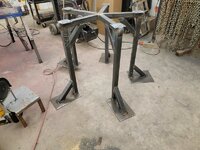

Shop table I built this weekend.
Yes, they are the arcflat legs from Langmuir. The casters I added are rated at 500 lbs per caster and are levelers as well. Once the rubber feet are lowered it is rock solid. They are threaded 12mm so they bolted right on. I like the ones on the table I made as well, they roll better because of their size and are lockable. Hard to say which I like better since they are different applications.A couple of questions on the legs, are those the Arcflat legs? On the two tables you show which casters do you like better?
Thanks. It came on the saw which is the evo380 from evolution.Very nice table, I see the saw on the rack below has a circular clamping wheel did your saw come with that or did you add it? Looks like it is much quicker to clamp different size material than the silly one on my Morse Metal Devil.
Thanks for the clarification! Looks like you used some pretty heavy gauge steel - was this laying around or do you think thin wall would suffice, excepting the mounting plates for the soffits?Thanks. The mounting points for the posts were buried with 160 lbs of concrete (the pic of these mounting points were from another projected mounted the exact same way). I had to add a support leg to one of the post as the sail were pulling it out of square (leveraged force is amazing). This was done with a piece of 1" square tube and turn buckle as an adjustable support pushing against the patio edge. This fixed the out of square issue nicely.
As far as mounting points on the house. I made a stainless receiver style brackets that mounted under the soffits and bolted up to the roof truss framing. This had a couple advantages for me, one I can attach the sails above the gutters, and two I can take most of the hardware down in the rainy season. I plan to polish these up over the winter and add an eye bolt to them.
Cheers
If I remeber correctly it was .1250 on the posts. With our Western Washington winds during the summer I think you could go thinner and get away with it. I plan on taking the down for the winter.Thanks for the clarification! Looks like you used some pretty heavy gauge steel - was this laying around or do you think thin wall would suffice, excepting the mounting plates for the soffits?
That looks handy. Are any of the outlets on the power strip not being used? I might suggest plugging any unused holes with some plastic safety plugs you would use where small children play. Keep grinding trash out of the contacts.Here are my last 2 welding projects:
Cart for my blasting cabinet I bought this winter
Rotating work station for grinders, belt sander, drill press and band saw
I'm in S E WA - we get 70-80 mph every year and over 100 every 10 yrs or so, but always Chinook winter (Pineapple Express) winds when the sails would be down. However, we have thunderstorms every summer with 30-40-mph gusts, but otherwise very little wind in the summer. Getting steel in rural E WA is not a problem, and we have recyclers that will sell cutoffs etc cheap.If I remeber correctly it was .1250 on the posts. With our Western Washington winds during the summer I think you could go thinner and get away with it. I plan on taking the down for the winter.
I see that you are also from Washington if you are on the west side you this might be helpful. I bought my steel from Interwest in Fife, and the Stainless came from Metal Supermarket in Kent. The Metal Supermarket has a room of shorts, you have to ask someone to point it out to you because it is pretty hidden in the back. I can usually find SS for $2 pound.
I put gorilla tape over the 2 empty outlets before I started using it.That looks handy. Are any of the outlets on the power strip not being used? I might suggest plugging any unused holes with some plastic safety plugs you would use where small children play. Keep grinding trash out of the contacts.
Thanks for posting! How tall is the centerline from floor to pivot point?Here is the rotissorie I built.
Features include: (1) arbor locks with spring loaded pins where the pin handle holds the pin in the retracted position for one man operation; (2) hydraulic jacks for raising but hitch pins in double shear to ensure arbors are concentric; (3) bushed center of gravity adjuster to raise or lower body to adjust for balance (use deep well socket and impact gun on coupling nut); (4) caster wheels with brakes at all corners - I used an oil pan drain bolt to lock wheel at 90 degrees; (5) push handles on both ends.
A fun project that is getting its use now.
The top of the base to the pivot is 36" in the fully closed position. However, these items telescope to raise via the jack and the hitch pins. Not sure how much it can rise further (too much junk in garage to inspect). The plans I used shows the insertion piece as 30" from pivot center to its bottom. So it appears the tubes nest about 30" worth.Thanks for posting! How tall is the centerline from floor to pivot point?






looks Awesome!!I finally got around to finishing and painting the fab table I built last year.
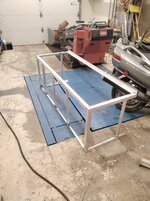
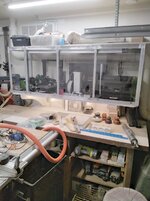
This table has been a very ambitious project for me. For starters, everything except the top and the hardware was sourced from local scrapyards, requiring a lot of extra effort but saving me a pile of money on steel.
This table is about to get a short-column Powermatic 1200 drill press bolted to the non-extendable end, so I added a vertical reinforcing brace there and decided to go ahead and paint the frame while I had it all apart. My "new" Reed 3C will also be replacing the current Athol 625 while I'm at it.
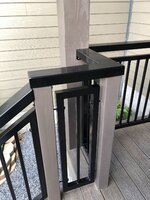
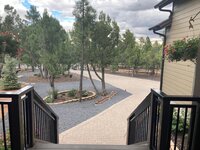
Some really nice stuff. Stairs are amazing!!My biggest decorative one to date. The front stairs. A bit of welding and forge work.
Turning a dead blast cabinet into a usable one.
The 3-D printer enclosure. And all the lift infill.
The trailer made out of two junkers.
I finally got around to finishing and painting the fab table I built last year.
This table has been a very ambitious project for me. For starters, everything except the top and the hardware was sourced from local scrapyards, requiring a lot of extra effort but saving me a pile of money on steel.
This table is about to get a short-column Powermatic 1200 drill press bolted to the non-extendable end, so I added a vertical reinforcing brace there and decided to go ahead and paint the frame while I had it all apart. My "new" Reed 3C will also be replacing the current Athol 625 while I'm at it.
Yeah. That's Harry, the very corporeal dog. The camera on my tablet doesn't do well with moving things, so Otto n Harry, who are busy little terriers/terrors, often look ghosty n cartoonish.Kay, I hate to tell you this, but I think you have a ghost dog haunting your stairs.
I thought maybe he had warrants, so you blurred him for his own good.Yeah. That's Harry, the very corporeal dog. The camera on my tablet doesn't do well with moving things, so Otto n Harry, who are busy little terriers/terrors, often look ghosty n cartoonish.

That is just outstanding! I love the clever use of bottle jacks. Do you experience any binding when raising or lowering the caster assemblies, or is it pretty smooth?I finally got around to finishing and painting the fab table I built last year.
This table has been a very ambitious project for me. For starters, everything except the top and the hardware was sourced from local scrapyards, requiring a lot of extra effort but saving me a pile of money on steel.
This table is about to get a short-column Powermatic 1200 drill press bolted to the non-extendable end, so I added a vertical reinforcing brace there and decided to go ahead and paint the frame while I had it all apart. My "new" Reed 3C will also be replacing the current Athol 625 while I'm at it.