Provincial
Well-known member
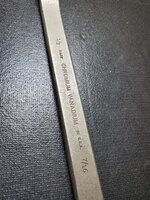
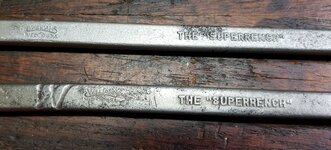
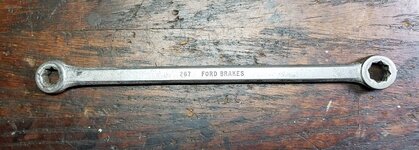
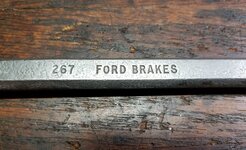
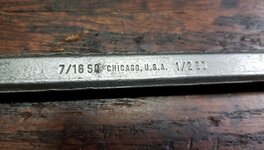
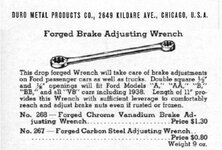
I picked up a couple of Ford brake adjusting wrenches Sunday. Based on Private Lugnutz's saying "One of anything is just one, two is a pair, but three is a collection." I now have a collection! Since there was an in-depth discussion of these wrenches on a KRW thread, I thought that we should have a dedicated thread on these, since there are multiple designs and applications.
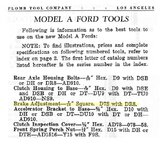
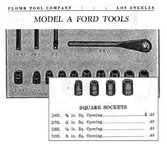
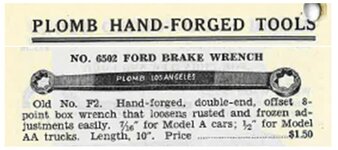
First, a little background. Starting with the Model A in 1928, Ford used four-wheel mechanical, internal-expanding, drum brakes. These were adjusted by screwing a wedge in and out that moved the anchor points of the shoes. This wedge had a square shank for the adjusting wrench. Ford used this system until the 1939 model year, when it adopted hydraulic brakes. Cars had a 7/16" square, and the trucks had a 1/2" square.
The original tool for adjusting the brakes was the tire iron that came with each Model A (and Model AA truck) as part of the tool kit. It had a square hole punched in the handle end. Sometimes, the adjuster was difficult to turn, and tool companies were quick to offer wrenches with more length, giving more leverage.
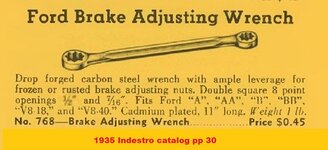
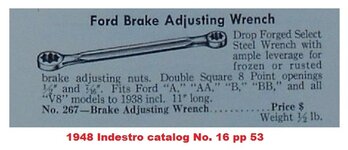
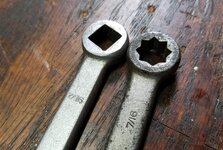
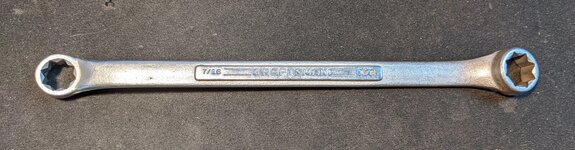
Here is a photo of an original Model A tire iron, along with a Truth wrench for comparison. The Truth tool has 8-point drives for both size adjusters. All the aftermarket Ford brake tools I have seen combine these two sizes.

Note that these wrenches were flat, or had small angles for clearance. The skinny tires on the Model A made access pretty easy.
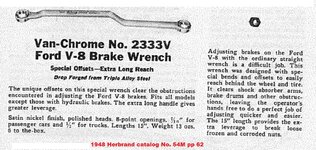
With the introduction of the Flathead V-8 in 1932, Ford began including tires that were both wider and smaller in diameter. Pretty soon, the brake adjusting wrenches needed an offset to clear the wheel/tire. No doubt, suspension parts made access more difficult, too.
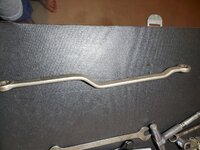
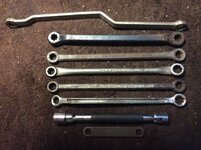
Here is a photo of the progression of these offsets, with later Cornwell and MAC tools for example.

Here is a photo showing the difference in offsets of the two later wrenches. Also note the difference in length. I have positioned them so the opening sizes match. It appears that there was no common pattern for these.

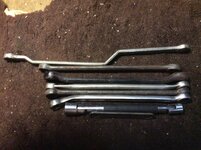
Here is a photo of the two from a different angle.

And from the flip side.

Everyone please chime in with your photos and comments!
First, a little background. Starting with the Model A in 1928, Ford used four-wheel mechanical, internal-expanding, drum brakes. These were adjusted by screwing a wedge in and out that moved the anchor points of the shoes. This wedge had a square shank for the adjusting wrench. Ford used this system until the 1939 model year, when it adopted hydraulic brakes. Cars had a 7/16" square, and the trucks had a 1/2" square.
The original tool for adjusting the brakes was the tire iron that came with each Model A (and Model AA truck) as part of the tool kit. It had a square hole punched in the handle end. Sometimes, the adjuster was difficult to turn, and tool companies were quick to offer wrenches with more length, giving more leverage.
Here is a photo of an original Model A tire iron, along with a Truth wrench for comparison. The Truth tool has 8-point drives for both size adjusters. All the aftermarket Ford brake tools I have seen combine these two sizes.
Note that these wrenches were flat, or had small angles for clearance. The skinny tires on the Model A made access pretty easy.
With the introduction of the Flathead V-8 in 1932, Ford began including tires that were both wider and smaller in diameter. Pretty soon, the brake adjusting wrenches needed an offset to clear the wheel/tire. No doubt, suspension parts made access more difficult, too.
Here is a photo of the progression of these offsets, with later Cornwell and MAC tools for example.
Here is a photo showing the difference in offsets of the two later wrenches. Also note the difference in length. I have positioned them so the opening sizes match. It appears that there was no common pattern for these.
Here is a photo of the two from a different angle.
And from the flip side.
Everyone please chime in with your photos and comments!