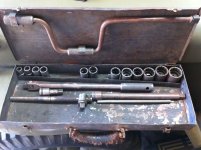
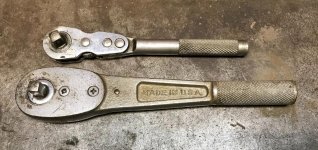
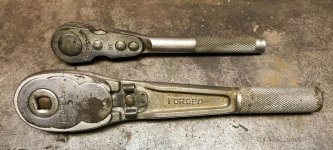
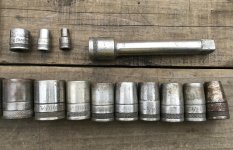
Ganymede started a good thread on "Ell" handles on the General Discussion board a few years ago. Link
here. I contributed a few times starting on page 2, as did four.cycle, and prompted by your post, I just updated my contributions to the thread with an interesting Indestro I found this year.
I won't repeat myself verbatim here, but gist my thoughts, for those who don't follow the link.
Called L- or Ell-handles due to the shape, but functionally, they're more like L- and Half T handles, because they were also used to turn fasteners with what we think of as the top of the L, with ones hand on the leg of the L. In fact, Indestro and Hinsdale made a version they explicitly called T-L handles with a sort of sheath-like handle that pivoted one way or another (into T or L position) for ease of holding.
In cruder forms (simple hex stock, round stock with female drive opening socket press-fit on the end, etc) they were one of the first drive tools and handy long before socket drive tools standardized on the sliding tee, overlapping in many sets through the 40's with sliding tees, and were eventually recognized as redundant to the sliding tee.
As for their usefulness, when you are using a sliding tee with the drive head slid all the way out to the ball or pinch or whatever stop at end of the handle - you are essentially using the sliding tee in a position that is no different than using an old L-handle.
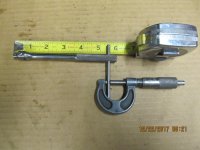
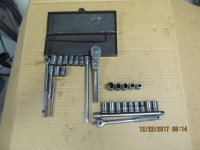
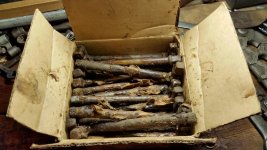
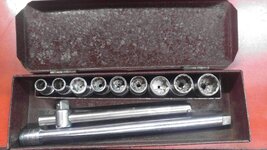
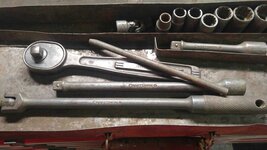
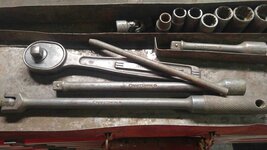
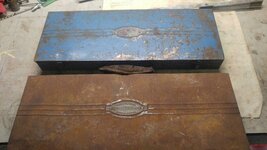
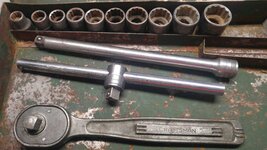
A US Army Ordnance Dept type, at 8" x 3/8" with 1/2" drive studs forged on each end, much smaller than the versions you find in commercial sets, were specified in prewar and wartime Army GMTK's, and prized by WWII collectors for that reason. Of those types, I've had Armstrong and APCO-Mossberg, easily the most predominant maker of the wartime versions, in onesy-twosies over the years. Ditto the other WWII collectors here on GJ. And I had a NOS box of NOS paper-and-preservative coated examples last year (
see Thumbnails 1 and 2), including a Plomb - to my delightful surprise! (In the process of getting that one back from Tin Medic, actually, who has found another one.)
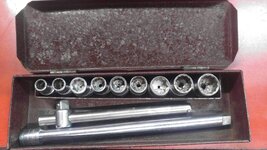
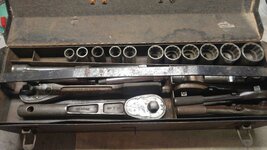
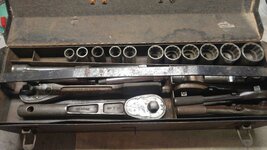
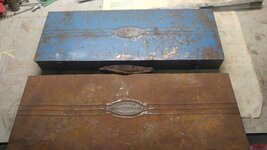
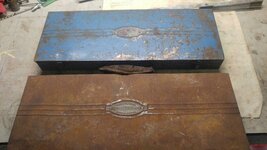
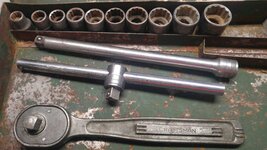
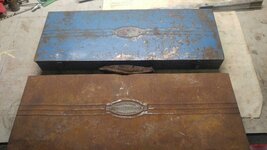
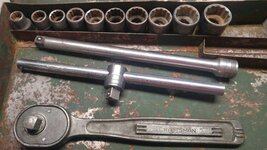
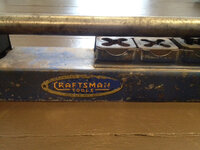
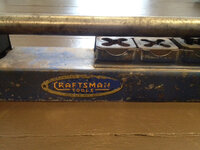
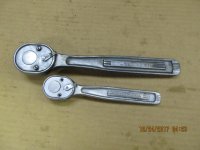
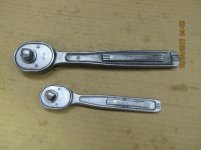
Of the larger type, made of 1/2-inch round stock with the drive studs pinched or machined on the ends, I used to have a Long C Craftsman BE, now moved on to another collector to complete a BE set. (
See Thumbnails 3 and 4.) And I, too, have an unmarked example here somewhere. Wondering, now that I'm seeing Rileysan's comparative analysis, if it is an unmarked New Britain. I'm going to have to try to find it.
Signed,
Buddy the
Ellf