To avoid these ads, REGISTER NOW!

Show your "Long C" Craftsman!

Ole Slewfoot

Well-known member
Joined
Feb 22, 2016
Messages
5,098
Location
Freedom, CA
A related issue. The so-called "Nested Diamond" handle pattern grip was used on many types of pliers, including combination slip joint, dykes, lineman's, and angle-nose (Water pump). But not all the pliers have the Circle-C code. Some have an AM code. Some have other codes if I recall correctly. That can only mean one of a few things:
- Either Sears & Roebuck owned the pattern, and gave it out to multiple mfgrs to use in their dies
- One of the mfgrs owned it, and let other Sears & Roebuck mfgrs use it
- Or the codes are not mfgr's codes (i.e., one mfgr who owns the grip made them all)

Or one mfgr owned the pattern, and made so many pliers they for one reason or another used more than one code., like circleH/BE.

Micing the hinge element of multible same size pliers might give another clue
 
To avoid these ads, REGISTER NOW!

Private Lugnutz

Well-known member
Joined
Mar 30, 2012
Messages
30,534
Location
The Authentic Jersey Shore
Or one mfgr owned the pattern, and made so many pliers they for one reason or another used more than one code., like circleH/BE.
That was my third point, Slew. See the parenthetical comment.

To give credit where credit is due, this would lend credence to Todd's theory that some of the codes we assume are mfgr's code are actually codes for different forge or factory locations.
 

Rileysan

Well-known member
Joined
Sep 11, 2015
Messages
4,298
Location
Milwaukie, Oregon
This would technically be pre Long-C but I can't think of a more appropriate place to post it.

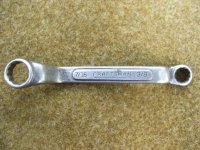
"Craftsman Vanadium Steel"

Craftsman 1092-F, 5/8" x 11/16" tappet wrench. One comment by a collector on the Craftsman tool collector FB page was that it was made by Vlchek as it matches one of their wrenches.

That would make this one pre 1942 (the earliest mechanic's tool catalog I have access to).

Edit: I had a few minutes to spend on a PC this afternoon and found my tappet wrench on Alloy Artifacts. They speculate these were offered from 1930-1932 but give no clue as to the maker. I took the liberty of checking Google for "1092-F tappet" and found that there is more than one manufacturer who used that number. That means one of three things: 1) one manufacturer made those wrenches for the other manufacturers (my personal guess); 2) all the manufacturers got together and decided on an industry numbering standard for tappet wrenches; or 3) there is one huge coincidence on the numbering scheme.

Anyone have any thoughts?

Brian
 

Attachments

  • 0916182005.jpg
    0916182005.jpg
    43.2 KB · Views: 55
Last edited:
OP
O

Outlawmws

Well-known member
Joined
Aug 9, 2011
Messages
39,191
Location
The Badlands
I think the handle pattern explanation is that Sears had someone come up with something unique, made sure that Sears "owned" the rights to have other mfg's use it (think Craftsman raised panel) and worked mfg's for low bids. hence Channellock making lineman's pliers when that wasn't their wheel house.

I've no doubt the ones I have are CL made. Every feature other than the grip patterns match.

I should probably pull out older dykes and see if I can find a match, but that ain't happening until after hunting season. I have two weeks to complete the trailer, pack it and be ready, and other things also need my attention...

Markings for MFG I think was well established and certainly later pliers had makers marks for the supplier, and almost every other tool as well. is it an absolute? No, but it fits the facts.
 

Private Lugnutz

Well-known member
Joined
Mar 30, 2012
Messages
30,534
Location
The Authentic Jersey Shore
I think the handle pattern explanation is that Sears had someone come up with something unique, made sure that Sears "owned" the rights to have other mfg's use it (think Craftsman raised panel)
This was the first of my three possible explanations, which I dismissed because I'm not aware of any precedent for Sears owning any design rights or even having the capacity to do so. I'm not following you on your example of a precedent. If you mean DOEs, DBEs and combos with a raised panel on the shank, I don't think it was unique (Barcalo, to name one, used it), while there is some debate about which mfgr "CI" was (with Moore Drop Forge being the leading candidate), I'm not aware of anyone thinking there were multiple "CI" suppliers using the same raised panel design, and, all the Craftsman examples have the same "CI" code (unlike the pliers situation, where all the pliers have the same grip but different codes).

Maybe after hunting season we can delve into this further. :)
 

gpw_42

Well-known member
Joined
Apr 24, 2017
Messages
717
Location
NC Sandhills, USA
Picked up this Craftsman SDBE at a pawn shop yesterday. Took plenty of time sorting through a ton of wrenches, but it was nice to sit in their air conditioned floor during the heat of the day

Didn't see anything which made think of a code of any type on this one.
 

Attachments

  • Craftsman SDBE JPG.jpg
    Craftsman SDBE JPG.jpg
    62.4 KB · Views: 31

3baygarage

Well-known member
Joined
Sep 1, 2013
Messages
11,946
Location
SW Florida/from Buffalo,NY
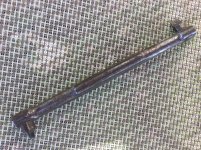
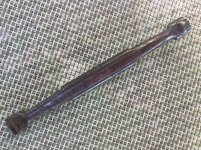
Slant C 2 way screwdriver.

No diagonal blades. And Phillips, who needs Phillips anyway? :)

It has some style to it.


attachment.php


attachment.php


attachment.php


attachment.php


attachment.php
 

Attachments

  • F3859FD5-26A2-480C-AF27-504CE7B45503.jpg
    F3859FD5-26A2-480C-AF27-504CE7B45503.jpg
    129.1 KB · Views: 275
  • 3BC5C2ED-D395-40BE-9078-6B37AEF674A1.jpg
    3BC5C2ED-D395-40BE-9078-6B37AEF674A1.jpg
    169.5 KB · Views: 273
  • 40FC6E9F-E75B-4F0B-BC3E-6E7F3BB0EB9F.jpg
    40FC6E9F-E75B-4F0B-BC3E-6E7F3BB0EB9F.jpg
    169.8 KB · Views: 271
  • 7F2D30ED-00F9-4E07-BF13-241A7DB54F74.jpg
    7F2D30ED-00F9-4E07-BF13-241A7DB54F74.jpg
    169 KB · Views: 272
  • 4BAB0F8A-3FA3-42F4-93CF-2539F26E4D72.jpg
    4BAB0F8A-3FA3-42F4-93CF-2539F26E4D72.jpg
    169.4 KB · Views: 275

LesserSon

Well-known member
Joined
Feb 7, 2016
Messages
5,054
Location
PA USA
Rileysan:
The regular DOEs do follow an “industry standard” number scheme, and while I think it did originate with a few early mfgs (Billings, Armstrong?), I don’t think there has to be industry-wide agreement (SAE) to bring other mfgs into line. Newcomers and smaller competitors would be led to adopt the existing numbering schemes of larger, older competitors to make their product more marketable. Some then added a one- or two-digit prefix that distinguished their brands from competitors, and from similar-function, different alloy internal lines. Bonney, for instance, used the ** or 7XX industry standard number on their carbon DOEs, added a 1[0XX] or 1[7XX] to their CV and later Bonaloy lines, and a 3[0XX] or 3[7XX] to their Zenel line. Later, some in the industry (Bonney, Snap-On) moved to using 32nds of an inch on DOES as a numbering scheme. None of these schemes seems to have been defended as proprietory intellectual property, so there doesn’t seem to me to be any reason why a mfgr wouldn’t want to keep their product recognizeably interchangeable with their competitors’.

Your particular example recalls to me the numbering system of Vlchek tappets (discussed around here), which, given the long association of Vlchek with Sears, suggests them as the pre-underline logo 1930s “Craftsman Vanadium” DOE manufacturer.
 
Last edited:

Rileysan

Well-known member
Joined
Sep 11, 2015
Messages
4,298
Location
Milwaukie, Oregon
Rileysan:
The regular DOEs do follow an “industry standard” number scheme, and while I think it did originate with a few early mfgs (Billings, Armstrong?), I don’t think there has to be industry-wide agreement (SAE) to bring other mfgs into line. Newcomers and smaller competitors would be led to adopt the existing numbering schemes of larger, older competitors to make their product more marketable. Some then added a one- or two-digit prefix that distinguished their brands from competitors, and from similar-function, different alloy internal lines. Bonney, for instance, used the ** or 7XX industry standard number on their carbon DOEs, added a 1[0XX] or 1[7XX] to their CV and later Bonaloy lines, and a 3[0XX] or 3[7XX] to their Zenel line. Later, some in the industry (Bonney, Snap-On) moved to using 32nds of an inch on DOES as a numbering scheme. None of these schemes seems to have been defended as proprietory intellectual property, so there doesn’t seem to me to be any reason why a mfgr wouldn’t want to keep their product recognizeably interchangeable with their competitors’.

Your particular example recalls to me the numbering system of Vlchek tappets (discussed around here), which, given the long association of Vlchek with Sears, suggests them as the pre-underline logo 1930s “Craftsman Vanadium” DOE manufacturer.

Excellent information! I appreciate your input.

Brian
 

Private Lugnutz

Well-known member
Joined
Mar 30, 2012
Messages
30,534
Location
The Authentic Jersey Shore
I took the liberty of checking Google for "1092-F tappet" and found that there is more than one manufacturer who used that number.
I didn't see your edit until LesserSon's reply. Who was the other mfgr? I am very curious now.

Your particular example recalls to me the numbering system of Vlchek tappets...
I can see where you'd think that, given the embedded "92". But a tappet wrench with 5/8 x 11/16 service openings is a Vlchek "93".

I have to admit I haven't paid too much attention to early (pre-underline, pre-"CI") Craftsman tappet wrenches, so I just went to AA to see if there are others to examine. There are. And they don't match the Vlchek numbering scheme, either. They have a Craftsman 1090-F in their collection that is 7/16 x 17/32. That wrench is a Vlchek "90A". They also have a Craftsman 1090-D in their collection that is 1/2 x 9/16. That wrench is a Vlchek "92".

The Craftsman model numbers may be more reflective of an earlier Vlchek model numbering scheme, built around a "9X" concept, but using a few letter suffixes added to 90 for opening size variants, before moving on to a 91 and a 92 etc. Unfortunately, there are no Vlchek catalogs in the public domain before 1936, as far as I know.

The early Craftsman tappets do exhibit some characteristics (namely, the shape of the jaws and the shanks) that could be Vlchek. But I don't know if they're unique enough to exclude other mfgrs, and the markings don't scream Vlchek. And they don't have any forge numbers, which would really nail it.

This is an interesting development.
 

Rileysan

Well-known member
Joined
Sep 11, 2015
Messages
4,298
Location
Milwaukie, Oregon
I didn't see your edit until LesserSon's reply. Who was the other mfgr? I am very curious now.


I can see where you'd think that, given the embedded "92". But a tappet wrench with 5/8 x 11/16 service openings is a Vlchek "93".

I have to admit I haven't paid too much attention to early (pre-underline, pre-"CI") Craftsman tappet wrenches, so I just went to AA to see if there are others to examine. There are. And they don't match the Vlchek numbering scheme, either. They have a Craftsman 1090-F in their collection that is 7/16 x 17/32. That wrench is a Vlchek "90A". They also have a Craftsman 1090-D in their collection that is 1/2 x 9/16. That wrench is a Vlchek "92".

The Craftsman model numbers may be more reflective of an earlier Vlchek model numbering scheme, built around a "9X" concept, but using a few letter suffixes added to 90 for opening size variants, before moving on to a 91 and a 92 etc. Unfortunately, there are no Vlchek catalogs in the public domain before 1936, as far as I know.

The early Craftsman tappets do exhibit some characteristics (namely, the shape of the jaws and the shanks) that could be Vlchek. But I don't know if they're unique enough to exclude other mfgrs, and the markings don't scream Vlchek. And they don't have any forge numbers, which would really nail it.

This is an interesting development.

Armstrong was there as well as Blackhawk. Interestingly, Vlchek and Billings (makers of Craftsman prior to this model according to AA) did not come up during my Google search. However, I didn't have much PC time and wasn't very thorough. I may have missed something important.

Brian
 

LesserSon

Well-known member
Joined
Feb 7, 2016
Messages
5,054
Location
PA USA
I should have recalled my first post about the Vlchek tappet on the DOE thread!
The 1949 Williams catalog lists Superwrench tappet numbers with the same openings as Rileysan’s.
Here’s AA’s Superwrench example to compare.
Their earlier tappets look even more like Rileysan’s. AA says they moved from the 9X to the 109X numbering before Superwrench, but their only example is a 1090, I think. That puts it in about the right timeframe to make the Craftsman Vanadium. Notice they were stamping, not forging-in in the 1920s.
 

Attachments

  • 1C0869F6-CBEB-42F6-965B-D2091A8B3242.jpeg
    1C0869F6-CBEB-42F6-965B-D2091A8B3242.jpeg
    78.6 KB · Views: 7
Last edited:

Private Lugnutz

Well-known member
Joined
Mar 30, 2012
Messages
30,534
Location
The Authentic Jersey Shore
Armstrong was there as well as Blackhawk.
That makes perfect sense, since Armstrong and Blackhawk had a partnership. Besides the wrenches that provide the most obvious sign of the partnership - the dual-marked BLACKHAWK-ARMSTRONG wrenches from the early 1930's through late 1940's, many Armstrong and Blackhawk DOE and DBE wrenches had the same part numbers, and looked like the same wrenches. Including tappet wrenches. I'm not 100% positive who was supplying whom, but I strongly suspect Armstrong for Blackhawk.

All of the Craftsman 109X-X model number tappet wrenches have the same exact model numbers and sizes as their Armstrong 109X-X, Blackhawk 109X-X, and Armstrong-Blackhawk 109X-X counterparts. But the Armstrong and Blackhawk tappet wrenches with those model numbers are post-war (late 1940's), and the Craftsman are identified as pre-war (early 1930's). I think those categorizations probably blinded them to the identical model numbers, which is unique as far as I can tell to only those three brands (which in essence, is one OEM), and which, in my opinion, is impossible to ignore. Perhaps making the connection even more elusive for them was the fact that Armstrong was not using that model numbering scheme in the early 1930's for their own tappet wrenches. They were using a 40X (401 through 409) scheme (note, as was Blackhawk, which were probably Armstrong-made) from the early 30's through at least 1939.

If you compare the wrenches - despite the Craftsman apparently being made pre-war (certainly marked like pre-war wrenches with the VANADIUM reference) and the Armstrong, Blackhawk, and Armstrong-Blackhawk being made post-war - they look a lot alike.

Strangely, maybe Armstrong (for its own Armaloy line, for Blackhawk, and for the Blackhawk-Armstrong line) started using the old Craftsman model numbering scheme after the war. ??
 

Private Lugnutz

Well-known member
Joined
Mar 30, 2012
Messages
30,534
Location
The Authentic Jersey Shore
Just saw your Williams post, LS. (I was typing when you posted...) Interesting. Might need to look even deeper now to see if it was Williams or Armstrong.

EDIT: One data point to Williams' favor is they were using that model number scheme for their tappet wrenches in the same timeframe as the early Craftsman Vanadium tappet wrenches. One data point to the contrary is they were using Chro-Moly. Armstrong was not using that model number until late 1940's, but they were using Chrome Vanadium.

Might have to get the mics out! :)
 
Last edited:

leg17

Well-known member
Joined
Aug 11, 2011
Messages
1,371
Location
Kentucky
Williams original numbers were widely adopted.
A purchasing agent might specify by Williams number.
Others wanted to be able to supply a "29", for example.
In my opinion, we owe a lot to the Williams company for their pioneering work in standardization.
(And their quality was tops as well.)
 

Private Lugnutz

Well-known member
Joined
Mar 30, 2012
Messages
30,534
Location
The Authentic Jersey Shore
That's true. Tappet wrenches were different, though, for some strange reason. The numbers that were widely adopted from Williams across the industry (with some notable exceptions, including Plomb) were for most DOE wrenches and DBE wrenches. But even though a Williams 3/8 x 7/16 DOE engineers wrench is a 723, their tappet wrench with those same exact sizes was 1090A. Many mfgrs who adopted the Williams system for their DOEs/DBEs used a unique system for their tappet wrenches. Herbrand, Duro, and Bonney, to name but a few, used the ISNs for DOEs, but used H-1 through H-4, D-1 through D-4, and 3420-3428 for tappets, respectively. Probably best to have this conversation on the DOE thread though so as not to sidetrack Outlaw's thread.
 

LesserSon

Well-known member
Joined
Feb 7, 2016
Messages
5,054
Location
PA USA
Hey, look at this: Earl W “Bill” Myers, president of Forged Steel Products(Vacuum Grip), and from 1931-1939, Snap-on, held the 25Oct1921 design patent D59506 for nested diamonds grip pattern on pliers.
He also patented the VacuumGrip plier ornamental pattern - D57252, 8Mar1921. I mention this because that design is also a bit more complex than how it appears on actual tools.
I think it is interesting that the AA site does not explicitly connect the nested diamonds patented pattern with the Craftsman pliers grips, because they list the patent.
I have to say, this surprises me, because when we were discussing who made C’man pliers, I did compare them to Vacuum Grips, and didn’t think there was as much resemblance as with Crescent. This makes me wonder, and I don’t have any one-to-one matches between VG and Cman pliers.
 
Last edited:

Private Lugnutz

Well-known member
Joined
Mar 30, 2012
Messages
30,534
Location
The Authentic Jersey Shore
First things first. Is it just because I'm drunk and posting when I shouldn't be (bad form, Lugz!), or have you gone back to your first avatar, LS? If that's your second avatar, and I'm just having a drunk senior moment, for the sake of my sanity, what was the first?

On point, very interesting discovery, LS!! It's funny (not haha but ironic) that Forged Steel was so powerful and yet so not famous. I was just talked about them and Myers on Otg's E.J. Brooks pliers thread.
 

LesserSon

Well-known member
Joined
Feb 7, 2016
Messages
5,054
Location
PA USA
Just a lubricated lapse, I think, Lugz. My first avatar was an altered photo of me sitting below a Harley hung from a ceiling. The wreaths of fake flames made it too confusing to tell what anything was. My second short-lived avatar was a ladybird beetle on a day lily leaf. I’ve had this current avatar for most of my GJ membership.
 
Last edited:
To avoid these ads, REGISTER NOW!
OP
O

Outlawmws

Well-known member
Joined
Aug 9, 2011
Messages
39,191
Location
The Badlands
Interesting timing on the design patent. granted in 21, 14 years life, so ended in 1935.

Long C started in about 32-33, but that was based on power tool catalogs. there is a dearth of hand tool catalogs for the 30's... It could be the started with the company that had the patent, or they could have licenced the patent, or both.

If Vac-U-grip went with the "Os" they could easily have been happy to get some income from the design patent, especially in the depression, but by 1935 it was done and could be used by anyone...

Only hand tool catalog I have is 1942.. it definitely showed the diamond grip in the few craftsman pliers that were in the catalog. Half were Dunlap...
 
OP
O

Outlawmws

Well-known member
Joined
Aug 9, 2011
Messages
39,191
Location
The Badlands
the oval embalms came after Long C mostyl 50;s but a little overlat to 40's & 60's

The eras were
Pre, long C, - Early thirties
Long C 32-33 to mid/late 40's
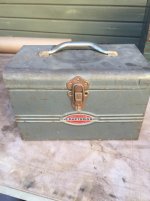
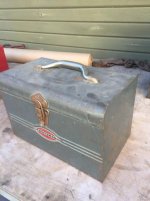
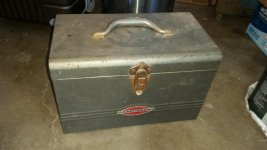
Heratige with the oval emblem your box has, - Late 40's to early 60's
Crown Mostyl 60's
then block logo and others. later
 

Jaydb07

Well-known member
Joined
Jun 26, 2018
Messages
335
Location
Lodi, CA
the oval embalms came after Long C mostyl 50;s but a little overlat to 40's & 60's

The eras were
Pre, long C, - Early thirties
Long C 32-33 to mid/late 40's
Heratige with the oval emblem your box has, - Late 40's to early 60's
Crown Mostyl 60's
then block logo and others. later


I did a search for “heritage” to find the proper thread for me to use. None seemed right. Do you have a link for the right thread?
 

honza.vosalik

Well-known member
Joined
Feb 27, 2016
Messages
882
Location
Missouri
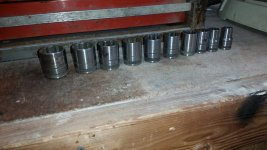
I cleaned up this long C 1/2" set today. Was quite nasty before. Goes from 1/2" to 1".
 

Attachments

  • 20180923_205221.jpg
    20180923_205221.jpg
    148 KB · Views: 39

Rileysan

Well-known member
Joined
Sep 11, 2015
Messages
4,298
Location
Milwaukie, Oregon
Looks good. I’ve wondered what is a good way to clean nasty sockets.

Elbow grease!

I usually wipe them clean with brake clean then coat them with WD-40 to preserve them. If rusty, I'll clean them with a .014 wire wheel on my bench grinder. Internally, I use a mini wire wheel mounted in a drill.

Cleaning sockets is the worst chore in the shop!

Brian.
 

Smokeshow69

Well-known member
Joined
Dec 7, 2012
Messages
8,368
Location
Pacific Northwest
Elbow grease!


I usually wipe them clean with brake clean then coat them with WD-40 to preserve them. If rusty, I'll clean them with a .014 wire wheel on my bench grinder. Internally, I use a mini wire wheel mounted in a drill.


Cleaning sockets is the worst chore in the shop!


Brian.


I agree all except for the last part [emoji23] for some strange reason I actually enjoy cleaning them and like the quick turn time for seeing the efforts of your work ! If I am cleaning a bunch at a time I will stand them up in a metal coffee can and spray them down with engine degreaser and let them marinate in it for a few hours before I go at them with the wire brushes.


Sent from my iPhone using The Garage Journal mobile app
 

Jaydb07

Well-known member
Joined
Jun 26, 2018
Messages
335
Location
Lodi, CA
Elbow grease!


I usually wipe them clean with brake clean then coat them with WD-40 to preserve them. If rusty, I'll clean them with a .014 wire wheel on my bench grinder. Internally, I use a mini wire wheel mounted in a drill.


Cleaning sockets is the worst chore in the shop!


Brian.


What’s that mini wire wheel look like? I’ve wanted to find some small thing to put on a Foredom tool or drill that can get inside small recesses such as a socket.
 

honza.vosalik

Well-known member
Joined
Feb 27, 2016
Messages
882
Location
Missouri
I agree all except for the last part [emoji23] for some strange reason I actually enjoy cleaning them and like the quick turn time for seeing the efforts of your work ! If I am cleaning a bunch at a time I will stand them up in a metal coffee can and spray them down with engine degreaser and let them marinate in it for a few hours before I go at them with the wire brushes.


Sent from my iPhone using The Garage Journal mobile app

From my experience brake parts cleaner seems to attach grease better than engine degreeser.
 

Stuart in MN

Well-known member
Joined
Sep 8, 2005
Messages
23,088
Location
Minneapolis
I'd toss the sockets in a can of solvent and let them soak for a while, then rinse off. Simple, and minimal effort.


I wouldn't use wire brushes - there should be no need for such harsh methods of cleaning that may damage the finish, unless there's rust to be removed.
 
To avoid these ads, REGISTER NOW!
Top Bottom