Not according to
this thread from this summer.
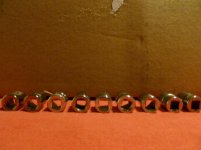
It even has a pic showing a Craftsman and an Armstrong socket and they sure look identical to me.
I started that thread, and it was the start of my quest to see what I could find out about the finishing process and the durability of plating on various brands of tools.
On top of that, I have 15 years of experience having parts plated, and I can spot the metal a part is plated with from across the room, literally.
My opinion is based on every recent production SK and Craftsman socket I've ever personally inspected (quite a few, not just a couple sets), as well as an article that specifically named Craftsman's exclusive nickel-only plating, and a phone call to Armstrong tool application support that confirmed they do indeed blast the inside of the sockets and use a proper 3-stage chrome process.
I wish I still had sockets here to compare,
the difference is plain as night and day on sockets I've handled. The Craftsman sockets were dull gray with bird **** looking insides, and the Armstrong were bright silver with absolutely spotless insides.
There are some exceptions... for instance, if you look at Craftsman sockets above 1", you'll notice they have significantly different color plating. If they "all have the same plating", how could that be possible?
I can say, that in the Craftsman line, the plating looks like it came from an entirely different line once you go large enough in sockets. There's nothing to say that smaller or less common size sockets may share plating processes also.
All I can say, is that the majority of Craftsman and Armstrong sockets I've personally compared, were nowhere near looking similar. That includes ones that I've personally owned, as well as several full toolboxes at work.
The only real question that remains for me is if Armstrong has swtiched to nickel plating and I was looking at old sockets... that seems rather impossible as all the sockets I've viewed were of somewhat recent purchase, and included laser engraving.
The only real way to put it completely to bed for me, would be to obtain recent production sockets of all sizes from both brands, and do a photo comparison where the lighting was correct to show the plating color difference. It isn't that hard to angle the camera so the photo's refectivity doesn't show the difference. I have to say, in the picture you reposted, the plating color doesn't look identical to me. It's really hard to say with the way the lighting is in the photo.
Any time I hear someone say "well, they looked the same to me", I cringe. A snickers bar and a piece of dog **** look the same. A harbor freight made in india combo wrench and a Snap-on, look the same to some people.
Chrome and nickel plating "look the same" to some people. In fact, that's what Danaher was counting on when they decided to cheap out and go with plain nickel, as mentioned below, is only slightly more useful than spraypaint.
From my research putting chroming over the top of nickel is almost entirely a cosmetic procedure, it doesn't add much additional protection. I poked around on plating forums and that is the conclusion I came up with. Far too much emphasis is placed on it IMO.
That's not true at all.
Chromium is specifically used as a wear resistant coating inside valve seats, ball bearing races, etc.
It is significantly harder than Nickel, in fact it is significantly harder than most metals, which is why it makes a great wear resistant coating, which is also why it makes a great coating for tools.
Nickel plating is not very durable, IMO nickel plated tools might as well be spraypainted. It's corrosion resistant, but has very little to no abrasion resistance. Properly done Chrome also forms a cohesive coating, so it's got less porosity and less propensity to plating failure and premature corrosion.



I would have loved to paint the inside of my sockets, it would have been nice, with the thickness of the paint I would have had a complete collection of half size sockets, 10,5 14,5 17,5 ...