To avoid these ads, REGISTER NOW!

Solid Rivets 101

OP
M

machine_punk

Well-known member
Joined
May 14, 2011
Messages
2,540
Location
Napa Valley, California
Here is the tool I would recommend. This is one of those 'magic' tools. I'd use it just to watch it do what it does, perfectly every time. (The other one is the pneumatic rivet squeezer, which is pure joy to watch).

I buy my tools from Brown Tool, if at all possible (they tend to have US-made versions of most tools, so you can make the choice).

This is the more-expensive version of the two rivet cutters available. after using this version of the tool, I can definitely recommend it. It does the job beautifully.
View media item 14083
View media item 14085
View media item 14086
Once you've used this tool to cut your rivets to length, you will kick yourself for doing it any other way (ask me how I know!?!?)

I'll have to defer to others above, for aerospace riveting rules. I'm pretty much self-taught in this and I don't ever build stuff which will ever actually be used in aerospace. I do, however, generally use the military-spec manuals in designing my projects.

Kev
 
To avoid these ads, REGISTER NOW!

Idle Serge

Well-known member
Joined
Apr 28, 2014
Messages
272
Location
SE Washington State
Not sure if this is much of a contribution but I purchased and plan to use the RevitNuts/Nutserts in the near future.


Youtube video of the tool I am using:


Kevin54

MEMBER EMERITUS
Joined
Jan 12, 2005
Messages
29,341
Location
Urbana, Ohio
Here is the tool I would recommend. This is one of those 'magic' tools. I'd use it just to watch it do what it does, perfectly every time. (The other one is the pneumatic rivet squeezer, which is pure joy to watch).

I buy my tools from Brown Tool, if at all possible (they tend to have US-made versions of most tools, so you can make the choice).

This is the more-expensive version of the two rivet cutters available. after using this version of the tool, I can definitely recommend it. It does the job beautifully.
View media item 14083
View media item 14085
View media item 14086
Once you've used this tool to cut your rivets to length, you will kick yourself for doing it any other way (ask me how I know!?!?)

I'll have to defer to others above, for aerospace riveting rules. I'm pretty much self-taught in this and I don't ever build stuff which will ever actually be used in aerospace. I do, however, generally use the military-spec manuals in designing my projects.

Kev

That's where his company needs to find the Specs for riveting. Again when it comes to the aerospace industry, it's a whole new ballgame. I know that when we shave rivets, we had to use a certain shaver that was approved. Then in the specs it does specify that you can use either one up or one down in length.

Also when it comes to assembling the parts,, and this is for the OP.....does the customer specify whether or not the part is to have "iridite" or "Conversion coat" BEFORE assembly? And if so, it should be noted on the drawing as to what CLASS of Conversion Coat.....normally it will designate a Class 1, or a Class 3, Conversion coating. Normally the rivets are already coated from the factory. But if you are riveting two pieces of aluminum together, the two pieces NORMALLY have to have Conversion Coat on them as this prevents any corrosion. Even if the part it painted, and again, normally, there will be a conversion coating before paint.

Aerospace is a whole different ballgame than say the automotive industry. There are a lot of specs that one has to know before assembling parts. Myself, I was in Tool & Die, but I also had classes for Soldering, Lens Potting, ESD, FOD, Riveting. And I had to pass to get a certification in the classes.

So for the OP.....if your company is making and assembling parts for another company, and the parts are for and Aerospace company, look into some specs before your company possibly could get into trouble. Not saying they will, but if per chance a plane goes down, **** rolls downhill real fast in a lawsuit. And most companies don't get a slap on the wrist, they just lob off the whole damn arm and then some.

Believe it or not, but FOD (Foreign Object Debris or Foreign Object Damage) is a huge problem in the industry. Just ask anyone that works in Aerospace. That is the reason that toolboxes are 'shadowed" today. IIRC, it was a socket that took down a Blackhawk helicopter. The socket was rolling around in the back and got caught up in the tail rotor drive system.

Another incident of FOD was shorted out circuit boards. In our company, some testing was going on, and there was a failure on some PC boards. I got to looking at a few of the boards after my wife pointed some things out (she was a 40 year assembler) and what was shorting the boards out in testing was a heli-coil tang. The small tang on the heli-coil that you have to knock off after inserting it......we always used a snap punch made by Heli-coil to remove the tangs. What was happening was a lot of the assemblers were not paying attention to the tangs. In a thru hole, the tang would go out the bottom. In a blind hole, the tang would stay in the hole if no one flipped things over and got it out. So in testing, and a lot of it was vibration testing, the tang may com out and fall on a circuit board, shorting out a component. My wife never had a failure on a board. Any time there was a heli-coil and she had to remove the tang, she always worked over a white shop towel, or a paper towel, and she would compare the amount of tangs to the amount of heli-coils. If you have 30 heli-coils, there better be 30 tangs accounted for.

And a little brag about my wife.....her voice used to be used on the Voice cockpit recorders years back, plus she was singled out to build a few very important lights that made it to the Moon. :rocker:
 

tmkr81

New member
Joined
Jun 25, 2014
Messages
3
Kevin54: You are exactly correct about dealing with aerospace companies. They live & die by there specs. The same 100° countersunk rivet has different dimensions that have to be held for the different customers. The aerospace companies tie your hands but its understandable why. After reading your first post I went back to review the spec for "rivet length allowance" & there is something in there about different rivet length but its kind of open to interpretation. So I am now working with our quality department/their engineering department to see if we can in fact use a shorter rivet.

Nastyzen/Machine-Punk: After Nastyzen suggested the rivet trimmer I searched the web and found that most of the models available are for use on aluminum. Even the ones marked heavy duty where only for aluminum, I don't know how well it would work on the harder Monel & Stainless rivets we are using. I tried to snip one with some dikes and it barley made a dent.

I am going to make a fixture where I can machine like 50 at a time on the mill but the "home run" would be to be able to form the rivets without any additional operations as additional operations just add cost to the job.
 

Kevin54

MEMBER EMERITUS
Joined
Jan 12, 2005
Messages
29,341
Location
Urbana, Ohio
Kevin54: You are exactly correct about dealing with aerospace companies. They live & die by there specs. The same 100° countersunk rivet has different dimensions that have to be held for the different customers. The aerospace companies tie your hands but its understandable why. After reading your first post I went back to review the spec for "rivet length allowance" & there is something in there about different rivet length but its kind of open to interpretation. So I am now working with our quality department/their engineering department to see if we can in fact use a shorter rivet.

Nastyzen/Machine-Punk: After Nastyzen suggested the rivet trimmer I searched the web and found that most of the models available are for use on aluminum. Even the ones marked heavy duty where only for aluminum, I don't know how well it would work on the harder Monel & Stainless rivets we are using. I tried to snip one with some dikes and it barley made a dent.

I am going to make a fixture where I can machine like 50 at a time on the mill but the "home run" would be to be able to form the rivets without any additional operations as additional operations just add cost to the job.

:eek2:First off, I want to apologize. For some reason I was thinking that when i replied that this was your thread. I'll be alright....maybe:tard:

Anyways, to respond to cutting the rivets down and making a fixture to do it, make a grinding fixture instead of a mill or lathe fixture.

Take one plate that is large enough to hold your 50 rivets, and drill 50 holes into the plate allowing enough spacing between to account for head height. If the rivets are countersunk rivets, leave the diameter of the countersink just a little smaller than the head diameter. This allows the head to stick up a few thousandths. Next, take another plate to back up the head side of the rivets, and make sure you have enough room to add some .....either flat head socket head cap screws, or counterbored holes for a standard cap screw. You can then add either a piece of soft aluminum, or some fairy stiff, but thin urethane between the two plates.

Drop all of your rivets into the holes, add your spacer material, then add your backing plate and tighten everything down tight. Now you can run everything on a surface grinder. Even if one or two spin per chance in the fixture, you won't damage the grinding wheel and after you grind them down to the height you need, leave them in the fixture, and you can now wire brush the burrs off.

If you use the fixture as a mill fixture, if a rivet spins, it can bust the corners of the end mill. A grinder has a clockwise direction in the vertical plane, whereas a mill has a clockwise rotation in the horizontal plane. If you run them on a wet grinder, you can knock out 50 in just a few minutes. It takes longer to load the rivets than it does to grind them.

Another little trick that you can use on down the road......drill bushings. Find the appropriate size of drill bushing that fits the shank of whatever you are running in the lathe and wanting to cut down. Take a Dremel with a thin cutoff wheel and split the drill bushing on one side only. You can now use the drill bushing as a small collet. If you are running a lathe with a 5c collet, and a quick release handle, put in a "collet stop". Now instead of back loading the 5C collet, all you have to do is slip parts in and out of the drill bushing, and your 5C with a collet stop sets your dimension of cut.

I have a container that has quite a few drill bushings that I have used for years to cut anything down that is round and has a head on it. Even if you don't have a lathe to run 5C's, you can use the drill bushing in a 3 jaw chuck.

Just a couple of tips to maybe help a fellow machinist out. :thumbup:
 

Kevin54

MEMBER EMERITUS
Joined
Jan 12, 2005
Messages
29,341
Location
Urbana, Ohio
tmkr81...I spoke with my buddy at work. He's off this week but he is going to send me a copy of the riveting specs Monday when he comes in.
 

paranoid56

Well-known member
Joined
Dec 18, 2008
Messages
1,596
Location
San Diego, Ca
20140326_072454_zps246344eb.jpg
[/URL]


passportJDM? keep an eye on them as they seem to use crappy anodization and they seem to fade (at least on mine they did)
 

Idle Serge

Well-known member
Joined
Apr 28, 2014
Messages
272
Location
SE Washington State
passportJDM? keep an eye on them as they seem to use crappy anodization and they seem to fade (at least on mine they did)

Thanks for the heads up; these are actually SickSpeed--I got em for super cheap from one of the local distributors. The main business it located and hour west of me.

I will eventually for with FatFourCustoms fender washer who anodize them to my liking. They are a bit more but great and better product.
 
OP
M

machine_punk

Well-known member
Joined
May 14, 2011
Messages
2,540
Location
Napa Valley, California
Not sure if this is much of a contribution but I purchased and plan to use the RevitNuts/Nutserts in the near future.

I want this thread to be 'the GJ-all-things-riveting' thread. So, post away, if you have something to contribute, or something to ask about riveting.

For those who skipped to the end, please remember to go back and check the front, for resources for riveting.

Thanks for all the A&P guys who have stepped in to answer the technical questions.

Kev
 

Kevin54

MEMBER EMERITUS
Joined
Jan 12, 2005
Messages
29,341
Location
Urbana, Ohio
While I'm sitting here for a few minutes waiting on water to dry, I have a couple more little bits of info about rivets. One is a rivet shaver. We had to use them at work to shave down rivets so they would meet specs. If things are made correctly, there shouldn't be a need to shave a rivet, but certain jobs required that we did. If you notice there is also a dial that is marked in .001 increments plus two feet for stabilization.

You had to look up the spec for the part and rivet to see what allowance was permitted. If you were shaving the head of a countersunk rivet, IIRC you were allowed no more than .002 above the material, but you were not permitted to touch the material, or shave the rivet below the surface of the material.

14-011D_M.jpg


These are what the cutters look like for the shaver.

286ca8d99c685f2c9fb940b7d0b677c0.jpg


The most common rivets we used were either the countersunk flat head rivet, a drilled rivet, and a universal head rivet. In our aircraft line of work was lighting. Thousands of rivets used daily, but nothing overly large.

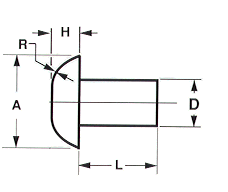
The four sizes of the Universal Head Rivets that we used are 1/16", 3/32", 1/8", and a 3/16". The diameters listed are the body diameter of the rivet. The corresponding head sizes are 1/8", 3/16", 1/4", and 3/8".

A Universal Head Rivet IS NOT a round head rivet. A proper tool for nesting the head of the rivet is required. Some tools are sold to nest the head, but a lot of them are sold and are not correct. So what happens is that if the rivet is not nested properly, you can get a ring deformation around the head of the rivet in your material, or you can get a ring deformation in the head of the rivet itself. Neither meets specs in the aircraft industry. Below is the proper configuration for a Universal Rivet. If you notice, there is a slight flat area on the head. The corresponding depths for the cutters are .027, .040, .054, and .080 deep. You can go a little shallower, but not deeper. If you go deeper, then you will get a ring deformation around the head of the rivet.
p3c.gif


Then there is a tubular rivet, sometimes called a drilled rivet. It actually has a round head to it. Most of the times a nest is made using a ball-nose end mill since it is a true spherical radius and does not have a flat like a universal head. The punch to roll over the drilled or tubular side takes a special punch. There are a couple formulas floating around for making the punch to roll them over, but the formula is not cut in stone because there are many variables that can flaw the formula. It can be the material the rivet is made from, and material may vary slightly from lot to lot, but is still within specs. It may be the plating causing a problem, if it is plated. I may be the case of sitting in the vats a little to long when conversion coating (iridite) the rivets.

Over the years, I have made literally thousands of rivet punches for all sorts of rivets. For tubular rivets, on certain days, I could make a punch to roll over the end in maybe 30 minutes from grabbing the stock to heat treating and polishing it. Then there were days that i would have to cut and try the punch 15 times before I could get one to roll properly, and it may have been the same as one I made in minutes a month ago. They could be simple at times, and other times you'd be pulling your hair out.

This is the Drilled or Semi-tubular rivet, and not the full radius on the head.

220px-Strivet333.JPG


An eyelet is the same concept for a punch to roll the eyelet over, but you need a nest that fits the other factory portion of the eyelet. If you look at the pic below, the nest would look just like the head of the eyelet. It's usually easier for some reason to make a punch for an eyelet than it is for a drilled rivet :lol: And once the other end is rolled over, it should look exactly like the factory head.

high_quality_eyelet_binding.jpg


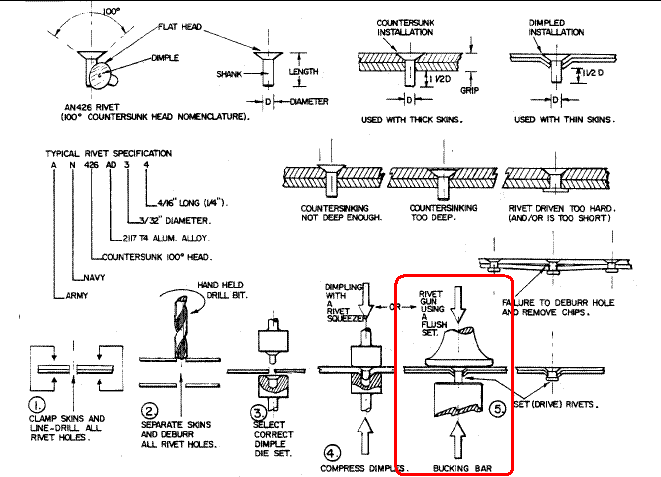
Then you have your flat head rivet.It is what it says. It has a flat head and has a countersink. You buck it just like a Universal Head. The only difference is that you will either have a countersunk hole for the head to fit in, or in the case of some sheet metal that is thin, you have to make a dimple tool. Even though it sounds simple to make a dimple tool, there is actually a little bit of work to it, and if you don't know anything about trig, then you don't know jack about a dimple tool. My apologies to anyone that has made dimple tools for large holes in sheet metal like Nasty made a gazillion sets of......but in the aerospace industry, things have to fit mating parts very precise. You want the dimple in the sheet metal to have a crisp line to it, so that you don't have a gap around the diameter of the head of the rivet and your sheet metal that it is going into. In order to know how to make the dimple tool, you need to know your rivet body diameter, your rivet head diameter, your angle of your rivet head, which is usually 100 degrees, then you have to basically draw the rivet out on paper, or on a Cad program, then you start adding in your material, then figure up the size for your punch, and figure up the size for your die. What works for say a .010 thick piece of material, will not work for a .020 thick piece of material. Granted, some will try to use the same, and some may get it past the inspectors, but wrong is wrong, whether it passes or not. It boils down to what is right, and what is a ****** piece of work. I always did it the proper way. I've watched people struggle, and I've watched people half *** things, just to get the job over with. I guess that is why I always made more money than my coworkers :lol: And when you are cutting metal, there is no reason to half-*** a job, just to get it completed, so you can grab another job and cut metal some more. :headscrat Here is a few diagrams of Flat Head or Countersunk Rivets. Also notice the number designation on the left hand side. The "AN" followed by the number and AN is "Army/Navy" On a lot of other components like Clinch Nuts, Anchor Nuts, you may have a "MS" preceding the number. MS is "Military Standard".

Also notice on the right hand side of the drawing where it says "Failure to deburr hole" and how the material is being held apart. That stands true for all rivets and not just a flat head rivet. And it stands true for ALL HOLES.....make sure they are deburred.

rivet_countersink.gif


Another good drawing I found is "Rivet Length". If you notice, both a Universal Head Rivet, and a Countersunk Rivet...the rivet length is measured differently. You want to make sure when ordering your rivets, that you get the appropriate length for what you are doing. You are talking quite a few thousandths difference in length between the two.

w6-DRAWING.gif


I'll post a link to this for the time being, as I need to find a good diagram of the types of rivet punches. This is for a Taumel Riveter. Taumel is the name of the company, and they make ORBITAL Riveting machines. An orbital riveter is a rotating riveter. It's automated, it will spin while putting downward pressure on your rivet. We had a few in our shop, and only two people that in later years knew how to properly make a orbital riveting punch. That was me, and the person I trained. Some thought they knew, but couldn't quite grasp the concept of holding an invisible dimension to .001 :lol: With a Taumel Orbital Riveter, the punch sets in the head at a 3, 4, or 5 degree angle. The length of the punch is a very, very, critical dimension to properly roll over a rivet. If your punch is too long, you are past your centerline intersection point. If your punch is too short, you are not reaching the centerline intersection point. And when that happens, there is no way to properly roll over the rivet. We always used a Taumel for extremely hard large rivets. Normally made out of Stainless Steel and were used to hold the wiper blades onto the wiper arms, and riveting the arm to the wiper main body. With the size of the rivets, there was no way to buck the rivet, be consistent, and mainly just get it done. But the orbital riveter would form the rivet right down in a few seconds. A good way to describe how critical the length of the orbital punch is, would be to take a pencil, and with the point of the pencil down on a piece of paper standing straight up and down......now lean the pencil over a few degree, holding the eraser end with your finger. Now rotate the eraser end around in a 1" circle or so. Now pull back on the pencil still leaning at the same angle and notice how far off of center the point is if you were looking straight down from the top. And it would be the same thing if you pushed the point through the paper at an angle. So dead on the money is the way an orbital punch has to work.

Here is a link to a Taumel Orbital Riveter http://www.taumel.com/Pages/selecting_machines.html I found a good pic as to what I was talking about. I guess I didn't search deep enough.

T-8dim.jpg


TC-HEAD.jpg
 

theoldwizard1

Well-known member
Joined
Feb 22, 2011
Messages
43,077
Location
SE MI
I have not read all of this post, so I might have missed this,

Most of the new aluminum F150 is put together with self piercing rivets. The robot does a "pinch" like it is going to spot weld and then shoots a rivet through. The rivet is partially hollow.

animation.gif


Adhesive is used in addition to rivets in some areas.

There is only 1 steel "sheet metal" panel in the whole truck. The dash panel (a.k.a. firewall). The additional rigidity was required to prevent body twist. Adhesive is used in addition to rivets to prevent galvanic corrosion.


Very few body shops will be certified by Ford to do repairs. The aluminum repair area most be isolated from the rest of the shop to prevent ANY steel particles from being transferred to the aluminum panels. No tools can be used on both steel and aluminum panels.
 

Kevin54

MEMBER EMERITUS
Joined
Jan 12, 2005
Messages
29,341
Location
Urbana, Ohio
Very few body shops will be certified by Ford to do repairs. The aluminum repair area most be isolated from the rest of the shop to prevent ANY steel particles from being transferred to the aluminum panels. No tools can be used on both steel and aluminum panels.

So that means that any Ford dealership that will do the repairs will have to have a separate room build, and then have to buy a press to be able to do what is shown. Then they will have to train the employees to run a press, unless Ford is going to supply the equipment. Other than that, they will have to have a factory setup somewhere to do the repair.
 

Defender Chassis

Well-known member
Joined
Dec 7, 2007
Messages
1,129
Location
Williamstown, WV
So that means that any Ford dealership that will do the repairs will have to have a separate room build, and then have to buy a press to be able to do what is shown. Then they will have to train the employees to run a press, unless Ford is going to supply the equipment. Other than that, they will have to have a factory setup somewhere to do the repair.

I bet the rivets are just used during assembly to hold things until the adhesives cure. I would bet clamps will be acceptable for a repair shop environment.
 

Defender Chassis

Well-known member
Joined
Dec 7, 2007
Messages
1,129
Location
Williamstown, WV
I have not read all of this post, so I might have missed this,

Most of the new aluminum F150 is put together with self piercing rivets. The robot does a "pinch" like it is going to spot weld and then shoots a rivet through. The rivet is partially hollow.

animation.gif


Adhesive is used in addition to rivets in some areas.

There is only 1 steel "sheet metal" panel in the whole truck. The dash panel (a.k.a. firewall). The additional rigidity was required to prevent body twist. Adhesive is used in addition to rivets to prevent galvanic corrosion.


Very few body shops will be certified by Ford to do repairs. The aluminum repair area most be isolated from the rest of the shop to prevent ANY steel particles from being transferred to the aluminum panels. No tools can be used on both steel and aluminum panels.

I used to work at a place that had a similar setup. The rivets had a waist and were used as a punch. The lower die was fixed and had a raised ridge that would shove the metal around the rivet into the waist area after the hole was punched and the rivet was in position. There was a similar upper die to do the same from the top. It worked well with new tooling but the raised ridge on the dies would quickly deteriorate and results varied from that point forward.

See page 6 in the following link:
http://www.alueurope.eu/talat/lectures/4103.pdf
 
Last edited:

porschedude996TT

Well-known member
Joined
Oct 28, 2007
Messages
2,384
Location
Santa Maria, California
Comments from a Long Time Aircraft Structures Guy here.

Today was the first time I've seen this thread and felt compelled to chime in.

1st Comment: I think I know the reason on why, but while I was in the aircraft industry making aircraft we had a wide range of rivet lengths to include 1/2 size lengths.

2nd Comment: I don't see anything about two man team to rivet things. We had a language to communicate with each other. To define this team, there was a Riveter and a Bucker. It was a series of taps with that went like this.
Rat-tat-tat (small not very powerful) from riveter showing where he was on the rivet he is trying to set.

Bump to the tail of the rivet by the Bucker using the Bucking Bar to indicate that he was there and ready to buck the rivet. (This could be felt by the Riveter.)

The Riveter will Set the Rivet using his experience with the power of the rivet gun he was using, the size of the rivet and the amount of material surrounding the rivet. (Yes, this all plays into how long and how much trigger, and how much power the Riveter adjusted into the rivet gun.)

When finishing the first Set on a Rivet, the Bucker would Tap Tap once if the rivet needed some more attention. He would Tap twice to tell the Riveter that this rivet was good. Or he would tap three times indicating to drill the rivet out because it was not acceptable (Flat or some other reason to reject the installation; See link: http://www.vansaircraft.com/public/Specs.htm )

It depends on the team and the work when to drill out a badly set rivet. Sometimes right after it was first set or to wait and drill all the bad ones at the same time and then re-rivet the series or take it one at a time and drill it out immediately and insert another rivet.

The Riveter could also reject the installation from his side. Sometimes if the angle of the rivet gun is not optimal, and the rivet set jumps and causes a smile or two on the head of the rivet. He can choose to drill it out and the Bucker should remain observant of a possible bad rivet coming toward him or maybe even a drill bit if the Riveter isn’t using a drill stop.

• When riveting, one will learn that a rivet will work harden and after the first attempt to set the rivet, it may require a whole lot more power or energy to flatten the tail diameter of the rivet to the desired 1-1/2 times the shank diameter.
• Also when riveting the un-set length of the rivet should be 1-1/2 times the diameter in length.
• Rivet Guns come in different sizes. I have only used 2X, 6X, and 8X Rivet Guns, but they go up to 9X and then the series number changes to 80X and some other series that are for huge rivets, like on a Ship.
• There is also the use of rivet tape. You can insert most of the rivets on an assembly with clecos in between the rivets to temporarily hold the assembly together. The tape is striped and the center is clear to see the heads of the rivets.
• The assembly can also be assembled using individually installed rivets. It is amazing what one can remember when shooting rivets all day long and assembling the same item frequently. This whole take a 4-1/2 length and this entire row takes 4 length rivets until this rivet which changes to 5 length rivets…
• Another problem that surfaces in aircraft assembly is the sealant used to seal the junction. When you install a rivet with PRC 1031 which is a gooey mess, the rivet tail needs wiped off before bucking the rivet. Otherwise the rivet will not form correctly and you will end up with a boot shaped tail. See link above.
 

Kevin54

MEMBER EMERITUS
Joined
Jan 12, 2005
Messages
29,341
Location
Urbana, Ohio
Porschedude....I just received a copy of the rivet specs from a friend where I worked, and that is the same one you posted. I also have a couple of others to post, but I'll have to change the format.
 
To avoid these ads, REGISTER NOW!
OP
M

machine_punk

Well-known member
Joined
May 14, 2011
Messages
2,540
Location
Napa Valley, California
Whew! You said a mouthful.

Thanks for that. I am sure I would have got around to discussing the driving of rivets when you cannot reach for yourself, but I appreciate the summary you wrote. I am always pleased when folks who have 'done this for a living' contribute to the thread.

Kev.

Comments from a Long Time Aircraft Structures Guy here.

Today was the first time I've seen this thread and felt compelled to chime in.

1st Comment: I think I know the reason on why, but while I was in the aircraft industry making aircraft we had a wide range of rivet lengths to include 1/2 size lengths.

2nd Comment: I don't see anything about two man team to rivet things. We had a language to communicate with each other. To define this team, there was a Riveter and a Bucker. It was a series of taps with that went like this.
Rat-tat-tat (small not very powerful) from riveter showing where he was on the rivet he is trying to set.

Bump to the tail of the rivet by the Bucker using the Bucking Bar to indicate that he was there and ready to buck the rivet. (This could be felt by the Riveter.)

The Riveter will Set the Rivet using his experience with the power of the rivet gun he was using, the size of the rivet and the amount of material surrounding the rivet. (Yes, this all plays into how long and how much trigger, and how much power the Riveter adjusted into the rivet gun.)

When finishing the first Set on a Rivet, the Bucker would Tap Tap once if the rivet needed some more attention. He would Tap twice to tell the Riveter that this rivet was good. Or he would tap three times indicating to drill the rivet out because it was not acceptable (Flat or some other reason to reject the installation; See link: http://www.vansaircraft.com/public/Specs.htm )

It depends on the team and the work when to drill out a badly set rivet. Sometimes right after it was first set or to wait and drill all the bad ones at the same time and then re-rivet the series or take it one at a time and drill it out immediately and insert another rivet.

The Riveter could also reject the installation from his side. Sometimes if the angle of the rivet gun is not optimal, and the rivet set jumps and causes a smile or two on the head of the rivet. He can choose to drill it out and the Bucker should remain observant of a possible bad rivet coming toward him or maybe even a drill bit if the Riveter isn’t using a drill stop.

• When riveting, one will learn that a rivet will work harden and after the first attempt to set the rivet, it may require a whole lot more power or energy to flatten the tail diameter of the rivet to the desired 1-1/2 times the shank diameter.
• Also when riveting the un-set length of the rivet should be 1-1/2 times the diameter in length.
• Rivet Guns come in different sizes. I have only used 2X, 6X, and 8X Rivet Guns, but they go up to 9X and then the series number changes to 80X and some other series that are for huge rivets, like on a Ship.
• There is also the use of rivet tape. You can insert most of the rivets on an assembly with clecos in between the rivets to temporarily hold the assembly together. The tape is striped and the center is clear to see the heads of the rivets.
• The assembly can also be assembled using individually installed rivets. It is amazing what one can remember when shooting rivets all day long and assembling the same item frequently. This whole take a 4-1/2 length and this entire row takes 4 length rivets until this rivet which changes to 5 length rivets…
• Another problem that surfaces in aircraft assembly is the sealant used to seal the junction. When you install a rivet with PRC 1031 which is a gooey mess, the rivet tail needs wiped off before bucking the rivet. Otherwise the rivet will not form correctly and you will end up with a boot shaped tail. See link above.
 

GsVs

New member
Joined
Mar 29, 2015
Messages
1
Hey ...

Great Thread .... glad I found it.

... thanks to Kev and all the others that have posted. :thumbup:

I've done some "Pop" riveting in the past, but no Solid Rivets ... Yet !
I have been wanting to get into metal working for a long time ... taking a welding class now, Rivet's has always been an interest - its time I buy a few new tools (and rivets)!

This thread has answered many of my questions ... but I'm sure I will have some more questions as I get started ...

Keep up the great work all ...
 
Last edited:

jimkinney

Well-known member
Joined
Jan 3, 2009
Messages
298
Location
Florida's Space Coast
Just came across this and will be back. Great thread.

On a different note, happened across a Three Stooges episode where Moe was driving rivets that Curly was bucking with his head. This was on high rise construction, and you know where/how it ended.

Keep up the good work.

Jim
 

gymbo39

Well-known member
Joined
Dec 27, 2009
Messages
153
Location
So Calif
I have a little experience, was an aircraft structural repair technician for 23 years. Not sure how many solid rivets that equates to but I'm sure its a couple.
 

Gonzo3333

Active member
Joined
Jan 3, 2014
Messages
25
Somebody ran a very tall power cart into one of the aircraft in the hangar I work in. Here are a few pictures of the doubler that we made and installed.

Edit: I could not figure out how to attach more than one photo, so here is the shop head side of the almost completed repair. It just needs to be painted.
 

Attachments

  • image.jpg
    image.jpg
    12.1 KB · Views: 208
Last edited:

porschedude996TT

Well-known member
Joined
Oct 28, 2007
Messages
2,384
Location
Santa Maria, California
I worked as an aircraft structures mechanic for small company and then the buyout and then work for a bigger company. I worked in a shop that made Lot Orders of parts, non-serialized parts to put on shelves for next station to use these sub assemblies to make larger sub-assemblies until you have a complete airplane. It was a high performance twin engine aircraft called the Aerostar. Aluminum pieces into special holding devices called Jigs, which were made to align detail parts to be drilled and riveted. It actually was a lot of fun.

I recall shooting rivets for the main carrythru beams for the wing attachment to the fuselage. Using a "Z" shaped bucking bar and a 6x rivet gun, which made a real racket in the shop. A normal rivet gun was a 2x or a 3x, so this 6x was one high powdered one.
 
Last edited:

E.rodz

Well-known member
Joined
Nov 11, 2009
Messages
2,434
Location
st.paul MN.
thanks for the very inspiring thread. it has inspired me to buy a bunch of riveting equip. I have leaned a ton from your posts I have a few questions about the equip. that i bought wondering if you know anything about it what the original purpose was.the first one is a Thremoid and it almost looks like it was made for boots, it did not come with any dies so i bought a set of air chisel dies and converted it to use these dies .


here it is back in action riveting the grill for my Gmc truck.


and just picked this beauty a couple weeks ago .it also cam with no dies so i am going to machine some conversion adapters to use my rivet squeezer dies for it .
 
OP
M

machine_punk

Well-known member
Joined
May 14, 2011
Messages
2,540
Location
Napa Valley, California
E.Rodz: Nice equipment! Great job converting the equipment for your purposes. I've seen the second machine and would like to have something similar...but no room in my shop, yet. I'm not familiar with the first machine, but it looks like it would be great for putting in smaller solid rivets...let your foot do the work.

I have the handheld pneumatic rivet squeezers. They are great, if they reach far enough into your project. Otherwise, you pretty much have to use a rivet gun and bucking bar to reach the middle of larger panels.

I've always liked the way you painted/decorated your shop. I'm planning to do an art deco/rivets/aircraft theme in my shop eventually. I want it to be an inspiring place to work.

All: Glad to see this thread revived a little! I still teach solid rivets, whenever I go to a Metal Meet (Santa Cruz and San Luis Obispo, both in California).

I'm getting a bunch of copper and brass rivets in a couple of weeks. I want to have contrasting metals for my projects. I've also switched to the soft aluminum rivets, when I use aluminum rivets, since I'm not doing anything critical (aircraft). I stuck with standard aircraft sizes (universal head and countersink head), since that is what most of my tooling is.

Kev
 
Last edited:
OP
M

machine_punk

Well-known member
Joined
May 14, 2011
Messages
2,540
Location
Napa Valley, California
1942 Disney animated film on flush riviting, the other link is bad.

I've seen that before...great little educational film. Thanks for sharing.

I have a little experience, was an aircraft structural repair technician for 23 years. Not sure how many solid rivets that equates to but I'm sure its a couple.

I'm sure there are a few things you could teach me about about riveting.

Somebody ran a very tall power cart into one of the aircraft in the hangar I work in. Here are a few pictures of the doubler that we made and installed.

Edit: I could not figure out how to attach more than one photo, so here is the shop head side of the almost completed repair. It just needs to be painted.

Nice patch! It still amazes me that folks can be that careless around aircraft. I suppose it is easy to get in a hurry, when you have a job to get done.

I worked as an aircraft structures mechanic for small company and then the buyout and then work for a bigger company. I worked in a shop that made Lot Orders of parts, non-serialized parts to put on shelves for next station to use these sub assemblies to make larger sub-assemblies until you have a complete airplane. It was a high performance twin engine aircraft called the Aerostar. Aluminum pieces into special holding devices called Jigs, which were made to align detail parts to be drilled and riveted. It actually was a lot of fun.

I recall shooting rivets for the main carrythru beams for the wing attachment to the fuselage. Using a "Z" shaped bucking bar and a 6x rivet gun, which made a real racket in the shop. A normal rivet gun was a 2x or a 3x, so this 6x was one high powdered one.

I've got 4x & 3x rivet guns. Thinking about getting a 6x and doing some larger rivet sizes. For now, I seem to do smaller projects. Speaking of which, I guess it's about time to post some pics of recent projects.

I've had a few folks contact me with questions, on this forum and over on Welding Web. I'm happy to answer anything I know.

Kev
 
OP
M

machine_punk

Well-known member
Joined
May 14, 2011
Messages
2,540
Location
Napa Valley, California
Recent Projects:

A tote for art supplies for one of my relatives: (note that the center, wrap-around piece is all made from ONE piece of sheet metal...bent and folded to fit).
IMG571.jpg


Installed a strip of LED lights on the back of the hold-down bar on my shear...'cause my eyes aren't getting any younger. Doesn't particularly have anything to do with solid rivets, but thought it might be a helpful idea for others who are having a hard time seeing the mark anymore:
LEDs-Installed-8001.jpg


A Steampunk welding station--holds a gas economizer, electric torch lighter, tips and other accessories for my Meco Midget AO torch...
Aero-Welding-Station-leftfront-medium3.jpg


I've started a new practice...if I complete a project without any mistakes, I go back and intentionally put a mistake in and 'repair' it. In this case, I cut a hole and patched it with a piece of copper:
Aero-Welding-Station-rightrear-close.jpg


And a bracket I brazed together, to hold the accessories for the torch:
welding-Station-1-e1452573089194.jpg


One of the two can holders I made with some scrap galvanized I had hanging around the shop. I built these to either hang on standard rack rail (as you see here..the standard 19" apart) or hang on a screw by key slots I drilled into the holder, on standard stud spacing).
Aero-Can-Holder-frontleft-medium.jpg


Seed starter trays I made for Mrs. Machine_Punk. I sealed the ends with silicone caulk, to make them water tight...
IMG_3276-800x533.jpg


Kev
 
Last edited:
OP
M

machine_punk

Well-known member
Joined
May 14, 2011
Messages
2,540
Location
Napa Valley, California
Where did you source the copper and brass rivets? Thanks!

I'll give you the name of the place I am working with, but read the warning below, before contacting them.
http://www.hansonrivet.com/

Hanson Rivet. I actually found them a LONG time ago. It seems like they actually manufacture rivets. Whether or not they do, they seem to have a huge stock of rivets in just about any material, head style or size you could ask for.

UPDATE: I just got in touch with one of the managers of this company and they have a wealth of knowledge in rivets. He gave me some great ideas on using rivets for my projects. This is definitely a company I am looking forward to working with.

Kev
 
Last edited:
Joined
Jul 27, 2016
Messages
7
I have a fishing reel I need to install some rivets on, if I post pictures can you advise me what to buy to set the rivets?
 
To avoid these ads, REGISTER NOW!
Top Bottom