That grip ranged from 1957-1963ish. The hinge-handles may have persisted later. Among ratchets, the streamline shank would precede the outline shank. I think Bonney was juggling different designs for ratchet mechanisms, and maybe they overlap.

You are using an out of date browser. It may not display this or other websites correctly.
You should upgrade or use an alternative browser.
You should upgrade or use an alternative browser.
Spreading the Bonney affliction!
- Thread starter bonneyman
- Start date




Oldtuleguy
Well-known member
- Joined
- Nov 4, 2017
- Messages
- 10,467


Private Lugnutz
Well-known member
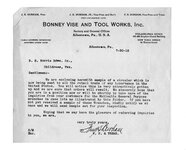
What's the source of that letter, leg?
Found it on eBay.What's the source of that letter, leg?
Seems legit.
Private Lugnutz
Well-known member
Nice. I was wondering if the photo was from a site or if you owned the letter and took the pic. That's a very cool piece of ephemera to have in your collection. Good on you.
Lugz almost everything I post pictures of is from my collection.Nice. I was wondering if the photo was from a site or if you owned the letter and took the pic. That's a very cool piece of ephemera to have in your collection. Good on you.
Private Lugnutz
Well-known member
Tools, of course, that's my automatic assumption. I've known you too long to think otherwise. I just couldn't tell if you were offering that like a bit of research or if you owned it. If it had been from a larger online reference I would've liked to have poked around in whatever it was further. Again, very nice piece of history of have!
Private Lugnutz
Well-known member
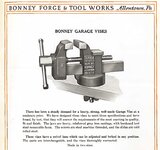
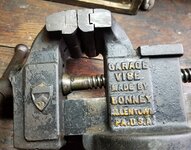
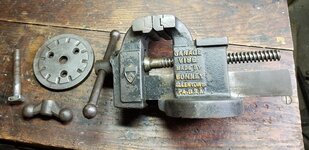
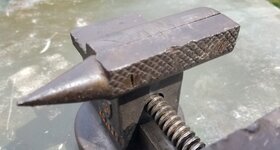
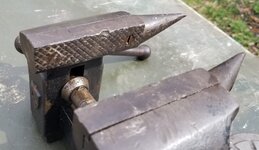
I found this No. 830 Garage Vise at the flea market this morning. Swivel base. 3" jaws. With a horn insert. Just enough traces of the black and orange finish scheme to make the overall honestly aged appearance very appealing. They introduced these in 1922, or thereabouts, I believe. The catalog excerpt is from 1923.
Attachments




Private Lugnutz
Well-known member
@LesserSon reported seeing one similar to this or exactly like this on eBay last February and he and @3baygarage had a brief conversation about the horn jaws insert upthread here. I've been searching through catalogs and trade journals etc for any literature on that feature. Initial speculation was they were custom, and they are not mentioned in any Bonney catalog. Notice that the anvil has no horn, which is not typical for a general utility garage or farm vise. My hunch, and it's just a theory, is that perhaps customer feedback complaining there was no way to bend wire, make rings, etc, prompted Bonney to offer these inserts as a way to compensate for that. I thought about removing them, to get a better view of them, but after some initial attempts, I decided against it for now. The screws are stubborn and one is badly boogered already.
Attachments


Very cool. Interesting that the horns are on the jaws and there are 2 of them.@LesserSon reported seeing one similar to this or exactly like this on eBay last February and he and @3baygarage had a brief conversation about the horn jaws insert upthread here. I've been searching through catalogs and trade journals etc for any literature on that feature. Initial speculation was they were custom, and they are not mentioned in any Bonney catalog. Notice that the anvil has no horn, which is not typical for a general utility garage or farm vise. My hunch, and it's just a theory, is that perhaps customer feedback complaining there was no way to bend wire, make rings, etc, prompted Bonney to offer these inserts as a way to compensate for that. I thought about removing them, to get a better view of them, but after some initial attempts, I decided against it for now. The screws are stubborn and one is badly boogered already.
Private Lugnutz
Well-known member
I've been thinking of them as two halves making one horn, but I agree, they could be used separately and/or together, and it might more rightly be described as two. The set up reminds me of long nose chain pliers for shaping metal and wire into rings and ovals that electricians and also jewelers use. You could do some bending and hold the workpiece or an associated workpiece at the same time. It's apparent that it never caught on, though, and there are some obvious disadvantages, too. But certainly unique and cool to see.Interesting that the horns are on the jaws and there are 2 of them.
The shape reminds me of sickle bar mower guards. I agree with possibly holding and bending as the reason for 2 horns. Hopefully in an old book or ad or catalog that someone can find to provide the answer.I've been thinking of them as two halves making one horn, but I agree, they could be used separately and/or together, and it might more rightly be described as two. The set up reminds me of long nose chain pliers for shaping metal and wire into rings and ovals that electricians and also jewelers use. You could do some bending and hold the workpiece or an associated workpiece at the same time. It's apparent that it never caught on, though, and there are some obvious disadvantages, too. But certainly unique and cool to see.
3baygarage
Well-known member
Wow, great find. The fact that it's called a Garage Vise, how suitable!
S-K Tool Fanatic!
Well-known member
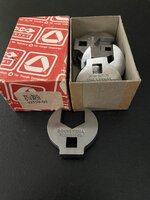
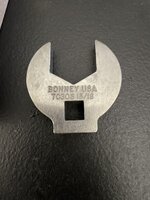
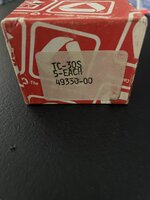
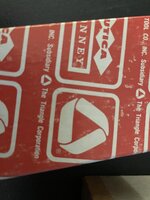
Found this at a $3 a pound store, there were 4 more boxes available that I didn’t buy but may buy later if they are still there.
Oldtuleguy
Well-known member
- Joined
- Nov 4, 2017
- Messages
- 10,467
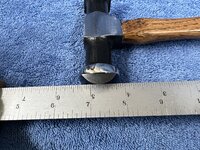
A handy size, equivalent to 24mm
I've been thinking of them as two halves making one horn, but I agree, they could be used separately and/or together, and it might more rightly be described as two. The set up reminds me of long nose chain pliers for shaping metal and wire into rings and ovals that electricians and also jewelers use. You could do some bending and hold the workpiece or an associated workpiece at the same time. It's apparent that it never caught on, though, and there are some obvious disadvantages, too. But certainly unique and cool to see.
Yeah, we’ve had a year to think about what they’d be for, and all I’ve got is rings, coils, and (my best thought) S-hooks / figure-8 hooks.The shape reminds me of sickle bar mower guards. I agree with possibly holding and bending as the reason for 2 horns. Hopefully in an old book or ad or catalog that someone can find to provide the answer.
MP&C
Well-known member



Old Radar
Well-known member
Shiny!
Private Lugnutz
Well-known member


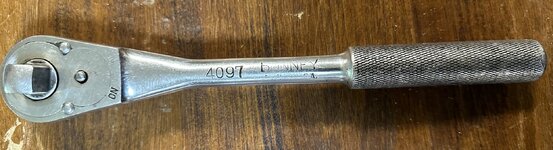
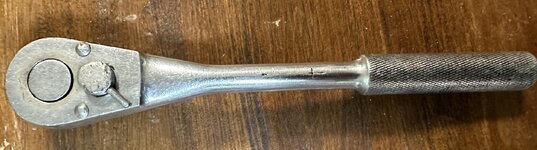
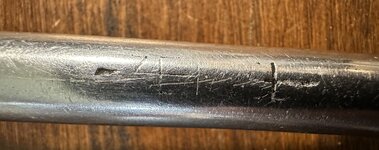
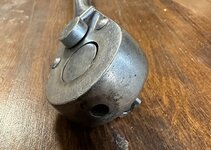
Bonney 4097 1/2" drive ratchet with "Zenel" stamping. 10" long, 20 tooth. 1/4" dia. unthreaded hole in top of head. Missing fitting for lubrication? Handle is hollow, with a 7/16" ID.
At first I though this ratchet had pretty weak stampings, but realized that it's wear from a whole, whole lot of use. If this thing could talk! Ratcheting mechanism is still superb.
Edit: just found a Youtube video on the 4097
The hollow handle is meant for an extension bar: a "Stendo". Of course, this is in place of the time-honored pipe-extender, providing that "tooth-fragmenting" torque that we've all experienced. This factory cheater bar is inserted and threaded into the hollow ratchet handle. Yup, try to find a "Stendo" out there folks!
At first I though this ratchet had pretty weak stampings, but realized that it's wear from a whole, whole lot of use. If this thing could talk! Ratcheting mechanism is still superb.
Edit: just found a Youtube video on the 4097
Attachments

Last edited:

Raineman
Well-known member
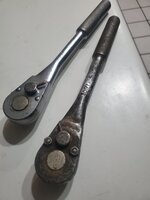
Fantastic!John Deere TY3168 1/2" drive (Bonney A-702K I believe). This is one beastly 1/2" ratchet.

Mikeske
Well-known member
OH yes it is a beastly 1/2". I have three of the Bonney A-702K ratchets and if you carefully remove the spring clip on the anvil side and clean the ratchet with brake clean blow it out with air gently and then apply some wheel bearing grease (thin coat) and reassemble it this will really smooth out the ratcheting action. I been doing that since the early 1980's on mine and it works much smoother after the cleaning and greasing.John Deere TY3168 1/2" drive (Bonney A-702K I believe). This is one beastly 1/2" ratchet.
3baygarage
Well-known member
Saw one sell with the bar maybe two years ago. I was interested but couldn't justify the price.Bonney 4097 1/2" drive ratchet with "Zenel" stamping. 10" long, 20 tooth. 1/4" dia. unthreaded hole in top of head. Missing fitting for lubrication? Handle is hollow, with a 7/16" ID.
At first I though this ratchet had pretty weak stampings, but realized that it's wear from a whole, whole lot of use. If this thing could talk! Ratcheting mechanism is still superb.
Edit: just found a Youtube video on the 4097The hollow handle is meant for an extension bar: a "Stendo". Of course, this is in place of the time-honored pipe-extender, providing that "tooth-fragmenting" torque that we've all experienced. This factory cheater bar is inserted and threaded into the hollow ratchet handle. Yup, try to find a "Stendo" out there folks!
Oldtuleguy
Well-known member
- Joined
- Nov 4, 2017
- Messages
- 10,467
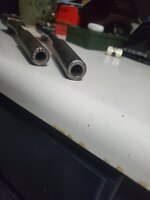
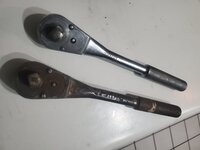
RTM
Well-known member
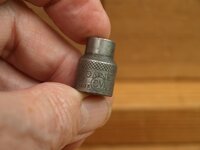
Another find from Saturday's Estate Sale. 4 universal swivel sockets 12 point, TU12, TU14, TU16, & TU18, 3/8", 7/16", 1/2" & 9/16". Each markled with patent us2304766, held by Cornwell, from 1940. Looks like the TU12 was first introduced in 1947. By 1963, they list 7 sockets up to 3/4", TU24.

Last edited:
Oh yes, the 1/2" -702K's were weighty! Very good for co-worker "adjustment".John Deere TY3168 1/2" drive (Bonney A-702K I believe). This is one beastly 1/2" ratchet.
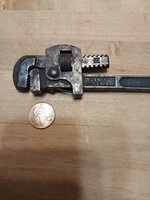

Thanks. Interesting that it is marketed as a motorcycle wrench with the "Bonney Motor Stillsons" in the 1923 catalog. Or one that is similar.Nice 6” example. That particular design of Stillson wrench is illustrated in the 1926 Bonney catalog. Before that, the markings are shown stamped (not forged) into a bulkier frame.

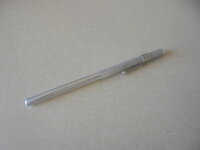

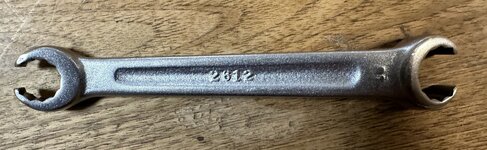
I have some of those. Were really helpful inside tight gas furnace enclosures when replacing a gas valve or pilot assembly. Short and compact, really nice.Bonney 2612 flare-nut wrench, 12 pt., 1/2" X 3/8". Real (non-photo) view of wrench is actually much better than photo.