To avoid these ads, REGISTER NOW!

Spreading the Bonney affliction!

To avoid these ads, REGISTER NOW!

outofbounds

Well-known member
Joined
Oct 23, 2019
Messages
1,393
Location
Michigan
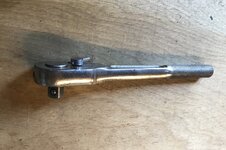
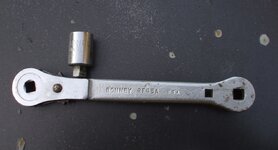
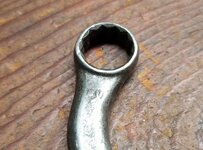
Turned up this Bonney 2640 special combination wrench today. Curious if this a special aircraft tool.
 

Attachments

  • IMG_9361.jpeg
    IMG_9361.jpeg
    583.7 KB · Views: 19
  • IMG_9362.jpeg
    IMG_9362.jpeg
    822.4 KB · Views: 20
  • IMG_9365.jpeg
    IMG_9365.jpeg
    682 KB · Views: 17
  • IMG_9366.jpeg
    IMG_9366.jpeg
    909.7 KB · Views: 15

LesserSon

Well-known member
Joined
Feb 7, 2016
Messages
5,050
Location
PA USA
1950-ish Chrysler torque-ing wrench. I think the length and twist are to allow it to flex, so an experienced mechanic could apply correct torque by feel (and not, as I originally suggested in that post, to extend its reach). I don’t think this relatively inexpensive design lasted long, as readable and then callibrated torque wrenches were more precise.
 

LesserSon

Well-known member
Joined
Feb 7, 2016
Messages
5,050
Location
PA USA
IMG_3376.jpeg
An interesting pair of DOEs. Both marked Mack (Truck), with “R” date codes (DR & GR), but both the embedded-shield logo and USS/OC/SAE fractional inches marks indicate the No37 is from 1926, while the plain “BONNEY” logo on the S-wrench indicates 1940.
 

LesserSon

Well-known member
Joined
Feb 7, 2016
Messages
5,050
Location
PA USA
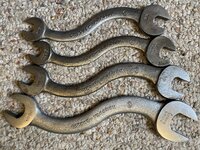
But then… Here are four S-wrenches purchased together in similar condition from one vendor. All four IQ date codes, but two have the embedded-shield logo with USS/OC/SAE sizes and two have the plain-BONNEY logo with fractional-across-flats sizes.
Obviously, the sizes are stamped in a separate, later process from the forged-in date codes, so maybe Bonney logo and size stamps are not to be trusted when identifying which 14-year cycle they’re from?
 

Attachments

  • IMG_3378.jpeg
    IMG_3378.jpeg
    1.8 MB · Views: 12
  • IMG_3377.jpeg
    IMG_3377.jpeg
    1.9 MB · Views: 20

Private Lugnutz

Well-known member
Joined
Mar 30, 2012
Messages
30,486
Location
The Authentic Jersey Shore
My first reply, to your first pair of wrenches, was Mack-centric, more of a remark on it looking like they made engineers wrenches for Mack kits early, and "S" wrenches for Mack kits later.

Maybe it's just my limited grey cells, LS, but I'm not seeing anything about those four "S" wrenches that casts any doubt on dating schemes.

Reading forged-in "IQ" codes on wrenches with forged-in CHROME-VANADIUM (CV) markings and stamped with the Bonney embedded shield logos, nut and bolt standard size markings (i.e., the 1081-A and 1077-C) as 1925 is perfectly consistent with the thinking that they used that size marking convention and logo up through the late 1920's/1930 or so.

Likewise, reading forged-in "IQ" codes on wrenches with forged-in CHROME-VANADIUM (CV) markings and stamped with the plain Bonney name logo, no embedded shield, milled opening sizes (i.e., the 1079-S and 1077-S) as 1939 is perfectly consistent with the thinking that they changed to the new sizing convention and the plain name logo in the late 1920's/1930 or so. They were still using those CHROME-VANADIUM (CV) dies well up through 1942 and we even see some 1943's sneak in before the WPB extended grace period ended.

Granted, the earlier wrenches being in good, clean, rust-free condition and happening to also be "S" wrenches with "IQ" codes coming from the same vendor does look deceptively set-ish, but it tell us nothing empirical about the origins of any of the wrenches or their provenance, and doesn't break any logic of the dating scheme.

If you're suggesting that all the wrenches could've been forged at the same time, i.e., in 1925, and the early-sizes-and-logo wrenches stamped in 1925, and the later-sizes-and-logo wrenches stamped in 1939, I suppose it's possible. I just don't see how that possibility is enough to distrust the date code system. It's just as possible and maybe moreso that the latter two were forged with the same or similar dies in 1939 and stamped in 1939.

The "IQ" codes being identical (with the same placement and number of mysterious dits or dots we sometimes see accompanying date codes, including two of your examples) might make me wonder.

If I was apt to think anything outside the box on these, it would be to wonder if maybe we're wrong, or off, or too strict about the transitions to the new logo and sizing. Either coming earlier (i.e., all these wrenches are from 1925) or later (i.e., all these wrenches are from 1939) on some types and styles of wrenches.

But I would have to see a lot more of it at scale and scope to get me off the CW.
 

LesserSon

Well-known member
Joined
Feb 7, 2016
Messages
5,050
Location
PA USA
I’m definitely NOT doubting the 2-letter month/year codes. My doubts arise from what’s stamped on the faces. I’m still prossessing what I’m seeing.
Yeah, there’s no provenance, but I have not thought of a plausible random or intentional series of events that would bring these four wrenches together now, if they had been forged two-and-two, fourteen years apart to the month. I think they must have been originally forged in the same month of the same year.

Here’s where I’m at:
1924 - CV-circle logo added to the spelled-out alloy on the dies.
Sep1925 - all four wrenches forged and stored unfinished.
1925-1927 - Two are ground out to size, stamped with the embedded-shield logo, 1077-C and 1081-A and respective USS/OS/SAE conventions of the time. Now stored in semi-finished state for about five years.
1927 - size convention changes to across-flats.
1932 - plain-BONNEY logo replaces embedded-shield logo.
1932-1946 - The other two (having remained unfinished for about seven years) are ground to size, stamped with plain-BONNEY logo, 1077-S and 1078-S and fractional size across-flats, and also stored semi-finished. An order including all four (and possibly others), initiates plating, then they are shipped and remain together until I purchase them.

1. I am suggesting that sized wrenches were stored in a semi-finished state until required, because if they were always plated first, an order of plain steel wrenches would always need to be forged from scratch.
2. 1939 is a possible year of plating and sale, but I think it is a distractor, suggested by the IQ code.
3. 1946 is a limit on “Made in USA” under the plain BONNEY logo - not necessarily a limit on when they were sold. But I think it most likely they were sold close to 1932.
 
Last edited:

Private Lugnutz

Well-known member
Joined
Mar 30, 2012
Messages
30,486
Location
The Authentic Jersey Shore
Thanks for elaborating, LS. I'm sure you saw that I was ahead of you on that in my last post.

I do think you could be inordinately affected by buying these together, though.

Don't you have any other later era logo/size markings wrenches with "IQ" codes in your collection? Or any "xQ" codes regardless of the first letter? Have you ever suspected that any of them were made in 1925 instead of 1939 before now? Why not? Just because you didn't acquire them all at the same time?

Why aren't you suspecting that the "S" wrench with the "Mack logo and the "DR" code was forged in 1926 around the same time that the big DOE wrench with the "Mack" logo and the "GR" code was forged?
I have not thought of a plausible random or intentional series of events that would bring these four wrenches together now,
?! Like me, I am presuming you own several dozen Bonney wrenches from several eras. I am presuming some of them are the same type of wrench and that some of those have date codes exactly one cycle apart. And I am further presuming that you didn't find them all together at the same time. If you put four of them together now - two from 1924, two from 1934, for example - and you sold them at Jake's next week, it's exactly the kind of series of events that could've brought those four "S" wrenches together. Someone liked Bonney CV "S" wrenches. Someone was trying to put a set of Bonney CV "S" wrenches together. Someone who didn't notice or care or understand logos and size markings. Maybe not even a collector, but a user. And then WWII broke out! :)
 

LesserSon

Well-known member
Joined
Feb 7, 2016
Messages
5,050
Location
PA USA
A couple weeks ago, I laid out all my Bonney tappet wrenches on the floor and organized them by date codes. I had no difficulty distinguishing wrenches from different cylces bearing similar date codes - there are morphological differences, plating material differences, condition differences. I make an effort to match up “pairs” with as similar date codes as possible, and even when purchased in clutches from apparent sets, they rarely bear exactly the same date codes or look as much alike as these S-wrenches do.
It seems to me rather more far-fetched that a mechanic (or any other person) in the 1930s put together a set of S-wrenches based on their date codes which were also made in two batches exactly fourteen years apart, than the way I reconciled them in my last post, which cuts that fourteen-year span in half.
 

LesserSon

Well-known member
Joined
Feb 7, 2016
Messages
5,050
Location
PA USA
I DO suspect the Mack wrenches were made within one year, but I purchased them months apart.
 
Last edited:

leg17

Well-known member
Joined
Aug 11, 2011
Messages
1,369
Location
Kentucky
Do you suppose the "date" codes may date, or otherwise identify, the die manufacture and not necessarily the date(s) that the die was used? I have never seen any 'witness' around those forged-in codes that indicates that the code had been changed.
Perhaps, for example, a die set is made, given an identification code, or 'date' code, and then used until it's practical number of 'hits' is used up when another replacement die set is made and given a different, distinguishable code? That practice is commonly seen in injection molding even today. It identifies the tool, or mold, or die, that was used for production for Quality Control purposes. Actual date of use is a separate issue.
My 'nother two cents on this subject.
 

LesserSon

Well-known member
Joined
Feb 7, 2016
Messages
5,050
Location
PA USA
I have zero familiarity with the realities of industrial forging. I would defer to the opinion of someone who has, but it would still be an opinion. I think there’s plenty of room for what you described, and that it makes sense. But I’m not sure HOW much of a difference it makes to the production sequence of tools - the codes are already only interpreted as approximations to the month, not days or shifts or hours.
At BEST, the codes can only indicate the (month/year) date a given tool was forged (or the date of the die or the intended period of use of the die). What I was getting at is that production continues for several steps after forging, with no further indication of how long the tool sat between those stages or was finally shipped out.
My reconstruction asserts that the grinding and stamping of faces occurs prior to plating, and that there was in at least some cases, a gap of years between the forging date and stamping date, and again between the size stamping date and actual sale, during which the stamps were changed.
 

MShaw

Well-known member
Joined
Mar 2, 2015
Messages
1,013
Location
York, Pa.
Just as a process insight, when I worked for New Britain the lower cost wrenches (Husky, Sparta, Penncraft) were forged, machined, polished, plated and delivered to the warehouse unmarked. They would be stamped in the warehouse to the sales order requirements.
 

LesserSon

Well-known member
Joined
Feb 7, 2016
Messages
5,050
Location
PA USA
Thank you for your insight. Were those box wrenches?
It seems to me that for open-end wrenches, separating the machining and stamping would invite mis-marked sizes (not that we don’t see that occasionally).
 

Private Lugnutz

Well-known member
Joined
Mar 30, 2012
Messages
30,486
Location
The Authentic Jersey Shore
It seems to me rather more far-fetched that a mechanic (or any other person) in the 1930s put together a set of S-wrenches
That was just meant to be a funny flourish at the end there, LS, nodding to WWII and its alloy restrictions resolving these kinds of dating issues with respect to wrenches made in that era and the more assuredness of the next forged-in date code cycle. It could've been your vendor who gathered them together, or the guy he got them from, etc.

Lest it seem as if I am protesting too much, I will reiterate and re-emphasize that I do think it's possible they were all forged in the 1925 "IQ" period. As a theory, the idea of tools sitting around for a few years in pre-finish surplus is not at all foreign to me. I have postulated it with several other brands due to similar issues. The latter two (the 1079-S and the 1077-S) could've been stamped after the logo and sizing convention transitions and well before the next "IQ" period (1939). (My notes say by 1930, not 1932, but I'll have to re-visit why.) After all, it was start of the Great Depression, and things weren't exactly flying off the shelves.

EDIT: To accentuate that point, since I don't think you're a Snap-on follower, @LesserSon...
Like a few other collectors, I have a few sockets stamped with multiple date codes. They are all in the 1928-1932 timeframe. I have one socket in particular that was stamped four (4) times with 4 different date codes. That's four years of it being unsold. One can easily see Bonney wrenches made in the same general time frame, forged with a date code, and sitting for that many years before the demand prompted them to eventually be prepared for selling. In the interim, the stamping dies changed for the logo and the size convention.
 
Last edited:
To avoid these ads, REGISTER NOW!

Private Lugnutz

Well-known member
Joined
Mar 30, 2012
Messages
30,486
Location
The Authentic Jersey Shore
Even without the "BU" (February 1943) date code, this KMO "FUEL AND WATER PUMP" DBE wrench was unmistakably made by Bonney. The shape and the raised lettering give it away. They were made to service Detroit Diesel engines, they have been seen with an FSN (41-W-1495-100), and I found a very similar one made for Gray Marine a few years ago, linked here.
 

Attachments

  • 20241006_145226.jpg
    20241006_145226.jpg
    679.4 KB · Views: 19
  • 20241006_145234.jpg
    20241006_145234.jpg
    633.8 KB · Views: 19
  • 20241006_195914.jpg
    20241006_195914.jpg
    141.1 KB · Views: 19
Joined
Oct 6, 2024
Messages
8
Got a few Bonney, (my first), combo's at an estate sale for $1.00 each. Full polish 3/8', 1/2" and 9/16''. A pleasure to hold and use.:thumbup:
I just bought a ⅜" drive 9/16, ½, ⁷/¹⁶, and ³/⁸ 12 point sockets, all later Loc-rite stuff for $1 each and a ½" drive ⅝ for $2. They looked either unused or barely used from an antique store. I'm putting everything I once had stolen from me years ago back together for cheap. I love Bonney, too!
 

Private Lugnutz

Well-known member
Joined
Mar 30, 2012
Messages
30,486
Location
The Authentic Jersey Shore
I got this one recently. Bonney V25 1/4".
Nice find. Late 1945, 1946, or so. If it was chromed, I'd guess later. During the war the COO was "MADE IN U.S.A." and the selector had a weird shape. The top and bottom were rounded and knurled, but the sides were flat and smooth, almost like they made them round and then machined the sides. Probably because the ratchet was assembled with peened pins, not screws, and the heads were not flush. I have one, also dark finish, almost exactly the same - same marking, same selector, same finish, but mine is pinned. Mine and yours probably represent a very short production sequence.
 

z28lsc

Well-known member
Joined
Jan 27, 2021
Messages
200
Location
Gardena CA
Nice find. Late 1945, 1946, or so. If it was chromed, I'd guess later. During the war the COO was "MADE IN U.S.A." and the selector had a weird shape. The top and bottom were rounded and knurled, but the sides were flat and smooth, almost like they made them round and then machined the sides. Probably because the ratchet was assembled with peened pins, not screws, and the heads were not flush. I have one, also dark finish, almost exactly the same - same marking, same selector, same finish, but mine is pinned. Mine and yours probably represent a very short production sequence.
I seen the pinned ones as well I need to find me one too. Thanks for the info.
 

Private Lugnutz

Well-known member
Joined
Mar 30, 2012
Messages
30,486
Location
The Authentic Jersey Shore
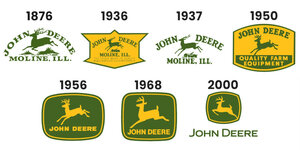
Gah! When you see a stylized (modern or ultramodern) John Deere logo you don't think anything of it. But in the context of the historical John Deere logos, I can't "unsee" the fact that the stylized logos are anatomically weird! Where is the other half of the deer? And I guess it's not just how many legs, but whether the deer is bounding (2000 >) or landing (< 2000)! :)
 

Old Radar

Well-known member
Joined
Apr 17, 2019
Messages
2,754
Location
San Antonio, TX
The North Pole's successful litigation in 1950 forced JD to change from Reindeer to White Tail.
America's thirst for "newer and younger" icons can be seen in the mid-60s change from ten point racks to eight pointers.
At the same time, the decreasing ratio of deer encounters in their natural woodland habitats to sudden headlight encounters on public highways drove the two-legged "deer-in-the-headlights" profile into prominence.
 

Beerhippie

Well-known member
Joined
Oct 13, 2023
Messages
9,677
Location
Far NE Oregon
It does look familiar:

w11-3_s-2.gif

I recall laughing with friends about the deer xing signs being--obviously--whitetail in muley country back before whitetails invaded and displaced the muleys to the most remote areas around here.

Oh, and the Nevada Randy Deer and Randy Bull warning signs... very explicit.
 

Mike'smeatshop

Well-known member
Joined
Apr 1, 2023
Messages
1,273
It does look familiar:

w11-3_s-2.gif

I recall laughing with friends about the deer xing signs being--obviously--whitetail in muley country back before whitetails invaded and displaced the muleys to the most remote areas around here.

Oh, and the Nevada Randy Deer and Randy Bull warning signs... very explicit.
They only see half a deer nowadays.
 
To avoid these ads, REGISTER NOW!
Top Bottom