alinc100
Well-known member
Ideally I'd love to see it filled as this MC set but I'm not sure I have the patience: 

"Lessons with Andy", Part IV: How to call someone a cheap ******* and get away with it!You would have gasped at the price and walked right on by, LOL.

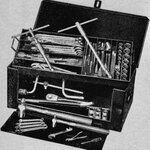
Later catalogs show a clearer suggestion for putting those wrenches in the removeable tray.As far as organization goes, it's gonna be hard pressed to organize. The lower compartment is just open, wrenches will just splay about.
IDK - some of us are cheapskates most of the time, so we can drop big bucks when something extraordinary comes along - and your find is extraordinary.You would have gasped at the price and walked right on by, LOL.
I don’t think you’re that far away, though. Take out all the nonBonney, accept that you have 40xx sockets instead of the Dxx sockets…Ideally I'd love to see it filled as this MC set but I'm not sure I have the patience
We call it "Thinking with Lincoln " around here. LOL And it really wasn't high priced , and you are not a "cheap *******" you are frugal, shrewd, thrifty, and very wise. It will likely become a flip . I have several other Bonney pieces ,I'm going to have to see what is period appropriate and may fit in."Lessons with Andy", Part IV: How to call someone a cheap ******* and get away with it!
If you paid dearly I'm assuming it's a keeper then. I know you've been flipping a lot of tools as a matter of course, including the Bonney roller, so I wasn't sure. Nice. If you do decide to complete it, maybe I can fill some holes.
Thanks, that pic helps alot. I'll have to tinker as time allows and see what I can make happen.Later catalogs show a clearer suggestion for putting those wrenches in the removeable tray.
IDK - some of us are cheapskates most of the time, so we can drop big bucks when something extraordinary comes along - and your find is extraordinary.
Ditto - I was also going to comment on it, but got caught up reorganizing your inventory to align with the catalog’s. I have two or three Bonney black metal boxes (none big), and the orange tartan badges vary from barely discernable to not as clear as yours.The little corner badging is cool. As the piece de resistance, I would protect it by all means possible.
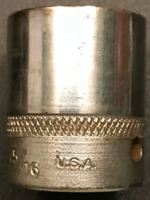
No older than late 1940's. Bonney sockets and other tools were marked "MADE IN U.S.A." prewar and wartime. Like Williams and several other mfgrs, they reduced the COO marking to just the initials "U.S.A." during the transition period just after WWII. And they're chromed.How old would those be?



A great visual timeline. I can say I learned something today...now If I can just remember where.......I would narrow that: late 1950s to early 1960s, without hard proof, but not without evidence.
As Lugz said, “Made in U.S.A.” persisted immediately post-WWII. On some tools with date codes, it looks like they switched to “U.S.A.” around June 1946, but on others, as late as April 1947.
But there were never date codes on sockets. I see this example as wartime.
And this one, maybe 1946/7.
Then there’s this, maybe around the Miller Manufacturing years(1954-)?
And then what you’re looking at, with concave diamonds, possibly Alliance OH years (1957-64)?
After which, an inversion, maybe Kelsey-Hayes (mid1960s) era?
Then a clear Triangle stamp, smooth walls (and LocRite lobes) after 1966.
And I take this to be the demise under Cooper Tool ownership.

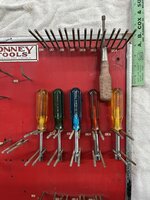
Hello & Welcome; lots of good info around here - keep us informed on your progress & please do share other info with us - it's an easy crowd here - again Welcome.I am working on filling this Bonney tool board and have identified all but the 8 on the top right, the part numbers are SN6, 7,8,9,10,11,12,14, all starting with SN. I have looked at all the alloy Artifact pages and catalogs, searched the numbers on Google and e-bay with no luck, can anyone fill me in on those 8 tools, the gap between the pegs are 1/4 inch, the space to the next tools on the bottom is less than 4 inches and there is almost no room to the top of the board, any info would be appreciated. Thanks
Somehow I have gotten addicted to filling in old tool boards of different brands
Fromam working on filling this Bonney tool board and have identified all but the 8 on the top right, the part numbers are SN6, 7,8,9,10,11,12,14, all starting with SN
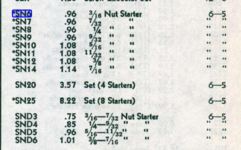
The asterisk might be the most significant bit of information on that page!From...

You can add the GJ Bonney thread to this list, because I don't recall seeing any "Nut Starters" posted here, the Search function doesn't reveal any being posted naming them in the text, and, I have to admit, I have never seen one in the wild or a photo. Granted, I don't generally collect Bonney tools made after 1950, so I know virtually nothing about that era or later. There are plenty of late to modern era Bonney collectors here so they may have examples, but I had no idea what the tool even looked like. So I went looking.I am working on filling this Bonney tool board and have identified all but the 8 on the top right, the part numbers are SN6, 7,8,9,10,11,12,14, all starting with SN. I have looked at all the alloy Artifact pages and catalogs, searched the numbers on Google and e-bay with no luck,

I am working on filling this Bonney tool board and have identified all but the 8 on the top right, the part numbers are SN6, 7,8,9,10,11,12,14, all starting with SN. I have looked at all the alloy Artifact pages and catalogs, searched the numbers on Google and e-bay with no luck, can anyone fill me in on those 8 tools, the gap between the pegs are 1/4 inch, the space to the next tools on the bottom is less than 4 inches and there is almost no room to the top of the board, any info would be appreciated. Thanks
Somehow I have gotten addicted to filling in old tool boards of different brands
That has got to be a collectors worst nightmare, A tool board with empty slots for tools that are rare as hens teeth.The asterisk might be the most significant bit of information on that page!
You can add the GJ Bonney thread to this list, because I don't recall seeing any "Nut Starters" posted here, the Search function doesn't reveal any being posted naming them in the text, and, I have to admit, I have never seen one in the wild or a photo. Granted, I don't generally collect Bonney tools made after 1950, so I know virtually nothing about that era or later. There are plenty of late to modern era Bonney collectors here so they may have examples, but I had no idea what the tool even looked like. So I went looking.
Based on the name and the provisions and dimensions for hanging them on that board, I was picturing something like a screw starter, for nuts instead, or very small nut drivers, and - lo and behold, that's pretty much what they were!
Top of page 9 Catalog C-2 (1950)...
Despite the PD-13 Descriptive Price List (1956) claiming to apply "to Catalogs D-2, M-2, C-3, Display Catalog #1 & All Previous Catalogs", I could not find them in Catalog M-2. At least not on the same page or vicinity as they appear in the C-2. There is no copy of Catalogs D-2 or C-3 on IA/ITCL, so I could not check those. They do not appear in Catalog C-1 (1947) or Catalogs 43 (1943) and I stopped there, highly doubting earlier production.
Snerk. Agreed! But if he's anything like me - and I suspect you and other tool boardThat has got to be a collectors worst nightmare, A tool board with empty slots for tools that are rare as hens teeth
Let's just say ..You've came to the right place. The knowledge ,friendliness, and shear volume of this place make it great. I started looking last night in catalogs on IA/ITCL in between other things but never was able to beat these guyz.First I want to thank all that read and helped on my Bonney tool board issue, Oregon Dave, RTM, Private Lugnutz, Snaparxon, and anyone else that started the research. As soon as I saw them my thought was I had never seen these. So as I continue the search, I am already in the process of making a set to put in there place. These nut starters must be pretty short as there is not much room for them. Thanks to all again. It is hard to believe how happy it makes me to just know what these are and have a picture/drawing. Also this is my new favorite forum.
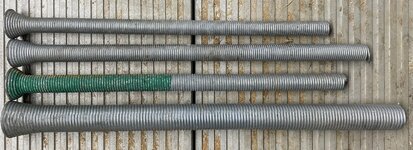 They are longish helical springs that widen at one or both ends, used by hand to put a smooth bend into soft copper tubing without kinking.
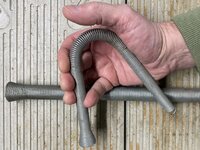 They come in a few sizes for common sizes of copper tube. I can easily imagine someone picking one up, experimentally jamming a nut into the end, and thinking, “this could come in handy!”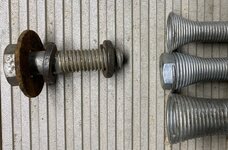

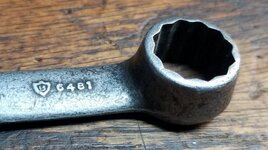


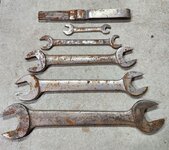
Which Todd ID'ed for him.An old B-shield non-symmetric-profiled DBE. Anyone know about the bottom wrench?
Adding the following comment....battery terminal wrench.
LS found one back in 2019, posted here...Later numbered 2875.
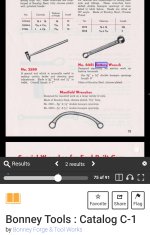
Note that neither BB or LS noted any Bonney branding or any other markings (customer, etc)....a 1931 (EW) battery wrench 6481.


You right. I corrected it. Some makers did use COO before it became law. Apparently Duro was one of them.The "R" in the date code and the embedded Princeton shield branding ("BON{/}NEY") date the obstruction wrench to 1926.
(I'm not sure where you're getting the info that 'MADE IN U.S.A.' comes after 1930.)
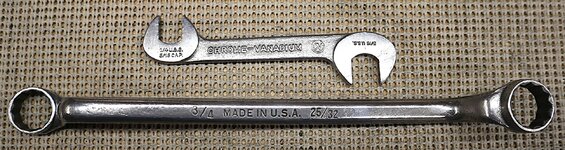
The second wrench was made by Duro-Indestro. Bonney TM'ed a stylized form of "Chrome-Vanadium" (note, with a hyphen) - as well as the abbreviation 'CV', but did not own all rights to all forms of the name of the steel composition itself, which was used by many mfgrs. DI used "Chrome Vanadium Steel" branding.
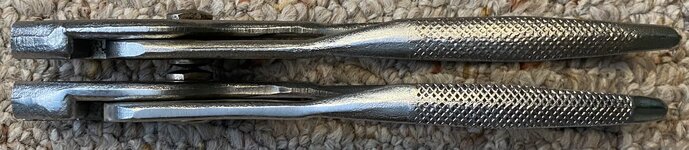
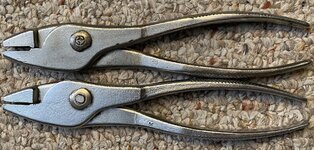
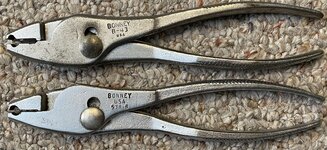 Trip to Jake’s Flea this morning. Real purpose was to pick through some Indestro pressed steel DOE kit wrenches I ignored last weekend, but they turned out to not include the two sizes I wanted. Instead, $3 bought the Bonney B-43 Corbin hose clamp pliers at top of each photo. My phone notes told me I didn’t have a pair.
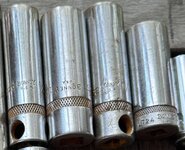
Well, there was some Horse Trading and I brought them home.Is there a good reference which I can use to assess the age of Bonney Sockets?
How old would those be? (Not mine (?yet))
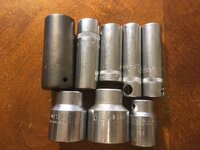


Boy that did clean up like new.My first bonney screwdriver that I have found in the wild. It was rusted and faded but it cleaned up pretty good.
Yes it did. I just used a razor blade, steelwhool and flitz on the handle.Boy that did clean up like new.
It's likely because on the archive website if you looked there. It's all jumbled up when you try to search things. But I managed come across a few catalogs with itHere's the rub.
I cannot find a reference to the 6481 P/N in any Bonney catalog. Not in the numerical index or in the wrenches or special wrenches pages with the other special wrenches. In fact, there aren't any other 64xx series tools of any kind. I looked in every cat between 1926 and 1943.
The first cat the battery wrench appears in is No. 134 (1934), it has a Zenel panel look, and its P/N is 2875. It appears with that look, that P/N, and a very similar description in every cat throughout the 1930's and 1940's.
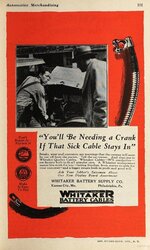
I'm all ears. But my instincts tell me they were making these on contract exclusively for customers such as Whitaker (and probably other battery supply houses), not in-house sales, hence the minimal Bonney branding, and when they finally put it in a Bonney catalog, as a Bonney branded product, it had been given a different P/N.