Mikeske
Well-known member
Oh man someone offer him $122.00Ohhh. He shot you down.


Oh man someone offer him $122.00Ohhh. He shot you down.

 ) We've all paid 'stupid' money for things we just had to have, knowing we were grossly overpaying, but this just isn't one of them for me. And I will admit, part of it is just not wanting to give that guy that kind of price for them.
Found a A-702k ratchet in junk drawer at a pawn. Walk out of the pawn shop with it and my wallet $2.00 lighter.

It was in a junk drawer and I saw it first.Only two bucks for a 1/2" drive? The police should be knocking at your door!
 I can't complain at all and I got her cheap. Funny thing was the pawn shop had a bunch of Craftsman ratchets in the same drawer marked at $8.00 a piece and the the Bonney was not marked. I grabbed the Bonney and did not even bother with the Craftsman stuff.
It was in a junk drawer and I saw it first.
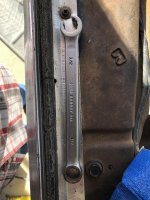
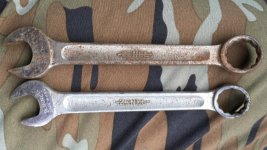
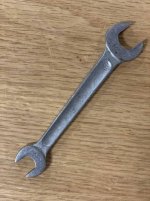
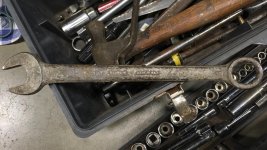
One of my favorite 1/2” wrenches I use constantly. I finally looked at it, and it is a Bonney....
I can’t remember if it was my dads or my step dads....
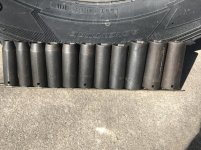
I picked up a really nice set of Bonney deep impact sockets at an auction yesterday.
Very nice set 3/8-1”
I started a type-study conversation here. Your LT12s look like they fall between my number 5 and number 6, and your T10 looks like my number 6. My guess is late 1950s for the LT12s and early 1960s for the T10. Because catalog illustrations aren’t usually updated to reflect minor changes, I doubt they can be absolutely dated that way. Unless sets are found with dated receipts, we may never know the exact begin and end dates for some things. I don’t think two LT12s are part of any single “set,” but you can certainly build a number of sets around you finds.I've had these 3/8" drive Bonney sockets for a couple of years. I REALLY like the look. Two are the same 3/8" deep ones marked LT12. The shallow 5/16" is marked LT10. First, the finish looks slightly different and I'm not sure if these were part of a set. Anyone know? I'm wondering if anyone can provide any details like when these were made and point me to a catalog where I can see what would have made up a set. I'd like to see if I can put a set together.
Thanks!


I don’t have enough examples to do a real type-study, so there’s nothing definitive about my numbering, and the scan resolution of many catalog pdfs is too low to be sure of subtle changes.
I looked in my pdfs, and I do think my earlier “late 1950s” estimate should be “early 1950s.” i see your LT12s are slightly different, but I don’t think they’re different enough to suggest different eras of production, unless one says “MADE IN U.S.A.” and the other “U.S.A.”
LS Thanks for the info and the links. So would I be correct in thinking these 3 sockets are 3 different types per your type-study? I guess clearly they are all in the type 5-7 groups. The two LT12s don't look exactly the same in height and other minor differences and the LT10 is definitely different than the other two. It's not quite straight forward for me to grasp the details of the type-study without someone pointing these details out with the sockets at the same time.
The catalog was useful to see what other pieces Bonney sold and to see the sets that were available around 1967.

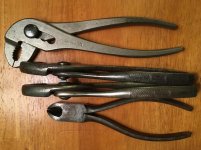
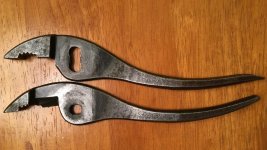
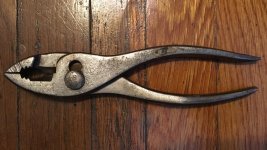
Nice find, LS! Wartime. Or not later than 1946.Only bought the pair of pliers, however.
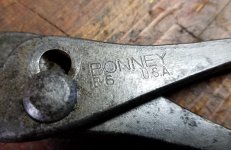
Nope. Especially not early ones. I've been looking. I have a 1946 or later pair with the san serif logo, the model number ("B6") and "U.S.A." behind the pivot.I have not seen many of them.
Crescent. CeeTeeCo was a brand name. They made slip-joints in three disctinct lines in this era: Crescent (92X), MoToR KiT (G2X) and CeeTeeCo (H2X). I don't know about the Crescent house-brand, but the MoToR KiT and CeeTeeCo pliers have their model number forged-in under the handles near the pivot. All of them had the Crescent checker-dot grip as far as I know. The differences were in weight and finish - and price....the grip pattern looks CeeTee.
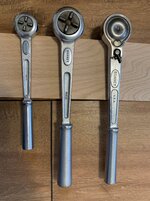
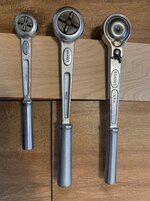
Hey guys I’m late getting into this, here are my bonney ratchets. I already posted these to the ratchet collection thread. I feel like they belong here also.
Sent from my iPhone using The Garage Journal mobile app
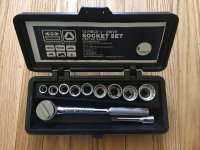
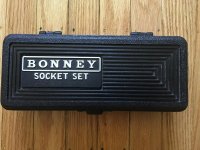
i picked this set up yesterday. I love the lettering on the top of the socket case.
When I bought my Bonney toolset in 1982 I also got and lost the plastic boxes. I promptly lost the plastic boxes as they slowed me down and the jobber gave me socket rails to hold my sockets. Flash forward to 2 years ago when I retired and I started to rebuild my Bonney tools and I got a couple of the plastic boxes on sets to fill in the lost tools. I never used the plastic boxes except when I go to pull apart yards or traveling and then reload them and put them in my toolbag. It is easy with the plastic boxes to see what is missing from my kit.Sweet snag!
Great looking condition, too! I'd place the age to the late 70's. Can't say exactly when Bonney went to plastic socket boxes but they are that way in the 1977 catalog. Probably trying to save money.
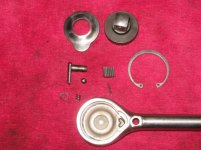
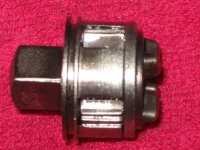
Thanks bonneyman! Now I’m not afraid to disassemble them. That internal looks a lot like the standard SK internal, what do you think?
Sent from my iPhone using The Garage Journal mobile app
When I bought my Bonney toolset in 1982 I also got and lost the plastic boxes. I promptly lost the plastic boxes as they slowed me down and the jobber gave me socket rails to hold my sockets. Flash forward to 2 years ago when I retired and I started to rebuild my Bonney tools and I got a couple of the plastic boxes on sets to fill in the lost tools. I never used the plastic boxes except when I go to pull apart yards or traveling and then reload them and put them in my toolbag. It is easy with the plastic boxes to see what is missing from my kit.

Crescent. CeeTeeCo was a brand name. They made slip-joints in three disctinct lines in this era: Crescent (92X), MoToR KiT (G2X) and CeeTeeCo (H2X). I don't know about the Crescent house-brand, but the MoToR KiT and CeeTeeCo pliers have their model number forged-in under the handles near the pivot. All of them had the Crescent checker-dot grip as far as I know. The differences were in weight and finish - and price.
I haven't studied it closely but I think Crescent probably made more than just the slip-joints for Bonney. They weren't really a pliers house.