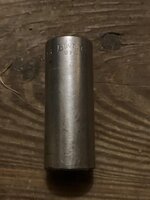
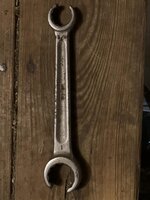
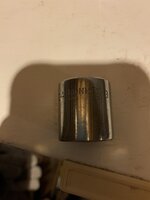
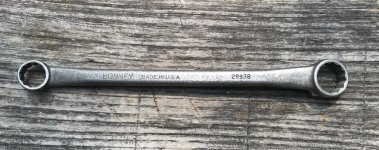
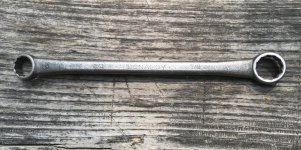
I have some questions I hope the Bonney aficionados can help me with.
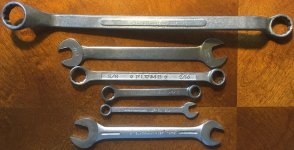
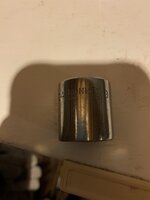
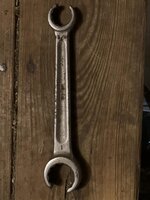
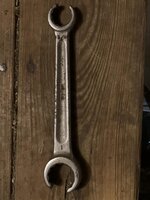
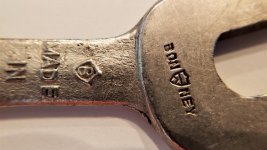
Last week I found this Bonney CV 1723 1/4 & 1/16 Hex Cap DOE. Researching on AA, I’ve learned that it was likely made between 1923 and 1925 base upon these two assertions:
-- CV-Circle logo with Chrome-Vanadium, used in advertisements as early as 1923
-- B-Shield logo. First use unknown, used until approximately mid 1920s. The date code system indicates that this marking was discontinued in mid to late 1925.
My question involves the date code discussion on AA. They have promoted the seemingly reasonable theory that the often-seen forged two-letter codes represent the manufacture date of the tool. They even provide a link for readers to visit the web page of Skip Echert, an AA reader who has researched this and whose findings align with the views of AA. That link, however, is dead.
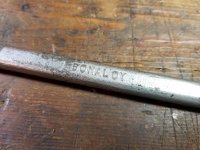
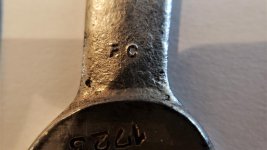
My particular wrench has the forged-in letters FC, and given the other empirical evidence on the wrench, is at odds with the following quote from AA (emphasis is mine):
“The reader's suggestion seems reasonable enough, and we are now in the process of reviewing our numerous examples of tools (mostly wrenches) with forged-in codes. The preliminary results indicate that the forged-in codes do appear to represent a date coding system, although in a slightly different form than the original suggestion.
The main difference is that Bonney appears to have used only the 14 letters M-Z to indicate the year, rather than all 26 letters, with the 12 letters A-L reserved for use only as the month codes. With the use of this restricted set of letters for the year code, the system would cycle through the codes every 14 years.
Some of the strongest evidence in favor of the date code intepretation comes from a series of early wrenches marked with the Chrome-Vanadium or CV-Circle logo plus a forged-in B-Shield logo. Based on this combination of markings,
these wrenches would be expected to have been manufactured in 1923 or the following few years, and in the available examples the year codes are clustered together as "O", "P", and "Q". Thus if the baseline of the system is selected as 1921 for the first "M" code, the {O,P,Q} codes would correspond to 1923-1925, fitting nicely with our prior expectations.”
Without viewing Mr. Echert's analysis I cannot say what differences prompted AA to use a "slightly different form than the original suggestion." But AA's dating method (without their M-Z restriction) would put my "F" coded wrench back to 1914, which is clearly wrong. Has anyone found other examples that don’t fit within this dating system? Are there differing theories that attempt to decode these letters?
Thanks! I'm looking forward to your comments.





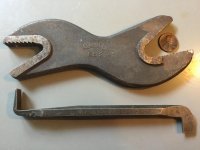

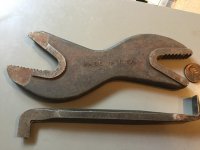
 Oddly, we don't have a catalog reference. Deduction places it sometime between very early and the 1914 Princeton shield logos, and somewhere between Philly and Allentown.