3baygarage
Well-known member
Neat find. I hadn’t seen your Williams before or don‘t remember. I’m in to see what purpose these served.

What is the application?I found this low profile DBE at the flea this morning. Extra long skinny shank with extremely thin heads especially for the opening sizes (1-5/8" x 1-1/2"). I recognized it immediately because I already have a wartime Williams ALLOY V Superrench just like it painted very light green. I never could identify the application for the Superrench, but now I have an FSN (41-W-890-20). The best surprise was the forged-in date code marking: "JU". October 1944. Whereas the Williams is all gussied up with all kinds of markings, there is no other marking on this one except the FSN, but it's undoubtedly a Bonney. The nice thing about having the Williams was I didn't have to measure the openings!
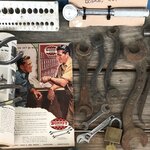 Yesterday, I picked up a few DOEs, a Popular Science, and a TT707 ratchet, among other things.
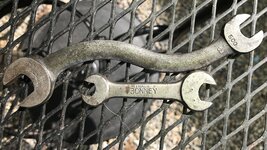 The No21 caught my eye mostly because of TRADE / MARK bracketing BONNEY, as illustrated in the 1914-1923 catalogs. The trademark was granted 1908, first use 1876. The fractions stamped on the back are USS without that explicit label, nor SAE, hexC equivalents. I think I may have ignored this type in the past, not recognizing that it is as old (or older?) than the forged-in Princeton shield and B-shield types that pop up in the same catalogs. I don’t know where the Bonney-arc (jellybean, pickle) type fits in.
 As dumb luck would have it, I merely bent the selector spring. Too narrow to squeeze a sewing needle into the coil, I plucked a bristle from a wire brush, fed that through, and began manipulating the coil between the smooth areas of the jaws of two long nose pliers. Eventually, I got it into some approximation of straight without snapping it.
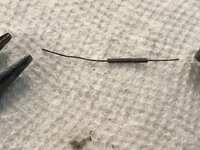 I reversed its orientation upon reassembly, but it seems it encounters similar stress either way. It will work for a while, anyway.

I’m in to see what purpose these served.
What is the application?
UNAIU found the FSN in an old Worthpoint sale in which the seller connected the wrench to the M4 Sherman tank.Inquiring minds want to know!
I’m leaning toward this as my eyes begin to glaze over from the nearly 500 page technical manual!But the seller in the Worthpoint record (almost certainly an eBay sale) may also have just been wrong.

Yeah even three decades later mechanics would not read the entire manual just find the section they needed for the repair at hand and then scan it and then go to work. Most repairs they would not even bother with the manual just using experience and tribal knowledge.I’m leaning toward this as my eyes begin to glaze over from the nearly 500 page technical manual!
Haha. Yeah, I gave up after 50 or so pages, but I was trying to **** those guys in!I’m leaning toward this as my eyes begin to glaze over from the nearly 500 page technical manual!
Lol, and those are the ones I fixed!! You should have seen how small the first try was! Let me try again……from my phone this time.Ah, cute little postage stamp pictures. (Just FYI, clicking isn't making them bigger, so a real tease)


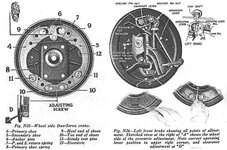
Thanks for confirming I was thinking of the right brakes, humber. But I'm trying to ascertain if it makes sense for the wrench. Would the AF diameter of the anchor pin nuts on 14" brakes be that big? Or is the application (i.e., vehicle/brakes) likely bigger?
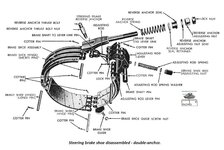
 They make more sense for the shape of the wrench, being external and jamming against each other. And they have ”anchor” in their names.
Thanks. No cigar, but proportionally realistically possible (1-1/2" x 1-5/16").The anchor nuts on the 14” Bendix brakes I have are 1 & 3/16”
These are nothing like the steering brakes on the Sherman tank but that was interesting reading today.
Here's an image
I don't know where you're getting those numerical referents from, but if you're talking about "DD" and "BB", identified as the (Reverse Anchor) "Lock Nut" and "Reverse Anchor Adjusting Nut", respectively, on the figure Otg posted, I agree. And, they appear to have slightly different AF diameters, possibly such as the difference between 1-1/2" and 1-5/16".A278621 (reverse anchor adjusting nut) and 219760 look nearly 3” in that diagram...[ ]...They make more sense for the shape of the wrench, being external and jamming against each other. And they have ”anchor” in their names.

I don't know where you're getting those numerical referents from, but if you're talking about "DD" and "BB", identified as the (Reverse Anchor) "Lock Nut" and "Reverse Anchor Adjusting Nut", respectively, on the figure Otg posted, I agree. And, they appear to have slightly different AF diameters, possibly such as the difference between 1-1/2" and 1-5/16".

This collection used to be down the road a ways from me, but was sold off in 2014Anyone have a sherman tank handy?

 www.autoweek.com