Thanks, but I tend to just pick stuff up when I see it cheap.If you want to try to make a set, I have several.

You are using an out of date browser. It may not display this or other websites correctly.
You should upgrade or use an alternative browser.
You should upgrade or use an alternative browser.
Spreading the Bonney affliction!
- Thread starter bonneyman
- Start date
Oldtuleguy
Well-known member
- Joined
- Nov 4, 2017
- Messages
- 10,486
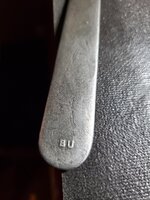
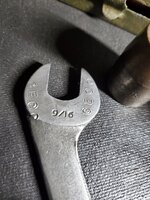
An old cv wrench



Private Lugnutz
Well-known member
...with interesting proprietary stamps. General Electric tool room? At least they used the flip side.An old cv
RTM
Well-known member
Here's one I have not seen in this thread. My favorite online tool monger had this one, and I am a sucker for different hacksaws, so I grabbed it. Nothing near a steal, but fun and different. My other two low profile hacksaws are home made, or school shop made, so nice to see one from a major mfgr. Only downside: it uses 8" blades. Good news is my blade punch will poke holes in 12" blades so I can still use it.
Bonney 2625, seen in a few catalogs, 1957 - 60 at least.

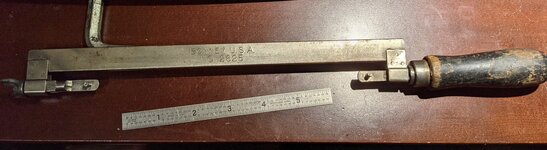
Bonney 2625, seen in a few catalogs, 1957 - 60 at least.
Bonney Quality Tools : Catalog 57-S : Bonney Forge & Tool Works : Free Download, Borrow, and Streaming : Internet Archive
132 p., illus., 19.0 cm, trade catalog
archive.org
Oldtuleguy
Well-known member
- Joined
- Nov 4, 2017
- Messages
- 10,486
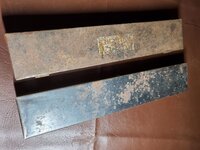
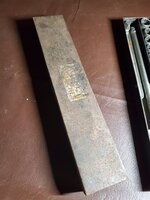
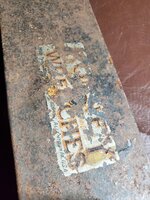
Been watching this rusty old bonney box on ebay for a few weeks. Curiosity (and beer) led to the final purchase. Turned out to be an early 3/8 set box. Slightly different than the 29 set I have, but still sporting some decal.


Private Lugnutz
Well-known member
As I was looking at how long it is the first thing that came to mind was the T6 CV extension I have, before I scrolled down to see you have one as well. Everytime I look at the extension it makes me wonder how long the dang box must've been! At least 18"!Turned out to be an early 3/8 set box
Oldtuleguy
Well-known member
- Joined
- Nov 4, 2017
- Messages
- 10,486
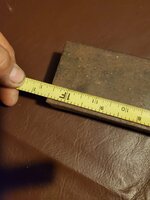
Here are some measurements

Private Lugnutz
Well-known member
Oh. So that's not the T6 extension, then.
TD set includes T2, T5, T12, T14, T16, T16, T18.
TD1 set adds T28 ratchet.
But there is room for a T6, and the 1932 catalog shows it in the box, despite not including it in the list.
Nice…envious.
Now I will measure every steel box I see, looking for 2-7/16x12-7/16”! (I think you’re looking at the top of the tape - 100THS FT - not the bottom, Lugz.)
TD1 set adds T28 ratchet.
But there is room for a T6, and the 1932 catalog shows it in the box, despite not including it in the list.
Nice…envious.
Now I will measure every steel box I see, looking for 2-7/16x12-7/16”! (I think you’re looking at the top of the tape - 100THS FT - not the bottom, Lugz.)
Last edited:
Private Lugnutz
Well-known member
Well, it is upside down, and my brain does work sideways, but I'm pretty sure I'm reading it right. If so, I'll have to consult the catalogs, because there is no way my T6 extension is fitting in that box!I think you’re looking at the top of the tape - 100THS FT - not the bottom, Lugz.


Oldtuleguy
Well-known member
- Joined
- Nov 4, 2017
- Messages
- 10,486
The set that has tools includes a 12" and a 6" extension, Date code U (1929). The rusty box has lid mounted opposite side, but otherwise same layout/dimensions. I may take it to someone for a reproduction decal.
Last edited:
Oldtuleguy
Well-known member
- Joined
- Nov 4, 2017
- Messages
- 10,486
Well, it is upside down, and my brain does work sideways, but I'm pretty sure I'm reading it right. If so, I'll have to consult the catalogs, because there is no way my T6 extension is fitting in that box!
T4 and t5 in there, 6 and 12 inch.
Private Lugnutz
Well-known member
Thanks. I saw that. I am more or less replying to LS, who said...T4 and t5 in there, 6 and 12 inch.
there is room for a T6, and the 1932 catalog shows it in the box,
Private Lugnutz
Well-known member
No problem. It made me assemble all my Bonney 3/8-drive stuff, which is more than I thought I had, and also understand that I need the TD2 set box, which is longer, for the T6, and also wider, for the T9 speeder.

Oldtuleguy
Well-known member
- Joined
- Nov 4, 2017
- Messages
- 10,486
Probably came in bigger box in 30s
Mintgrun
Well-known member
At least you don't have to find a box to fit this 4091A, Lugz. It's a fatty too, at 5/8" thick. This one is mentioned by you in post #3308, but it is a catalog reference, not an actual example. This seems like a fun time to share it, while the long-extension topic is current. Tom


I’m asking, because there are probably surviving boxes with decals worn off or painted over, and the early catalogs don’t give dimensions. Any details like these could save a box from anonymous oblivion.
Last edited:
Oldtuleguy
Well-known member
- Joined
- Nov 4, 2017
- Messages
- 10,486
No latches lid just snaps shut. Thought I was lucky it had a bit of decal.
Last edited:
I grabbed this off the 'Bay from across the Pond a few weeks ago. Whats the significance of the #720? It is a real small wrench and what I like about it is the raised font. The socket is just for reference on the size.


Private Lugnutz
Well-known member
That is a very unusual wrench.
First of all, because Bonney didn't typically make any DOE's with the Bonney name as forged-in lettering ("raised") on the shanks. DBE's, but not DOE's, as far as I can recall. The only DOE wrench they did that for was the 585 series DOE's they made for the QMC and Ordnance Dept during the war. It had the 585- series stock number forged-in on one side of the shank, and "BONNEY", just like yours, on the flip side.
Then there's the date code. Based on the features and finish (natural steel), that "LU" appears to be 1943.
The "720" appears to be the model number with the ISN ("20" for 5/16" x 1/4" DOE wrench) embedded. But I have never seen a 720, even a regular 720. They made engineers wrenches with 5/16" x 1/4" openings, but the -ZENEL- was a 3020 and the regular CV and alloy steel were 1020.
That is the smallest DOE engineer's wrench they made. Everything smaller was ignition/electrical wrench configurations.
And what's it doing overseas?
My from the hip gut hunch is Lend-Lease.
EDIT: It looks they may have actually mimicked the 585 series dies. They put the "BONNEY" on the shank. But instead of the "585-**" part numbers (which were very peculiar to the QMC, actually re-using US Army QMC drawing numbers), they went with ISN instead. The Bonney 585's punched the sizes in the faces of the flip side jaws though. Those forged-in sizes are kinda cool to see on the shank, reminiscent of some DBE's.
First of all, because Bonney didn't typically make any DOE's with the Bonney name as forged-in lettering ("raised") on the shanks. DBE's, but not DOE's, as far as I can recall. The only DOE wrench they did that for was the 585 series DOE's they made for the QMC and Ordnance Dept during the war. It had the 585- series stock number forged-in on one side of the shank, and "BONNEY", just like yours, on the flip side.
Then there's the date code. Based on the features and finish (natural steel), that "LU" appears to be 1943.
The "720" appears to be the model number with the ISN ("20" for 5/16" x 1/4" DOE wrench) embedded. But I have never seen a 720, even a regular 720. They made engineers wrenches with 5/16" x 1/4" openings, but the -ZENEL- was a 3020 and the regular CV and alloy steel were 1020.
That is the smallest DOE engineer's wrench they made. Everything smaller was ignition/electrical wrench configurations.
And what's it doing overseas?
My from the hip gut hunch is Lend-Lease.
EDIT: It looks they may have actually mimicked the 585 series dies. They put the "BONNEY" on the shank. But instead of the "585-**" part numbers (which were very peculiar to the QMC, actually re-using US Army QMC drawing numbers), they went with ISN instead. The Bonney 585's punched the sizes in the faces of the flip side jaws though. Those forged-in sizes are kinda cool to see on the shank, reminiscent of some DBE's.
Last edited:
Private Lugnutz
Well-known member
It wasn't very far!...as far as I can recall

It was bothering me, so I went digging in a box of old weird miscellaneous wrenches I haven't pulled out in years.
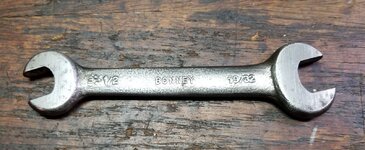
Sure enough, I have an ISN 25 of the same style wrench as your ISN 720. And I have to take back the wartime 585 adjacent theory. I think they may have harkened back to this marking scheme when they were turning those out, but our wrenches are much older. You can tell by the thick shanks and thick, round heads. Mine is also an "LU" code, but it refers assuredly to 1929, and together our wrenches allude to either an incredible cross-Atlantic coincidence, or a very short production run. I'm going with the latter.


Last edited:
Lugz thank you for that awesome, detailed reply! When I posted i had a gut feeling you'd have one similar to mine. I haven't the slightest idea why this was across the Atlantic. The stuff from Great Britain is popping up in my Ebay feed more often lately. Im keeping my eye out for others now!
Private Lugnutz
Well-known member
My pleasure. One addendum on the "720" marking, which continues to fascinate me....
Even though Bonney, like many other mfgrs, adopted the Williams numbering scheme (whose high and almost unanimous adoption rate is why it became known as the industry standard), they also extended it - apparently some time between 1925 and 1933, which contains the year (1929) your wrench was made.
This will take some explanation.
Most DOE engineers wrench charts start at 721, which is a 5/16" x 3/8" wrench. Williams' own wrench charts in Williams period catalogs up through 1943 start at 721. I couldn't find a Williams catalog with a 20 wrench in it. And true to form, in the Bonney 1925 catalog their smallest wrench is the 721. However, in the Bonney 1933 catalog, their smallest wrench is a 1020 (5/16" x 1/4").
If you don't understand ISN-embedded model numbering schemes, the "20" is the ISN. The "1" is a type of wrench or steel prefix that many mfgrs, including Bonney, used to distinguish engineers wrenches of different compositions, typically alloy from carbon, or alloy from special alloy. The "0" is just a filler, because that digit is needed for ISN's with a "7" prefix. Williams' first wrenches all had whole number model numbers, 21 through 40 or whatever. When they started making them with new, different milled openings, they needed a way to give them a model number that fit the system, but all the whole numbers were taken, so they used the "7" prefix to squeeze in a smaller wrench, and a letter (A, B, and C) suffix to squeeze in larger wrenches. A 723 (3/8" x 7/16"), for example, is smaller than a 23 (13/32" x 1/2"), but they couldn't give it a "22" because that was already taken for the 5/16" x 1/2" wrench. A 723-A (3/8" x 1/2") is bigger than a 23, but they couldn't give it a "24", because that was already taken for the 13/32" x 19/32" wrench. If you look at any DOE wrench chart in any period catalog, this will all become very apparent.
That was all necessary prelude to make sure the significance of my real point is understood.
Bonney's carbon steel line wrenches had straight up ISN numbers. Their CV line used 1XXX. Later, their Zenel line used 3XXX.
A Bonney CV eng wrench with 5/16" x 1/4" openings, therefore, was model number 1020. "1" for the series, "0" as filler, and "20" as the embedded ISN.
A Bonney -ZENEL- eng wrench with 5/16" x 1/4" openings was model number 3020. "3" for the series, "0" as filler, and "20" as the embedded ISN.
To emphasize my point, here're examples that have a 7XX ISN...
A Bonney CV eng wrench with 7/16" x 3/8" openings was model number 1723. "1" for the series, and "723" as the ISN.
A Bonney -ZENEL- eng wrench with 7/16" x 3/8" openings was model number 3723. "3" for the series, and "723" as the ISN.
Finally, the point.
A Bonney carbon steel wrench with 7/16" x 3/8" openings was model number 723. No prefix for CV or Zenel. Just 723. And again if you look at any wrench charts, you will find 27's, 727's, and 727C's, 29's and 729's, etc etc.
A Bonney carbon steel wrench with 5/16" x 1/4" openings should have been a "20", NOT a "720." The "7" in "720" implies smaller than "20" sizes.
When Bonney decided to make a wrench smaller than the 721 in 1929, I think they made a mistake giving it the 720. It should've been just a 20. And it was a mistake they recognized and corrected in the 1933 catalog.
You have a cool novelty wrench there.
Even though Bonney, like many other mfgrs, adopted the Williams numbering scheme (whose high and almost unanimous adoption rate is why it became known as the industry standard), they also extended it - apparently some time between 1925 and 1933, which contains the year (1929) your wrench was made.
This will take some explanation.
Most DOE engineers wrench charts start at 721, which is a 5/16" x 3/8" wrench. Williams' own wrench charts in Williams period catalogs up through 1943 start at 721. I couldn't find a Williams catalog with a 20 wrench in it. And true to form, in the Bonney 1925 catalog their smallest wrench is the 721. However, in the Bonney 1933 catalog, their smallest wrench is a 1020 (5/16" x 1/4").
If you don't understand ISN-embedded model numbering schemes, the "20" is the ISN. The "1" is a type of wrench or steel prefix that many mfgrs, including Bonney, used to distinguish engineers wrenches of different compositions, typically alloy from carbon, or alloy from special alloy. The "0" is just a filler, because that digit is needed for ISN's with a "7" prefix. Williams' first wrenches all had whole number model numbers, 21 through 40 or whatever. When they started making them with new, different milled openings, they needed a way to give them a model number that fit the system, but all the whole numbers were taken, so they used the "7" prefix to squeeze in a smaller wrench, and a letter (A, B, and C) suffix to squeeze in larger wrenches. A 723 (3/8" x 7/16"), for example, is smaller than a 23 (13/32" x 1/2"), but they couldn't give it a "22" because that was already taken for the 5/16" x 1/2" wrench. A 723-A (3/8" x 1/2") is bigger than a 23, but they couldn't give it a "24", because that was already taken for the 13/32" x 19/32" wrench. If you look at any DOE wrench chart in any period catalog, this will all become very apparent.
That was all necessary prelude to make sure the significance of my real point is understood.
Bonney's carbon steel line wrenches had straight up ISN numbers. Their CV line used 1XXX. Later, their Zenel line used 3XXX.
A Bonney CV eng wrench with 5/16" x 1/4" openings, therefore, was model number 1020. "1" for the series, "0" as filler, and "20" as the embedded ISN.
A Bonney -ZENEL- eng wrench with 5/16" x 1/4" openings was model number 3020. "3" for the series, "0" as filler, and "20" as the embedded ISN.
To emphasize my point, here're examples that have a 7XX ISN...
A Bonney CV eng wrench with 7/16" x 3/8" openings was model number 1723. "1" for the series, and "723" as the ISN.
A Bonney -ZENEL- eng wrench with 7/16" x 3/8" openings was model number 3723. "3" for the series, and "723" as the ISN.
Finally, the point.
A Bonney carbon steel wrench with 7/16" x 3/8" openings was model number 723. No prefix for CV or Zenel. Just 723. And again if you look at any wrench charts, you will find 27's, 727's, and 727C's, 29's and 729's, etc etc.
A Bonney carbon steel wrench with 5/16" x 1/4" openings should have been a "20", NOT a "720." The "7" in "720" implies smaller than "20" sizes.
When Bonney decided to make a wrench smaller than the 721 in 1929, I think they made a mistake giving it the 720. It should've been just a 20. And it was a mistake they recognized and corrected in the 1933 catalog.
You have a cool novelty wrench there.
Last edited:
Private Lugnutz
Well-known member
Keep reading, LS. I think the 720 is a mistake. Should be just a 20. It has 20 sizes and it's carbon steel. They muffed going smaller than 721. There is no 720 wrench that I know of, but if there was, it wouldn't be 5/16 x 1/4.
Private Lugnutz
Well-known member
But a really cool mistake to own!
Raineman
Well-known member
Great info. Thanks.
Really nice condition chrome on that socket, JjKk40!
I have full set of thise D series CV and almost full of the A series CV and most of the chrome is in excellent condition! I'm actually trying to complete a set of the Nickel plated script CV style. Harder to find the ones I need tho!

Raineman
Well-known member
I’m finding myself doing that with what I would think are the most common pieces.
I’ve left a lot of things out in the wild, but if its marked Bonney, it comes home with me, regardless of whether I have 1 or 20 of it.
I’ve left a lot of things out in the wild, but if its marked Bonney, it comes home with me, regardless of whether I have 1 or 20 of it.
genog
Well-known member
Couple of Bonaloys that I found at the Flea Market
