To avoid these ads, REGISTER NOW!

Stepped into the porcelain deep end

dmeadow

Well-known member
Joined
Sep 3, 2005
Messages
952
Location
Houston, Texas
Thanks guys. I've been looking at both of those, and other transitions. the Reno Ramp just looks so perfect, but at that much of a cost increase I don't blame you ar all for going with the more readily available Reno-U. It still gives you an awesome looking finished edge.

I wonder if that aluminum ramp would get dented and scratched up over time, as well?
 
To avoid these ads, REGISTER NOW!

SapesOfIndia

Well-known member
Joined
Feb 9, 2013
Messages
130
Location
Atlanta, GA
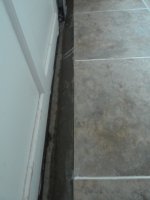
I got a $5 bag of Quikrete 80 lb. Crack-Resistant Concrete and create a 2" ramp going up all the way to the top of the first tile.
I kept it wet for a week for slow cure.
Only time will tell is it works but right now it looks pretty solid.
 

Attachments

  • P1030497_s.jpg
    P1030497_s.jpg
    122.4 KB · Views: 242

Dakota00

Well-known member
Joined
Mar 9, 2008
Messages
1,078
Location
Woodbridge, Ontario
P.S. I'd like to thank everyone for helping and commenting along the way, but especially Dakota00, slickgt1, duneslider, and ZEKE for pushing me past my analysis-to-paralysis issues during the project! Last night was my first "mess" on the tile and it was a cinch to clean. I'd tracked in water, mud, and some antifreeze spills. Came right up.

Your welcome!!

Congrats on the beautiful flooring job you did, that will withstand and outlast all of us here!! ;)
 
OP
W

wesalexleft

Well-known member
Joined
Apr 13, 2011
Messages
146
Location
Memphis, TN
I'm moving onto the last details on the tile floor and wanted to ask opinions. I'd left a small expansion gap between the tile and the stub wall when putting down the floor. I'm now in the process of painting the stub wall which draws attention to the expansion gap. I want to glue some PVC quarter round to the stub wall to hide the gap. Any recommendations for adhesive? I know the PVC will have expansion/contraction so what type of glue would work best? I'd planned on gluing to the wall only every 10" or so, and then caulking continuously with a caulk like Vulkum.
 
OP
W

wesalexleft

Well-known member
Joined
Apr 13, 2011
Messages
146
Location
Memphis, TN
Sure do. Not to the degree of some people here, but I'll be doing my share of front ends, brakes, and such. I won't be welding, and my Zen woodworking takes place outside, but all my auto and motorcycle maintenance will happen in here. That is the reason for it. I'd already had some oil and grease spill accidents with the original rough finished concrete and had to do something.
 

MQ Unlimited Media

Well-known member
Joined
Mar 14, 2012
Messages
143
Location
SoCali
I only say that because I've never seen a completely tiled floor in a garage before. I didn't mean any disrespect with that comment, just wondering if it was to showcase rather than work in. How does it stand up to floor jacks?
 

JakeKohl

Well-known member
Joined
Feb 23, 2012
Messages
1,365
Location
Greenville, SC
I only say that because I've never seen a completely tiled floor in a garage before. I didn't mean any disrespect with that comment, just wondering if it was to showcase rather than work in. How does it stand up to floor jacks?

There are several dozen threads on the topic here - but it holds up very well. It's harder than the concrete it's attached to and as long as you have a thorough application of the mastic without voids, the tiles are extremely hard to break. It's very temperature resistant (sparks, etc.) and very hard. Most people think of tile and consider the durability when installed in a house over a wood subfloor ... it's a different animal when that same tile is bonded to a concrete surface. If it's good enough for grand central station.....
 

SapesOfIndia

Well-known member
Joined
Feb 9, 2013
Messages
130
Location
Atlanta, GA

duneslider

Well-known member
Joined
Jan 20, 2013
Messages
2,247
Location
Riverton, Utah
I jack stuff up on my cement floor all the time, do you want pictures of that? I even put the jack close to joints, no damage yet. ;)
 

JimVonBaden

Well-known member
Joined
Dec 2, 2011
Messages
15,716
Location
Northern Virginia
You know its funny, there are still no pictures of others doing whats in those pics on any other floor.

And oh yea, that floor still looks like the day I installed it. I even washed it a month ago just to check.

Look at Jack Olson's thread. He has the "inferior" ceramic tiles, and has for years with no issues. Oh, and he definitely workes on his.

Jim :cool:
 

slickgt1

Well-known member
Joined
Oct 11, 2010
Messages
1,674
I jack stuff up on my cement floor all the time, do you want pictures of that? I even put the jack close to joints, no damage yet. ;)

Sure you don't leave any marks? Go spill some oil and let it sit for an hour or so. That is still a mark. Leave some brake fluid dripping overnight because you trying to find a leak. I have spilled a 5 gal bucket of trans fluid all over floor, and not have even the smallest stain after I clean up.
 

duneslider

Well-known member
Joined
Jan 20, 2013
Messages
2,247
Location
Riverton, Utah
Its called patina :evil: If I wanted it to look perfect I would keep the doors locked and not let anyone one in.

Don't get me wrong, I like tile. I have installed tens of thousands of feet of it. There is no such thing as a perfect flooring material. Everyone has different needs and wants and desires.

Your floor looks great and I am sure it meets your needs but I wouldn't be happy with it in my garage. Though I have considered it more than once.
 

saxman2u

Active member
Joined
Aug 23, 2011
Messages
25
I've started putting down porcelain this past weekend as it was the first good weekend of the year for weather. 18" X 18" non rectified porcelain tile, USA, PEI IV with Flexbond thinset. It's taking much longer than i had anticipated however. I've done tiling before, but the added steps to ensure a very strong bond in the garage are greatly adding to the time. I'd guess I'm averaging about 15 minutes per tile by the time I burn in the thinset, spread more thinset with the notched trowel, and then backbutter the tiles before placement. After placement, bedding it in with motion and a rubber mallet before moving on to the next tile.
Yesterday the temps were in the low 70's during the day, and the high 50's at night. I've gotten about 20% of the tile down as of now. I wanted to finish it up next weekend, but now temps are forcast next weekend with highs around 50 and low in the mid 30's. With a heater in the garage, should I be okay with these temps? I don't want lose bond strength, but I do want go get this finished too.


Here are a few pictures.

thanks,

Did you prep the concrete floor in any way? Or, did you just start laying the tile down?
 
To avoid these ads, REGISTER NOW!

slickgt1

Well-known member
Joined
Oct 11, 2010
Messages
1,674
Its called patina :evil: If I wanted it to look perfect I would keep the doors locked and not let anyone one in.

Don't get me wrong, I like tile. I have installed tens of thousands of feet of it. There is no such thing as a perfect flooring material. Everyone has different needs and wants and desires.

Your floor looks great and I am sure it meets your needs but I wouldn't be happy with it in my garage. Though I have considered it more than once.

Yea, if I had nice concrete, I might have left it alone. But after doing this floor, every garage will have tile. Too many people work in my garage. Friends, Neighbors, you name it. I'm like the tool king of my area, with a place to use those tools. Which is a huge problem in NYC. A floor that doesn't piss me off every time someone doesn't clean up properly, is my biggest reward.
 

SapesOfIndia

Well-known member
Joined
Feb 9, 2013
Messages
130
Location
Atlanta, GA
Where does everyone get their tile from?

Anyplace better than the rest?
Clearance or sale tiles from box stores is a good and economical choice for garages.
Just make sure to get Porcelain if possible with PEI 4 or 5 (better) and higher co-efficient of friction (0.6 or more).
Spend money on epoxy grout if you feel like spending more else use darker grout so that spills won't show up in the grout.
 

dmeadow

Well-known member
Joined
Sep 3, 2005
Messages
952
Location
Houston, Texas
I found mine at a tile store that was advertising closeouts on Craig's List. The tile I got was original a $3.50 per square foot 18"x18" tile that I got for $0.99 per square foot. Even got the tile store to install it at a more reasonable rate than I could find from independent tile setters. (No, no pics, install is in a couple of weeks). The same store was selling similar closeouts on 12"x12" tile for $0.69 per square foot, but I didn't want that many grout lines in the space I've got. Not a lot of choices in color and style, but it is a garage, after all. I just got something light, with neutral colors.

There have been some threads of other people finding left over lots on Craig's List from commercial installations, etc. Mostly these tend to be small quantities, though, and, in my experience, not always a bargain.

Originally I had some 20"x20" tile lined up from Arizona Tile that was about $0.81 per square foot. It was a special deal-- the tile supposedly had minor imperfections in the glaze. Found out it was PEI 3, though, so no go.

Floor and Decor also has some inexpensive porcelain tile if you have one near you.
 

DefSport

Member
Joined
Jan 19, 2013
Messages
24
Did you prep the concrete floor in any way? Or, did you just start laying the tile down?

If the concrete is clean, just sweep it and then start laying. If you've got significant oil spots I'd probably try to clean those up first with the usual methods before laying tile. Polymer modified thinset sticks REALLY well to clean concrete.


I'm about 350 sq ft into my 600 sq ft garage so far with 12x24" PEI 4 porcelain tile. It's taken a bunch of days working on it, but I generally try to keep it under about 4-5 hours at a time just so I don't start really hating the job.

I also see a lot of people advocating back buttering the tile. It's not a necessary step IMO, and it somewhat defeats the purpose of troweling the thinset - which is to provide a uniform volume of thinset per tile. Just trowel it all in straight lines, then move the tile back and forth perpendicular to those trowel lines while applying pressure. I personally like standing on the tile and bouncing versus the rubber mallet, but it's slower. You will get as good a bond as your subsurface allows with this method, and you will have the same amount of thinset under every tile.
 

Angelfire

Well-known member
Joined
Mar 22, 2012
Messages
1,367
Location
New Mexico and Ireland
hmmm, no back butter? No thanks. I'll keep back buttering for those jobs that demand 100% coverage. Simply troweling in one direction and twisting the tile doesn't get it done....that's the bare minimum for installing anyway.
 

SapesOfIndia

Well-known member
Joined
Feb 9, 2013
Messages
130
Location
Atlanta, GA
If the concrete is clean, just sweep it and then start laying. If you've got significant oil spots I'd probably try to clean those up first with the usual methods before laying tile. Polymer modified thinset sticks REALLY well to clean concrete.


I'm about 350 sq ft into my 600 sq ft garage so far with 12x24" PEI 4 porcelain tile. It's taken a bunch of days working on it, but I generally try to keep it under about 4-5 hours at a time just so I don't start really hating the job.

I also see a lot of people advocating back buttering the tile. It's not a necessary step IMO, and it somewhat defeats the purpose of troweling the thinset - which is to provide a uniform volume of thinset per tile. Just trowel it all in straight lines, then move the tile back and forth perpendicular to those trowel lines while applying pressure. I personally like standing on the tile and bouncing versus the rubber mallet, but it's slower. You will get as good a bond as your subsurface allows with this method, and you will have the same amount of thinset under every tile.

Backbuttering should not add to the thickness of the thinset between floor and tile. Backbuttering should be done with flat side to make sure that the thinset goes inside crevices of the tile. Any extra thinset should be removed before laying the tile. Porcelain tiles are usually Imprevious and backbuttering helpd create the best bond.
Plus is helps people who are OCD confirm their OCD nature. :lol:
 

Dakota00

Well-known member
Joined
Mar 9, 2008
Messages
1,078
Location
Woodbridge, Ontario
If the concrete is clean, just sweep it and then start laying. If you've got significant oil spots I'd probably try to clean those up first with the usual methods before laying tile. Polymer modified thinset sticks REALLY well to clean concrete.


I'm about 350 sq ft into my 600 sq ft garage so far with 12x24" PEI 4 porcelain tile. It's taken a bunch of days working on it, but I generally try to keep it under about 4-5 hours at a time just so I don't start really hating the job.

I also see a lot of people advocating back buttering the tile. It's not a necessary step IMO, and it somewhat defeats the purpose of troweling the thinset - which is to provide a uniform volume of thinset per tile. Just trowel it all in straight lines, then move the tile back and forth perpendicular to those trowel lines while applying pressure. I personally like standing on the tile and bouncing versus the rubber mallet, but it's slower. You will get as good a bond as your subsurface allows with this method, and you will have the same amount of thinset under every tile.

I don't agree with your method of installation, especially for a garage floor. But, do as you please on your own job!!
 

DefSport

Member
Joined
Jan 19, 2013
Messages
24
hmmm, no back butter? No thanks. I'll keep back buttering for those jobs that demand 100% coverage. Simply troweling in one direction and twisting the tile doesn't get it done....that's the bare minimum for installing anyway.

Not twisting, moving at least 2-3 trowel feature sizes (i.e. 3 x 1/2") against the grain of trowelling. It absolutely ensures 100% contact with the thinset when done correctly. The key is to deform the thinset via tangential motion so that the trowelled thinset flows together uniformly.

Backbuttering should not add to the thickness of the thinset between floor and tile. Backbuttering should be done with flat side to make sure that the thinset goes inside crevices of the tile. Any extra thinset should be removed before laying the tile. Porcelain tiles are usually Imprevious and backbuttering helpd create the best bond.
Plus is helps people who are OCD confirm their OCD nature. :lol:

In my experience it's just one more variable that makes it a little more difficult to keep the same amount of thinset under each tile. I understand how it's done, but do you end up with exactly the same amount of thinset every time? I know I probably don't.

I don't agree with your method of installation, especially for a garage floor. But, do as you please on your own job!!

I get 100% thinset to tile adhesion. Not sure how much better it can be? Back buttering allows you to plop the tile on the thinset with a little shimmy and hopefully you get a good bond, but that's also not supporting the entire tile. The key is to completely get the thinset to flow together into a uniform surface. The only real way to do this is to move the tile back and forth against the thinset direction. This also happens to give you complete thinset coverage.


I was **** and did a bunch of tests just to see if my previous tile laying experience was matching with my engineering understanding of the situation. So even with back buttering the tiles and just plopping them down, you've still got the problem of only supporting say 50-70% of the tile since the trowel lines have not been smoothed into a uniform surface.


Here's a good video from the Tile Council of North America that goes over proper installation, that you don't need to backbutter, and the importance of thinset trowel technique:


My testing mirrors their recommendations. And you definitely want to use a larger trowel for the larger tiles.
 

bullnerd

Well-known member
Joined
Sep 17, 2012
Messages
5,690
Location
Jersey
FWIW-Defsports technique was shown to me by my grandfather about 30 yrs ago. Thats how I always did it. Dont know if its right or wrong.
 

Dakota00

Well-known member
Joined
Mar 9, 2008
Messages
1,078
Location
Woodbridge, Ontario
I get 100% thinset to tile adhesion. Not sure how much better it can be? Back buttering allows you to plop the tile on the thinset with a little shimmy and hopefully you get a good bond, but that's also not supporting the entire tile. The key is to completely get the thinset to flow together into a uniform surface. The only real way to do this is to move the tile back and forth against the thinset direction. This also happens to give you complete thinset coverage.

My concern is not as much the issue of back buttering but the time and energy wasted on standing and bouncing on fresh laid tiles. Which makes laying a flat floor (not level) very hard to do. I only back butter when it's required to do so in certain jobs, mainly heavy traffic areas and garage floor applications. I never use a mallet either when laying tiles, I wasn't taught that way. Only time I use a mallet is when installing tiles or stone slabs on top of drypack.
 

slickgt1

Well-known member
Joined
Oct 11, 2010
Messages
1,674
You don't just plop down the tile if you backbutter or not. You still have to wiggle it back and forth to set it. I / we have always done that. But, for a garage, and your ability to jack up 5000lb car on one tile, do you want to take a chance of not doing this. I backbuttered every single one. I have zero concern of breaking any tile. As you can see by the link in my sig.

So when you back butter, you have excess thinset. You wiggle back and forth to get the tile to the correct set position. You scoop up the excess thinset and move on. If you just set the tile on a ground troweled thinset, by the time you wiggle back and forth, a 1/16th gap in your thinset is enough for you to start breaking tiles. Yea you might not hit it just right, and never break that tile, but I rather be sure, that the ****-ton of thinset being squeezed out, is truly the rejection thinset, not just what I moved around.

You also need to remember, that not all tiles are straight, as in perfectly flat. You just troweled a floor, which is very flat. Now, a 12" x 12" tile (bigger tile = more possible bow) has its edges bowed down. You wiggle it a bit, but the amount of spread you get at the edges will be different than the amount of spread in the field of the tile. When you back-butter, you also get more wiggle ability to set the tile to the correct pitch in relation to the other tiles.

To each his own, but I rather be OCD in the garage. And as far as OCD goes, I skimmed my tiles and floor first. Then troweled floor, then back-butter. Then I would set the tile, and depending on where I was on my crooked *** floor, I would actually remove the tile 30 min or so later, to check what kind of imprint it left and how it picked-up/stuck to the mudjob/tile.
 

DefSport

Member
Joined
Jan 19, 2013
Messages
24
I'm not saying back buttering doesn't help at some level, but you still have to deform the trowelled thinset to get good support of the tile. So I'm just arguing it's largely unnecessary. It doesn't take long at all to squeeze out air bubbles by either putting your knees on the tile or standing on it. If you've got full thinset coverage the height won't change at all, and you might just get a few bubbles of entrained air coming out of the edge of the tile. It's just going from about 90% to 100% thinset coverage on most tiles.


The one thing I don't like about back buttering a tile is you can't really tell how much is supported by the thinset bed. You pick the tile up and it looks like it's fully supported, but that's more a function of distorting the thinset bed into a uniform surface, not having a thin layer of thinset on the back of your tile not supported by anything.


As far as grinding the floor - I took a die grinder to a few areas on my floor that seemed high as checked by a 4' level. I probably should have checked a bit more, as I found some areas that were a bit out for my long 12 x 24" tiles. I choose good thinset coverage over making the tile more level, so I do have a couple of lips here and there with about 360 sq ft down. I could have pulled the tile up and ground the floor after getting the thinset up, but I'm already struggling to find time to finish it up, so small imperfections are just character in my mind. :D


The average "do it quick" tile guy gets a flatter floor by getting horrible thinset coverage on the tiles in my experience. Which is why I didn't want to pay anybody to tile the garage and potentially end up with a lot of expensive junk on the floor that I'd be constantly baby sitting.
 

duneslider

Well-known member
Joined
Jan 20, 2013
Messages
2,247
Location
Riverton, Utah
You all are free to do what you want but the industry recommendation is that you burn thinset into the back of the tile AND the substrate. That means you use the flat side of the trowel to apply a thin layer of thinset onto both surfaces. This forces thinset into all the little nooks and crannies, you CAN NOT get as good of a bond by ANY other method, Period. This is especially important with porcelain tile, if it doesn't absorb water well then it means it will be more difficult for the thinset to bond to it. Troweling the thinset with a notched trowel is meant to allow air bubbles to escape but it also leaves opportunity for not getting FULL coverage. I would custom notch my trowels to help aide in getting better coverage easier. I would also rather see someone notching thinset on the tile and floor than not. Again, a much better way to ensure full coverage. It all comes down to trowel size selection. You don't need/want more thinset than it takes to get full coverage. I have used 3/4x1" u-notch trowels on really large tile. I have used 1/2x1/2 and had to lay a notch on the tile and floor to get coverage. I have also used small v-notch trowels. Every tile is different.

Your great grand daddy could have been doing it with some other method for 1500 years but it still doesn't mean it is right. I really don't care what anyone decides to do in their own house/garage but I do get a little bothered when they try to spread their ignorance. ;)
 

duneslider

Well-known member
Joined
Jan 20, 2013
Messages
2,247
Location
Riverton, Utah
Floor grinding is always a good thing. Not always needed though. Most good thinsets are capable of great bond strength. If you have an extremely smooth floor you might want to consider it. Acid washing can help too. If you have areas that are oil stained and smooth concrete it can be a good idea to break the surface to allow the thinset better grab.
 

DefSport

Member
Joined
Jan 19, 2013
Messages
24
You all are free to do what you want but the industry recommendation is that you burn thinset into the back of the tile AND the substrate. That means you use the flat side of the trowel to apply a thin layer of thinset onto both surfaces. This forces thinset into all the little nooks and crannies, you CAN NOT get as good of a bond by ANY other method, Period. This is especially important with porcelain tile, if it doesn't absorb water well then it means it will be more difficult for the thinset to bond to it. Troweling the thinset with a notched trowel is meant to allow air bubbles to escape but it also leaves opportunity for not getting FULL coverage. I would custom notch my trowels to help aide in getting better coverage easier. I would also rather see someone notching thinset on the tile and floor than not. Again, a much better way to ensure full coverage. It all comes down to trowel size selection. You don't need/want more thinset than it takes to get full coverage. I have used 3/4x1" u-notch trowels on really large tile. I have used 1/2x1/2 and had to lay a notch on the tile and floor to get coverage. I have also used small v-notch trowels. Every tile is different.

Your great grand daddy could have been doing it with some other method for 1500 years but it still doesn't mean it is right. I really don't care what anyone decides to do in their own house/garage but I do get a little bothered when they try to spread their ignorance. ;)

Ignorance... :wtf:

That's pretty direct... and disrespectful.


Like I said, I personally tested my porcelain tiles for thinset adhesion without back buttering and they got 100% coverage when properly seated with plenty of pressure applied. So while you can sit there and talk about the method being inferior, it isn't according to my testing.

And as far as industry recommendations, I'll go ahead and post this yet again (from the Tile Council of North America):


So I'm not just pulling this out of my ****, and again, my testing mirrors what they show. As long as you really deform the thinset base, there will be coverage on the tile.

Back buttering can't hurt anything, but I don't think it's a "do or die" technique like some on here preach.
 
To avoid these ads, REGISTER NOW!
Top Bottom