You don't just plop down the tile if you backbutter or not. You still have to wiggle it back and forth to set it. I / we have always done that. But, for a garage, and your ability to jack up 5000lb car on one tile, do you want to take a chance of not doing this. I backbuttered every single one. I have zero concern of breaking any tile. As you can see by the link in my sig.
So when you back butter, you have excess thinset. You wiggle back and forth to get the tile to the correct set position. You scoop up the excess thinset and move on. If you just set the tile on a ground troweled thinset, by the time you wiggle back and forth, a 1/16th gap in your thinset is enough for you to start breaking tiles. Yea you might not hit it just right, and never break that tile, but I rather be sure, that the ****-ton of thinset being squeezed out, is truly the rejection thinset, not just what I moved around.
You also need to remember, that not all tiles are straight, as in perfectly flat. You just troweled a floor, which is very flat. Now, a 12" x 12" tile (bigger tile = more possible bow) has its edges bowed down. You wiggle it a bit, but the amount of spread you get at the edges will be different than the amount of spread in the field of the tile. When you back-butter, you also get more wiggle ability to set the tile to the correct pitch in relation to the other tiles.
To each his own, but I rather be OCD in the garage. And as far as OCD goes, I skimmed my tiles and floor first. Then troweled floor, then back-butter. Then I would set the tile, and depending on where I was on my crooked *** floor, I would actually remove the tile 30 min or so later, to check what kind of imprint it left and how it picked-up/stuck to the mudjob/tile.


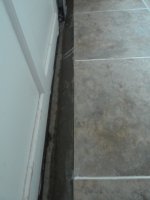

 If I wanted it to look perfect I would keep the doors locked and not let anyone one in.
