To avoid these ads, REGISTER NOW!

Sub-Panel in Garage-Adding 220v for Table Saw and Air Compressor

OP
M

Model A Fan

Well-known member
Joined
Dec 1, 2011
Messages
1,220
Location
NW Washington
Couldn't remember. I'd never run solid, let alone nm-b in conduit myself. Sure it can be done....
I'm assuming stranded would be best for running through conduit? I had planned on assembling the conduit as I went along. Pull the wires then run the conduit over them until I get it all glued up. If I were to go with stranded THHN, I've seen something saying 12GA wire is standard for outlets, so I could use my 12/2 for the outlets and my 14/2 for the lighting and out all that on 20A and 15A breakers respectively.
 
To avoid these ads, REGISTER NOW!

PCustoms

Well-known member
Joined
Jul 23, 2011
Messages
22,773
Location
VT
I'm assuming stranded would be best for running through conduit? I had planned on assembling the conduit as I went along. Pull the wires then run the conduit over them until I get it all glued up. If I were to go with stranded THHN, I've seen something saying 12GA wire is standard for outlets, so I could use my 12/2 for the outlets and my 14/2 for the lighting and out all that on 20A and 15A breakers respectively.
My personal opinion as a hack that has done a bit of wiring and seen a ton done, stranded in conduit.

I also don't think it's code to glue/assemble over wiring.

12awg is for 20a, 14awg for 15a.
 

wyliesdiesels

Well-known member
Joined
Aug 14, 2012
Messages
20,006
Location
Modesto, CA
I'm assuming stranded would be best for running through conduit? I had planned on assembling the conduit as I went along. Pull the wires then run the conduit over them until I get it all glued up. If I were to go with stranded THHN, I've seen something saying 12GA wire is standard for outlets, so I could use my 12/2 for the outlets and my 14/2 for the lighting and out all that on 20A and 15A breakers respectively.
dont do that. not only does code require the conduit run to be fully assembled first but the wet glue can damage the insulation on the wire. remember PVC glue is a solvent and can melt the insulation on the wire which is also PVC.
 
OP
M

Model A Fan

Well-known member
Joined
Dec 1, 2011
Messages
1,220
Location
NW Washington
My personal opinion as a hack that has done a bit of wiring and seen a ton done, stranded in conduit.

I also don't think it's code to glue/assemble over wiring.

12awg is for 20a, 14awg for 15a.
I was referencing something I had seen on a YouTube channel by the "Excellent Laborer" saying he installs 20A breakers for outlets in houses, and uses 15A for lighting. Will 15A be adequate for a garage or barn lighting set up? I was thinking of doing several 15A circuits for lighting so none are over-taxed. Especially since I have such large sub-panels I will be able to run plenty of circuits.
dont do that. not only does code require the conduit run to be fully assembled first but the wet glue can damage the insulation on the wire. remember PVC glue is a solvent and can melt the insulation on the wire which is also PVC.
Good point, I will assemble everything and budget for the THHN stranded if that's ultimately the route I end up going. My less than ideal other option is to run them through the wall. How many lines of Romex can I put through the same hole in studs?

Thanks guys, this is very helpful!
 
OP
M

Model A Fan

Well-known member
Joined
Dec 1, 2011
Messages
1,220
Location
NW Washington
Here is the wire I have to feed my sub panel. I'm going with a 90a breaker if I have a long enough run of it. 2 gauge aluminum will hold 90a adequately per the chart I used. If I wanted 100a I'd have to use a 1 gauge copper but since I have this aluminum wire on hand, I'll see if I have enough to make it work.

20220407_141341.jpg20220407_141412.jpg20220407_141346.jpg
 
OP
M

Model A Fan

Well-known member
Joined
Dec 1, 2011
Messages
1,220
Location
NW Washington
I think you meant #1 aluminum. #1 copper is 130A, #1 aluminum is 100A.
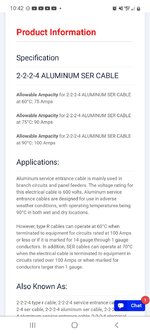
This was what I had been finding for aluminum cabling. Would I need to go for a cable gauge rated for 120A or higher to achieve my 80% load rating? What size ground? This site recommended 4 gauge copper ground with 2 gauge wire. I'll be operating in the 75°C bracket given all the breakers I've purchased are in that temp range.

Screenshot_20220408-224209_Chrome.jpgScreenshot_20220408-224225_Chrome.jpg
 

mike93lx

ALLIANCE MEMBER
Joined
Dec 9, 2013
Messages
37,515
Location
Richmond, VA
Not only is that wire missing the ground, It would require conduit the whole way. Plus, it looks like URD, which can't be used indoors.

Unless you wNt to run conduit, just buy 2-2-2-4 AL SER and breaker it at 90 (or less). Using a 60a breaker would save a chunk of money and it might be easier to source.

The 100a main in the sub is fine as it is just a disconnect
 
OP
M

Model A Fan

Well-known member
Joined
Dec 1, 2011
Messages
1,220
Location
NW Washington
Not only is that wire missing the ground, It would require conduit the whole way. Plus, it looks like URD, which can't be used indoors.

Unless you wNt to run conduit, just buy 2-2-2-4 AL SER and breaker it at 90 (or less). Using a 60a breaker would save a chunk of money and it might be easier to source.

The 100a main in the sub is fine as it is just a disconnect
I plan on installing a 100A breaker in the sub-panel at the top where a "MAIN" usually would reside (as a disconnect). I'll have the 90A breaker in the main panel supplying the power. I found a 90A breaker by accident and snapped it up. I'm going to replicate this project in my barn when I get the chance. My base project is just restoring power to the barn for my lighting, so it shouldn't be so complicated (to me). I have a small sub-panel in my barn running the lighting that is powered by a long wire from my house. I am going to get it disconnected and I will connect the current sub-panel in the barn to a 30A or so breaker in the soon-to-be installed new sub-panel. I'd probably disconnect everything but all the wiring is run throughout the barn through the rafters/floor joists in the ceiling and it would be a lot of work to pull everything out and then rewire it. Might make it look nicer though...

I'm assuming this is the 2-2-2-4 that you were referring to? If so, I'll buy that since it is so inexpensive compared to trying to monkey with what I already have.

2-2-2-4
 
Last edited:

wyliesdiesels

Well-known member
Joined
Aug 14, 2012
Messages
20,006
Location
Modesto, CA
Not only is that wire missing the ground, It would require conduit the whole way. Plus, it looks like URD, which can't be used indoors.

Unless you wNt to run conduit, just buy 2-2-2-4 AL SER and breaker it at 90 (or less). Using a 60a breaker would save a chunk of money and it might be easier to source.

The 100a main in the sub is fine as it is just a disconnect
It may be URD however it does have an RHH/RHW rating
 
OP
M

Model A Fan

Well-known member
Joined
Dec 1, 2011
Messages
1,220
Location
NW Washington
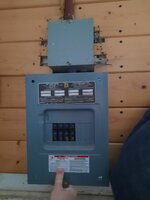
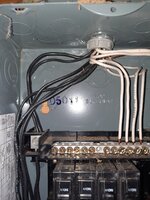
Out of curiosity I opened up the little sub-panel in my barn since I'm going to be doing both my barn and garage with twin projects. I'm going to replicate the sub-panel install in my barn since it will become a workshop at some point for my car projects. It currently has no power because of a windstorm, so perfect time to disconnect the wiring from the house and connect it to my irrigation service panel (200A main breaker). The current sub-panel in the garage is also a mess... someone didn't know what they were doing beyond connecting wires or seems.

For a new sub-panel inside a building receiving a new power source from an outside main breaker, is the anything special wiring-wise I'll need to do? Can I use the same 2-2-2-4 going from outside to inside as long as I use conduit? I think 1½ should be good enough for 2-2-2-4 feeding a 90A [main] breaker in the new 100A rated sub-panel.

This project will be a twin of my garage panel install aside from the garage power source being my main breaker in the house (no exterior power source) and my barn power source being powered be the outside breaker.
 

Attachments

  • 20220413_193455.jpg
    20220413_193455.jpg
    172.7 KB · Views: 43
  • 20220413_193506.jpg
    20220413_193506.jpg
    143 KB · Views: 49
  • 20220413_193608.jpg
    20220413_193608.jpg
    324.6 KB · Views: 48
  • 20220413_193608.jpg
    20220413_193608.jpg
    324.6 KB · Views: 50
  • 20220413_193630.jpg
    20220413_193630.jpg
    305.3 KB · Views: 49
  • 20220413_193651.jpg
    20220413_193651.jpg
    353 KB · Views: 62
  • 20220413_193758.jpg
    20220413_193758.jpg
    390.5 KB · Views: 66

mike93lx

ALLIANCE MEMBER
Joined
Dec 9, 2013
Messages
37,515
Location
Richmond, VA
Can I use the same 2-2-2-4 going from outside to inside as long as I use conduit? I think 1½ should be good enough for 2-2-2-4 feeding a 90A [main] breaker in the new 100A rated sub-panel.
SER doesn't require conduit unless it is subject to damage.

You don't need to drop to a 90a main in the sub. It's the breaker feeding that sub back at the source that needs to be less than or equal to 90.

The sub can have whatever size main you want as it is just a disconnect.
 
OP
M

Model A Fan

Well-known member
Joined
Dec 1, 2011
Messages
1,220
Location
NW Washington
wow thats a huge mess. needs to be ripped out and replaced
Yes, I was..."shocked" 😅😋 my plan is to redo all of that and feed that sub-panel from the new one I'm installing. Probably 30A and used 10/3 wire for it. That will be all my lighting for the barn...LEDs upstairs and down.
SER doesn't require conduit unless it is subject to damage.

You don't need to drop to a 90a main in the sub. It's the breaker feeding that sub back at the source that needs to be less than or equal to 90.

The sub can have whatever size main you want as it is just a disconnect.
I'm planning on a 90A sub-panel so I can have plenty of juice for the equipment I plan to run or expand into one day. The reason I'd use conduit is for running it along a rafter from outside (buring it for part of the run underground to go from outdoor main to the rafter of my barn) so it isn't tasty looking for any mice. They seem to love "spicy spaghetti".111111111FG_7wC-XIAoY7KS_jpg-2303088.jpeg
 

mike93lx

ALLIANCE MEMBER
Joined
Dec 9, 2013
Messages
37,515
Location
Richmond, VA
Yes, I was..."shocked" 😅😋 my plan is to redo all of that and feed that sub-panel from the new one I'm installing. Probably 30A and used 10/3 wire for it. That will be all my lighting for the barn...LEDs upstairs and down.

I'm planning on a 90A sub-panel so I can have plenty of juice for the equipment I plan to run or expand into one day. The reason I'd use conduit is for running it along a rafter from outside (buring it for part of the run underground to go from outdoor main to the rafter of my barn) so it isn't tasty looking for any mice. They seem to love "spicy spaghetti".111111111FG_7wC-XIAoY7KS_jpg-2303088.jpeg
SER can't be underground. You will need xhhw, mhf or URD for that. URD can't be indoors, so I would stay away from that.

Unless it is just a short stretch that you are protecting with conduit, i would not rim ser in conduit. It will be a pain to pull through


No argument on a 90a feed. My comments were about how you breaker it. No need to change the main breaker in whatever panel you buy
 
To avoid these ads, REGISTER NOW!

Carguy99

Well-known member
Joined
May 25, 2012
Messages
717
Location
Warrenville IL
It seems to me that someone should put together a sub panel kit. answer some questions maybe talk on the phone and it’s shipped to your house. wire breakers panel conduit …
Email some approved links on best installation practice.
or just a list of things you need,a shopping list Of sorts.
 

mike93lx

ALLIANCE MEMBER
Joined
Dec 9, 2013
Messages
37,515
Location
Richmond, VA
It seems to me that someone should put together a sub panel kit. answer some questions maybe talk on the phone and it’s shipped to your house. wire breakers panel conduit …
Email some approved links on best installation practice.
or just a list of things you need,a shopping list Of sorts.
Sounds like a lot of variables, complexity and headache for anyone doing that.
 
OP
M

Model A Fan

Well-known member
Joined
Dec 1, 2011
Messages
1,220
Location
NW Washington
SER can't be underground. You will need xhhw, mhf or URD for that. URD can't be indoors, so I would stay away from that.

Unless it is just a short stretch that you are protecting with conduit, i would not rim ser in conduit. It will be a pain to pull through


No argument on a 90a feed. My comments were about how you breaker it. No need to change the main breaker in whatever panel you buy
So what I'm seeing is the best option might be the "MHF" aka "Mobile Home Feeder"? It is roughly $3/foot, is allowed to be buried, can be run through conduit, and is approved for indoor/outdoor use? I'm sorry for the departure from my initial garage (all interior project) posting, but I'm mirroring the garage project to my barn with the variable being the main power source for the barn being an outdoor main breaker of 200A.

Here is the 2-2-2-4 MHF I am now eyeing since it can be indoor-outdoor use:

2-2-2-4 MHF Wire

My plan for the barn power feeder is:
1. Run conduit from main breaker down into the ground making a "U" shape that is the distance between the main breaker pole and the outer exterior wall of the barn (roughly 6' in distance I'd be burying conduit). Then up the wall another 6' or so into the rafter overhang (also in conduit).
2. Run the 2-2-2-4 MHF or whatever along a rafter and drill an access hole into the wall between rafters for the wire to enter the room where the sub-panel will go.
3. Run wire down the wall into the sub-panel (in conduit or not? I'm not sure)
4. Connect the 2-2-2-4 MHF up to the sub-panel feeding the 90A main breaker on the sub-panel.
5. Run wiring for my other circuits and connect the smaller sub-panel (with the horrific wiring) with an appropriate sized wire (8/3 perhaps?) and 240V breaker (all lighting and outlets...so 20A aka 12 gauge 12/2?)
6. ?????

Thanks for the continued help, this is going to make my place so much better.
 
Last edited:

mike93lx

ALLIANCE MEMBER
Joined
Dec 9, 2013
Messages
37,515
Location
Richmond, VA
MHF must be in conduit everywhere except underground

Dont exceed 360 degrees between pull points

You do not need to drop the main in the sub to 90a. That's a waste of money. Use what it comes with, which will be between 100a and 200a.
 
OP
M

Model A Fan

Well-known member
Joined
Dec 1, 2011
Messages
1,220
Location
NW Washington
MHF must be in conduit everywhere except underground

Dont exceed 360 degrees between pull points

You do not need to drop the main in the sub to 90a. That's a waste of money. Use what it comes with, which will be between 100a and 200a.
How does one go from a buried wire to conduit above ground? Do I just stick the conduit into the ground and feed the wire through it and then bury the cable and conduit end?
 
OP
M

Model A Fan

Well-known member
Joined
Dec 1, 2011
Messages
1,220
Location
NW Washington
Yup. Run the conduit until the wire is deep enough (24" likely) and use a sweep to get it horizontal.
Reading this table here:

Rigid PVC Conduit, Schedule 40 -- Table C10

It appears I can run five 2 gauge wires max through 1.25" Schedule 40 conduit. If I go up to 1.5", I can fit more and pulling may be easier. I just see the price jump and figure the extra $15 or so to go to 1.5" might be money well spent since it will likely pull easier.

However, I spotted this older thread here:

What size conduit for MHF

And it states that minimum MUST be 1.5" since MHF is not considered "wire" but rather "cable". So (speaking out loud here), I will go with 1.5" just to be on the safe side.

For the horribly wired sub-panel and "box" (what is that thing called where all the wires are wire nutted together?), what would be the best course of action? Pull all the wires and run new? I'm not sure what the purpose of all the wiring connected together is. I assume one of the sets in that "box" feeds the sub-panel in the barn already, and then the rest is for lighting and outlets? It is pretty sketchy looking, and overly complicated looking. I think I'll wind up running 8/3 to it to run a 40A breaker to operate this smaller box. Or would it be recommended to run only a 20A breaker since I'm only running lighting and 120V outlets on it? My 240V outlets will be handled by the new sub-panel I'm installing, and hopefully by keeping them separate, I'll be able to avoid too much re-working of the system that's already there.
 

mike93lx

ALLIANCE MEMBER
Joined
Dec 9, 2013
Messages
37,515
Location
Richmond, VA
1.5 would make for an easier pull anyway.

That is just a junction box and was possibly put there to extend the wires. I am guessing there used to be a fuse or breaker panel there and when it was replaced, it was MO Ed down, likely due to the wires coming out of the wall.

I would be tempted to pull it and start over, but I would at least start with making a schematic of the existing and then go from there.
 
OP
M

Model A Fan

Well-known member
Joined
Dec 1, 2011
Messages
1,220
Location
NW Washington
1.5 would make for an easier pull anyway.

That is just a junction box and was possibly put there to extend the wires. I am guessing there used to be a fuse or breaker panel there and when it was replaced, it was MO Ed down, likely due to the wires coming out of the wall.

I would be tempted to pull it and start over, but I would at least start with making a schematic of the existing and then go from there.
Good plan, a schematic would be very helpful so I know how to re-run if that's the route I wind up going. I have to do that for my garage too since the lighting and outlets are fed off a circuit in the house and only one light is running off of the sub-panel in the garage. The people who did the wiring years ago painted the wires when they sprayed the rafters/joists. Is using a junction box like that (even if kinda ugly) OK? If I were to re-run the wires, could I re-use the wires that are currently there, if not for their original circuit but maybe other circuits since they're all a little short?
 

mike93lx

ALLIANCE MEMBER
Joined
Dec 9, 2013
Messages
37,515
Location
Richmond, VA
Good plan, a schematic would be very helpful so I know how to re-run if that's the route I wind up going. I have to do that for my garage too since the lighting and outlets are fed off a circuit in the house and only one light is running off of the sub-panel in the garage. The people who did the wiring years ago painted the wires when they sprayed the rafters/joists. Is using a junction box like that (even if kinda ugly) OK? If I were to re-run the wires, could I re-use the wires that are currently there, if not for their original circuit but maybe other circuits since they're all a little short?
I'd have to look closely if the box is overfilled, but otherwise, yeah, it is fine.

I will reuse wiring when it is in great shape. But if there is visible damage anywhere, or the install is suspect, I'll replace it. Wire has gotten expensive relative to historical pricing, but it still is a lot cheaper than a fire or troubleshooting issues down the road
 
OP
M

Model A Fan

Well-known member
Joined
Dec 1, 2011
Messages
1,220
Location
NW Washington
I'd have to look closely if the box is overfilled, but otherwise, yeah, it is fine.

I will reuse wiring when it is in great shape. But if there is visible damage anywhere, or the install is suspect, I'll replace it. Wire has gotten expensive relative to historical pricing, but it still is a lot cheaper than a fire or troubleshooting issues down the road
Thank you very much for your help and knowledge. The quotes I received for installing a panel and connecting it to the main breaker outside was $4100 and $4200 from two different electrical companies. They quoted $3k in materials alone :scared::scared::headscrat

This will be a fun project to do because I have a lot of areas in my barn that are not lit and don't have power sources. What this means is that I'll be able to run conduit and THHN for some outlets and Romex for lighting (walls are concrete at outlet height). I can continue to convert my barn into a workshop as it is little more than glorified storage a this point because it is devoid of electrical circuits throughout.
 

mike93lx

ALLIANCE MEMBER
Joined
Dec 9, 2013
Messages
37,515
Location
Richmond, VA
Thank you very much for your help and knowledge. The quotes I received for installing a panel and connecting it to the main breaker outside was $4100 and $4200 from two different electrical companies. They quoted $3k in materials alone :scared::scared::headscrat

This will be a fun project to do because I have a lot of areas in my barn that are not lit and don't have power sources. What this means is that I'll be able to run conduit and THHN for some outlets and Romex for lighting (walls are concrete at outlet height). I can continue to convert my barn into a workshop as it is little more than glorified storage a this point because it is devoid of electrical circuits throughout.
They either both don't want the job or the quotes are an indication of a "fair" price. Some stuff, like gfci breakers, can be very expensive and copper is very high.

If you have the time for research and to do the job, generally this stuff can by diy. If you are tight on time paying can be well worth it.

I am having a pool put in and just had all the electrical done. Could I have done it? Sure. It would have taken 5x as long since they had a crew of 4, plus they are experts, and it wouldn't have looked as neat as I don't do conduit work much. Sometimes writing the check is painful, but the result is worth it.
 
OP
M

Model A Fan

Well-known member
Joined
Dec 1, 2011
Messages
1,220
Location
NW Washington
So I just checked my outside main breaker for my barn and to my surprise...it's Eaton brand. I don't know why I wouldn't be able to but running a Square D Homeline panel as my sub-panel would still be OK? I'll just have to get the 90A or 100A breaker for installation in the main panel and use a 90A inside the sub-panel? I hope they're able to connected...20220420_182026.jpg20220420_182038.jpg20220420_181729.jpg

And I agree, sometimes cutting a check is painful, but sometimes jobs are worth paying to have done. I'm doing that with my crawlspace insulation and drywall in my baby's nursery when I begin the renovation on that.
 

mike93lx

ALLIANCE MEMBER
Joined
Dec 9, 2013
Messages
37,515
Location
Richmond, VA
The brand of your sub doesn't matter. They don't need to match.

You seem confused on the breaker sizes.

The one going in your main must be 90 or smaller.

The one in the sub can be any size. 60a, 90, 100, 150, 200 whatever. It does not need to be 90. That breaker is just a on/off switch for the panel. Just buy a main breaker panel and use whatever it comes with. Personally, I would probably buy a 100-200a, 20-24 space panel. Stock is thin, so you may not have many choices.
 

Norcal

Well-known member
Joined
Mar 16, 2008
Messages
13,754
Normally I prefer that panels be the same brand & use the the same type of breaker, but since Eaton BR is the worst panel on the market currently, I call the BR panel"Zinsco II", a Homeline panel would be a good choice but buy one with a generous number of slots, don't have to use them all, but it's hard to add them if more is needed, I should follow my own advice though as my shop has a Cutler-Hammer CH panel that uses plug in breakers, a GE A-series panelboard, Siemens panelboard, and a SQ D, all requiring bolt on breakers that are not interchangeable, but I had them on hand.
 
OP
M

Model A Fan

Well-known member
Joined
Dec 1, 2011
Messages
1,220
Location
NW Washington
The brand of your sub doesn't matter. They don't need to match.

You seem confused on the breaker sizes.

The one going in your main must be 90 or smaller.

The one in the sub can be any size. 60a, 90, 100, 150, 200 whatever. It does not need to be 90. That breaker is just a on/off switch for the panel. Just buy a main breaker panel and use whatever it comes with. Personally, I would probably buy a 100-200a, 20-24 space panel. Stock is thin, so you may not have many choices.
I understand now what you are saying. I will use the lower rated breaker (90A) in the main panel feeding the sub-panel (where I will have the "main" be 100A since the breaker in the main panel will be the one that trips). The panel I bought it a 125A panel by Square D with 24 spaces, and I bought exactly the same stuff for my garage. 90A I managed to locate at a hardware store that stocks nearly everything, whereas Home Depot and Lowe's do not carry the more "odd" amp breakers like that. Do these panels come with a main breaker included? I saw on the package it only came with two 30A two-pole breakers and three 15A single-pole breakers. It did not mention a main breaker included, but maybe its already installed? I haven't opened the packages yet to look and see.
Normally I prefer that panels be the same brand & use the the same type of breaker, but since Eaton BR is the worst panel on the market currently, I call the BR panel"Zinsco II", a Homeline panel would be a good choice but buy one with a generous number of slots, don't have to use them all, but it's hard to add them if more is needed, I should follow my own advice though as my shop has a Cutler-Hammer CH panel that uses plug in breakers, a GE A-series panelboard, Siemens panelboard, and a SQ D, all requiring bolt on breakers that are not interchangeable, but I had them on hand.
I'm bummed to hear they're the worst; but its what I have and what I have to work with now. I'll post pics of my wiring plan for comment in a little bit.
 

mike93lx

ALLIANCE MEMBER
Joined
Dec 9, 2013
Messages
37,515
Location
Richmond, VA
I understand now what you are saying. I will use the lower rated breaker (90A) in the main panel feeding the sub-panel (where I will have the "main" be 100A since the breaker in the main panel will be the one that trips). The panel I bought it a 125A panel by Square D with 24 spaces, and I bought exactly the same stuff for my garage. 90A I managed to locate at a hardware store that stocks nearly everything, whereas Home Depot and Lowe's do not carry the more "odd" amp breakers like that. Do these panels come with a main breaker included? I saw on the package it only came with two 30A two-pole breakers and three 15A single-pole breakers. It did not mention a main breaker included, but maybe its already installed? I haven't opened the packages yet to look and see.

I'm bummed to hear they're the worst; but its what I have and what I have to work with now. I'll post pics of my wiring plan for comment in a little bit.
Great. A main breaker panel will always come with the main. Other breakers may or may not be included in the kit.

A main lug panel will not have a main breaker. You can "convert" it by back feeding through a breaker instead of using the lugs

Can you provide a link to the panel you bought?
 
OP
M

Model A Fan

Well-known member
Joined
Dec 1, 2011
Messages
1,220
Location
NW Washington
Great. A main breaker panel will always come with the main. Other breakers may or may not be included in the kit.

A main lug panel will not have a main breaker. You can "convert" it by back feeding through a breaker instead of using the lugs

Can you provide a link to the panel you bought?
Here is the one I purchased. It was $89 when I bought it, so I think I will go back and get a price adjustment as its $20 cheaper than was before and I bought two of them. Looks like it was also 20A breakers and not 15A that came with it.

Square D Homeline 100-Amp 24-Spaces 48-Circuit Main Breaker Plug-On Neutral Load Center (Value Pack)
 
OP
M

Model A Fan

Well-known member
Joined
Dec 1, 2011
Messages
1,220
Location
NW Washington
Here is my conduit/wiring plan. I will run conduit in the aboveground and exposed areas and bury the 2-2-2-4 MHF at 24" underground without conduit. I plan to run this conduit out of either the side hole, or out of a bottom hole on the existing Eaton panel outside, then span the distance between the main breaker and then up the wall of the lean-to into the rafters/ceiling joists to the exterior wall of the barn and then through the 2x6 top and then down at a 90 degrees where it enters the barn interior into the sub-panel.

Hopefully my pictures make sense.
 

mike93lx

ALLIANCE MEMBER
Joined
Dec 9, 2013
Messages
37,515
Location
Richmond, VA
A big benefit of running conduit underground as well is being able to get the trunch dug, lay the conduit then backfill. You can then deal with the wiring later. If you run it exposed underground, you have to leave the trench open until the wire is placed. The conduit also protects the wire in the long run
 
To avoid these ads, REGISTER NOW!
Top Bottom