INTRO POST 4 of 4
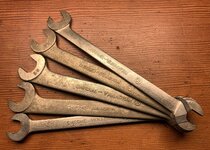
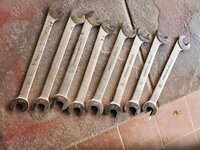
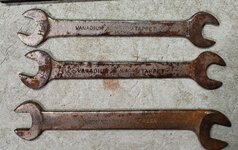
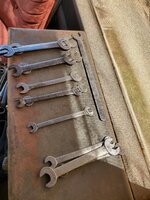
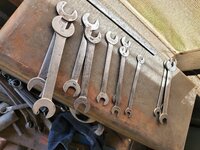
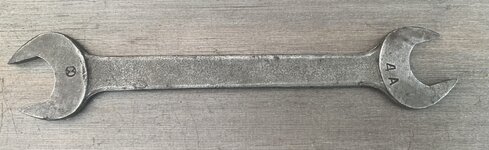
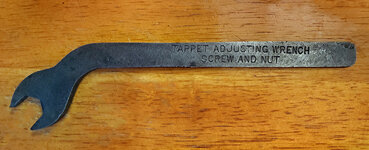
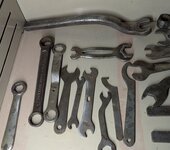
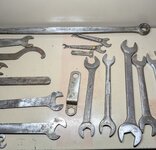
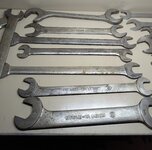
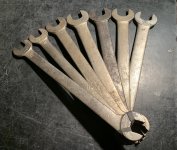
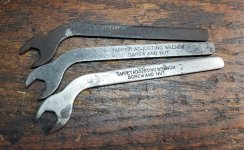
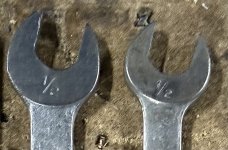
Most guys have experience or knowledge of needing two tappet wrenches, one for the nut at the top of the tappet or lifter itself and one for the adjusting screw on top of that. In fact, my only hands-on personal experience with tappet wrenches is setting the valve clearance on my 1943 Willys MB, and it takes two. It’s done at TDC for ignition, when both valves are closed. The tappet in the L head is not on a cam lobe, and the valve is held closed by a spring. The tappets are self-locking. (Only early jeeps had separate locknuts.) You hold a tappet wrench with a 1/2” opening to hold the lifter/tappet (hex nut), and another with the same size opening to turn the hex head on the adjuster screw. The TM says you do it with the same hand, a feeler gauge in the other. The tappets and stems were worn/ground bad on mine, so a feeler wasn’t much use, and I followed an equation-turn method (based on the spec that an L134 engine tappet adjuster screw has 24 threads per inch, and that 1 complete 360* turn of the tappet adjuster hex head was 0.042“) that is well-known in the G503 community. To be honest, it always took a lot of trial and error to get it right.
Here’s an L134 engine. (Ignore the valve keepers, which are unusual in a wartime block, and before someone says it, yes, I know the springs are upside down! Don’t ask!)

Here’s an illustration of an L134 engine from a jeep TM showing two tappet wrenches in use. The wrench in his left hand is holding the tappet still. The left in his right hand is making the adjustment.

Here’s an illustration from a different manual showing two tappet wrenches and a feeler gauge in use. This is the famous "scissors" method. The left hand is holding the feeler gauge. The fingers of the right hand are holding the wrench at the bottom on the tappet while the thumb gently nudges the adjusting screw.

But, here is an illustration I grabbed from a period book showing three (3) wrenches in use (made by Bonney, by the way!),
and an illustration from a modern book on antique car maintenance, showing why.


It seems as though the third wrench in these three-wrench set-ups is for a valve-tappet type in which the locknut is different, separate from, not a part of the hex head on a self-locking tappet/lifter. My impression is that you needed to hold the tappet/lifter itself steady or still, or it would turn, loosen the locknut, and then turn the adjuster, and when you're done setting your lash, tighten the locknut, while holding the tappet/lifter, because all three were independent of each other.
In both figures one hand is using two wrenches to hold the tappet and loosen the locknut, while the other hand is using a wrench to make the adjustment.
Having said all that about 2- and 3-wrench tappet adjustments, I have no clue how you would adjust valve tappet clearance with only one (1) wrench. There are several cars and trucks like that. Not only no jam nut, but no need to hold the tappet?
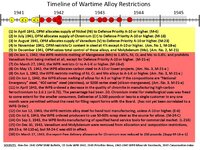
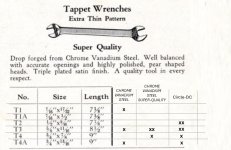
For those who are curious, you should be able to use the chart above, identify a car or truck by make, model, and engine type that needed three (3) wrenches, or one (1) wrench, and then go find some views or maintenance procedures for those vehicles to see if it provides an explanation. I will probably do that in good time, but if someone beats me to it, I won’t be upset.
Or, someone smarter than I, with more experience working on more vintage engines (such as Provincial, humber or ttpete, etc), might know the answer.