jakemac
Well-known member
HF 26” Toolbox Modify Thread
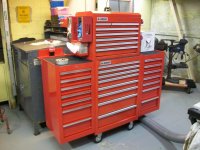
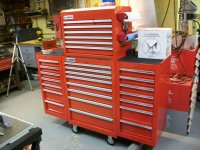
A few months ago I mentioned how my HF 26” box had an issue with me adding a 7-drawer side box to it (with another planed for the other side).
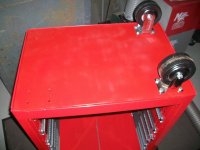
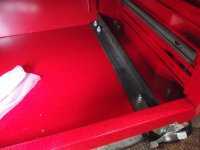
Here’s the problem(s). The 26” box isn’t built to handle the weight of additional add-ons. It’s a great box for the money, with a drawer layout that I like, but it isn’t a Clydesdale. The casters use a lighter gauge steel than the ones on the HF 44” box and a smaller base. But that isn’t the real issue, the big problem is that there is no frame under the box to handle extra weight. Instead, there are two strips of 18 gauge steel spot welded to the 18 gauge bottom of the box in an attempt to stiffen the bottom. For a single stack that isn’t overloaded, this would be adequate . Unfortunately, I live in the real world where my toolbox will get stuffed to the gills.
Here’s my attempt to beef up the toolbox, with pictures.
I started with a steel plate I picked up at the scrapyard. I wanted to use 3/16” plate, but when I got it home I realized that it was 1/4” instead (better too much than too little). It had a bow to it, so I ran over it with my truck a few times (20 + jumping up an down on the bumper ) to straighten it out. I didn’t get it all, but it’s close enough. I was going to cut it to size with a sawsall, but I was too lazy. I marked the lines and took it to a machine shop with a hydraulic shear. Since it was already marked, they chopped it for free even though I offered to pay. Next it was off to the wire cup to clean it.
Preparing to wire brush the plate for the rust neutralizer, primer, and paint.

While I was painting the plate I needed to empty the box and prepare the bottom.
Emptying out the cabinet.

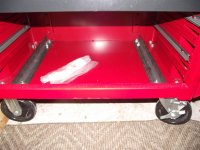
Interior of case, showing insert nuts for the casters that will have to be drilled out from the other side.

Removing the Casters. I finally found a use for my 3/8" Speeder Ratchet !

The insert nuts go through the case and bracing, and then are crimped like rivets. They will need to be drilled out to remove the braces.
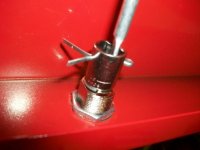
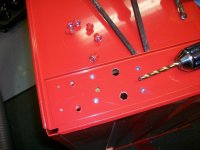
Drilling out the insert nuts and spot welds on the thin gauge bracing, to remove it.

A few months ago I mentioned how my HF 26” box had an issue with me adding a 7-drawer side box to it (with another planed for the other side).
Here’s the problem(s). The 26” box isn’t built to handle the weight of additional add-ons. It’s a great box for the money, with a drawer layout that I like, but it isn’t a Clydesdale. The casters use a lighter gauge steel than the ones on the HF 44” box and a smaller base. But that isn’t the real issue, the big problem is that there is no frame under the box to handle extra weight. Instead, there are two strips of 18 gauge steel spot welded to the 18 gauge bottom of the box in an attempt to stiffen the bottom. For a single stack that isn’t overloaded, this would be adequate . Unfortunately, I live in the real world where my toolbox will get stuffed to the gills.
Here’s my attempt to beef up the toolbox, with pictures.
I started with a steel plate I picked up at the scrapyard. I wanted to use 3/16” plate, but when I got it home I realized that it was 1/4” instead (better too much than too little). It had a bow to it, so I ran over it with my truck a few times (20 + jumping up an down on the bumper
) to straighten it out. I didn’t get it all, but it’s close enough. I was going to cut it to size with a sawsall, but I was too lazy. I marked the lines and took it to a machine shop with a hydraulic shear. Since it was already marked, they chopped it for free even though I offered to pay. Next it was off to the wire cup to clean it. Preparing to wire brush the plate for the rust neutralizer, primer, and paint.
While I was painting the plate I needed to empty the box and prepare the bottom.
Emptying out the cabinet.
Interior of case, showing insert nuts for the casters that will have to be drilled out from the other side.
Removing the Casters. I finally found a use for my 3/8" Speeder Ratchet !
The insert nuts go through the case and bracing, and then are crimped like rivets. They will need to be drilled out to remove the braces.
Drilling out the insert nuts and spot welds on the thin gauge bracing, to remove it.
Attachments


Last edited: