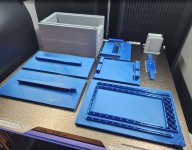
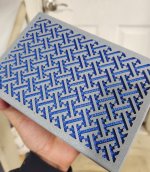
This is interesting. I printed a pile of rectangular templates for a project on my brand new H2D, figuring that they would be square as the printer costs 2K and my old Prusa had no problems printing square objects. I was horrified when I checked the parts with a machinist square. They were not square at all. It was obvious on a 3.5” x 5.5” print. Larger prints were even more off and could easily be seen using a framing square!
So, I ordered the Vision Encoder and then watched a bunch of Youtube vids on it, only to find that nearly everybody evaluated the VE incorrectly. Most people printed a small trinket, calibrated with the VE, and then printed the trinket again. Obviously, these dimwits didn’t see a difference in the prints and came to the conclusion that the VE does nothing. Most figured that the VE would only do something for their printer after several thousand hours of printing. These people don’t understand the point of the VE. The point of the VE is to improve accuracy over long distances in X and Y, not to improve overhangs, VFA, top layers, etc.
So, I devised a test to find out if the VE does anything. I designed a 9”x9”x0.375” test piece and printed one before calibration with the VE and then printed another.
I don’t have a 9” long machinist square, so I had to make one on my mill using its table (which is in mint condition), a screwless vice, and a 123 block. I set it up and locked the vice and 123 block between the quill and the table using the knee crank. The setup was perfectly square and rock solid.
Test setup:
I first checked the edges of each print for straightness on the mill’s table. Out of the eight edges, only a 1.5” long section of one edge could I slip 0.0015” feeler gauge under and this was probable due to shrinkage, uneven cooling, or something like that. I think these results are pretty freaking unbelievable. Consider pre and post VE straightness results the same.
I then checked each corner of each print for squareness. I set each print on the table, one at a time, put four light weights into each bottom window of the print for stability, and then slid the print against the vice/123 block and measured the gap with feeler gauges.
Pre-VE results:
I measured from 0.0075”-0.014” on the pre-VE print. 0.014” is too much as far as I’m concerned and for what I want to use the H2D for. This is what 0.014” out of square looks like on a 9” long part. You'll want to view these images full-size. Look at the huge gap on the bottom of the vertical edge!
Post-VE results:
I measured from 0.0015”-0.002” on the post-VE print. I don’t know about you, but I think that's pretty incredible for a 9” long object if you ask me. I should mention that both prints were done with the left nozzle which may be slightly less precise than the right nozzle since it moves up and down, although I have not read anything definitive on this yet.
This is what 0.002” out of square looks like.
Summary: The H2D (and probably the H2S, also) can be extremely accurate, but you have to shell out another $100 to unlock its full potential. If you want to make functional prints that fit together or if you want to print templates or other layout tools, the VE is definitely worth it.
Edit: I forgot to mention that the pre-VE print was printed with a shrinkage rate set in the filament profile, so the length of each side of the print was very accurate and within a few thousandths. After cal'ing with the VE, parts began printing slightly small, so I had to calculate a new shrinkage rate. This was unexpected, but easy enough to fix. If you run a VE cal, check dimensions again if you already had shrinkage dialed in.