Are you stopping production of your cup holders?
moving production to MN where my cousin is taking over day to day production.

Are you stopping production of your cup holders?
Appreciated.. we need 4 of them.. trying to make it a teachable moment and get the kid exposed to CAD or at least a CAD like program. If he wants 'em, he can design 'em and print them off at the library.

The volume that you are cranking out is impressive! Is that about a days worth of printing?
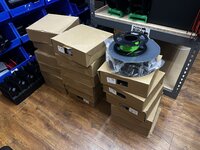
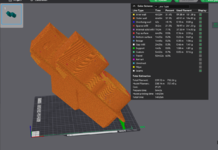
How much scrap filament do you typically end up with? I'm not thinking about failed prints, rather the left over bits of filament from change overs, purging etc? Are you at a point where you could justify reprocessing the scrap?8 hours each for them. each printer can knock out 3 a day assuming things are running well. Plenty of failures along the way. 7% is my factor currently.
These are part of a bi weekly batch so I spread them out between other jobs to not eat up the entire fleet. really nice jobs to run over night to keep printer rest time to a min.
thats about a weeks worth of filament. 1kg spool for reference on top there.
50ish KG a week is no small feat!
Always interesting to see how print farms are working, running the longer prints overnight makes complete sense too. Then the smaller prints can be run during the day when there is someone around to reset the printer.
Are you moving the whole farm to MN? or keeping some at home for prototyping?
How much scrap filament do you typically end up with? I'm not thinking about failed prints, rather the left over bits of filament from change overs, purging etc? Are you at a point where you could justify reprocessing the scrap?
I think about this a lot these days as my company is really thinking about the long term impact of all the plastic parts we produce. At least when dealing with scrap from molding the material type is well known so it does have value as regrind for uses where they are less concerned about the details of the materials.
very little left on spools. purge lines and poop really isn't much in the grand scheme of things for what we're doing. moving to 5kg spools so each printer might end up with 3 poops a week. purge lines i been meaning to change the start code to reduce the size. mainly cause the robot vacuum doesnt like the long ones.
;===== noozle load line =============================== M975 S1 G90 M83 T1000 G1 X18.0 Y1.0 Z0.8 F18000;Move to start position M109 S{nozzle_temperature_initial_layer[initial_extruder]} G1 Z0.2 G0 E2 F300 G0 X240 E15 F{outer_wall_volumetric_speed/(0.3*0.5) * 60} G0 Y11 E0.700 F{outer_wall_volumetric_speed/(0.3*0.5)/ 4 * 60} G0 X239.5 G0 E0.2 G0 Y1.5 E0.700 G0 X18 E15 F{outer_wall_volumetric_speed/(0.3*0.5) * 60} M400
spools themselves are a giant pain. not sure if shredding and running a recycling line would make sense. I'd rather end up just having my own filament production line and use the spools in a loop.

 www.filabot.com
Spools do seem to be the biggest waste in 3d printing. Hopefully reusable spools and filament refills start becoming more the norm, not a fan of cardboard spools really.
Of course if you are big enough to justify a filament production line, then that would make good use of old spools.
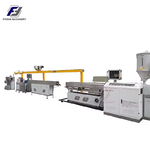
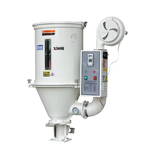
I wounder if you use enough to justify getting resin in pellet form then processing it into your own filament. A while ago we were discussing where the cross over points on cost were. I think pellet resin, the form we feed into high volume mold machines, is something like 1/10th the price of filament on a spool. At some point it seems like it would be cheaper to buy the machine that forms the filament. Of course, it needs to be a clear advantage to take on the risk of a new machine and learning curve.
I was curious and found this machine (never heard of them prior to my search) for $7500.
It claims it can produce 2lb (~1kg)/hr. Assuming $1 for pellets vs $10 for filament it saves $9 per kg of resin (ignoring operating cost which aren't free). So assume you use 90kg per week, it would save ~$800/week in material. So that would take about 10 weeks to pay for the machine. The machine would also have to run basically non-stop for 4 days to keep up with demand. I could see it paying for itself in a year but I could also see complications that could really hurt that ROI estimate. If you run different filament types, have breakdowns, get lower quality output, if the dies wear out quickly.Filament Extrusion - Develop or Recycle Filament for Any 3D Printer
3D Filament Extruders, make and develop filament from almost any plastic, additive or filler source. Allowing you to 3D Print with the materials or recycle feedstock you choose.
Do you know if the big print farms extrude their own filament or perhaps get better prices from sources?
Better have a hell of a recycling agreement either way. Between the plastic, the spools, and the cardboard boxes, you'll need it. I thought more about the cardboard after your initial post than the plastics, but the above posts have good points. Im interested to see where you go with that.
Meanwhile on my one little measly printer I think about what to do with the dang boxes and some spools from my 1kg stuff. I am finding the boxes are nice for dividing and sorting hardware on active projects. They're disposable and seal up so they can't be dropped and dump out. They soak up oils, and are easy to write on (label). I do like that if one sticks to the Bambu system, you don't have all the extra spools at the end. You just buy the reloads. Its almost worth the shipping wait times in my opinion, for personal use of course. A business can't bother with that obviously.

Most filament is not recyclableBetter have a hell of a recycling agreement either way. Between the plastic, the spools, and the cardboard boxes, you'll need it. I thought more about the cardboard after your initial post than the plastics, but the above posts have good points. Im interested to see where you go with that.
Meanwhile on my one little measly printer I think about what to do with the dang boxes and some spools from my 1kg stuff. I am finding the boxes are nice for dividing and sorting hardware on active projects. They're disposable and seal up so they can't be dropped and dump out. They soak up oils, and are easy to write on (label). I do like that if one sticks to the Bambu system, you don't have all the extra spools at the end. You just buy the reloads. Its almost worth the shipping wait times in my opinion, for personal use of course. A business can't bother with that obviously.
I was assuming he meant just putting it in blue bins on the curb, but that is intriguing
I was assuming he meant just putting it in blue bins on the curb, but that is intriguing


To be clear, I am happy to send them to anyone who wishes. I also have the same design videos for Solidworks as well.Slowtwitch, I am happy to send some basic tutorial videos I made for teaching my students (OnShape). Walks them thru both some basic shapes, as well as slightly more complicated setup (90deg LB Conduit box). This was taught to 7th graders.
Take a serious look at Microsoft 3D Builder. Cork sniffers will scoff at it but it’s stupid simple to use, very effective at achieving results and is a great introduction to conceptually understanding what you are trying to do from a design perspective. I have several patents from products I designed with it, and I’d bet if I had used my autodesk programs,I might not have completed those project.Hey guys.. I'm sure this has been answered numerous times, but here it goes again..
What's the best program to design a small part.. free and beginner friendly?
It's for a 24th scale RC truck wheel.. so about half dollar diameter, 1/2" or so thick.. a small cylinder essentially
with a hex on the back side.
Thanks.
I just took a look and I think I will try to show it to a few people (and kids). I've been a long time SW user but I've always wondered about a program that would be reasonably easy for people who don't have 3D modeling experience (and aren't used to thinking about how to build a model in parametric CAD). In particular it would be nice to have something that is reasonably easy for kids to use so they can successfully design then print something.Take a serious look at Microsoft 3D Builder. Cork sniffers will scoff at it but it’s stupid simple to use, very effective at achieving results and is a great introduction to conceptually understanding what you are trying to do from a design perspective. I have several patents from products I designed with it, and I’d bet if I had used my autodesk programs,I might not have completed those project.
its not the tool that counts, it’s the result.
My Heart loves this, my wallet definitely does not though hahahaim really really hoping bambu comes out with a larger format.
300x600x600 or something.
My Heart loves this, my wallet definitely does not though hahaha
unfortunately even with the first two numbers reversed, I don't think it will be enough.I'd pay 1200 a pop for a true 500x500x500 p1s unit.
unfortunately even with the first two numbers reversed, I don't think it will be enough.
I believe that's normal on the little tab at the back, my printer does it on all of the plates. From what I can see online, it's part of the nozzle cleaning process and is completely normal.Speaking of PEI plate.....do they all scratch the coating off with the nozzle in a little spot in the very back of the plate before starting a print, or is it just mine?


Will you come home to a video of someone stealing it?It's here!
But I'm out of town for a few more days
Will you come home to a video of someone stealing it?
we have the HSM 425 at my work. It's a top-notch unit if you're considering it.Oh. yea doubt single stream would have a good time with PETG, PLA, ABS, GFN, etc.
this is something I'm thinking about down the line: