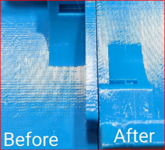
Since I got my printer (Sidewinder X1) it has always shown these stepper motor patterns on shiny filament. These are what Prusa is calling "VFA" or "vertical fine artifacts" and they are caused by the stepper motor vibration / cogging (the printer also has other artifacts like ringing, but that's another story...) These VFA's are on every shiny print and correspond perfectly to the stepper motor frequencies. In my opinion, these are endemic to all normal printers, and can be seen on practically all prints if you just print shiny filament and use the right lighting. They are impossible to feel, so it means they are only a few thousanths at most, and don't impact function, but unforunately 90% of my printing is on shiny PETG and I'm just tired of seeing them. They appear to be endemic to all cartesion 3Dprinters, but only show up if you use shiny filament and your printer is otherwise tuned well.
There was a big effort to address these on the Prusa Mk3 with no sure fix, and they have been newly addressed on the Mk4 by Prusa using the most advanced Trinamic drivers and trying different waveform patterns (apparently the latest Trinamic drivers contain multiple alternate waveforms for tuning) with some results. My printer already has Trinamic 2100 drivers with StealthChop, which tells me that I probably can't address these with stepper drivers, and need to do something different. The problem seems to be there are only about 5 full steps per mm, which is "just enough" resolution for 3D printing, and although running 16x microstepping and StealthChop smooth things out a lot, apparently not enough.
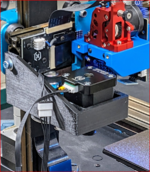
I was curious if gearing down the axis would help, so I put in a 3:1 gear reduction on the X axis that simply bolts on in place of the factory stepper. The same belt and mount is used, only needing to update steps/mm in firmware (no need to reflash firmware). This takes the axis to 15 full steps per mm. It did help, as you can see below, and I think I'll do the Y axis next. The downside is I had to reduce my travel move speed from 200mm/s to 80mm/s for reliable operation, although I think I can tune this back higher. And, there is a real chance the higher stepper speeds will introduce new resonances due to the higher RPMs it is now running, although time will tell. This is also working my 8bit board harder, since the stepping frequency is now tripled and soon will be 6x-ed, although I normally print slow like 20-40mm/s anyway, since PETG prints better slow IME.