Silly Rabbit
Member
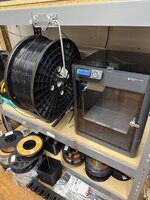
Testing the MMU for my Prusa recently. A couple of feed issues that hopefully has been resolved with some small adjustments.


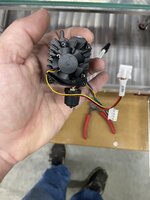

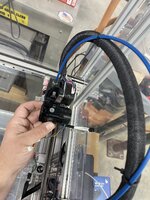
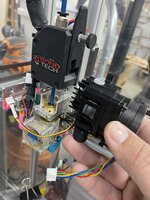
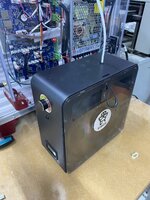
If it’s PETG it needs driedThanks for the response. I don't think the filament is wet, it's been inside my loft in a wood burning house, it's dry enough to cause nosebleeds. The last print was almost the same model with same filament and came out good. I've let it run for now, we'll see tonight.
My basement is dehumidified and runs in the 40 percent range. For the first few years I printed I would dry in the oven if it had been out for a long time but I usually printed right out of the bag. Until I bought my first filament dryer I didn't realize how active drying while printing made a huge difference. So many problems disappeared especially with PETG. Even a few hours in the oven isn't really great for large prints as lower layers on the spool don't get as dry as the upper layers due to lack of surface area/air flow during drying.Yeah you're right, some of my old PLA filaments either don't extrude correctly and I found are brittle so need to be dried out. Prints perfect with new filament.
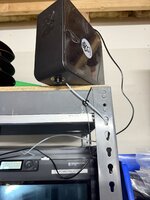
Might be a good use for the heating element out of the "heated bird watering bowl" I found at the dump.
No direct experience, but I think it's going to be my next printer. My MK3S+ is a beast and has been 100% reliable, but I would like faster prints at times. Slightly better quality is the icing on the cake. I can upgrade my MK3S+ to a 3.5 which will give me the faster prints, but then I'm going to lose out on all of the other pluses of the Core One and its future upgrades. I think a Core One makes a lot more sense than a Bambu imo. The support, parts availability, open source, and COO all mean so much more to me than saving a couple hundred bucks.I have started to reach the limit of the small build plate on my Prusa Mini. I've been very happy with the Mini and would prefer to stay in the Prusa environment but could be swayed. Keeping everything local (non-cloud based) is important, and compatible with OctoPrint is a plus.
Anyone have experience with the new Prusa CORE?
and not having to upload your prints to chinaNo direct experience, but I think it's going to be my next printer. My MK3S+ is a beast and has been 100% reliable, but I would like faster prints at times. Slightly better quality is the icing on the cake. I can upgrade my MK3S+ to a 3.5 which will give me the faster prints, but then I'm going to lose out on all of the other pluses of the Core One and its future upgrades. I think a Core One makes a lot more sense than a Bambu imo. The support, parts availability, open source, and COO all mean so much more to me than saving a couple hundred bucks.
::ducks for cover::
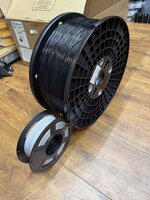
10KG?
Are they much cheaper than the 1 and 5kg spools? It seems like they should be, but also have to be a pain to move around in bulk.

Wow, that is some great pricing!
I thought you were mostly working in PETG, but from the looks of it, you are getting into the other materials as well.
**** of Theseus CR-10

Well, the only things original are the frame and the bed, so... yeah. The **** of Theseus.



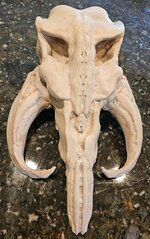
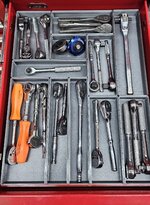
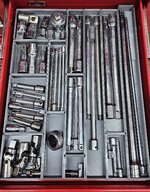
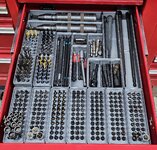
How do you account for parallax and focal length warping? This method seems like it would not be accurate enough for a lot of applications and would need a lot of prototyping and tweaking on the back end to get it right, but I could be wrong.Photograph it, import the image into your modeling program of choice, trace it in a sketch, scale it to proper size.
Programs such as Photoshop can take the warp out if you input the lens that was used.How do you account for parallax and focal length warping? This method seems like it would not be accurate enough for a lot of applications and would need a lot of prototyping and tweaking on the back end to get it right, but I could be wrong.
You may have an application where it is not sufficiently accurate. During my working career, one of the groups I started up and managed did reverse engineering of machine parts. Even though we used a Coordinate Measuring Machine, we still had to do prototyping, tweaking, and logical thinking to establish workable tolerances.How do you account for parallax and focal length warping? This method seems like it would not be accurate enough for a lot of applications and would need a lot of prototyping and tweaking on the back end to get it right, but I could be wrong.
Programs such as Photoshop can take the warp out if you input the lens that was used.
If you are using digital SLR use a longer focal length.
I use the portrait setting on my phone which is essentially a longer focal length.
You might need to still do some tweaking of you model after your first print. I usually print partial models to check fit before I print the entire thing.
Thank you for the thorough responses--also, the laser printer 2D prototype method is a crazy good idea. Never thought to do something like that.You may have an application where it is not sufficiently accurate. During my working career, one of the groups I started up and managed did reverse engineering of machine parts. Even though we used a Coordinate Measuring Machine, we still had to do prototyping, tweaking, and logical thinking to establish workable tolerances.
Nowadays, I’m pretty much just looking to produce things like Gridfinity holders for tools I’ve got, so shapes that are generously oversized are my main goal. I also save on filament costs by printing a 2d drawing of my model at full scale on a laser printer, then comparing the print to the part and tweaking dimensions if necessary before 3d printing.
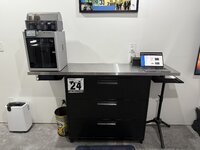
Another awesome idea. I never thought to simplify it like that.You can also trace something on a piece of paper and draw a line of a set length. Scan that in to your PC and use that to start your design from. We use that method frequently to program funky shaped parts to be cut out on the laser. Generally the scans are 1:1.