KnurledNut
Well-known member
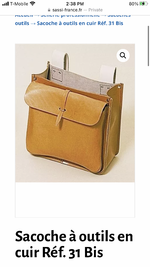
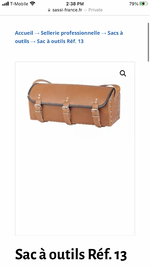
Not to derail the Facom thread, but Klein does great leather goods:



I like that a lot.Not to derail the Facom thread, but Klein does great leather goods:
It’s a style of tool bag that likely goes back at least a century or more.Really, what practical modern day use do these bags have?
The inconvenience of those buckles, for starters.
Also, dimensions for anyone's interest - BV.100 is 35x10x10cm, and the 703232 is 40.5x14.5x12.5cm.
 www.sassi-france.fr
For future reference, approximately measured from image via proportional scaling:Anyone with the combination pliers able to help me out with some jaw measurements please?
185mm (187A.18G or 187A.18CPE), jaw length (spec) 36mm.
205mm (187A.20G or 187A.20CPE), jaw length (spec) 42mm.
I'm interested in the length of the frontal gripping area and the cutting blade.
For comparison, the Knipex 02 02 180 I've received has a 32mm jaw, of which the gripping area is 7mm (too short in my opinion) and the cutter 16mm. I'll be returning it for a differently sized/proportioned combination plier, or a linesman.
I make the length of the flat gripping area 11mm, and the cutting edge 13mm.Anyone with the combination pliers able to help me out with some jaw measurements please?
185mm (187A.18G or 187A.18CPE), jaw length (spec) 36mm.
205mm (187A.20G or 187A.20CPE), jaw length (spec) 42mm.
I'm interested in the length of the frontal gripping area and the cutting blade.
For comparison, the Knipex 02 02 180 I've received has a 32mm jaw, of which the gripping area is 7mm (too short in my opinion) and the cutter 16mm. I'll be returning it for a differently sized/proportioned combination plier, or a linesman.


Those proportions seem well balanced.I make the length of the flat gripping area 11mm, and the cutting edge 13mm.
And even on the 200, it's only 9mm.The length of the gripping area on the Knipex pliers is short (yes 7mm) but only on the “high leverage” 02 pattern.
I can also see the 03 has a thinner head (narrower jaw), at least in the 200 length. The thickness of the 02 200 is 13mm which I feel is about right. Why do you consider 03 more of an equivalent, given the Facom is high leverage?The “standard” 03 pattern (which is more of an equivalent to the Facom) has different proportions, and a gripping area of 10mm.
This isn't to my liking, as I have no need for such a long cutter in a multi purpose plier especially a shorter one. Both the 180 and 200 have 16mm-ish blades within 32mm and 37mm jaw lengths respectively (Facom are 36mm and 42mm). But I appreciate they are just balancing various trade-offs with their design.On the “high leverage” pliers the pivot is closer to the jaw tip, so for a comparable length tool, something has to give. Knipex decided it was the gripping surface.
My needs also have a bit more outdoor oriented aspect. I bought them and returned them immediately - I hadn't realised how small and narrow (10mm) the head was, and that the flat gripping area was so short. Now I'm weighing up what to get instead.The plated pliers you see below live in my “property maintenance” box, and I have to say I find them perfect for the job. There’s enough grip to pull out a small nail or cable clip, the rounded gripping area does all I ask, and the cutters will handle any wire, or domestic electrical cable.
I shortlisted the 187A.20G but thought it looked a bit oddly long (42mm jaw) and thin (11.5mm thick). I'm not sure what to think of their modern comfort handles (even after removing the spring), and I'd prefer not to have the chrome that comes with them. It also comes in a Stanley flavour 0-89-868. Looking at Gedore 8250-200 next.I have to say though, that although the Knipex are good quality and value, I’m coming round to the view that I slightly prefer the Facom.
Yes, they do.Those proportions seem well balanced.
And even on the 200, it's only 9mm.
I can also see the 03 has a thinner head (narrower jaw), at least in the 200 length. The thickness of the 02 200 is 13mm which I feel is about right. Why do you consider 03 more of an equivalent, given the Facom is high leverage?
This isn't to my liking, as I have no need for such a long cutter in a multi purpose plier especially a shorter one. Both the 180 and 200 have 16mm-ish blades within 32mm and 37mm jaw lengths respectively (Facom are 36mm and 42mm). But I appreciate they are just balancing various trade-offs with their design.
My needs also have a bit more outdoor oriented aspect. I bought them and returned them immediately - I hadn't realised how small and narrow (10mm) the head was, and that the flat gripping area was so short. Now I'm weighing up what to get instead.
I shortlisted the 187A.20G but thought it looked a bit oddly long (42mm jaw) and thin (11.5mm thick). I'm not sure what to think of their modern comfort handles (even after removing the spring), and I'd prefer not to have the chrome that comes with them. It also comes in a Stanley flavour 0-89-868. Looking at Gedore 8250-200 next.


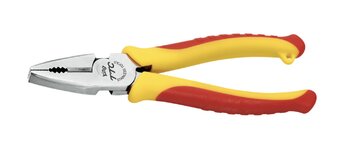
Interesting. They do use the words "High Mechanical advantage due to off-set rivet and cutting edge geometry reducing effort", but by your numbers that's more marketing speak. Relative to everything else, it's not that important to me.With regard to the Knipex equivalent of the Facom, the Facom look standardish to me, rather than high leverage, and Facom don’t market them as anything other than that. In fact, they only offer one style!
Comparing 180mm pliers, the regular Knipex measure 49mm from pivot to tip. The “high leverage” just 38mm, and the Facom between the two at 44mm. So, they in practice they are a compromise design.
I did have a look at them and ordered a PW-103DG (190mm) high-leverage linesman-esque. Good head, but I think I'll be sending it back too as I'm not keen on the comfort grips. They're very rounded so don't spread the pressure near as well as the much flatter Knipex, and the flick at the end (presumably to aid pulling) leaves 2cm of unusable grip, putting my hand too far forward on the arch. A longer version would solve the latter, but dipped handles won't improve on the former, and I do want comfort grips on a cutting plier.Tsunoda - have to be considered. They offer combination pliers in their King TTC range, although the linemans style seem to be more common.
The 02 is a bit harder at 63 HRC vs. 60 - according to the calculator, that's 16%.I find the Knipex 03-180 to be too soft, both jaws and cutter. I damaged mine rather easily.
Yep. Have both. Definitely prefer the harder. I researched all those specs after being disappointed. Probably should have done so beforehand.The 02 is a bit harder at 63 HRC vs. 60 - according to the calculator, that's 16%.
Since that, there have been a few more. And I'm pretty much done with my tool refresh project for now.It was suggested to me by @Squankum in the arrivals thread that I cross post here.


To answer my own question, possibly something to do with celebrating 100 years - https://web.archive.org/web/2019090...nce-coupante-192t-18upe-une-innovation-facom/And just generally how something like this came to market. Launched in 2018
Compact size, (or at least length).Just wondering if anyone here bought the 192T.18UPE. Now discontinued.
And just generally how something like this came to market. Launched in 2018, a good few years after Knipex TwinForce came out - which isn't weird, doesn't need an elastic band to keep it shut, and has a larger jaw opening. I can't even figure out the intention of the lever physics - the ends of the handles are jointed, so the hand force is applied at only half way of the length of the handles. Or maybe it has some characteristic I can't see that makes it really good at some application.
But I'm all for out of the box things like this engineers come up with, getting through corporate and actually produced.
I don’t know what the original role was for this tool. I suspect there was a specific use in mind.Just wondering if anyone here bought the 192T.18UPE. Now discontinued.
And just generally how something like this came to market. Launched in 2018, a good few years after Knipex TwinForce came out - which isn't weird, doesn't need an elastic band to keep it shut, and has a larger jaw opening. I can't even figure out the intention of the lever physics - the ends of the handles are jointed, so the hand force is applied at only half way of the length of the handles. Or maybe it has some characteristic I can't see that makes it really good at some application.
But I'm all for out of the box things like this engineers come up with, getting through corporate and actually produced.
I don’t know what the original role was for this tool. I suspect there was a specific use in mind.
But this is just so typical of Facom, and one of the reasons I like their tools. Original ideas, nicely executed - as you put it “out of the box” - and generally available at a reasonable price.
Sometimes Facom are ahead of the game. I’ve got several tools in thst category. Sometimes things don’t quite work out, and new designs fade away, as seems to be the case here
All too often though, I think they are too far ahead, and innovative things are discontinued before most prospective buyers are even aware of their existence.
So long as they keep trying I’m happy!

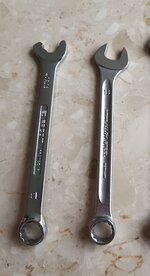
Pretty sure I remember someone posting that type by Snap-on, in the new tool arrivals thread a few weeks back.anyone else make an open wrench with a similar broken jaw?
Perhaps it was something like - make a high leverage cutter, go a bit wild on the innovation theme for the 100th anniversary, and don't infringe upon Knipex's patents.I suspect there was a specific use in mind.
thanks, I just googled, they call it "speed wrench"Pretty sure I remember someone posting that type by Snap-on, in the new tool arrivals thread a few weeks back.
Yes, that’s exactly what I mean!does 40R fits your description of "FACOM ways"?
anyone else make an open wrench with a similar broken jaw?
Yes, Snap On make, or made, these too.Pretty sure I remember someone posting that type by Snap-on, in the new tool arrivals thread a few weeks back.
That’s called an “Open End Ratcheting Wrench”, although there may be other names.does 40R fits your description of "FACOM ways"?
anyone else make an open wrench with a similar broken jaw?
 .
.
That’s called an “Open End Ratcheting Wrench”, although there may be other names.
I think it was claimed a while ago that the double open end ratcheting wrenches Armstrong used to make used the same open ratcheting geometry. (Some sort of Facom/Armstrong sharing agreement).
Open End ratcheting designs probably go back at least a 100 years though.
Every once in a while someone patents a new slight tweak to the geometry.
Snap-On has made a number of different versions over the years, although most seem to remain in regular production for only a few years.
Supposedly one of the Snap-On designs was made as a torque wrench head, and used for quickly tightening something to correct torque on one of the Detroit Auto Production lines.
Those were probably specially ordered by the manufacturer.
The Armstrong version are sometimes available on eBay.
The Snap-On version have been made in numerous types, some with box ends, some with open ends, and maybe flare wrench ends as well.
These also turn up on eBay, but I don’t know the item numbers.
Gearwrench makes a version with an extra mechanical piece in the ratcheting open end jaw.
Personally I would avoid this, but I think the wrenches have been available for a while so maybe they work
Facom probably kept their version available and in production as long as any other manufacturer, except the SAE sizes.
I have no clue if the King Tony version would work better better than the single piece versions or not.thanks for sharing
that open ratcheting geometry is uncommon here, and I am not a snap-on fans (because of the shiny chrome), hence know nothing about snap-on lineup
the closest one is made by King Tony with a movable piece in the jaw
For snipping light duty wire, it is probably nice if your finders are close to the pivot. You can't do that with regular pliers. I think these are probably very comfy to use.Just wondering if anyone here bought the 192T.18UPE. Now discontinued.
And just generally how something like this came to market. Launched in 2018, a good few years after Knipex TwinForce came out - which isn't weird, doesn't need an elastic band to keep it shut, and has a larger jaw opening. I can't even figure out the intention of the lever physics - the ends of the handles are jointed, so the hand force is applied at only half way of the length of the handles. Or maybe it has some characteristic I can't see that makes it really good at some application.
But I'm all for out of the box things like this engineers come up with, getting through corporate and actually produced.
The only redeeming feature I can imagine is that there might be an ergonomic benefit for repetitive use, as your strongest fingers operate directly on the movement range, without needing to shift your hand back to the end of the handles like on a normal plier.
This video showing the hand action seems to support thisFor snipping light duty wire, it is probably nice if your finders are close to the pivot. You can't do that with regular pliers. I think these are probably very comfy to use.
I can see how it could be nifty to snip things with it. But I must say it looks extremely odd and I can believe they sold poorly.This video showing the hand action seems to support this
"Scars, natural marks, and variations in color are inherent to leather and underline its beauty. They attest to the purity of the hide."
Although I'm a bit surprised to see a couple of misspellings in there.
To answer my own question, possibly something to do with celebrating 100 years - https://web.archive.org/web/2019090...nce-coupante-192t-18upe-une-innovation-facom/
And it's good for working on fighter jets!
does 40R fits your description of "FACOM ways"?
anyone else make an open wrench with a similar broken jaw?
I can't even figure out the intention of the lever physics - the ends of the handles are jointed, so the hand force is applied at only half way of the length of the handles. Or maybe it has some characteristic I can't see that makes it really good at some application.
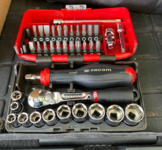
I should add that I don’t think you can go far wrong with these sets. My own “Nano” set is probably my most used 1/4”drive.
The quality, even Taiwan made, is very high. Very close to Snap On (not quite as good I admit) but might even score slightly higher on consistency. (I’ve never received a “Friday afternoon” Facom)!
The content of the sets, with the included 1/4” bits, is exactly what you need on modern vehicles, and the fitted plastic boxes are just so well thought out that nothing else comes close.
Facom offer those sets with several different ratchets.
The round head ratchet’s are made in Italy.
As are the “dustproof” ratchet’s.
Not sure about the Rotator ratchets. There was recently a slight design change so I’m suspecting Taiwan now.
The original “palm control” ratchet’s are Italian.
The ratchet you have
And it’s quick release cousin
are both made in Taiwan.
Your set is therefore predominantly made in Taiwan, except for the screwdriver style spinner handle, which will be made in France, as all Facom screwdrivers continue to be.
I think the general consensus around here is that Facom are one of the few companies who managed to outsource to Taiwan without any major deterioration in quality.
There are some tools that I notice are not quite as good, and some that are simply slightly different, but Facom took the trouble to have their own patterns of tool made in Taiwan, and to the same standards, rather than taking the lazy option of simply rebadging generic products.
Screwdrivers, pliers and hex keys, together with some more specialised tools, continue to be made in France.
Although generally, I do slightly prefer the French made tools, with regard to 1/4“ drive ratchets I’d opt for the style I preferred, irrespective of country of origin. It’s seldom I say that.
The “nano” sets are available with all the ratchet’s shown, and the boxes remain the best out there!

I think it has to do with the anatomy of human palm
our grip is the stronger between the base of the palm and fingers nearer to the thumb, weakest at the pinky
on a conventional shape pliers, those stronger gripping force is wasted by gripping nearer to the fulcrum of the pliers
I happened to have a spring grip on my desk
it felt lighter when you reverse it
Why do some of these Facom ratchet sets have holes in the boxes? Is it just for design's sake?
It's so you can inspect to make sure no sockets are missing. If it weren't for those holes you'd have to... uh, open the lid, I guess. Kind of a FOD issue (foreigh object, debris), I guess, so expensive/critical machinery isn't brought down by the socket you left behind.