Y'all overthinking this, it's a EU company that mostly sell to Europeans. Like I mentioned most companies will Tailor products to the market. It's a common practice.
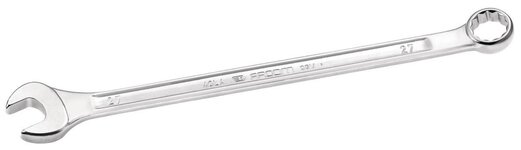
Sure but it's wrenches. Just a little bummed they don't even offer a whole range - set or not. Especially sonce all the sizes are clearly being manufactured in the 441XL version.
I agree with you. I like the simplicity of Japanese cars, especially stuff in the engine bay. I understand why the Europeans are always hunting for a ‘better’ way to do things, but you gave a great example of something I just don’t think needs improving, or if it does, not on my own vehicles thanks very much. (Though I thought the point of those spring-loaded caps with a hard travel limit was mainly to prevent the cap being too tight to easily remove after a few hundred heat cycles.)
I’d love to see up close and personal how American vehicles are designed. I have some vague ideas, but not about the details like this, because even on forums like this one, no-one talks about them. Your comments are fun because you’re a very close observer of mechanical things.
Thanks, that is very flattering to me. I have very limited experience with American vehicles here in Europe. Even our John Deere tractors historically come from Germany, and US cars werenever big here.
There is one clear difference even when it comes to companies like "European" Ford where you see American influence. Japanese and American (and Korean) cars will generally always use wheel studs and lug nuts. European cars almost always use lug bolts.
I'm a bit pessimistic regarding European cars. For all the talk about German engineering, the cars are designed give the owner a percieved high quality feel while everything beyond that is made to be absolutely as cheap as possible, squeezed out to the last cent. How much can a company realistically save by using a lug bolt instead of a nut? Practically nothing, it just makes it more annoying when fitting wheels but they don't give any car regarding that, because European cars aren't supposed to be serviced by the owner anyway.
My old Relault Clio 3 - removing half the bottom to gain access to the drain plug and sticking my hand up in the guts of the engine somewhere at the side to reach the oil filter, positioned so it drips hot oil down to your elbow if you remove it without the factory tool. Of course the drain plug uses some proprietary rubber-oring-metal hybrid gasket that gets destroyed upon every change and the screw has some tiny inside-drive that wears out if you reuse it. On the Yaris - jack the car up a bit at the front right wheel, the drain plug sticks out to the side so it does not drip while you remove it. Oil filter on the bottom right next to it, pointing upwards so nothing drips. 15-20 min job even without a lift or any special tools. The oil pan is alloy not sheet steel, and has a surprisingly long thread for the drain bolt (guess that can help with preventing it from stripping, and sealing better?). The gasket was (most surprisingly to me) a very regular copper washer.
Probably very unfair to even compare my '97 Toyota Land Cruiser Diesel here. That was just the best time for quality and reliability with relatively modern comforts. Tall enough that you don't even need to raise it up anyway. It does use a lot of oil, but the replacement is super simple. Everything made to be super reliable. Alternator and AC have separate belts, both are powered by 2 V belts so if one snaps the other still runs. It has two batteries "just to be sure". I can disconnect both batteries and could still start it with a pull rope in a pinch.
I do own a Shovelhead but I haven't wrenches on it much yet. Project waiting for its time... I think people judge Harleys too much. They have some well known issues but many parts are clearly made to very high standards. Hard to fault the paint or chrome quality for sure. I think the US Imperial thread standard is just a very bad thing for Harley - the standard pitch is overall coarser than regular metric pitch. That probably makes them unscrew easier from vibrations. The finer threads used in the engine are usually fine, the engine does not rattle itself apart, but the rest of the fasteners that have near wood-screw-like threads are just a very bad design choice. But using finer threads everywhere would probably be weird at the time. To be fair mine is from the late AMF days, so it is about "as bad as they come", the bikes that started all those Harley stereotypes. I do like the power delivery, and I don't mind the handling at all.
I do wish to have one of the classic quality made American cars, regardless of cost here, but most are just too big to really be usable here.




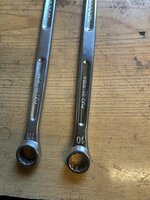
 ).
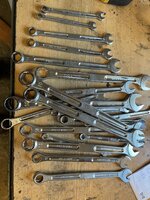
).