To avoid these ads, REGISTER NOW!

The Lugzsonian - A Virtual Tour

OP
P

Private Lugnutz

Well-known member
Joined
Mar 30, 2012
Messages
30,604
Location
The Authentic Jersey Shore
Apple was extensively used for the handles of those vintage saws.
This would've been an even niftier synchronicity if the D-95 I used didn't have a Disstonite handle! :)

We did add a recent find to the Owl Tree. The Y-shaped remains of this tree that has given me many years of crisps, tarts, and pies will be turned into a folk arty tribute to our mascot in no time.

Owl Tree.jpg
 
To avoid these ads, REGISTER NOW!

Smokeshow69

Well-known member
Joined
Dec 7, 2012
Messages
8,383
Location
Pacific Northwest
This would've been an even niftier synchronicity if the D-95 I used didn't have a Disstonite handle! :)

We did add a recent find to the Owl Tree. The Y-shaped remains of this tree that has given me many years of crisps, tarts, and pies will be turned into a folk arty tribute to our mascot in no time.

Owl Tree.jpg
Seems like a “wise” use of that tree to carry on that legacy👍
 
OP
P

Private Lugnutz

Well-known member
Joined
Mar 30, 2012
Messages
30,604
Location
The Authentic Jersey Shore
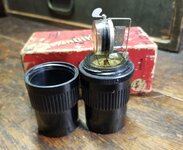
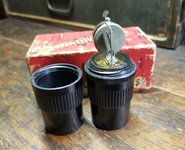
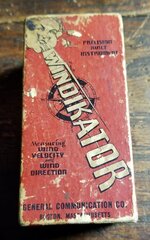
The Acquisitions Dept, who has an eye for the quirky, came home from a trip to the flea this morning with a vintage Windikator. (Technically, it's an anemometer, the Curator feels compelled to hastily add, but if there is a better neologism blending the function and marketing of an instrument that measures wind velocity and direction, we can't think of one!) While we are primarily dedicated to antique and vintage tools here at the Lugzsonian, long-time followers know we have a penchant for mid-century vintage navigating and survival stuff, such as our 1944 US Navy Liferaft Emergency Fishing Kit No. 10, our 1942 Opisometer, our prewar Sunnto field compass, and our even older Marble's Matchsafe.

The Windikator, patented (2309581) in 1943, will fit in just fine in the same wing!

20250711_125436.jpg20250711_125544.jpg20250711_125708.jpg
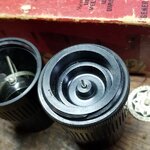
20250711_125719.jpg20250711_125730.jpg20250711_125742.jpg20250711_125800.jpg20250711_125841.jpg
 
Last edited:
OP
P

Private Lugnutz

Well-known member
Joined
Mar 30, 2012
Messages
30,604
Location
The Authentic Jersey Shore
You may have noticed that ours bears a PAT. PEND. marking on the face of the velocity dial. The patent was applied for in 1939, granted in 1945, and there is one currently for sale on the Big Fleabay in the Sky with the patent number marked on it instead, so we're pretty sure ours was produced sometime between 1939 and 1945. We have seen a couple others in our research, almost always missing the compass dial, and none with the box.

If you're wondering how it works, that long rectangular vane in the back hinges with pressure on it, turning the needle on the velocity dial. The smaller vane on the top spins the entire instrument, which sits on top of the compass dial disc, which free floats on a point.

The Curator found ads between 1939, such as this one...

Windikator Pop Sci 1939.jpg

...through 1950. It was especially popular in magazines such as Flying and Motorboating, like this one.
 
Last edited:

Lou's Garage

Well-known member
Joined
Feb 12, 2008
Messages
581
Location
Anderson, SC
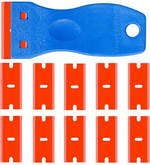
The Acquisitions Dept came home with a safety blade type scraper this morning, enthused by its folding design, and thinking it worthy of the predilection documented in these posts...

The Curator is not so sure.

We know enough about the history of the automotive windshield to know it's been laminated with some kind of plastic, in some kind of process, since, oh, say, 1904, improved for many decades, and we know that lately car manufacturers and aftermarket enterprises are doing all kinds of things with hydroponic, hydrophilic, and UV-resistant coatings and polyethylene terephthalate (PET) film, but we have no idea what the WARNING means, frankly. And we're wondering how old this tool is.
Considering the warning message, that tool would be from the 80's. In the middle 80's auto manufacturers (most notably Cadillac) experimented with an interior (of the car) liner of plastic in an effort to reduce laceration injuries. A razor blade scraper such as yours would damage that passenger facing liner if you were to scrape off an old inspection or registration sticker with one. I was a NY vehicle inspection station at the time and we were advised to purchase a special plastic scraper specifically for those windshields. I still have both types: I use the folding razor blade scraper regularly and I use the plastic version for jobs where I don't want to scratch anything. I attached a photo of a plastic scraper for reference:

1752334585534.png

Lou Manglass
 

four.cycle

Well-known member
Joined
Oct 19, 2015
Messages
28,953
Location
Tacoma, Washington
;)

I figured that would go over about as well as Dennis Miller making the joke about Madame Butterfly during an NFL football game when they made the mistake of hiring him as their "color man".
But yes, the longbowmen. Of course. The box says it's perfect for "archers"! (y)

I shot that in to datamp.org - wondering if they'll put it up. I mean... it is a tool, by definition, right? :dunno:
 
OP
P

Private Lugnutz

Well-known member
Joined
Mar 30, 2012
Messages
30,604
Location
The Authentic Jersey Shore
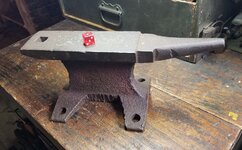
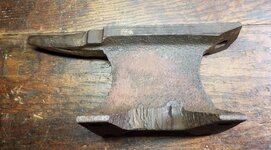
We're lovin' everything about this homemade rail anvil found at the flea this morning, from the hardie hole to the step or table to the horn, which has a very convincing, appealing shape, to the size (15 lbs!), which is perfect for our little tinkering shop. Whoever shaped this up did a fine job and the face has a nice ring to it.

20250803_140728.jpg
 

Attachments

  • 20250803_140710.jpg
    20250803_140710.jpg
    866.1 KB · Views: 11
  • 20250803_140655.jpg
    20250803_140655.jpg
    659.9 KB · Views: 17

Smokeshow69

Well-known member
Joined
Dec 7, 2012
Messages
8,383
Location
Pacific Northwest
I really like the look of that anvil as well! If I had found it in the wild I would have brought it home for sure! Even though it’s small it is super useful for smaller jobs and doesn’t take up a ton of real estate or money out of your pocket either
 
  • Like
Reactions: 555
To avoid these ads, REGISTER NOW!

LesserSon

Well-known member
Joined
Feb 7, 2016
Messages
5,075
Location
PA USA
I am going to post a chart below. But just to re-explain what I did here, first...

- I searched ITCL (again, @Mark Stansbury 's massive hand tools catalog library on Internet Archive) on the terms "Pyralin", "Tenite", "Cellulose Acetate Butyrate", and then just "Cellulose", "Acetate", and "Butyrate" individually, because "Cellulose Acetate Butyrate" got very few hits. (Just as a side-note, they are all celluloids.) Each search produced a mess of catalogs.

- In each case, I made a list of the names of the mfgrs and the dates of the catalogs in which the words appeared. It could appear once or on multiple pages. I did not record that.

- I started to keep track of the types of tools, but after a while it became tedious and also unnecessary. Most of the instances were drivers, soft-face hammer tips, or hacksaw handles.

- I populated an Excel file with the data (I "smoodged" the dates + or - 1 year if they were an even year for fit) and sorted it A-Z.

- Lastly, I assigned colors to each plastic because it was easier to 'see' the data than reading it. The colors have nothing to do with the color of the plastic. They all came in several colors, mainly amber, red, green, and black, with additives, but also translucent. Do not misconstrue the pale yellow as amber, etc. I mnemonically picked Teal for Tenite, Pink for Pyralin, and Chartreuse for any combination of C/A/B.

Stinkdriver Study Roadmap.jpg

New version of the chart, with Plomb included...

Stinkdriver Study Roadmap.jpg
Lugz, I happened to be scrolling around this morning and came across three interesting pdfs on the Eastman website, documenting interaction studies of some of our favorite plastics - Tenite CA, Tenite CAB, Tenite CAP.
What caught my attention was MOTHBALLS, because I have read the suggestion in old Popular Mechanics-type books or magazines that placing mothballs in a toolbox can protect against rust. Mothballs can be made with camphor, naphthaline, or dichlorobenzene, which seem pretty hard on Tenite. Maybe when we find similar-age toolhandles in different states of degradation, in addition to possible brand-specific or historically-changing plasticizer formulas, part of the difference may be due to intentional or unintentional storage with such rust-inhibiting, but plastic-degrading compounds by previous owners.
Anyway, don’t put your plastic-handled tools in any enclosed space that contains mothballs.
 

Outlawmws

Well-known member
Joined
Aug 9, 2011
Messages
39,266
Location
The Badlands
LS, did they have anything bad to say about camphor? I've heard that suggested to prevent rust as well; even bought some but never used it.
 

LesserSon

Well-known member
Joined
Feb 7, 2016
Messages
5,075
Location
PA USA
LS, did they have anything bad to say about camphor? I've heard that suggested to prevent rust as well; even bought some but never used it.
According to Wikipedia, camphor is a terpenoid and a cyclic ketone. These are both broad categories of compounds, but notice that some terpenoids give cloves their distinctive flavor, and essential oil of clove dissolved cellulose acetate, while wintergreen attacked the surface. Most of the ketones that are listed dissolved the Tenites.
Also, camphor is the plasticizer for nitrocellulose to make celluloid, the first commercial plastic. I can imagine that a little might slow the deteriation of celluoid, but also soften/weaken the surface, since it’s not under high pressure.
And really, until a tool (or knife) handle does show distinctive damage (crazing, melting, clouding), I doubt I’d know which it is, so no camphor for my tools.
 

four.cycle

Well-known member
Joined
Oct 19, 2015
Messages
28,953
Location
Tacoma, Washington
Maybe when we find similar-age toolhandles in different states of degradation, in addition to possible brand-specific or historically-changing plasticizer formulas, part of the difference may be due to intentional or unintentional storage with such rust-inhibiting, but plastic-degrading compounds by previous owners.
This question needs to be addressed to a broader audience, LS.

I am beyond intrigued.

* If I am understanding you correctly, you are positing there may be a possibility that the degradation process of some of these plastic compounds (used in the manufacture of tool handles) may be influenced by their environment? (e.g., mothballs, etc.) - correct?
 
  • Like
Reactions: 555

Beerhippie

Well-known member
Joined
Oct 13, 2023
Messages
9,842
Location
Far NE Oregon
This question needs to be addressed to a broader audience, LS.

I am beyond intrigued.

* If I am understanding you correctly, you are positing there may be a possibility that the degradation process of some of these plastic compounds (used in the manufacture of tool handles) may be influenced by their environment? (e.g., mothballs, etc.) - correct?
Don't forget the entire refinery production of oils, penetrants, solvents, sealants, additives, etc, that are often found in or near old toolboxes!
 

LesserSon

Well-known member
Joined
Feb 7, 2016
Messages
5,075
Location
PA USA
This question needs to be addressed to a broader audience, LS.

I am beyond intrigued.

* If I am understanding you correctly, you are positing there may be a possibility that the degradation process of some of these plastic compounds (used in the manufacture of tool handles) may be influenced by their environment? (e.g., mothballs, etc.) - correct?
I chose to post on Lugz’s thread because the topic is most frequently and thoroughly discussed here, and his manufacturer chart is a labor that clearly demonstrates his interest.
*In a word - yes.
But I have no hope the historical data required to distinguish the influences of theorized fluctuation of manufacturing formulas from the theorized variance of storage conditions.
Further, a proper experiment would require remanufacture of obsolete plastics - old examples are already old, so already down the road to decay. Incomplete as Eastman’s data may be in connection to tool handle formulas and chemical exposures, I think it’s all we may have available.
I think it’s worth noting that most historical plastics are a structural substance infused with an (often volatile) elasticizing substance (plasticizer). The degradation of their integrity through leaching, offgassing, or exudation of the plasticizer is inexorable. But we may reasonably infer that environmental conditions (especially exposure to reactive substances) can and do accelerate overall degradation, and avoiding those conditions should be a priority for collectors.
 
  • Like
Reactions: 555

Outlawmws

Well-known member
Joined
Aug 9, 2011
Messages
39,266
Location
The Badlands
Don't forget the entire refinery production of oils, penetrants, solvents, sealants, additives, etc, that are often found in or near old toolboxes!

💯

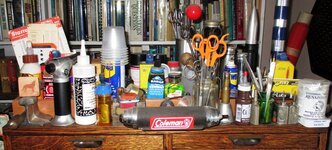
It's a bit scary to think how many chemicals I have in my "collection" after a lifetime of "I need some of this, for that"

Heck, just on top of my inside workbench's wood tool box is a 3X30 wood tray full of such, (mostly smaller containers) as well as most of the 2" in front of that...


Chemicals inside.jpg
 

RTM

Well-known member
Joined
May 13, 2019
Messages
13,190
Location
SF Bay Area
there would be no possible way to make any determination using any sort of "scientific method".
I doubt any of us would donate perfectly good tools to this study.

The only backdoor confirmatory study that could be done is to look for wrappers from camphor blocks, or mothballs. If present, look for a blast radius around it. I try to take As Found pix of each drawer, but I did fail once, found a rotted driver, and quickly threw it away. But no sign of mothballs or camphor wrappers.

But a mess in the center tray, and a rusty circle around it. Vacu Grips hurt, they got pulled out also ☹️


IMG_20191026_165038-X2.jpg
 
Last edited:
  • Like
Reactions: 555

Pagan Wizard

Member
Joined
Nov 4, 2019
Messages
21
Location
Earth
The Lugzsonian is located “down the shore”, as the Bennies like to say, in a sleepy little town just north of Asbury Park, New Jersey, famous for the remains of its fin de siècle Carousel, Casino Arcade, and Steam Plant, for Bruce Springsteen, and if only in my mind, for the King Tool Company, which for a very short period of time in the 1920’s produced the Onli-1, one of the coolest little close-quarter ratchet wrench sets ever made.
That's not a workshop, it's a museum, and it looks AMAZING!!!!!!!!!!!
 
OP
P

Private Lugnutz

Well-known member
Joined
Mar 30, 2012
Messages
30,604
Location
The Authentic Jersey Shore
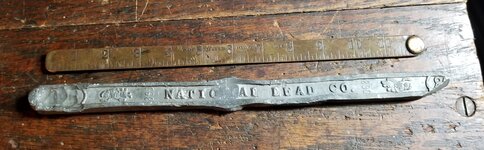
The Curator was surprised to learn that the company that made the #890 grade lead stick...

20250810_115548.jpg

...that the Acquisitions Dept brought home from the flea market this morning, with the "Dutchboy" logo...

20250810_115611.jpg

...used by plumbers, welders, tin knockers, and many others back in the day, now known as NL Industries, Inc. then known as the National Lead Company, was started in Philadelphia, believe it or not - four years before our country gained its Independence!

Here at the Lugzsonian we often refer to and collaborate with other deeply committed (and probably ought to be committed) hand tools research addicts Curators around the vintage hand tools websphere. In this case, about the only edit we would make to Jethro's excellent 'Wrenchwiki' blog write-up on the history of the National Lead Company, accompanying the Dutchboy brand antifriction (Babbitt) metal paperweight in his collection, would be a humorous, well-placed "(no pun intended)" in the first line.

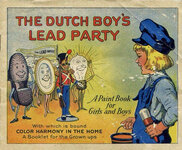
It's no secret why the National Lead Company reduced the name of the company to initials obscuring the element banned in quick succession from paint, gasoline, and many other harmful applications in the 1970's. Prior to that, though, lead was something worth celebrating for its all-pervasiveness. About the only pals missing from the front-and-centers at this party, for example...

dutchboyleadparty.jpg

...are pencils and bullets! :)

Don't worry, Dear Followers, we won't be licking or grinding it. Although we may use it as a paperweight to hold a book open from time to time.
 

Beerhippie

Well-known member
Joined
Oct 13, 2023
Messages
9,842
Location
Far NE Oregon
How long has it been since actual lead was used for pencils? Or do you mean the delicious lead-based paint we all loved to chew on?
 

Cruzan80

Well-known member
Joined
Jul 22, 2015
Messages
4,227
Location
Denver, CO
How long has it been since actual lead was used for pencils? Or do you mean the delicious lead-based paint we all loved to chew on?
Never. Graphite was originally called "black-lead", which had been shortened over time.


Beerhippie

Well-known member
Joined
Oct 13, 2023
Messages
9,842
Location
Far NE Oregon
OP
P

Private Lugnutz

Well-known member
Joined
Mar 30, 2012
Messages
30,604
Location
The Authentic Jersey Shore
Or do you mean the delicious lead-based paint we all loved to chew on?
Chewing on the erasers was just as bad! They were really out to get us. (This entire exchange has unfortunately made my memory recall the ignominious story of being rushed from Sacred Heart school to the emergency room to have two erasers removed from deep within my nasal cavities after sticking them there as a joke! :))

Lead 2.jpg
 
OP
P

Private Lugnutz

Well-known member
Joined
Mar 30, 2012
Messages
30,604
Location
The Authentic Jersey Shore
The Acquisitions Dept informs me he had some fun clawing through a Kennedy box (attached below) and history at the flea market this morning. It was being used by a draftsman of some kind, with most of the drawers chock full of pencils, led, styluses, protractors, etc, and all matter of drafting and other bric-a-brac. As with most machinists' type chest, there always seems to be other miscellaneous odds and ends and he came home with these smalls, which the Curator was happy to inspect, sort, catalogue, and admire.

20250817_120631.jpg
 

Attachments

  • 20250817_115602.jpg
    20250817_115602.jpg
    923.8 KB · Views: 16
To avoid these ads, REGISTER NOW!
Top Bottom