OP

You are using an out of date browser. It may not display this or other websites correctly.
You should upgrade or use an alternative browser.
You should upgrade or use an alternative browser.
The Lugzsonian - A Virtual Tour
- Thread starter Private Lugnutz
- Start date

Outlawmws
Well-known member
???

Looks like an acid trip to me...
Looks like an acid trip to me...
Last edited:
Beerhippie
Well-known member
Who knows? It was a long, long time ago.You're not thinking of Laughing Cow cheese, are you? That cow is wearing red disc earrings, each earring with the image of itself wearing red disc earrings, etc.
I can imagine the meeting where these images were dropped: "Hey, guys, we need to stop using recursive images in advertising. They're teaching children to think!"
Farmer J.
Well-known member
Referring back to post #1,384 with the medic's kit, and the specs of the Pomery Chest:

Managed to get some pics today of this chest in Gunwalloe Church which looks to me to be very similar, but the dimensions aren't the same.

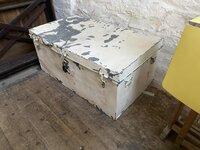

There is a tenuous connection with Naval battles and this particular Church, as my direct ancestors got married there shortly after the battle of Trafalgar in 1805. That was 8 generations ago..
Managed to get some pics today of this chest in Gunwalloe Church which looks to me to be very similar, but the dimensions aren't the same.
There is a tenuous connection with Naval battles and this particular Church, as my direct ancestors got married there shortly after the battle of Trafalgar in 1805. That was 8 generations ago..
OP
Private Lugnutz
Well-known member
Referring back to post #1,384 with the medic's kit,...
Thanks for following up, J. As someone who always goes with the better story in cases like this, I would squint and call it a Pomeroy, purloined from the US Navy.Managed to get some pics today of this chest in Gunwalloe Church which looks to me to be very similar, but the dimensions aren't the same.

Incredible.There is a tenuous connection with Naval battles and this particular Church, as my direct ancestors got married there shortly after the battle of Trafalgar in 1805. That was 8 generations ago.
OP
Private Lugnutz
Well-known member
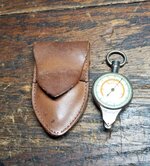
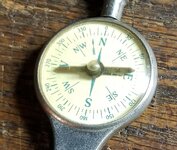
Some of you may remember the opisometer we found and dedicated a Curator's Corner to a few years ago. We added another one to the collection this morning. This one has a compass on the flip side. Made in Germany. Complete with leather sheath. Found at the flea market.
Attachments


OP
Private Lugnutz
Well-known member
^ I have never seen one with those graduations before, LS, and don't have any knowledge of or experience with the use of any kind of map measurer for nautical navigation beyond basic dividers, protractor and parallel rules on charts. Honestly, I was so excited about the little case and the compass on the back I didn't notice.
OP
Private Lugnutz
Well-known member
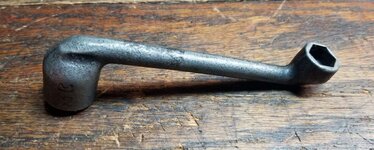
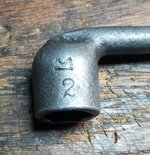
We've got antique, pre-Detachable Era, fixed (forged, welded, or pinned) socket wrenches stored everywhichwhere down here in the Lugzsonian and posted all over tarnation on GJ, including the Braunsdorf-Mueller, Vlchek, Gruber, Walden, and Mossberg threads, as well the often unidentified straight double-enders explored on @Leviton 's thread here, too. But there's really no good thread for this double end double offset, so we'll just post it here.
The "pipes" in the French term clés à pipes (which will typically translate as "pipe wrenches") refers to their hollow tubular shape, not the objects that this style of socket wrenches were used on. But when we immediately thought of this find from yesterday as a "pipe wrench," we had the smoking kind in mind!
Google Lens took some SWAGs at the crown-ish looking logo, none of which were credible.
We love the ornate numeral "2" stamp, implying a range of hex service openings. This one is 9/16" x 11/16".
The "pipes" in the French term clés à pipes (which will typically translate as "pipe wrenches") refers to their hollow tubular shape, not the objects that this style of socket wrenches were used on. But when we immediately thought of this find from yesterday as a "pipe wrench," we had the smoking kind in mind!
Google Lens took some SWAGs at the crown-ish looking logo, none of which were credible.
We love the ornate numeral "2" stamp, implying a range of hex service openings. This one is 9/16" x 11/16".
Attachments


Old Radar
Well-known member
It looks like your previous opisometer was a simple device that indicated inches and centimeters measured. Simply apply the result to the scale of whatever chart you're using to derive the actual distance.
Your new device has a fixed ratio that may have been designed for a specific chart.
I'm more familiar with jet navigation charts (JNC) where the scale is 1:2,000,000 and roughly 3" represents 60nm but...
Your new opisometer, with a direct scale of 1:0.87 (1" = 0.87nm) it seems you would need a lot of floor space to deal with a chart that detailed. If you increase the scale by a factor of 10 (1" = 8.7nm) I can imagine quickly reaching the limits of the device's accuracy tracing anything more than gentle curves.
I'm sure you would have mentioned any inscriptions giving clues to its use if it had any, so I'm as baffled as you an LS.
Your new device has a fixed ratio that may have been designed for a specific chart.
I'm more familiar with jet navigation charts (JNC) where the scale is 1:2,000,000 and roughly 3" represents 60nm but...
Your new opisometer, with a direct scale of 1:0.87 (1" = 0.87nm) it seems you would need a lot of floor space to deal with a chart that detailed. If you increase the scale by a factor of 10 (1" = 8.7nm) I can imagine quickly reaching the limits of the device's accuracy tracing anything more than gentle curves.
I'm sure you would have mentioned any inscriptions giving clues to its use if it had any, so I'm as baffled as you an LS.
OP
Private Lugnutz
Well-known member
^ Thanks for deriving the math! No other markings. I did find quite a few in a very cursory search online that were nearly identical, obviously made by the same company (not identified), except the inner scale read "Centimeters to Kilometers" instead of "Nautical Miles", one of which, linked here had a mechanical pencil niftily attached.
Outlawmws
Well-known member
The "pipes" in the French term clés à pipes (which will typically translate as "pipe wrenches") refers to their hollow tubular shape, not the objects that this style of socket wrenches were used on. But when we immediately thought of this find from yesterday as a "pipe wrench," we had the smoking kind in mind!
Google Lens took some SWAGs at the crown-ish looking logo, none of which were credible.
We love the ornate numeral "2" stamp, implying a range of hex service openings. This one is 9/16" x 11/16".
Do I gather from this you suspect it has French origins? If so I'd expect metric sizes. "2" would be 2 cm, or .787 inches, which maps to neither of the sizes mentioned. I'm guessing some arbitrary numbering for the set?
OP
Private Lugnutz
Well-known member
No. I was just joking around with "pipe" because of its appearance to a smoking pipe. (If you're not familiar with them, very modern French clés à pipes, made by the likes of FACOM etc, look EXACTLY like the socket wrenches made of tubular pressed steel by Vlchek and BMCo in the 1920's. I've prattled on about it up on the General thread. They are actually very popular with mechanics in Europe, despite being considered hopelessly obsolete here in the US.)Do I gather from this you suspect it has French origins?
As for the numbering, there is no number on the other socket. I was reading the "2" like a part number for the whole wrench (especially because it's next to the logo) in a range of similar wrenches, all with different service openings. If the No. 2 is 9/16" x 11/16", in other words, maybe the No. 1 was 5/16" x 7/16", and the No. 3 maybe 13/16" x 15/16"...etc. These are odd steps. And maybe I measured too crudely, but I think you probably know what I meant, now.
I'm not at all energized to research this. I just thought it was an interesting looking wrench.
Farmer J.
Well-known member
Never seen one like that before and the 'nautical miles' scale doesn't make any sense to me at all, but the compass is a neat feature. I have a couple of opisometers both of them are calibrated according to the various Ordinance Survey map scales. I will see if I can find them for comparison.Some of you may remember the opisometer we found and dedicated a Curator's Corner to a few years ago. We added another one to the collection this morning. This one has a compass on the flip side. Made in Germany. Complete with leather sheath. Found at the flea market.
OP
Private Lugnutz
Well-known member
You posted one upthread here, old mate. If you click on the link I just posted to the discussion of my first one and scroll down from there, you will find your reply and photos. You said it was your mum's.I will see if I can find them for comparison.
You did say you had another in the Rover that did not have such an occluded face plate.Beerhippie
Well-known member
That is a strange one. I've used opisometers quite a bit over the years and they were all calibrated in common USGS topo scales--1:25,000, for instance.^ I have never seen one with those graduations before, LS, and don't have any knowledge of or experience with the use of any kind of map measurer for nautical navigation beyond basic dividers, protractor and parallel rules on charts. Honestly, I was so excited about the little case and the compass on the back I didn't notice.
That one is just in inches, from the look of it--and the nautical miles is just a handy conversion from statute miles. You'd have to measure the distance on the map, then measure that off against the map scale--or do the math--then you could easily look up the equivalent in nauts. But, if you're already using a chart scaled in nauts, that would be superfluous.
Now, if had leagues, that would be handy.
Farmer J.
Well-known member
Ha ha, you beat me to it LugzYou posted one upthread here, old mate. If you click on the link I just posted to the discussion of my first one and scroll down from there, you will find your reply and photos. You said it was your mum's.
I had forgotten that I had posted Mum's old one. My other one, which I bought new, should be somewhere in the cubby box of one of 3 Land Rovers but was recently used by one of my Grandchildren.... I haven't actually used it for years now as I'm familiar with the routes to everywhere I go to within 300 miles of here and how far it is!
OP
Private Lugnutz
Well-known member
For sure. More of a cherished toy than an instrument. Although, they still have some practical utility for hiking.I haven't actually used it for years now
four.cycle
Well-known member
For your Seven-League Boots?Now, if had leagues, that would be handy.
Yes, the outer ring is direct measure of inches up to 39”.That one is just in inches, from the look of it--and the nautical miles is just a handy conversion from statute miles.
The ratio between the inner and outer ring is about 39:34 or 115%, which matches miles : nautical miles.
Clearly, the idea is to facilitate expressing distance in either unit. But I think there’s a learning curve to avoiding misapplying the conversion and overstating or understating distances.
BTW, Lugz, it’s quite attractve!
Provincial
Well-known member
Aviation often uses nautical miles/knots.
Beerhippie
Well-known member
And all nautical navigation uses nautical miles and knots (nautical miles per hour). Why? One nautical mile equals one second of longitude. One statute mile equals... one statute mile. Something about Roman troops, blah, blah, blah....Aviation often uses nautical miles/knots.
Farmer J.
Well-known member
I don't understand that.And all nautical navigation uses nautical miles and knots (nautical miles per hour). Why? One nautical mile equals one second of longitude.
Surely lines of Longitude converge at the Poles, so the distance between them becomes less as one travels North or South and become further away from the Equator? The Earth gets further around if one is nearer the equator.
Old Radar
Well-known member
^^^ Keen observation and absolutely correct. However, the distance between latitude lines remain a constant 60nm, and on nautical charts, that's where the scale is to measure distances.
Something like a Mercator projection, then? In the age of sail, when charts were developed, arctic navigation (where the distortion of distance is greatest) was almost unheard of.
OP
Private Lugnutz
Well-known member
Not to circumnavigate this conversation, but one of the remarkable contents of a little Veteran's Day care package hanging on the front doorknob...

... reminded us that we've been holding off on some potentially sad Lugzsonian news.
The reason it was so bittersweet to see the little owls (some of which are apparently wearing combat helmets!) tucked into the drawing (wethinks "Luca" must be a neighborhood kid...) that was included...

...is because we haven't seen our favorite guest, mascot, and spirit animal yet this year. He's running a month late now and we fear the worst, while still hoping for the best.
The lifespan of an Eastern screech owl is 8-10 years, and he's been with us from September to March/April for 4 years, but we have no idea how old he was back in 2021, or what might have befallen him since he last graced the hole in our old linden tree.
Not going to lie. It has been a source of mild depression. I'm getting grouchy telling people who ask that he's not back yet. I worry that his celebrity (the gawkers and professional photogs) may have urged him to seek a more reclusive hangout, but the thought of him regally napping and sunning himself somewhere more secluded is better than the thought of the breeze catching the feathers of his lifeless body desiccating under a tree in the woods down near the pond somewhere.
... reminded us that we've been holding off on some potentially sad Lugzsonian news.
The reason it was so bittersweet to see the little owls (some of which are apparently wearing combat helmets!
) tucked into the drawing (wethinks "Luca" must be a neighborhood kid...) that was included......is because we haven't seen our favorite guest, mascot, and spirit animal yet this year. He's running a month late now and we fear the worst, while still hoping for the best.
The lifespan of an Eastern screech owl is 8-10 years, and he's been with us from September to March/April for 4 years, but we have no idea how old he was back in 2021, or what might have befallen him since he last graced the hole in our old linden tree.
Not going to lie. It has been a source of mild depression. I'm getting grouchy telling people who ask that he's not back yet. I worry that his celebrity (the gawkers and professional photogs) may have urged him to seek a more reclusive hangout, but the thought of him regally napping and sunning himself somewhere more secluded is better than the thought of the breeze catching the feathers of his lifeless body desiccating under a tree in the woods down near the pond somewhere.
Beerhippie
Well-known member
Quite right. Once again, I got my Lat Lon confused. Lines of Latitude remain parallel and equidistant on a globe. So, one nautical mile = 1 second of Latitude.I don't understand that.
Surely lines of Longitude converge at the Poles, so the distance between them becomes less as one travels North or South and become further away from the Equator? The Earth gets further around if one is nearer the equator.
Now I'm going back to plotting my next journey in versts.
Smokeshow69
Well-known member
Sorry to hear about old screetch. Hopefully he will show up soon!
four.cycle
Well-known member
love the artwork.
Farmer J.
Well-known member
Well, the Veteran's Day gift package is a lovely idea i've not heard of this happening before.
A shame you're missing Screech Owl from his hideaway. He may well have decided to relocate if he thinks there was too much attention, but contemplating this on my morning walk today I reckon the important thing is that you provided somewhere for him to shelter and raised awareness of his needs whilst he has been there.
In my years as a farmer i've seen a lot of individual wildlife come and go, but the enduring thing is to provide or leave undisturbed the habitat for nature to thrive. After all, we are the most destructive species ever to inhabit this planet!
A shame you're missing Screech Owl from his hideaway. He may well have decided to relocate if he thinks there was too much attention, but contemplating this on my morning walk today I reckon the important thing is that you provided somewhere for him to shelter and raised awareness of his needs whilst he has been there.
In my years as a farmer i've seen a lot of individual wildlife come and go, but the enduring thing is to provide or leave undisturbed the habitat for nature to thrive. After all, we are the most destructive species ever to inhabit this planet!
OP
Private Lugnutz
Well-known member
^ Amen.
OP
Private Lugnutz
Well-known member
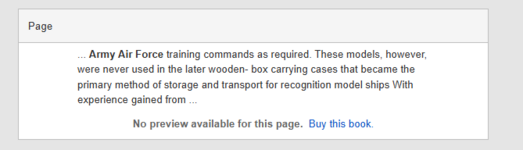
Some wonderful LEFT-BEHINDS this morning. Despite the personal connection here (as many of you know, Pop was a Merchant Mariner prewar, US Navy pilothouse ensign during the war, and Merchant Marines again after the war), $250 per was just too rich for my blood for these US Army Air Forces wooden carry cases filled with 1:1,200 scale "recognition" models of WWII era vessels.
Go ahead, say "Miniature Metal Models of Merchant Ships" ten times fast!
Go ahead, say "Miniature Metal Models of Merchant Ships" ten times fast!
Attachments


OP
Private Lugnutz
Well-known member
555
Well-known member
I probably would have forked over the $500. AAC/AAF stuff is my weakness.
OP
Private Lugnutz
Well-known member
Trust me, I was sorely tempted! I walked away, thought hard, went back, made an offer I knew would be lowball. The pricing was weird anyway. Who in their right mind would split them up when the most important marking is only on one case?!
OP
Private Lugnutz
Well-known member
The Curator had no idea what this odd brass "rule" was when the Acquisitions Dept dropped it off on the In Bench this morning, and neither did the Acquisitions Dept when he found it in a toolbox at the flea market.
Shown between a Hempl quoin and two DOE wrenches, one made by Williams for Kelly Press and the other for Chandler and Price, who made Linotype machines, as hints for our dear readers.

We were thinking some kind of obscure machinists' application until we thought about some of the markings harder and started doing some research.

Inches is self-explanatory. The "6 & 12 PT" refers not to hex and double-hex points, but typeset "Points". Agate is 5.5 points.
From the American Dictionary of Printing and Bookmaking (1894):
"Agate: A small size of printing-type, between pearl and nonpareil, half the size of small pica. A little over thirteen lines go to the inch. By the point system, it corresponds to five and a half points. Its chief use is for advertisements and market reports in daily papers, on which it is generally the smallest size used."

Turtle's refers to David Turtle. Hard to read, but under "NEW YORK," it says, "I.T.U. CARD" / "5419".
That's his International Typographers Union number.
Some trade mag notices from 1921...
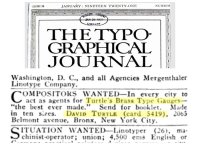
...and 1927.

^ That one helped us identify ours as a No. 3 (8 inches with 6 and 12 points and Agate).
Believe it or not, very thin, flexible, stainless steel versions of these Line Gauges (also known as "Printer's Rulers" and "Point Pals") are still made and used by typographers and others in modern print shops today. Usually with three units of measure on each side.
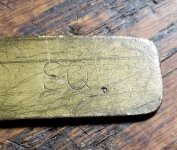
The flip side of ours is not used to measure height, width, length or anything else to do with lines and fonts and only bears the following stamp.
Shown between a Hempl quoin and two DOE wrenches, one made by Williams for Kelly Press and the other for Chandler and Price, who made Linotype machines, as hints for our dear readers.
We were thinking some kind of obscure machinists' application until we thought about some of the markings harder and started doing some research.
Inches is self-explanatory. The "6 & 12 PT" refers not to hex and double-hex points, but typeset "Points". Agate is 5.5 points.
From the American Dictionary of Printing and Bookmaking (1894):
"Agate: A small size of printing-type, between pearl and nonpareil, half the size of small pica. A little over thirteen lines go to the inch. By the point system, it corresponds to five and a half points. Its chief use is for advertisements and market reports in daily papers, on which it is generally the smallest size used."
Turtle's refers to David Turtle. Hard to read, but under "NEW YORK," it says, "I.T.U. CARD" / "5419".
That's his International Typographers Union number.
Some trade mag notices from 1921...
...and 1927.
^ That one helped us identify ours as a No. 3 (8 inches with 6 and 12 points and Agate).
Believe it or not, very thin, flexible, stainless steel versions of these Line Gauges (also known as "Printer's Rulers" and "Point Pals") are still made and used by typographers and others in modern print shops today. Usually with three units of measure on each side.
The flip side of ours is not used to measure height, width, length or anything else to do with lines and fonts and only bears the following stamp.
Last edited:
Mintgrun
Well-known member
I've got a No. 2 Turtle's type gauge that's 12 inches long with 6 & 12 PT. measurements and INCHES in sixteenths. The back side is blank. The digits and increments are about as plain as possible on this one; but overall, it is in pretty good shape.


My grandmother gave it to me after finding it at an antique store in Minnesota back in the seventies. I'm sure it was the Turtle name that inspired her to buy it.
My grandmother gave it to me after finding it at an antique store in Minnesota back in the seventies. I'm sure it was the Turtle name that inspired her to buy it.
OP
Private Lugnutz
Well-known member
Brother!I've got a No. 2 Turtle's type gauge

It is. I don't know if it's the sepia-toned light making less contrast or what, but that is blackface on the lowest surface, under the numbers and graduations, the same as on mine, right?The digits and increments are about as plain as possible on this one; but overall, it is in pretty good shape.
She had exquisite taste!My grandmother gave it to me after finding it at an antique store in Minnesota back in the seventies. I'm sure it was the Turtle name that inspired her to buy it.
Mintgrun
Well-known member
I don't know if it's the sepia-toned light making less contrast or what, but that is blackface on the lowest surface, under the numbers and graduations, the same as on mine, right?
No, this one is plain brass. It may have been black faced when new, but I don't see evidence of it now.
Gladys did have good taste. I had a lot of fun going to the antique stores with her and my mother as a kid. It's funny, sometimes the air in my shop reminds me of the way those stores smelled.
DetailSeeker
Well-known member
I think C. Weiland, Inc. is Chas. Weiland, Inc.--a New York wholesaler, rather than a manufacturer. He started out as a hardware agent/dealer in the 1890s, was incorporated as Chas. Weiland, Inc. by 1926, and had a lot of house brands by the 1930s. The company sometimes used one brand on another (Sid Axworthy/Parker Tool Co., below), so I feel kind of comfortable theorizing that he could absolutely have imported tools from Germany and used a "C. Weiland, Inc." brand on them. He used a lot of brands.
I was right about LesserDaughter2 having these. These seem to be marked C. Weiland. Inc Germany. So made for the English-speaking market. I’ve had no luck tracking down the manufacturer.

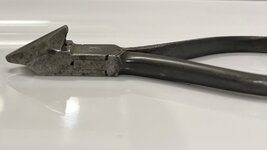

See, before my December vacation, the local tool library got a 10" stillson-style wrench made by the Parker Tool Co., New York. "Should be easy to look up," I thought.
View attachment 2470537
(I never learn, I swear to god.)
There were a few Parker Tool Co.s around (I ruled out ones in Texas and Minnesota), but there wasn't much on the one in New York. There were several other stillson-pattern Parker Tool Co. wrenches, and some "Sid Axworthy" branded axe-heads which were also stamped Parker Tool Co. Plus some calipers stamped Parker Tool Co. with no mention of a location (so maybe those were from elsewhere), and an eggbeater drill and pair of pliers marked both Parker Tool Co. and Germany.
"Sid Axworthy" is a little more distinctive than "Parker Tool Co." And when I started looking for that, I found two things: a racehorse named Sid Axworthy, from around 1900, and the Sid Axworthy brand of axes, hammers, and hatchets--both owned by Chas. Weiland.
Chas. Weiland is listed under Hardware Dealers, Agents, Etc in the October 25, 1894 issue of Hardware Age; a year later, he was buying full-page ads as an importer and wholesaler of hardware and cutlery. In 1905 the company was listed under Job Lots; in 1926 Chas. Weiland, Inc. was advertising for sales representatives. Three years later the address went from 149 Chambers St to 147-149 Chambers St, so he was doing well enough to expand.
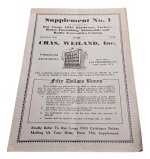
A 1933 catalog supplement says the company was established in 1882, but not when it was incorporated. By the 30s, Chas. Weiland, Inc. had started distributing tools under its own brands. Hardware Age had a list of jobber brands, and going through their issues from September 28, 1933 to 1961 I found the following Weiland brands. (Those without dates appeared from 1933 to 1961, after which I run out of issues.):
* ANDERSON, Emery Cloth, Plastering Trowels (until 1942, gone by 1943)
* BRONX PARK Grass Seed (until 1957, gone by 1960)
* CRESCENT, Auger Bits and Electric Soldering Irons (until 1947; as of 1948, it was just Auger Bits)
* JOHN DAY Files - also referred to as John T. Day
* LYON Electric Soldering Irons (appeared in 1948, up to 1953, gone by 1954)
* PALMER Paint and Varnish
* PARKER Stillson Pattern Wrenches (until 1947) - these are generally stamped "Parker Tool Co."
* PARKER Varnish Brushes (appeared in 1948, until 1960, gone by 1961)
* SAMPSON Axes, Stillson Pattern Wrenches and Trowels
* SID AXWORTHY Axes, Hammers and Hatchets
* WILKENSON Hack Saw Blades (until 1942, gone by 1943)
"Sid Axworthy" is a little more distinctive than "Parker Tool Co." And when I started looking for that, I found two things: a racehorse named Sid Axworthy, from around 1900, and the Sid Axworthy brand of axes, hammers, and hatchets--both owned by Chas. Weiland.
Chas. Weiland is listed under Hardware Dealers, Agents, Etc in the October 25, 1894 issue of Hardware Age; a year later, he was buying full-page ads as an importer and wholesaler of hardware and cutlery. In 1905 the company was listed under Job Lots; in 1926 Chas. Weiland, Inc. was advertising for sales representatives. Three years later the address went from 149 Chambers St to 147-149 Chambers St, so he was doing well enough to expand.
A 1933 catalog supplement says the company was established in 1882, but not when it was incorporated. By the 30s, Chas. Weiland, Inc. had started distributing tools under its own brands. Hardware Age had a list of jobber brands, and going through their issues from September 28, 1933 to 1961 I found the following Weiland brands. (Those without dates appeared from 1933 to 1961, after which I run out of issues.):
* ANDERSON, Emery Cloth, Plastering Trowels (until 1942, gone by 1943)
* BRONX PARK Grass Seed (until 1957, gone by 1960)
* CRESCENT, Auger Bits and Electric Soldering Irons (until 1947; as of 1948, it was just Auger Bits)
* JOHN DAY Files - also referred to as John T. Day
* LYON Electric Soldering Irons (appeared in 1948, up to 1953, gone by 1954)
* PALMER Paint and Varnish
* PARKER Stillson Pattern Wrenches (until 1947) - these are generally stamped "Parker Tool Co."
* PARKER Varnish Brushes (appeared in 1948, until 1960, gone by 1961)
* SAMPSON Axes, Stillson Pattern Wrenches and Trowels
* SID AXWORTHY Axes, Hammers and Hatchets
* WILKENSON Hack Saw Blades (until 1942, gone by 1943)