To avoid these ads, REGISTER NOW!

The Machine Work Thread

sanddan

Well-known member
Joined
Jul 7, 2005
Messages
708
Location
Oregon
My daughter had to "build" something as part of her home schooling assignment and share it with her classmates on Facebook. I'm tired of picking up markers, so I figured if we build something to hold them she might be excited to put them all back when she's done.

She learned deburring, turned some handles, and lubricated and drilled all 15 holes by herself (closely supervised for the helicopter parents out there).

I might make one of those for myself. Good job!
 
To avoid these ads, REGISTER NOW!

sanddan

Well-known member
Joined
Jul 7, 2005
Messages
708
Location
Oregon
Can someone translate this for me? :shocking:

I think he's saying that we may call ourselves "hobbyist's" but if we do professional work on professional machines we aren't much different from the pro shops. We just work for free. If you had to rebuild society after a major disaster, we would be an important part of the rebuilding.

At least that is what I thought when I read it. I think it was a complement?
 

matt_i

Well-known member
Joined
Mar 14, 2008
Messages
10,717
Location
SE Michigan
Got a bit more time in making some trunnions.


One was bronze bushed, the other got a 1/2-20 thread tapped into it.


Ultimately the parts became a "mobile base" asm for my sewing machine. I still need to design a handwheel for the raising screw.


MushCreek

Well-known member
Joined
Jan 14, 2015
Messages
9,736
Location
Upstate South Carolina
I posted this in another thread, but recently I had to figure out how to drill and tap 1/2-13 holes in the ends of 10' steel rods. Here's a pic of my 'OSHA-approved' set-up. I supported the outboard end with a piece of pipe, secured through a block of wood to a support post, and clamped to my horizontal bandsaw with a Vise-Grip chain wrench. The bandsaw just happend to be there, and was just the right height. I turned the steel rod at a very conservative 200 RPM. It worked well, but it would be irresponsible to advise anyone to do this at home.
 

Attachments

  • IMG_20200330_133506759_BURST000_COVER.jpg
    IMG_20200330_133506759_BURST000_COVER.jpg
    97.6 KB · Views: 152

whateg01

Well-known member
Joined
Mar 13, 2006
Messages
11,183
Location
doo dah, kansas, usa
I posted this in another thread, but recently I had to figure out how to drill and tap 1/2-13 holes in the ends of 10' steel rods. Here's a pic of my 'OSHA-approved' set-up. I supported the outboard end with a piece of pipe, secured through a block of wood to a support post, and clamped to my horizontal bandsaw with a Vise-Grip chain wrench. The bandsaw just happend to be there, and was just the right height. I turned the steel rod at a very conservative 200 RPM. It worked well, but it would be irresponsible to advise anyone to do this at home.

I don't really see a problem. The stock is supported and since it's mostly in the pipe or tube, it's casual bystanders are prevented from getting wrapped up in it. I can't recall whose video I was watching a couple nights ago but they talked about planning their Bridgeport, I think it was, at the end of the headstock so they could attach a steady rest for supporting long work. Keith Fenner had a hole in his wall of his old shop to stick shafts through.

Dave
 

JABgj

Well-known member
Joined
Nov 11, 2013
Messages
536
Location
So. California
I have a question for the group. I have a 10" Taiwanese lathe and the cross slide and compound don't have adjusting screws for the gibs on the sides of the castings, only at the ends. They will tighten things up, but the tool post will still rock a bit on heavy cuts and makes it so I am afraid to use a parting tool as the post rocks noticably when the parting bit catches to cut. I am thinking about adding gib adjusting screws on the side of the castings to push on the gib to snug things up better. Would appreciate your input.
 

ClappedOutBport

Well-known member
Joined
Mar 30, 2016
Messages
998
Your gib is a tapered gib it sounds like. Tightening the screws against each other does little, you need to move the gib to where it's tighter. Typically they tighten towards the rear. The procedure would be to back the rear screw most of the way out, tighten the front until the compound/cross-slide has the desired play, then snug the rear screw lightly. Unless your lathe is totally worn out, there should be no need to have side gib screws.
 

JABgj

Well-known member
Joined
Nov 11, 2013
Messages
536
Location
So. California
Your gib is a tapered gib it sounds like. Tightening the screws against each other does little, you need to move the gib to where it's tighter. Typically they tighten towards the rear. The procedure would be to back the rear screw most of the way out, tighten the front until the compound/cross-slide has the desired play, then snug the rear screw lightly. Unless your lathe is totally worn out, there should be no need to have side gib screws.
That is something I can certainly check out. I have had both apart a few times not fully understanding what you have just pointed out. Don't know if it is possible to install them wrong but it's easy enough to check. Thanks.
 

JABgj

Well-known member
Joined
Nov 11, 2013
Messages
536
Location
So. California
Here are a couple of shots. Now that you explained it to me, the gibs are tapered. The compound gib has only an adjusting screw at one end, with no lock screw. The cross slide does have a lock screw at one end and a adjusting screw that the other. When I took off the cross slide, the gib stayed in place until I loosened up the lock screw. Don't know if that is normal or if I tightened up the lock screw and sort put a bow in the gib thinking it was adjusted.
 

Attachments

  • compound 20200414_142637_resized.jpg
    compound 20200414_142637_resized.jpg
    155 KB · Views: 88
  • cross slide 20200414_143045_resized.jpg
    cross slide 20200414_143045_resized.jpg
    147.8 KB · Views: 88

ClappedOutBport

Well-known member
Joined
Mar 30, 2016
Messages
998
Use a straight edge to see if it's bowed. It's probably cast iron which is unlikely to take a set. Otherwise clean everything up well and reassemble. You're keeping it well lubed right? The slide looks a bit scored.
 

JABgj

Well-known member
Joined
Nov 11, 2013
Messages
536
Location
So. California
The machine itself has seen its share of use, but not terribly abused. Used enough to wear out the cross slide nut. I will clean it up and adjust again and see where it goes. Thanks for taking the time to look and 'splain things to me.
 

ClappedOutBport

Well-known member
Joined
Mar 30, 2016
Messages
998
You're welcome.

If it's any consolation, we have a 10" American lathe that's worn enough that I don't have much luck parting on it either. It's tough on these little lathes.
 

kazlx

Well-known member
Joined
Oct 30, 2012
Messages
2,851
Location
Tustin, CA
Some split clamps for a local wood worker.

2.5” square, .5” thick. 1” bore. 1018 steel.
 

Attachments

  • 9BF12F99-46A2-452F-A387-816595675996.jpeg
    9BF12F99-46A2-452F-A387-816595675996.jpeg
    120.1 KB · Views: 90
  • 9514B21C-FC24-4E94-9AB5-A3F98E4FF307.jpeg
    9514B21C-FC24-4E94-9AB5-A3F98E4FF307.jpeg
    132.3 KB · Views: 79

JABgj

Well-known member
Joined
Nov 11, 2013
Messages
536
Location
So. California
The results are in. So I cleaned everything up, oiled the parts and assembled and adjusted the gibs one more time. I chucked up a piece of 3/4" Home Depot hot roll steel and started to make a parting pass. I have to guess this is made from the stuff they can't make bed frame angle iron out of as I can not get a decent finish on it no matter what I do. Went OK for the first half and then grabbed and rolled the tool bit under the part. All stop. Took the stock out of the chuck and removed the parting tool from the post. I re-chucked the part closer to the chuck, and brought the parting blade in quite a bit, too much stick out. Re-centered and re-squared the tool and finished the cut without further issue. That is the part on the bottom right. Still had some grabbing and slight movement of the tool post, but way better than before.
From there I figured I would try and ruin everything or succeed and put a brass bar in the chuck. Brass gives me the puckers because it is so grabby. Started the cut and was doing better but still grabby so I stopped. I dropped the blade about a hair and a half below center and locked the compound, turned off the cross feed shaft and locked the saddle. Started back up and the cut was more consistent, less grabby and made it all the way without further issue. Whew. I put the hot roll back in and used the same setup from the brass and it cut better with only a hint of a grab mid-cut.
The result from the gib tune up and some of the things I watched on the YouTubes seems to have made things less nerve wracking. Just have to run and feed very slow and keep the tool sharp. And use lots of oil. Thanks for the assist.
 

Attachments

  • parting shot 20200414_191134_resized.jpg
    parting shot 20200414_191134_resized.jpg
    98.8 KB · Views: 118

whateg01

Well-known member
Joined
Mar 13, 2006
Messages
11,183
Location
doo dah, kansas, usa
...I have to guess this is made from the stuff they can't make bed frame angle iron out of as I can not get a decent finish on it no matter what I do...

You shouldn't expect a good finish from HRS. If finish is what you are after, some free machining alloys will work.

Dave
 

ClappedOutBport

Well-known member
Joined
Mar 30, 2016
Messages
998
Certainly not a parting expert, but something seems off there. Are you sure your tool is sharp? I guess it could just be the steel but I don't think I've ever seen gumming up like that.

Anywho, glad to hear your machine is a bit tighter now.
 
To avoid these ads, REGISTER NOW!

whateg01

Well-known member
Joined
Mar 13, 2006
Messages
11,183
Location
doo dah, kansas, usa
Certainly not a parting expert, but something seems off there. Are you sure your tool is sharp? I guess it could just be the steel but I don't think I've ever seen gumming up like that.

Anywho, glad to hear your machine is a bit tighter now.

If I don't have the gib pretty tight on my 10ee, it will tip the cross-slide and screw up the cut. I run into the same thing if taking a big bite with a boring bar. Parting blades take a full width cut, compared to most of the turning and facing that many guys, especially those with lighter machines, can take, so it does exert a high amount of downward force on the parting blade. With the more common use of QCTP, the tool is cantilevered off to the side of the cross-slide instead of being between the ways.

Dave
 

whateg01

Well-known member
Joined
Mar 13, 2006
Messages
11,183
Location
doo dah, kansas, usa
Would the oil make a difference? I was using motor oil rather than proper cutting oil/fluid.

Would the oil make a difference in what? The surface finish? It can, but in general mild steel is just not a good material for turning if you want a good finish. You can get small chunks of 12L14 on Ebay. Pick up a short piece and turn it and assuming your tool is sharp, well, even if it isn't probably, you'll see a remarkable difference. If I'm making parts from mild steel, I often touch up the finish with a file. If you run your hand over the part - not in the lathe under power - you can feel the little bits where the metal tears instead of shearing cleanly. A quick touch of the file will knock those off and at least provide a better feel.

Dave
 

matt_i

Well-known member
Joined
Mar 14, 2008
Messages
10,717
Location
SE Michigan
I have a question for the group. I have a 10" Taiwanese lathe and the cross slide and compound don't have adjusting screws for the gibs on the sides of the castings, only at the ends. They will tighten things up, but the tool post will still rock a bit on heavy cuts and makes it so I am afraid to use a parting tool as the post rocks noticably when the parting bit catches to cut. I am thinking about adding gib adjusting screws on the side of the castings to push on the gib to snug things up better. Would appreciate your input.

We can talk about the gib for a long while. Likely the slide is not well-fitted.

The gib has a slot for the single screw to control its location both ways. Many machines have 2 screws which oppose each other and push on the ends of the gib....and many ham-fisted people have broken the screws and gib ends.

My suggestion is to remove the leadscrew for that slide and/or its nut, clean and oil, and push the slide along by hand and get a feel for what minute adjustments to the gib can do. Its a precision adjustment, not a screw thread on a vise. Eventually the slide will become too hard to push by hand, and that's too far. Back off slightly from there and you'll have the proper adjustment. The dovetailed slide is a conundrum in being rigid enough to maintain alignment under load yet free enough to be positioned/adjusted by hand.

The above hinges on the machine having reasonable alignments within the slide and reasonable surface contact. Its possible the lathe was never "fitted" by printing the parts contact relative to each other, then scraping the high spots, to promote good contact over the entire travel. This step is omitted in order to save money because very labor intensive. You'd also be able to find issues like a bent gib.

One can take a fast look at surface contact by coloring the sliding surfaces with a sharpie marker and then reassembling the slide without the leadscrew as above, push back and forth under close clearance, and then disassemble. The sharpie will be rubbed off where there's contact and present where there's none. A person can get a quick look that way at the distribution of contact without any other advanced tools like surface plates, machine scrapers, scraper sharpeners or pre-scraped masters for printing.

One could spend several days learning about this and practicing it. I'm definitely in the noob category but have tried my hand. Trying to boil it down into a shorter and hopefully useful framework.
 

txvwnut

Well-known member
Joined
Jan 1, 2015
Messages
7,587
Location
Bedford, Texas
The results are in. So I cleaned everything up, oiled the parts and assembled and adjusted the gibs one more time. I chucked up a piece of 3/4" Home Depot hot roll steel and started to make a parting pass. I have to guess this is made from the stuff they can't make bed frame angle iron out of as I can not get a decent finish on it no matter what I do. Went OK for the first half and then grabbed and rolled the tool bit under the part. All stop. Took the stock out of the chuck and removed the parting tool from the post. I re-chucked the part closer to the chuck, and brought the parting blade in quite a bit, too much stick out. Re-centered and re-squared the tool and finished the cut without further issue. That is the part on the bottom right. Still had some grabbing and slight movement of the tool post, but way better than before.
From there I figured I would try and ruin everything or succeed and put a brass bar in the chuck. Brass gives me the puckers because it is so grabby. Started the cut and was doing better but still grabby so I stopped. I dropped the blade about a hair and a half below center and locked the compound, turned off the cross feed shaft and locked the saddle. Started back up and the cut was more consistent, less grabby and made it all the way without further issue. Whew. I put the hot roll back in and used the same setup from the brass and it cut better with only a hint of a grab mid-cut.
The result from the gib tune up and some of the things I watched on the YouTubes seems to have made things less nerve wracking. Just have to run and feed very slow and keep the tool sharp. And use lots of oil. Thanks for the assist.


My experience with hot-rolled is it gums up no matter what you do. If you want a good finish on hot rolled, cut it with a hacksaw and then polish it.
 

sanddan

Well-known member
Joined
Jul 7, 2005
Messages
708
Location
Oregon
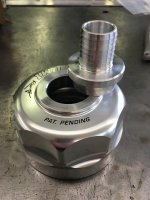
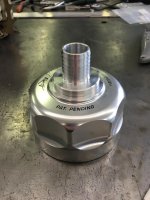
I had an old nozzle for a 5 gal plastic fuel jug that started leaking so was never used. I took it apart, everything except for the part that screws onto the fuel jug was discarded. My plan is to make an adapter with a spud that fits a 1" hose, eliminating the spring loaded nozzle. Simple yet effective and leak proof. I was going to press fit the adapter but missed the fit by .0005" so it will be tig welded instead.

NLBY8226.jpg WEXK1021.jpg
 

kazlx

Well-known member
Joined
Oct 30, 2012
Messages
2,851
Location
Tustin, CA
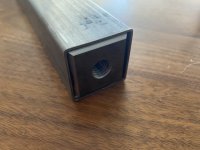
Some inserts for 1.5” 16g square tube and replicated some lineman climbers in aluminum for decorative pieces a dude makes.
 

Attachments

  • BD08F448-045B-44A5-9D6F-FA486F86FA18.jpeg
    BD08F448-045B-44A5-9D6F-FA486F86FA18.jpeg
    78.8 KB · Views: 934
  • BDACEC35-3677-4E00-B381-98DEC3A7382F.jpeg
    BDACEC35-3677-4E00-B381-98DEC3A7382F.jpeg
    103.8 KB · Views: 236
  • 3546AE2B-EE94-420A-8742-A942686F39DA.jpeg
    3546AE2B-EE94-420A-8742-A942686F39DA.jpeg
    78.2 KB · Views: 213
  • 5464CF23-E9D4-492B-898E-2AEE38BFB7E3.jpeg
    5464CF23-E9D4-492B-898E-2AEE38BFB7E3.jpeg
    122.9 KB · Views: 215
  • F5D93DD3-C0DA-4CA0-AB19-5597ADB8B0A0.jpeg
    F5D93DD3-C0DA-4CA0-AB19-5597ADB8B0A0.jpeg
    112.5 KB · Views: 245

Toolmaker51

Well-known member
Joined
Nov 26, 2015
Messages
176
Location
Missouri
re; Poor finish, gummy materials, or sticking tools...applies to lathes, mills, drills, grinders
All comments on machine tool alignment of gibs and respective flats, properly clamped material [rigidity], properly mounted tool, tool orientation/ centerline, speeds & feeds, cutting fluids, are valid.

The physics don't work independently, though one or a combination will overtake others, or when all can be 'incorrect'. A better term might be unbalanced.

The single most common issue, I rarely see addressed; is the form of the cutting edges. There is little evidence the small shops are equipped to sharpen cutters; not only grinders/ wheels and honing stones but understanding regarding formation of proper cutting edges.

The situation is not entirely their fault. The marketing of cutters is not centered on HSS, the focus is carbide inserts and then cemented bits. A result of this, the discretion and motivation to learn grinding is no longer widespread; mislead that carbide is the universal choice.

If a gummy material is being worked then tools need a proportional increase in sharpness. Carbide does not 'cut' in the traditional sense. It uses hardness to plow or push material off, compared to HSS which shears. Soft material piles up instead of being carried away from cut zone. That generates heat, enough to 'weld' to a cutter. And that interferes with cutting. Which worsens chip ejection. Cutting fluids reduce that, softer materials are kind of a cut and try situation in home shop environments.

I'm away from home on a renovation project; since January. So my log-in rate has dropped sharply. But make your posts and message me through the site if there are questions, solutions or ...
 

Griff93

Well-known member
Joined
Jul 25, 2009
Messages
1,121
Location
Huntsville, AL
Made some parts on our 4th axis the other day. I'm terrible about forgetting to take a picture while I'm machining stuff. I forgot to take any more pictures and the parts are now in the hands of the customer. These got some 2.125 8tpi stub acme threads cut into the middle of them.

2020-04-20_03-59-48 by Griffin93, on Flickr

2020-04-20_03-59-35 by Griffin93, on Flickr
 
Last edited:

kazlx

Well-known member
Joined
Oct 30, 2012
Messages
2,851
Location
Tustin, CA
Some reverse engineering.
 

Attachments

  • 640FE9F7-0C4F-49CA-B920-51F0B3B7CC0C.jpeg
    640FE9F7-0C4F-49CA-B920-51F0B3B7CC0C.jpeg
    133.4 KB · Views: 286
  • 219BE2A6-D179-4B3E-9D16-C276CC562EC2.jpeg
    219BE2A6-D179-4B3E-9D16-C276CC562EC2.jpeg
    98.9 KB · Views: 229
  • FABE716E-C46F-4281-A82D-79FD0D46C60F.jpeg
    FABE716E-C46F-4281-A82D-79FD0D46C60F.jpeg
    110.9 KB · Views: 179
  • 555AE26C-FE18-4F2A-A001-9F025E7137F7.jpeg
    555AE26C-FE18-4F2A-A001-9F025E7137F7.jpeg
    122.2 KB · Views: 188
  • 5FC9F14D-F852-45CA-883F-E7A64E1F63D6.jpeg
    5FC9F14D-F852-45CA-883F-E7A64E1F63D6.jpeg
    95.7 KB · Views: 180
  • 5B02B595-5AF3-4C45-8565-8AC553D2F790.jpeg
    5B02B595-5AF3-4C45-8565-8AC553D2F790.jpeg
    129.5 KB · Views: 186
  • 1B4CDD96-0E24-40D6-AB02-EE922872E0E0.jpeg
    1B4CDD96-0E24-40D6-AB02-EE922872E0E0.jpeg
    112.7 KB · Views: 187

kazlx

Well-known member
Joined
Oct 30, 2012
Messages
2,851
Location
Tustin, CA
I think it was replaced. Not my machine though. Went to a buddies place to use the Monarch to true up the faces to each other. Wasn’t worth the setup in the Fadal.
 

kazlx

Well-known member
Joined
Oct 30, 2012
Messages
2,851
Location
Tustin, CA
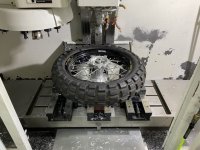
Nice. I assume there is some serious off road plans for that F700GS hence the conversion to spoked wheels. What hubs and rims did you use?

I had an F800GS for nine years before moving on to my F850GSA.

They are Rad hubs and Excel hoops. I think she found a deal on the wheel setup and just wanted an upgrade. I don’t know much about the bike.
 

BMW Rider

Well-known member
Joined
Apr 8, 2010
Messages
346
Location
Calgary, Alberta, Canada
They are Rad hubs and Excel hoops. I think she found a deal on the wheel setup and just wanted an upgrade. I don’t know much about the bike.

Sounds like wheels built by Woody's out of Colorado, had the same combo on my 800. The 700 has alloy wheels from factory which are less durable off road than the spoked ones.
 

Bears Fan

Well-known member
Joined
Jan 26, 2012
Messages
3,437
Location
Indiana
attachment.php


Kazlx


I would of loved having some of those for all the bench's that I have built over the years using 2" x 2" steel for the legs, great idea :thumbup: :thumbup:
 
Last edited:

kazlx

Well-known member
Joined
Oct 30, 2012
Messages
2,851
Location
Tustin, CA
Sounds like wheels built by Woody's out of Colorado, had the same combo on my 800. The 700 has alloy wheels from factory which are less durable off road than the spoked ones.

They travel quite a bit to ride/climb/bike/etc, so I'm sure they are looking for durable.

I would of loved having some of those for all the bench's that I have built over the years using 2" x 2" steel for the legs, great idea :thumbup: :thumbup:

Yea, they came out nice. The guy wanted 40 of them to start. I guess he builds furniture, so it would be a huge time saver. Not hard by hand, but a time ****. Easy on the Fadal and they come out clean, ready to weld in. These were cut for 1.5" 16g tube, but any size would be easy enough to do.
 

Ecosta777

Well-known member
Joined
Apr 26, 2016
Messages
271
Location
MA
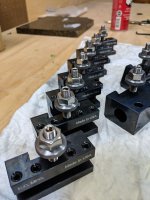
Nothing to fancy, but I didnt like the fit of the toolholders on my Phase II tool post. Its just the piston kind, not the wedge so tools dont always go back into the same location after they've been taken off. I cleaned up the dovetails on the toolpost itself since they weren't super straight, and not at 60 degrees.

I banged out 7 regular tool holders on the HAAS mill at work. I also made up a boring bar holder, and a cutoff tool holder. I should have taken better pictures of the cutoff holder, its actually a captive screw inside that pulls the wedge down on the tool, instead of the left / right handed stud the Phase II one had. I also made sleeves for the boring bar holder but I dont have photos of them. Just 1018 steel, ordered stainless hardware off McMaster, and blued them up with oxpho blue, engraved after bluing, and sprayed down with oil.
 

Attachments

  • tool7.jpg
    tool7.jpg
    118.7 KB · Views: 146
  • tool5.jpg
    tool5.jpg
    93.4 KB · Views: 131
  • tool6.jpg
    tool6.jpg
    80.5 KB · Views: 133
  • tool4.jpg
    tool4.jpg
    95.8 KB · Views: 130
  • tool3.jpg
    tool3.jpg
    51.7 KB · Views: 115
To avoid these ads, REGISTER NOW!
Top Bottom