I just finished the teacher's desk / industrial steel table leg fusion from a few posts above and thought I'd put the pics in a separate post.
This project started out to see what I could do with mostly free stuff in the shop, not really to create a sell-able item. The desk was a free CL find, the legs were attached to a metal table top and vise acquired for $35 at an auction (I only wanted the top and vise), the stain was leftover. I thought I could use scrap oak but I ended up buying and cleaning up red oak from a local mill. The expensive parts were all the fasteners (screw inserts from Amazon) and truss head screws from the local Ace. I also nixed the Minwax poly I had leftover as I was not pleased with it on previous projects. Paid about 3 times the cost for General Finishes at the local paint store. All told, about $50.
First, all fastening to wood (table legs to top, shelf boards, foot pads) were done with screw inserts so I could be taken apart. The top is 3 x 5, and the table sits 36" above the ground, so it won't fit through any man door unless the top is off. The fake d
Dutchman is really painted epoxy wood filler.

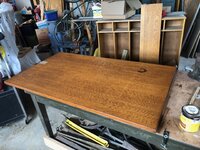
Next, the shelf boards drying after staining and poly. These were 4/4 red oak from a local sawmill. I had to cut down from an 11" wide x 10' rough sawn board, then joined and face planed in my "new" jointer. I am a bit disappointed that the staining did not match the table top (same stain). Obviously the table top veneer is not red oak! Oh well. The longer board on the left is a cap for a pony wall in the house.

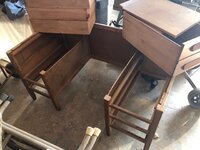
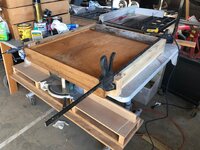
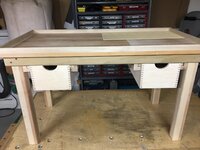
Next, Installing the drawer frame. This frame was literally cut out of the teacher's desk, but then a back was added on. Tried to match the poplar to the top with different stains, but I was no too successful. Part of my impatience.

Next, the shelves. Screwed from the underside using threaded inserts. They are evenly spaced, the pic is a bit of an optical illusion.

Next, the finished view from below. The original table metal brace was absolutely necessary to keep the table from racking. I had to cut it down, add a few more bolt holes, and paint to match.

The finished project. The black spot is an ink stain, the brown spot a repair of the veneer. I could have routed out the veneer, added a wood patch, but I've never done that and did not want to experiment with it now. Frankly, I just wanted to finish it up so I cut it out with a chisel, filled with epoxy filler, and painted. It is "rustic". BTW, in the background is a project left over from last year that I had to put aside as I could not get the poly finish right. It is a table top from the oldest dining hall on the Cornell Univ. campus. It is the next project and I hope to sell this one and reclaim my garage.


 windowwellsupply.com




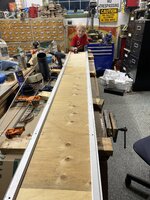
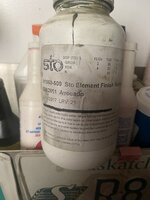
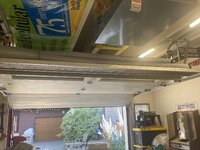

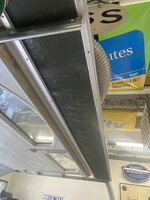 I finished my dust collector hose raceway. I used some left over stucco colouring cut with 50/50 water. The beauty of this is that the it still shows the wood grain unlike paint.

