Sorry in advance this is going to be pretty long and not enough photos for all of the work I did. I wanted to test fit a few more things before pulling the engine, one of them was the steering shaft as I knew it was going to be pretty close...a bit of an understatement:


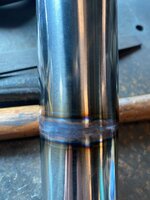
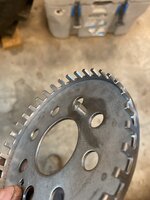
The rear coil didn't fit at all as it hit the steering shaft, the second from the rear won't allow you to put the plug wire on. I've got a set of aluminum valve covers on order that supposedly fit like stock so I'll hold off on relocating the coils until they arrive. If they don't I'll move these coils up toward the fuel rail. Next I fit a few other small things, driveshaft etc before pulling the engine for final assembly. One thing I noticed was the locating dowel for the crank position sensor tone ring was missing. I took a few measurements and put a piece of 3/8" rod in the lathe and made this:

Slight press fit and we were in business:
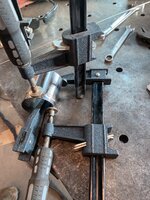
I replaced the factory oil pan with a fabricated aluminum pan I picked up from 417 Motorsports because it was 2" shallower than the stock pan. I had to relocate the pickup for the shaft driven oil pump and for some reason Ford thought it was a good idea to not use a gasket but to use RTV. I picked up some tube keys a while back and finely got to use one, highly recommend them, gave a nice consistent bead:
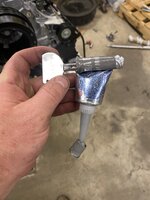
While the engine was out I build the alternator mount bracket, revision 1 in my hand and 2 on the alternator for the tensioner:
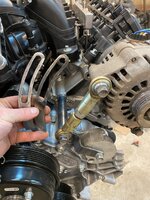
What I didn't put enough thought into before making those curved tension adjusters is that the alternator mount holes are not 180° apart meaning the radius of motion for the case and the mount holes are not the same meaning those wouldn't work. So I then used the heim joints I purchased for the Festiva's tie rods and used them to make a tensioner. That proved out the concept but sadly they were too big to be used in the end. I have revision 3 done now with the right size heim joints but didn't think to get a photo of them. The little bar has a machined nub on it to fit in the other locating hole where the factory tensioner normally goes.
I then went to install the clutch, throw out bearing, and slave cylinder to measure clearances. That is when I realized the flywheel wasn't machined right from the factory, holes were in the right location but not the right diameter but did have the correct thread pitch. Maybe someone can explain how that work but I was lost. I ended up tapping the holes from the back, then had to drill out the ~1/4" (6mm) of the hole that was supposed to be non-threaded. In the end if it didn't work the supplier was going to provide the right one, but I didn't want to waste days and days waiting on it. After all installed it held torque just fine, so a dab of thread locker and I decided to weigh the complete setup:

618.8 lbs (280.76 kg) (this includes the flywheel, clutch, alternator etc but there were no fluids in the engine), the 351w in similar trim was 559.6 lbs (253.9 kg) so 59.2 lbs (26.86 kg) heavier, the new trans is 40 lbs (18.15 kg) for a total gain of 100 lbs (45.5 kg). Not a bad penalty to gain 385 hp

I then moved on to the fuel system, I picked up a drop in fuel pump, replaced the stock pickup with it and I was ready to install wiring and the new -8 an (1/2") fuel lines:

Looks like I'd already done some of the wiring on it, I did wrap the wires more later as I ran out of the braided loom in the right size. Now fuel lines installed through now larger holes:

Sadly I can't rotate the pump because of the sump in the tank, the fittings are tight and this is the best option I could come up with given the existing constraints. I put the new fuel filter on just after the supply line leaves the trunk, ran both lines to the front, installed the fuel pressure regulator and ran out of parts as I realized I'd have zero chance at making the stock fuel rails work.
As an aside, when I did the LS swap in the S10 that swap had been done hundreds of times with every part available to bolt the engine in, the only fab work I had to do was for the exhaust from the collector to the muffler. Because these Godzilla engines are so new the aftermarket support is so limited everything is expensive and there is no way to know if the part I order will even fit my needs sometimes. If I'd have waited a few years this would have been a much easier swap but oh well here we are and it is more "fun" this way I guess.
More to come,
JB